
Editorial note: this article replaces the legacy content at the URL /it-it/cosa-è-l-agenda-come-sceglierla-per-migliorare-la-produttività with a 301 redirect. No references to brands, people or internal courses. No commercial CTA.
Paper or digital? The question looks like a matter of taste, but it touches something far more practical: how a person actually organizes their days.
A daily agenda is the tool — on paper or in electronic form — you use to record commitments, deadlines and blocks of activity, and to decide what to spend your time on over the next twenty-four hours. Six letters and an ancient function: agenda, from the Latin for "the things to be done" [1].
And yet, in front of the shelves of a bookstore or the screen of an app store, the choice is never trivial. Some people switch agendas every January, hoping the new tool will fix an old problem. Some keep three digital calendars and a paper planner open, and end up trusting none of them. Some give up entirely and rely on memory, until something slips.
This article clarifies what a daily agenda really is and how it differs from tools it is often confused with — calendar, to-do list, journal, planner. It then looks at the practical criteria for choosing one — format, layout, integration with your planning method, paper versus digital — and at the most common mistakes that make adoption fail within the first few weeks.
The point is not to prescribe a tool. It is to make conscious a decision that many professionals and business owners make on instinct, and that affects their time, energy and priorities every day.
Use your daily agenda to decide, not just to record dates
The word "agenda" is the neuter plural of the Latin gerundive agendum — "what must be done" [1]. Before it is an object, the word describes a function: holding together what to do and when to do it. Understanding the function explains why beautiful agendas so often go unused after a few weeks: whoever chose them did not separate the recording function from the deciding function.
What is an agenda really for, once all the week's commitments are written in it? The practical answer changes everything: it is not about recording time, it is about negotiating in advance what to say yes to.
In practice, an agenda performs two distinct functions, which call for different uses and formats:
Function 1 — A record of commitments. The agenda as a container of information: where I need to be, with whom, at what time. This function is retrospective in form — you write first and consult later — but forward-looking in content. It requires quick visibility, clear times and the ability to make changes. It does not require reflection.
Function 2 — A decision tool. The agenda as a system of priorities: what goes into the next 24 hours and with what weight. This function is the most neglected, yet the one that matters most for the quality of the day. As early as 1967, Drucker observed that no time management system works without first recording where time actually goes [5] — a historical source, used here as practical guidance.
An agenda used only for the first function is a calendar with more room to write. An agenda used for both is a tool that directs attention — and the choice of format has to account for both functions.
For a more structured approach to managing commitments, the cluster on managing commitments explains how to tell urgent from important before commitments even reach your agenda.
Tell agenda, calendar, to-do list, journal and planner apart before choosing the tool
Searches for "agenda" turn up products, apps and habits that are very different from one another. The confusion is not just about words: someone who picks a digital to-do list thinking they are getting "an agenda" ends up with no time structure; someone who buys a weekly agenda as a strategic planning tool ends up without the monthly view needed for long projects.
Are you looking for an agenda, or do you actually need a calendar, a to-do list or a planner? Much of the frustration with agendas comes from this category error — and it is corrected before buying, not after.
| Tool | Operational definition | Key difference from the agenda |
|---|---|---|
| Calendar | A time container of dates and recurring events — shows "what falls when" | The calendar is a conventional system for dividing time [6]; the agenda is the management tool for what you do within that time |
| To-do list | A flat list of tasks with no time constraint | The to-do list does not assign a "when"; the agenda does |
| Journal | A retrospective record of what happened | The journal looks back; the agenda looks forward [6] |
| Planner | A term for specific formats (weekly, monthly, project-based) | Often used interchangeably with agenda; typically used for horizons longer than 24 hours |
A note on format: a daily agenda (with the hours of the day, typically hour by hour) differs from a weekly agenda (7 days across a two-page spread) and from a monthly agenda (with a view of the whole month). These are not alternative tools but tools with different granularity — and the choice depends on how dense your daily commitments are, not on aesthetic preference.
Choose a paper or digital agenda based on the cognitive work, not on taste
The study by Mueller and Oppenheimer published in Psychological Science in 2014 [2] is one of the most cited on handwriting versus digital. The finding is not "paper beats digital," as it is often reported; it is subtler: participants who took notes by hand processed information more concisely and remembered it better over the medium term, because the slowness of writing forced them to select. Digital, by contrast, rewarded transcription speed and later search. The study's limitation should be stated: the sample consisted of university students taking notes during lectures — direct transfer to a professional work agenda is not automatic.
Do you reread your agenda alone, or share it with other people? The answer splits the world in two: those who work mainly alone gain from handwriting for the decision function; those who work with a team lose time if they give up digital sharing.
Four practical criteria for choosing the format:
Criterion 1 — Memory and selection. If the agenda is mainly for making decisions and remembering commitments (the decision function), handwriting supports semantic processing [2]. If it is mainly for passing information to others or for quick lookups, digital is more efficient.
Criterion 2 — Sharing with others. If commitments need to be visible to team members, assistants or business partners, a shared digital agenda is necessary. A paper agenda, by its nature, cannot be synced.
Criterion 3 — Mobility and frequency of changes. A professional with many appointments that shift during the day needs quick edits from different devices — digital is the only practical solution. Someone with a stable week and few changes can manage on paper.
Criterion 4 — Integration with existing systems. If the agenda is part of an ecosystem of tools (email management, task manager, CRM), digital allows integrations that paper cannot offer.
Choose your agenda layout based on how dense your days are
A day with 4 well-spaced appointments and 2 hours of independent work calls for a different agenda than a day with 11 micro-commitments, 3 calls and no free hour. Yet in a bookstore, agendas are not organized by day density but by looks and price range. Whoever chooses on instinct ends up with an over-designed tool (still blank after three weeks) or an under-designed one (commitments that do not fit in the available space).
What is the average density of commitments in a typical day? If you cannot answer with a rough number, you are choosing your agenda in the dark — and risk choosing the wrong one.
Italian time-use data from ISTAT show how dense the day of working people is: on average, employed people in Italy go through about 24 distinct episodes of activity and place and spend almost three hours doing several things at once [4]. An agenda poorly calibrated to the real density of commitments produces empty blocks (if the space is too large) or cramped, illegible entries (if the space is too small).
The three main layouts and the conditions under which each one fits:
Hour-by-hour daily view. Suits those with more than 6-8 commitments a day, at precise times. It needs generous space for each hour and makes overlaps easy to see. Limitation: it gives no visibility over the week as a whole.
Two-page weekly view. Suits those with 3-5 commitments a day whose distribution varies often across the week. It shows the whole week and lets you spot overloads or gaps. Limitation: less space for each single day.
Monthly page view. Suited to planning deadlines, recurring events and projects. It does not replace the daily or weekly agenda — it complements it with a long-range view.
A rule of thumb inspired by Drucker's principle of first observing where time goes [5]: record 5 real days — with actual commitments, not theoretical ones — before buying or setting up a new agenda. The right format emerges from the data, not from aspirations.
The method for building an agenda with time slots without wasting space
Do time slots in an agenda really help you get organized, or do they end up creating a schedule so rigid that it falls apart at the first unexpected event?
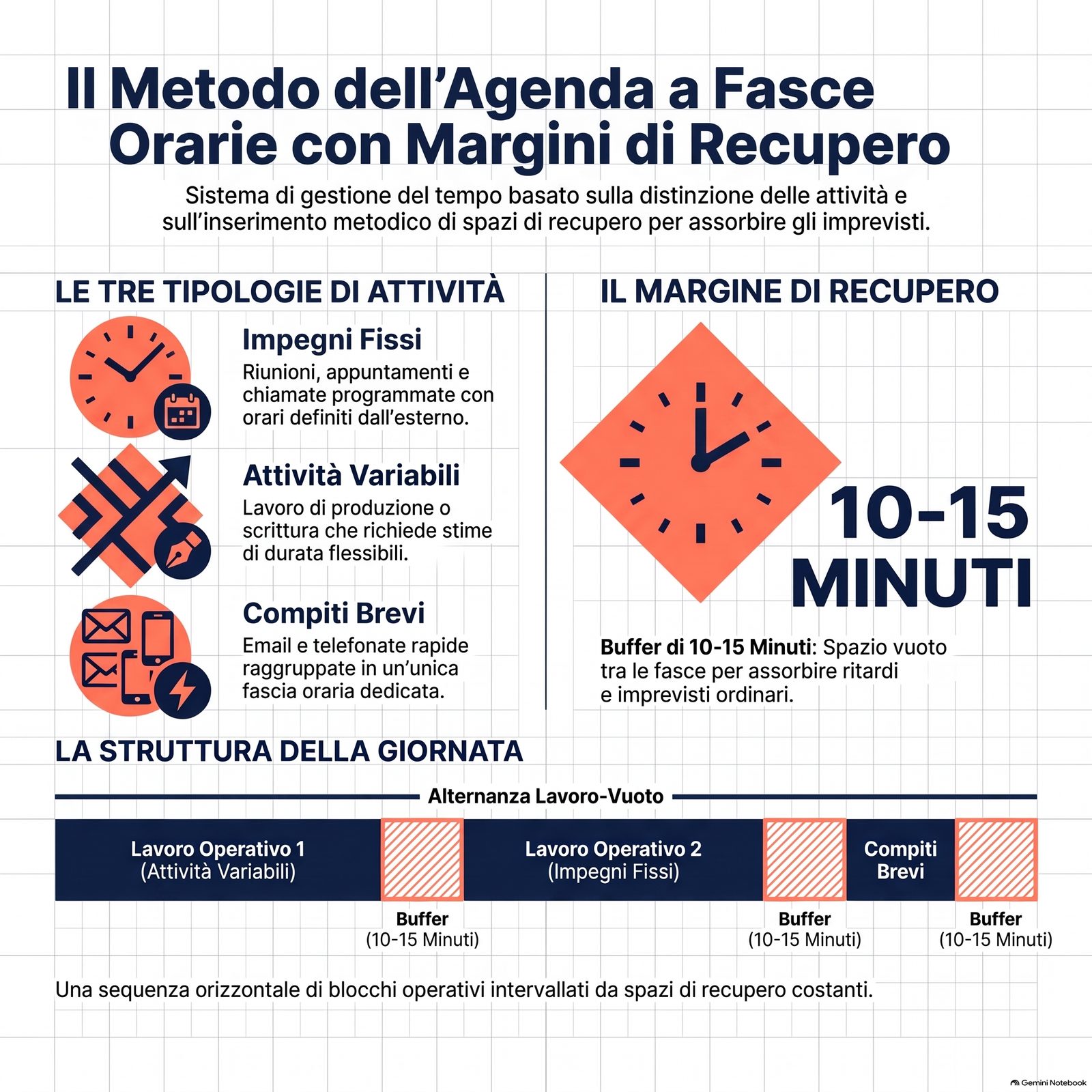
An agenda with time slots assigns a dedicated interval of time to each activity, instead of simply listing the day's commitments.
The difference seems small, but it changes how time is perceived and used: time slots force you to decide in advance how much time an activity deserves, not just whether to do it.
The risk, if they are applied without judgment, is building a schedule so dense that it collapses at the first surprise and is abandoned within a few weeks — the same abandonment pattern discussed later in this article under the most common mistakes.
The first practical step is to distinguish three types of activity by duration, before you even open your agenda.
Fixed-time commitments. Meetings, appointments and scheduled calls occupy a slot already set from outside.
Variable-duration activities. Production or writing work should be underestimated in the first week and then corrected based on the time actually spent.
Short, recurring tasks. Emails and quick phone calls deserve a single grouped slot, not scattered micro-spaces that break concentration.
A common mistake is filling the day with back-to-back slots and no margin: a single surprise — a call that runs long, a client who is late — is enough to push all the following appointments back in a chain.
Reserving a 10-15 minute margin between one slot and the next absorbs most ordinary surprises.
For a more structured way to handle unplanned interruptions, the cluster on managing interruptions explains how to classify them and reduce their impact.
An agenda with time slots is not the same as time blocking as a technique: the latter starts from the week's goals and assigns protected blocks of time to the most important work.
The time-slot agenda, by contrast, is the format through which those blocks are managed within a single day.
Time blocking remains the upstream technique; the time-slot agenda is its everyday landing tool.
The same ISTAT survey records, for employed people in Italy, about five episodes a day in which they report doing several activities at once [4], a condition that makes a margin between slots useful.
Once the logic of time slots within a single day is in place, the next step concerns the unit of time best suited to observing the overall workload: the single day or the whole week.
The criterion for choosing between a weekly agenda and a daily agenda
If you have few fixed commitments but several projects that run for weeks, do you gain more from a view of seven days or a view of twenty-four hours?
The weekly agenda — the two-page spread with the seven days side by side, already introduced as a layout in the previous section — is not a "reduced" version of the daily agenda.
Rather, it meets a different need: seeing the load of the whole week at a single glance.
It is the best choice for those with 3-5 commitments a day distributed unevenly across the days, while those with more than 6-8 daily commitments at precise times find the weekly view too cramped and need the daily one.
The difference is not aesthetic: it is the amount of information you need at a glance to decide.
The practical criterion starts from the number and nature of fixed commitments in the week, not from a preference for a roomier or more compact format.
Those who work on a few projects that unfold over several days — a sales negotiation that moves forward through successive contacts, a production job with steps spaced out over time — get more value from seeing the whole week on a single page.
Those who instead manage days packed with fixed-time appointments — a professional with clients back to back, a department manager with daily shifts and deliveries — find in the daily view the space the week does not offer.
One point deserves a clear distinction: the weekly agenda discussed here is the format — the page, physical or digital, with the seven days side by side — not the process by which you decide what goes into the week.
For the process of selecting weekly priorities, read the in-depth article on weekly planning.
The weekly agenda format remains a landing tool all the same: the densest days may call for a switch to a dedicated daily view, without abandoning the weekly view for the rest of the days.
For the granularity of the single day, the cluster on how to organize your workday covers the step from the week to the single working day.
The choice, then, is not between two alternative tools but between two zoom levels on the same planning method.
The most suitable format remains a preliminary choice: its real value is measured by the planning method the agenda is part of, more than by the page layout alone.
Integrate your agenda into a planning method, not as an isolated tool
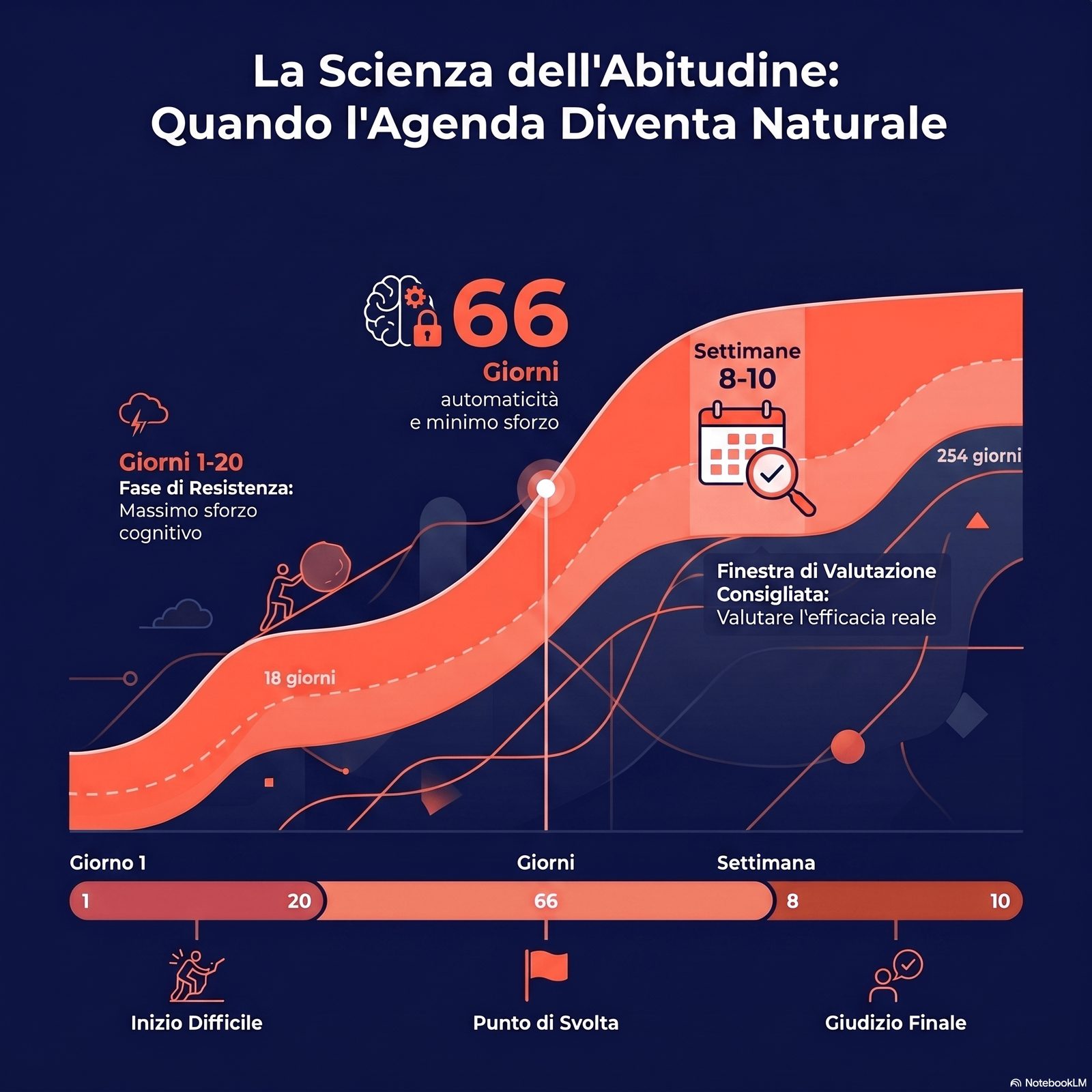
The research by Lally and colleagues published in the European Journal of Social Psychology in 2010 [3] measured the formation of daily habits in a sample of adults, finding a median of about 66 days for a behavior to stabilize, with wide individual variability (18-254 days). The finding explains a familiar phenomenon: someone who switches agendas in January and drops it in February has not necessarily picked the wrong tool — they judged the tool too early. An agenda works only if it becomes a habit, and habits take their own time.
How long have you been using your current agenda continuously? If the answer is less than eight weeks, any judgment of its effectiveness is premature — it is the method, not the tool, that has not yet settled in.
An agenda alone does not produce planning. It produces a container of commitments. Planning requires an upstream method that determines what goes into the agenda and in what order. The three levels of the method:
Level 1 — Weekly planning decides what matters in the week: priority goals, focus blocks, fixed commitments. Weekly planning is the frame within which the daily agenda operates.
Level 2 — Activity scheduling turns priorities into time slots. The cluster on activity scheduling describes the method for putting activities on the calendar realistically, with buffers for the unexpected.
Level 3 — The daily agenda is the operational tool where the higher levels land every morning. Without levels 1 and 2, the daily agenda collects whatever comes in — not what was chosen.
There is no public survey that measures how much of a professional's day is taken up by unplanned activities: what ISTAT documents for Italy is the density of working people's days, with about 24 distinct episodes and almost three hours of overlapping activities [4]. An agenda well integrated into a method does not reduce that density, but it decides in advance which commitments fill it, increasing the share of time you govern compared with time you simply endure.
Evaluating an agenda's effectiveness, as the evidence from Lally et al. [3] suggests, requires at least 8-10 weeks of continuous use before the behavior stabilizes — and therefore before you can tell a tool problem from a method or habit problem.
The daily ritual for organizing your agenda in under ten minutes
Is it better to organize your agenda in the evening, already looking at the next day, or in the morning, with the day still fresh in mind?
There is no single answer: each moment has a different advantage.
The evening reduces decision anxiety on waking; the morning lets you adapt the agenda to what happened in the last few hours.
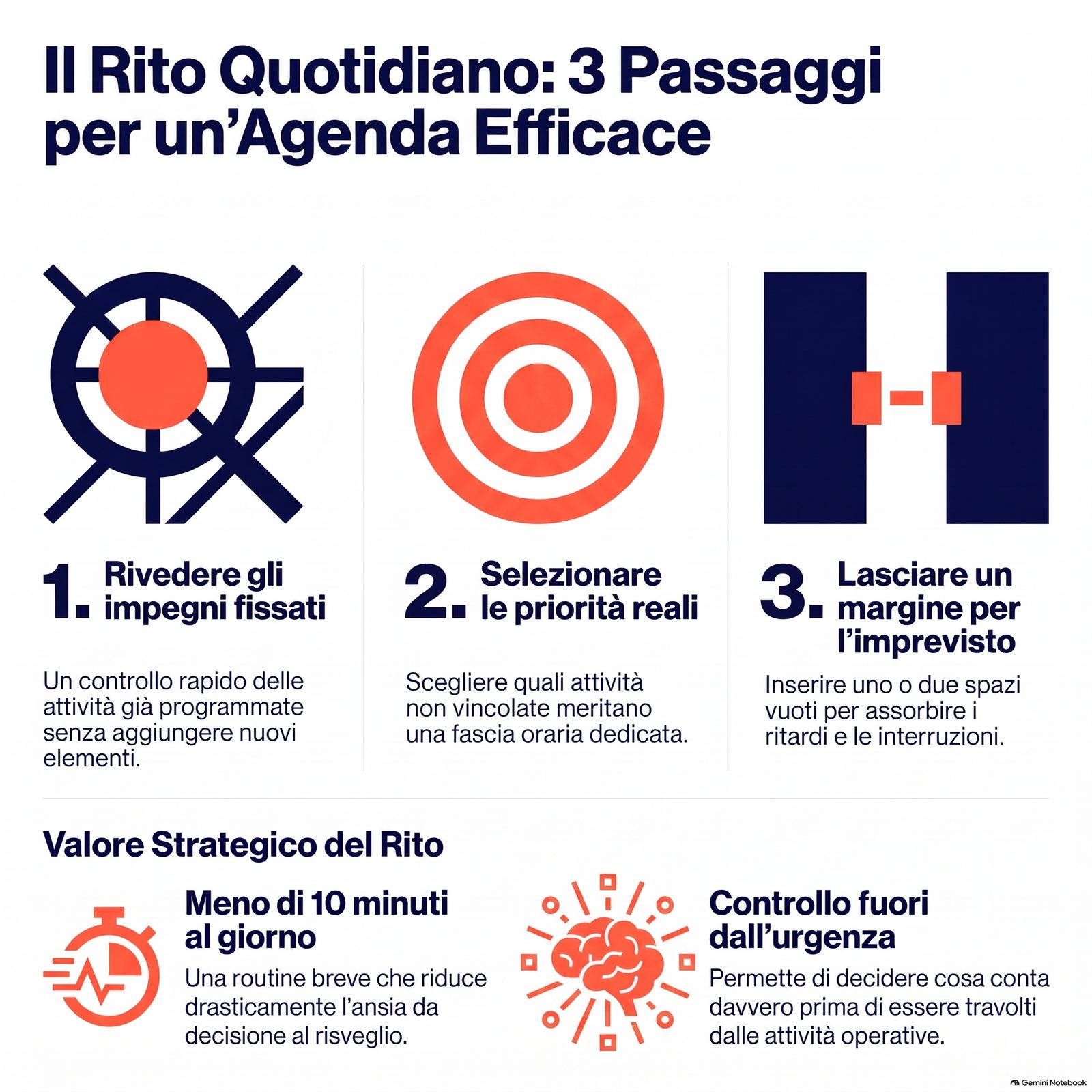
What matters most is not the time of day, but repeating a few fixed steps: review the commitments already in place, choose which activities truly deserve a block of time, leave a margin for the unexpected.
The most effective daily ritual comes down to three steps repeated in the same order, which take only a few minutes once they become a habit.
First step. Review the commitments already set, without adding anything new: it is a check, not a planning session.
Second step. Among the activities not yet tied to a time, select which ones truly deserve a dedicated slot.
The criterion is the same one described in the cluster on priority management, which separates what is really a priority from what only seems so because it is recent.
Third step. Leave one or two empty margins in the day for the unexpected, the same principle already described for time slots.
The ritual carries particular weight in a small manufacturing or craft business, where the business owner does not work from a single desk: they move from the office to the production floor, follow a job, answer a supplier, then return to the desk for administrative work.
In a setting like this, very common in small owner-run businesses, the problem is rarely a shortage of commitments; it is the lack of a protected moment in which to decide which of them really matter.
The ritual thus becomes the only moment when priorities are chosen away from the urgency of the shop floor, instead of being endured slot after slot.
Even a well-designed ritual can prove fragile in the first weeks if the chosen tool is too rigid for daily use, and that is exactly the phase where the most common mistakes hide.
Three mistakes that make people abandon their agenda in the first eight weeks
The most frequent mistake is not choosing the wrong tool. It is choosing the right tool and using it badly for the first four weeks — when it is not yet a habit [3] — until you abandon it. Three recurring patterns explain most abandonments: the over-structured agenda, the over-decorative agenda, and the agenda dropped after two weeks not because it does not work but because it was judged too hastily.
How many agendas have you abandoned in the last three years? Often the cause is not the tool — it is the haste with which the tool was judged.
Mistake 1 — The over-structured agenda (used like a form to fill in). Signal: filling in even a single box takes a cognitive effort that discourages daily use. Cause: the chosen format asks for information that does not match how the day actually unfolds — too many sections, too much granularity, too many mandatory fields. Fix: choose the minimum format that fits your real commitments, not the one that fits your ideal commitments. An agenda with half an hour of space for every hour of the day is useless for someone with three appointments a day and two blocks of independent work.
Mistake 2 — The over-decorative agenda (one the owner does not dare "ruin"). Signal: the handwriting is careful, crossings-out are avoided, you freeze deciding what to write for fear of getting it wrong. Cause: the perceived value of the physical object outweighs the perceived value of the function it should perform. Fix: crossings-out do not signal mistakes — they signal revised decisions, which is exactly the function of a planning tool. If you cannot use the agenda as a work tool (with corrections, arrows, quick notes), the format is probably wrong.
Mistake 3 — Abandonment after two weeks due to premature evaluation. Signal: after 10-15 days you conclude that "the agenda doesn't work" or "this format isn't for me." Cause: the behavior has not yet had time to settle into a habit. The evidence from Lally et al. [3] shows that the median time to form a habit is 66 days — the first two weeks are the period of greatest difficulty, not the time for evaluation. Fix: stick with the tool for at least 8 consecutive weeks, accepting that the first two or three will be imperfect, before drawing conclusions about whether the format fits.
Limits and conditions of applicability
The operational framework described here is based on research on note-taking, habit formation and work organization. A few clarifications:
- Mueller/Oppenheimer [2]: the study was conducted on university students taking notes during lectures. Transfer to professional use of an agenda is plausible given the cognitive mechanism (selection vs. transcription) but is not the subject of the original study. This should be stated, not taken for granted.
- Lally et al. [3]: the 66-day median refers to behaviors such as drinking water at lunch or taking a daily walk — not specifically to adopting a professional agenda. The reported variability (18-254 days) indicates that the number is indicative, not prescriptive.
- ISTAT [4]: the Italian time-use data cited refer to the 2013-2014 wave of the survey and to all employed people, not only the self-employed. In the diary, work is recorded as a single episode: the survey measures the density of the day, not the fragmentation within working time.
- Drucker [5]: a historical secondary source, cited as practical guidance, not as experimental evidence.
- No specific agenda brand recommended: the section on tools mentions Google Calendar, Outlook and Apple Calendar as neutral examples of the category, without comparative quality judgments.
Frequently asked questions
Is it better to have a single agenda for work and personal life, or two separate ones? There is no universal answer: it depends on the density of commitments, how often the two areas conflict and the type of work. Those with many personal commitments during the workday (medical appointments, driving children around, family activities) tend to benefit from an integrated agenda — one that shows conflicts before they happen. Those who can separate the two areas cleanly can keep two distinct tools, as long as they are consulted together at planning time. The cluster on organizing personal commitments covers this topic in more depth.
After how many weeks does it make sense to evaluate whether an agenda works? The evidence on habit formation [3] suggests not evaluating a tool before 8 weeks of continuous use. The first 15-20 days are the period of greatest resistance — not the evaluation period. Evaluation makes sense once opening and filling in the agenda no longer requires conscious effort.
Can a digital agenda be used for the "decision" function of an agenda? Yes, with a few precautions. The decision function — selecting what goes into the day and with what weight — does not require paper or digital as such: it requires a moment of deliberate reflection before opening your communication channels. Digital can support it if it is used in "offline" mode (main screen on the calendar, notifications silenced) during the morning planning session.
Operational summary
The daily agenda performs two distinct operational functions: recording commitments and guiding decisions about what to do in the next 24 hours. The choice of tool — paper or digital, daily or weekly — depends on the type of cognitive work required [2], the density of commitments and the need for sharing.
Evaluating effectiveness requires at least 8 weeks of continuous use [3] before you can tell a tool problem from a method or habit problem. An agenda integrated into a planning method (weekly, then daily) is more effective than an agenda used as an isolated tool.
The three most frequent mistakes — an over-structured tool, a "sacred" agenda you do not dare use, premature abandonment — all share the same root: treating the agenda as an object to own rather than as a tool to wear out in daily use.
Conclusion
Behind the seemingly harmless question "which agenda should I use?" lies a decision about method. The idea to hold on to is simple: an agenda is not an object, it is the physical or digital translation of how a person decides what to devote their days to. Changing it without changing the method that feeds it does not produce results; it produces one more tool to abandon.
The criteria gathered here — a clear distinction from neighboring tools, a paper/digital choice grounded in the cognitive work required [2], a layout calibrated to the real density of your days, integration into a planning method, evaluation after at least eight weeks of continuous use [3] — are not style options. They are filters that separate an agenda that works from one that decorates a desk.
The agenda is the first link in a longer chain. To build a method around the tool, see the in-depth articles on weekly planning and activity scheduling; to place the topic within time management as a whole, see the pillar article on time management for business owners.
A well-planned day is not a fuller day — it is a day in which fewer things are forgotten, fewer decisions are made in a hurry and more time is left for what matters.
Sources and references
[1] Treccani. Vocabolario online, entry "agenda". Istituto della Enciclopedia Italiana. https://www.treccani.it/vocabolario/agenda/
[2] Mueller, P. A., & Oppenheimer, D. M. (2014). The Pen Is Mightier Than the Keyboard: Advantages of Longhand Over Laptop Note Taking. Psychological Science, 25(6), 1159-1168. https://journals.sagepub.com/doi/10.1177/0956797614524581
[3] Lally, P., van Jaarsveld, C. H. M., Potts, H. W. W., & Wardle, J. (2010). How are habits formed: Modelling habit formation in the real world. European Journal of Social Psychology, 40(6), 998-1009. https://onlinelibrary.wiley.com/doi/10.1002/ejsp.674
[4] ISTAT. I tempi della vita quotidiana. Lavoro, conciliazione, parità di genere e benessere soggettivo, Istituto Nazionale di Statistica, 2019 (Indagine Uso del tempo 2013-2014). https://www.istat.it/it/files/2019/05/ebook-I-tempi-della-vita-quotidiana.pdf
[5] Drucker, P. F. (1967). The Effective Executive. Harper & Row. [Historical source — declared]
[6] Treccani. Vocabolario online, entries "calendario" (https://www.treccani.it/vocabolario/calendario/) and "diario" (https://www.treccani.it/vocabolario/diario/). Istituto della Enciclopedia Italiana.