
A 50-hour work week contains, on average, dozens of unplanned interruptions, meetings that run over and operational activities that absorb the time meant for projects. Without a planning protocol, the business owner gets to Friday evening with the feeling of having worked a lot and produced little. The phenomenon is not subjective: the classic research by Buehler, Griffin and Ross [1] documented how people tend to underestimate the time needed to complete their own tasks by 30-40%. Well-done weekly planning is the structural fix for that underestimation.
In operational terms, weekly planning means the sequence of three actions carried out within a fixed time window (the weekend or Monday morning): mapping the commitments and projects expected over the next 5-7 days, balancing the load across different roles (operational, managerial, strategic) and setting aside a review slot (weekly review) at the end of the period. It is not a long to-do list, it is not strategic planning, it is not filling up a calendar.
This article presents a protocol you can repeat in 30 minutes, usable by freelancers and by business owners with teams of different sizes, together with a template you can download for free. It describes the method, the most frequent mistakes and the Friday wrap-up practice.
Applying the test to find out whether a week is really planned
Some weeks, looked at with a cool head, have produced measurable results — an offer closed, a process improved, a difficult decision made — and other weeks, despite lasting the same number of days, seem to have evaporated. The difference rarely lies in the volume of work. It lies in how the available hours were allocated before the week began. Effective weekly planning has three distinctive traits that separate it from simply filling a calendar, and they are described here one by one.
How many work weeks end with the feeling of having worked a lot and produced little? The figure is not purely introspective: it is measured in the ratio between hours spent and projects that actually moved forward. Hours alone are not enough to explain it — in 2024, self-employed workers in Italy reported an average of 41.0 usual weekly hours in their main job, compared with 37.1 for employees [4].
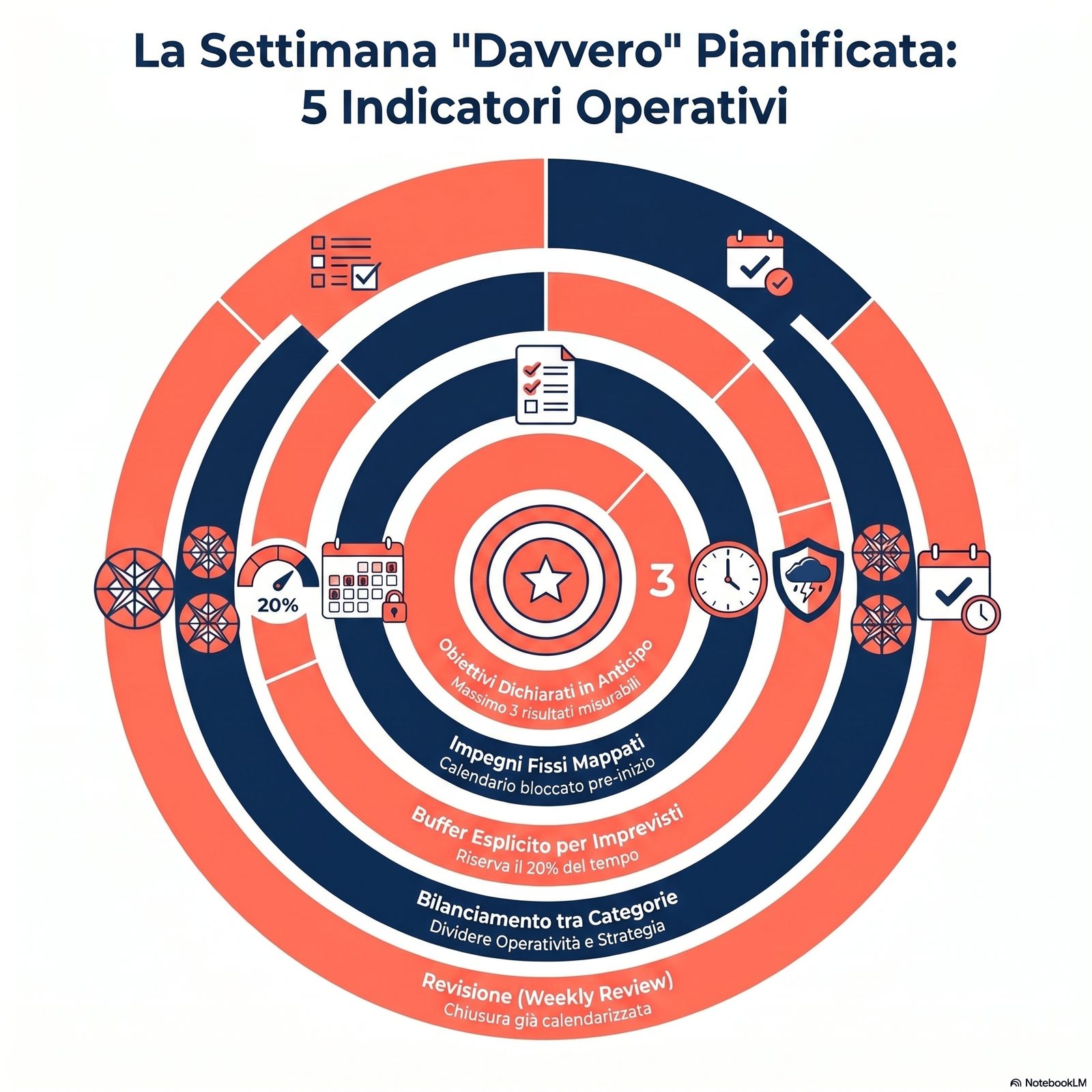
A week is planned in the operational sense when it passes five verifiable indicators:
- Goals for the week declared in advance — there are at most three expected results, written in measurable form, that set the week apart from the rest.
- Fixed commitments already mapped — meetings, appointments and deadlines are entered in the calendar before the week starts, not along the way.
- Explicit buffers — at least 20% of the available hours are reserved for the unexpected and not assigned to planned activities.
- Balance across categories — the plan distinguishes operational activities from project and strategic ones, and gives each one a time slot.
- Review scheduled — a wrap-up session (weekly review) at the end of the period is already in the calendar.
If at least three of these indicators are missing, the week is not planned — it is simply scheduled.
It is worth clarifying four distinctions that the typical reader tends to confuse with weekly planning:
- Weekly planning vs daily planning: the two tools work on different horizons (7 days vs 24 hours) and serve complementary functions. Daily planning works "inside" the weekly plan, translating its goals into daily time blocks — it doesn't replace it.
- Weekly planning vs strategic planning: strategic planning works on a quarterly or annual horizon (growth goals, resource allocation, positioning); the weekly plan is the operational execution of those goals. Confusing the two leads to tactical weeks with no direction, or to strategic plans that never turn into action.
- Weekly planning vs planner: the planner is the tool — paper or digital — while planning is the decision-making practice that comes before filling the planner. A full planner is not the same as a planned week.
- Weekly planning vs weekly to-do list: the to-do list is a flat list of things to do, planning is the allocation of those things over time and across roles. A to-do list without planning produces overload; planning without a to-do list produces vagueness.
Read next: activity scheduling.
Calculating weekly drift before filling the calendar
In 1994, three researchers from the University of Waterloo published a study that is still the reference on the so-called "planning fallacy": the systematic tendency to underestimate the time needed to complete one's own tasks, on average by 30-40% [1]. Applied to five working days, that underestimation produces a week that tends to close "late" regardless of good intentions. Then there is a second, less obvious cost: constantly switching from one activity to another leaves mental traces — called attention residue in the psychological literature — that reduce the output of every following hour. Measuring both costs is the first step to reducing them.
By how much do people underestimate project timelines on average? In the study by Buehler and colleagues on senior students working on their theses (33 cases analyzed), the average forecast was 33.9 days and the actual delivery came after 55.5, with less than a third of participants (29.7%) finishing by the date they had given [1]. The study measures underestimation on single tasks: it doesn't establish beyond how many activities scheduled in a week the error gets worse, nor how it progresses.
Calculating weekly drift follows a simple scheme:
Step 1 — Available working hours: start from actual hours, not nominal ones. If the week is 45 hours but 5 are absorbed by commuting or non-work travel, the starting point is 40.
Step 2 — Subtract fixed commitments: recurring meetings, institutional calls, daily check-ins with the team. These commitments are not negotiable in the current week and must be subtracted before planning anything else.
Step 3 — Subtract the buffer for the unexpected: the underestimation documented by Buehler et al. [1] makes a buffer necessary, but doesn't set its size; the operational criterion adopted here is to reserve at least 25-30% of the remaining hours for unplanned interruptions — urgent requests, technical problems, unexpected calls.
Step 4 — The hours realistically available for projects: what remains is the time you can actually plan. For many business owners, this number is lower than they assume — often less than 10-12 effective hours per week.
The hours that self-employed workers in Italy report usually working are on average higher than those of employees [4], but they are still hours to be allocated. The Italian business landscape, moreover, is made up of 94.9% micro-enterprises with up to nine employees, with an average size of 4.0 employees in industry and market services (2022 data) [5]: in such compact structures the same people cover several functions, and calculating drift is not a theoretical exercise but an operational necessity.
The 30-minute protocol: the structure that works for business owners
Thirty years of studies on goal formulation converge on one point: specific, challenging and measurable goals produce 12-25% higher performance than generic goals [2]. The weekly protocol that follows translates this evidence into five sequential steps that can be carried out in a single thirty-minute session, ideally on Friday afternoon or Sunday evening.
How long should it take to plan a work week? The operational answer, for a business owner or a freelancer, is between 25 and 35 minutes — beyond this threshold the noise increases, below it the allocation tends to stay superficial.
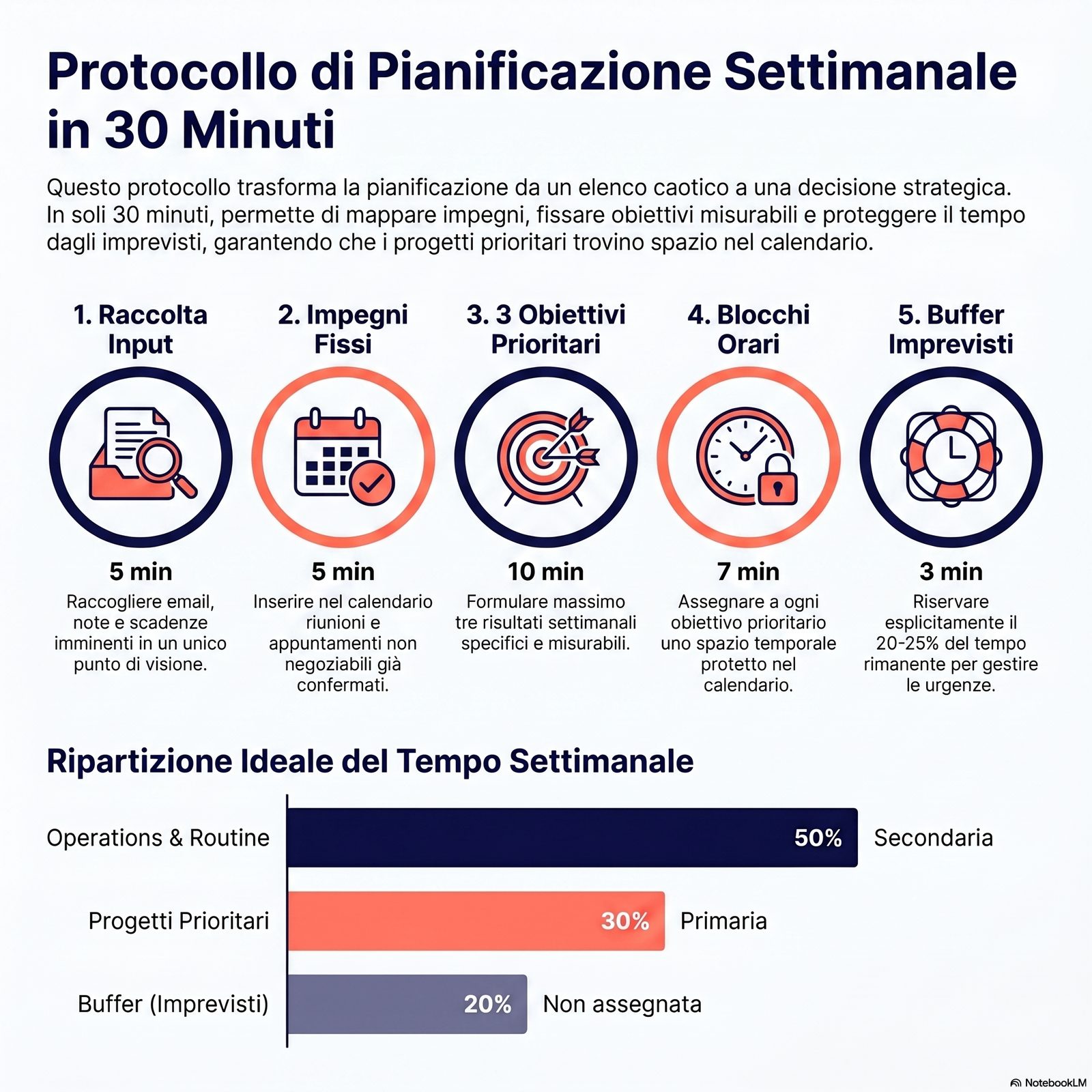
The five steps of the protocol:
Step 1 — Collecting inputs (5 minutes). Gather all the inputs for the coming week in a single place: pending emails, notes, requests received, upcoming deadlines. The goal is not to process them, but to have a complete view before deciding what goes into the plan.
Step 2 — Inventory of fixed commitments (5 minutes). Enter all the commitments already confirmed into the calendar: meetings, client appointments, administrative deadlines. These blocks are non-negotiable and define the perimeter within which you plan everything else.
Step 3 — Selecting 3 priority goals for the week (10 minutes). Formulate at most three goals for the week — the number is an operational criterion — in specific and measurable form, which is instead the condition supported by Locke and Latham's research [2]: not "work on project X" but "complete the sales proposal for client Y by Thursday." Beyond three main goals, the plan loses coherence.
Step 4 — Allocating time blocks (7 minutes). Give each priority goal at least one dedicated time block — protected from meetings and interruptions. This is the moment when planning differs from the to-do list: you don't list the activities, you decide when they get done.
Step 5 — Buffer for the unexpected (3 minutes). Explicitly leave 20-25% of the remaining time free. Don't assign these hours to specific activities: they are there to absorb the drift documented by Buehler et al.'s research [1].
The template you can download from this page — available for free and without registration — provides a fillable format that follows these five steps, adapted for individual business owners and small teams.
Balancing projects, operations and urgent matters: where everything fits in the week
A work week typically contains three categories of work: projects that move results (customer acquisition, product development, strategic decisions), operations that keep the company running (team meetings, accounting, communication) and unexpected urgent matters. The proportion between the three changes every week, but the allocation rule — which category goes into the calendar first — doesn't. Drucker put it sharply sixty years ago, referring to the need to "do first the work that brings results" [7], and the observation still holds as a guiding principle.
Which category of work goes into a business owner's weekly plan first? In the least productive weeks, the answer is "operations" — and projects end up filling whatever scraps are left, when there are any.
An operational guideline, to be adapted to your specific context, is the following:
- 50% of the hours available for planning: operations and recurring commitments (meetings, communication, day-to-day management).
- 30% of the available hours: projects that move results (the activities linked to the week's priority goals).
- 20% of the available hours: buffer for urgent matters and the unexpected.
This proportion is not an absolute rule — it is a guideline to be calibrated according to the type of week and the company's stage. A week with an imminent launch will have a larger share devoted to projects; a week of fiscal closing will have a larger share of operations. What matters is that the decision is explicit, not that it emerges by default.
The priority rule for entering time blocks, on the other hand, is stricter: priority projects go in first, then operations. Reversing this order — operations first, then projects "if there's time" — is the main cause of weeks in which strategic work never finds room. If you run a company with growth ambitions, the pillar on time management for business owners offers the systemic framework this rule belongs to.
For managing the balance between operational and strategic priorities, the cluster on priority management is also useful, as it describes the criteria for choosing between competing commitments.
The Friday weekly review: how to close the week to improve the next one
The practice of the weekly review has an explicit codification in the operational literature, particularly in David Allen's Getting Things Done [6] — a secondary source, used here with caution and without an authoritative tone. It is a 15-20 minute session, ideally on Friday afternoon, that closes the week just ended and prepares the ground for the next one. Research conducted by Phillippa Lally and colleagues in 2010 showed that forming a habit takes a median of 66 days of regular repetition [3]: the weekly review, repeated every Friday, reaches the threshold of automaticity around the third month of practice.
What makes a weekly review more than a simple recap? Three questions, asked in a precise order, turn 15 minutes on Friday into operational learning for the following week — and in 66 days that sequence becomes a habit [3].
The three questions of the weekly review, in order:
Question 1 — What was completed this week? Not a list of activities carried out, but a check of the priority goals declared on Monday: how many of the three goals were achieved, partially achieved or not touched? This step measures the effectiveness of the initial planning.
Question 2 — What slipped and why? For each goal not completed, identify the concrete cause: an unexpected interruption, an underestimate of time (planning fallacy [1]), the lack of a protected time block, a change of priorities imposed from outside. The diagnosis must be specific, not generic ("I had too much to do" is not a diagnosis).
Question 3 — What needs to be rescheduled or dropped? Goals not completed don't migrate automatically to the following week — they get reassessed. Some deserve to be rescheduled with high priority; others, in light of what emerged, can be eliminated or delegated.
The weekly review is also the moment to gather all the inputs accumulated during the week (emails, notes, requests) and move them into the capture system before starting the planning session for the following week. This closing gesture — emptying the system before starting again — is what separates a review ritual from a simple calendar check. For a deeper look at the systemic framework of time management, the pillar on time management for business owners is available.
Frequent mistakes: 4 anti-patterns of the showcase plan
Four recurring patterns explain most of the weekly plans that get abandoned after the first two weeks. They are not method errors — they are construction errors: the plan is fragile from the start and collapses at the first unexpected event. Recognizing them before building your own protocol saves you from having to redo it from scratch after a month.
Why do many weekly plans stop being used by the third week? Not for lack of discipline, but because the plan was designed for an ideal company that doesn't exist — not for the real week, made of interruptions and shifting priorities.
Anti-pattern 1 — The overestimated plan (zero buffer for the unexpected). The calendar is full down to the last available minute, with no room at all for the unexpected. At the first unexpected event — inevitable, as documented by Buehler et al. [1] — the plan collapses and the business owner spends the week in reactive mode. The fix is to explicitly reserve 20-25% of the hours as an unassigned buffer.
Anti-pattern 2 — The list plan (a flat to-do list with no time allocation). The plan consists of a list of activities with no indication of when they will be carried out. The result is a week in which the most urgent activities systematically push out the most important ones, because there is no protected time block for the latter. The fix is to give each priority goal at least one time block in the calendar.
Anti-pattern 3 — The plan without review (the weekly review is missing). The initial planning protocol exists, but no wrap-up session is scheduled. Without the weekly review, learning gets lost: the same underestimation of time repeats week after week without the system improving. The fix is to schedule Friday afternoon as a fixed review slot, even in a shortened 10-minute version.
Anti-pattern 4 — The plan "delegated to the calendar" (the tool replaces the decision). The digital calendar is full of colorful events and time blocks, but no decision has been made about what is a priority and why. The calendar shows commitments, not intentions. The fix is to separate the moment of decision (Sunday evening or Monday morning) from the moment of entering things into the calendar, which comes afterward.
Limits and conditions of applicability
The protocol described here was developed from empirical evidence on individual planning and time management. A few conditions limit its direct applicability:
- Contexts with high external variability: in sectors where priorities change unpredictably and often (health emergencies, logistics in crisis, live events), a fixed weekly plan can be more of a constraint than a tool. In these contexts, it makes sense to reduce the granularity of planning and increase the buffer share.
- Teams and complex organizations: the protocol is designed for an individual or a small operational unit. Weekly planning for large teams or multi-level structures requires additional coordination tools and processes beyond what is described here.
- Start-up phases: in the first weeks of use, the time the protocol takes may exceed the 30 minutes indicated. Lally et al.'s finding [3] on the 66 days of habit formation indicates that automaticity consolidates over time — the efficiency of the protocol grows with practice.
- Declared secondary sources: Allen [6] and Drucker [7] are historical and secondary sources, cited as established operational references, not as scientific authorities. Statements drawn from these sources should be read as practical guidelines, not as experimental evidence.
Frequently asked questions
Does weekly planning also work for people with variable or part-time hours? The protocol can be adapted to any schedule. The essential element is not the number of hours available but the distinction between hours devoted to priority goals and hours devoted to operations. Even in a 20-hour week, the five steps of the protocol — collecting inputs, fixed commitments, priority goals, time blocks, buffer — still apply.
How many weekly goals is it reasonable to set? Locke and Latham [2] study the difficulty and specificity of goals, not how many can be kept open in a week: the range of one to three main goals indicated here is an operational criterion of the editorial team, not a research finding. Beyond three, attention gets fragmented and none of the goals receives sufficient resources. If there are more than three candidate priorities, apply a selection criterion before starting to plan — for example the urgency/importance matrix described in the cluster on priority management.
What should you do when the real week departs completely from the plan? The deviation is normal and doesn't signal a failure of the method — it signals a gap between the initial estimate and operational reality. The Friday weekly review is precisely the moment to analyze the gap, identify its cause and improve the estimate for the following week. A plan that is never missed is not a realistic plan: it is a calendar of fixed commitments that would have happened even without planning.
Which tool is most efficient for managing weekly planning? The choice of tool — paper planner, digital spreadsheet, calendar app — is secondary to the method. The template you can download from this page works on paper or in digital form. The only requirement is that the tool lets you visually distinguish the work blocks on priority projects from routine commitments.
Do you need to involve the team in weekly planning? For freelancers, the protocol is individual. For business owners with a team, it helps to distinguish between personal planning (which follows the protocol described) and shared planning (which requires a weekly team alignment meeting, typically on Monday morning, separate from the individual planning session).
Operational summary
Effective weekly planning is built in three distinct moments: an initial 30-minute protocol (Sunday evening or Monday morning), a balancing rule by category of work applied during the week, and a 15-20 minute weekly review session on Friday afternoon.
The five-step protocol — collecting inputs, inventory of fixed commitments, selecting at most three priority goals, allocating time blocks, reserving the buffer — translates the research evidence on goal setting [2] and on the planning fallacy [1] into a repeatable weekly practice.
The weekly review, repeated at a fixed cadence, turns planning from a one-off act into a system that improves over time. Lally et al.'s finding [3] on the 66 days of consolidation indicates the realistic time horizon for expecting the ritual to become automatic.
The template you can download from this page is the fillable version of this system, designed to be used starting next week.
Conclusion
Weekly planning, understood in the operational sense described here, is not a bureaucratic act but a strategic decision compressed into thirty minutes: what goes into the next seven days, in what order and with what review slot. Three steps — the initial protocol, balancing by category of work, the Friday weekly review — build a system that, when repeated, reduces weekly drift and increases the share of time allocated to projects that move results.
Weekly planning works within a broader system. If you work at the level of the single day, it is worth reading more about daily planning as the everyday operational translation of the weekly plan. To frame time management structurally, the pillar on time management for business owners offers the complete picture.
The return on a well-built weekly plan can be measured concretely: extra hours each week devoted to projects that produce results, recovered by reducing drift. For a business owner, those hours accumulated over time are the mental space for a strategic decision that would otherwise stay in the drawer.
Sources and references
[1] Buehler, R., Griffin, D., & Ross, M. (1994). Exploring the "planning fallacy": Why people underestimate their task completion times. Journal of Personality and Social Psychology, 67(3), 366-381.
[2] Locke, E. A., & Latham, G. P. (2002). Building a practically useful theory of goal setting and task motivation: A 35-year odyssey. American Psychologist, 57(9), 705-717.
[3] Lally, P., van Jaarsveld, C. H. M., Potts, H. W. W., & Wardle, J. (2010). How are habits formed: Modelling habit formation in the real world. European Journal of Social Psychology, 40(6), 998-1009.
[4] Eurostat. Average usual weekly hours worked in the main job by professional status, full-time/part-time employment and economic activity — Labour Force Survey, dataset lfsa_ewhun2. 2024 data, Italy, aged 15 and over: employees 37.1 hours, self-employed 41.0 hours. https://ec.europa.eu/eurostat/databrowser/view/lfsa_ewhun2/default/table?lang=en
[5] ISTAT. Annuario statistico italiano 2025 — Capitolo 14: Imprese (2022-2023 data). https://www.istat.it/storage/ASI/2025/capitoli/C14.pdf
[6] Allen, D. (2001/2015). Getting Things Done: The Art of Stress-Free Productivity. Penguin. [Secondary source — declared]
[7] Drucker, P. F. (1967/2006). The Effective Executive. HarperBusiness. [Historical source — declared]