
Introduction
A freelancer who ends the day without touching the most valuable proposal. The owner of a small business who opens the inbox in the morning to dozens of requests from suppliers, customers and team members, and ends up answering the first ones, not the best ones. The leadership team of a midsize company that fills the calendar with operational meetings and once again postpones the strategic decision on the new product. In all three cases the hours worked are not few; what is missing is a criterion for choosing.
Priority management is the set of explicit criteria you use to decide, among many possible activities, which to do first and which to postpone, delegate or drop. It is not a calendar issue (that is planning) or a speed issue (that is execution): it is a matter of choice. And choice, when it is repeated dozens of times a day, benefits far more from a criterion than from instinct.
The pages that follow present five established decision frameworks — Eisenhower's urgent/important distinction, Pareto's 80/20 principle, MoSCoW, RICE/ICE and weekly prioritization as a 30-minute protocol — with examples calibrated to companies of different sizes. The article closes with the three false criteria that, according to the literature, lead even people with a system in place to choose badly.
The article is for anyone who wants to replace the constant pressure of urgent matters with a repeatable method of choice. It does not promise that you will work less: it promises that you will work on the right things.
Apply the test that separates a real priority from a mere urgency
The word "priority" is used so often that it has lost its meaning: almost everything in a company is described as a priority. Telling apart what really matters, what is just noise and what you do out of habit, however, requires a precise boundary. Without that boundary, every more sophisticated framework loses effectiveness because it is applied to a list that is already polluted.
How many of the activities labeled "priorities" today would survive a relevance test done with a cool head? In most operational calendars they are a minority — the rest is habit, other people's urgency or fear of saying no.
An operational definition of priority separates the concept from three nearby terms that readers genuinely confuse. Planning is about when to do things (calendar, sequences, deadlines). Priority management is about what to do first among many alternatives. Perfect planning of the wrong activities does not protect you from missed results. Time management techniques are about how to execute (Pomodoro, time blocking, batching) — they come into play after the priority has been chosen. Delegation is about who does the activity — it is a decision that follows prioritization: first you establish that the activity must be done, then you decide whether to do it yourself or assign it. Time management is the umbrella term that includes planning, execution techniques and prioritization; priority management is the subset that deals with choice.
As early as 1967, Drucker observed that the effective executive works on what is relevant — not on what is urgent, noisy or familiar [5]. The operational corollary is a three-question test to apply to every activity before putting it on the calendar:
- If this activity were not done this week, what would actually happen? If the answer is "nothing significant," the activity is not a priority.
- Who else could do this activity with an equivalent result? If the answer is "a team member," it is a candidate for delegation, not for personal prioritization.
- Does this activity bring one of the stated annual goals closer? If the answer is "no," it is a habit or someone else's urgency disguised as a priority.
Calculate the hidden cost of choices made too late
Deciding has a cost, even when the decision is small. Experimental research over the past two decades has documented two mechanisms that explain why, at the end of the day, even a well-prepared business owner chooses worse: the progressive erosion of the ability to choose (decision fatigue) and the leftover attention that every task switch leaves behind (attention residue). Both act silently, because they do not cause physical tiredness, but they reduce the quality of subsequent decisions. Understanding this mechanism changes the way you organize your day.
Why do end-of-day decisions, made in cold blood, so often look like postponement? It is not a lack of discipline: it is an effect documented by research — and the most robust fix is to decide upstream, not downstream.
Vohs, Baumeister and colleagues (2008) [3] conducted a series of experiments showing that repeated choices progressively erode subsequent decision-making capacity: the phenomenon was labeled "decision fatigue." The mechanism is not psychological in a vague sense: it can be measured as a change in the choices made, with a growing tendency toward conservative options or toward postponement as the day goes on.
Leroy (2009) [1] added a second layer: when you move from task A to task B, part of your attention stays attached to the previous task, reducing performance on the new one. This phenomenon — "attention residue" — accumulates over the day in proportion to the number of context switches.
Mark and colleagues (2016) [2] documented in real work settings how patterns of self-interruption (the business owner who interrupts the task at hand to answer a message) are associated with higher levels of stress and lower perceived quality of work.
The operational implication is direct: prioritizing means not only choosing what to work on, but also when to choose. Choices made early in the morning, with a cool head and full cognitive resources, tend to be better than those made in the afternoon under pressure. The weekly protocol (H2.6) turns this evidence into a repeatable practice.
Apply the urgent/important matrix to real business decisions
The distinction between what is urgent and what is important has a precise history: Eisenhower stated it in 1954 in Evanston, and it became the most cited operating principle in the productivity literature [6]. Yet in many business owners' calendars, the urgent keeps devouring the important — not because the framework is missing, but because it is applied without a criterion for recognizing the two categories. Telling them apart in a repeatable way, not by gut feeling, is the first decision-making skill.
How many of the day's "urgent" activities, reviewed at the end of the week, turn out to be truly important? In many companies the answer is less than half — the rest is perceived urgency, other people's deadlines or social pressure.
The four quadrants of the matrix:
Q1 — Urgent and Important. Deadlines that cannot be moved and have significant consequences (a sales proposal with a fixed deadline, a crisis with a key customer). Do it now, yourself. The risk of Q1 is that it grows without limit if Q2 is not looked after.
Q2 — Important, Not Urgent. Activities that move results in the medium term: new product development, team training, building processes. Schedule it in a protected block of time. In many companies, Q2 is the quadrant that is systematically squeezed to make room for Q1 and Q3. This holds back growth and produces more Q1 in the medium term.
Q3 — Urgent, Not Important. Other people's requests that present themselves as urgent but do not contribute to the business owner's goals: many emails, some meetings, many calls. Delegate it or respond within set times. The trap of Q3 is that social pressure makes it look like Q1.
Q4 — Not Urgent, Not Important. Low-impact routine activities, inefficient processes not yet eliminated. Reduce it systematically.
The criterion for recognizing importance — separate from urgency — is twofold: (a) the activity contributes to one of the stated annual goals; (b) the consequence of not doing it is irreversible or significantly costly in the medium term. Without these two criteria, the classification simply reflects the mood of the moment.
For an in-depth look at the framework, the reference article is the one on the Eisenhower matrix. If you then want to structure the execution of the selected activities, the reference is the article on time management techniques.

Pareto 80/20: how to use it to decide where to focus your attention
The Pareto principle is often reduced to the slogan "80% of results come from 20% of actions." The formulation is appealing, but in a company it becomes useful only when it turns into an operational question: which few activities produce most of the results that matter for the business. Without this step, Pareto remains an office poster.
Which three activities, if suspended for a month, would cost you the most important results of the year? Those activities are the business owner's Paretian 20% — the rest can be postponed, delegated or dropped without proportionate damage.
In 1906 Pareto described an asymmetric distribution in the Italian economy: a minority of causes produced the majority of effects [4]. The distribution is not a mechanical law that applies exactly with the 80/20 numbers to any business context. It should be treated as a rough heuristic: some activities yield far more than average, and identifying them is the first step toward focusing the business owner's cognitive resources on them.
An operational approach to applying Pareto in a company unfolds in three steps:
Step 1 — Map activities against results. For each area of work (customers, products, internal processes, team), list the activities carried out in the last quarter and associate each with a measurable or estimated result. You do not need precise cost accounting: an honest estimate is enough.
Step 2 — Identify where results are concentrated. Typically, a few customers generate most of the revenue, a few products most of the margin, a few activities most of the progress on strategic projects. The Pareto principle describes this asymmetric distribution as a starting point, not as a law.
Step 3 — Reallocate attention. Activities with disproportionately high returns deserve more of the business owner's direct attention. Those with low returns are candidates for delegation, reduction or elimination.
The necessary caution: the actual distribution in the company's real data may be 70/30 or 90/10, not necessarily 80/20. Use Pareto as a criterion for analysis, not as a justification for eliminating 80% of activities without checking the data of your specific company.
Read next: how to build and read a Pareto chart, which checks the asymmetry against your own numbers instead of assuming it — there the things being counted are problems that occurred, here the activities to be done.
When the question is instead about how saturated a role is rather than the order of activities, the reference is how to measure workload.
When projects compete: using MoSCoW and RICE without forcing the data
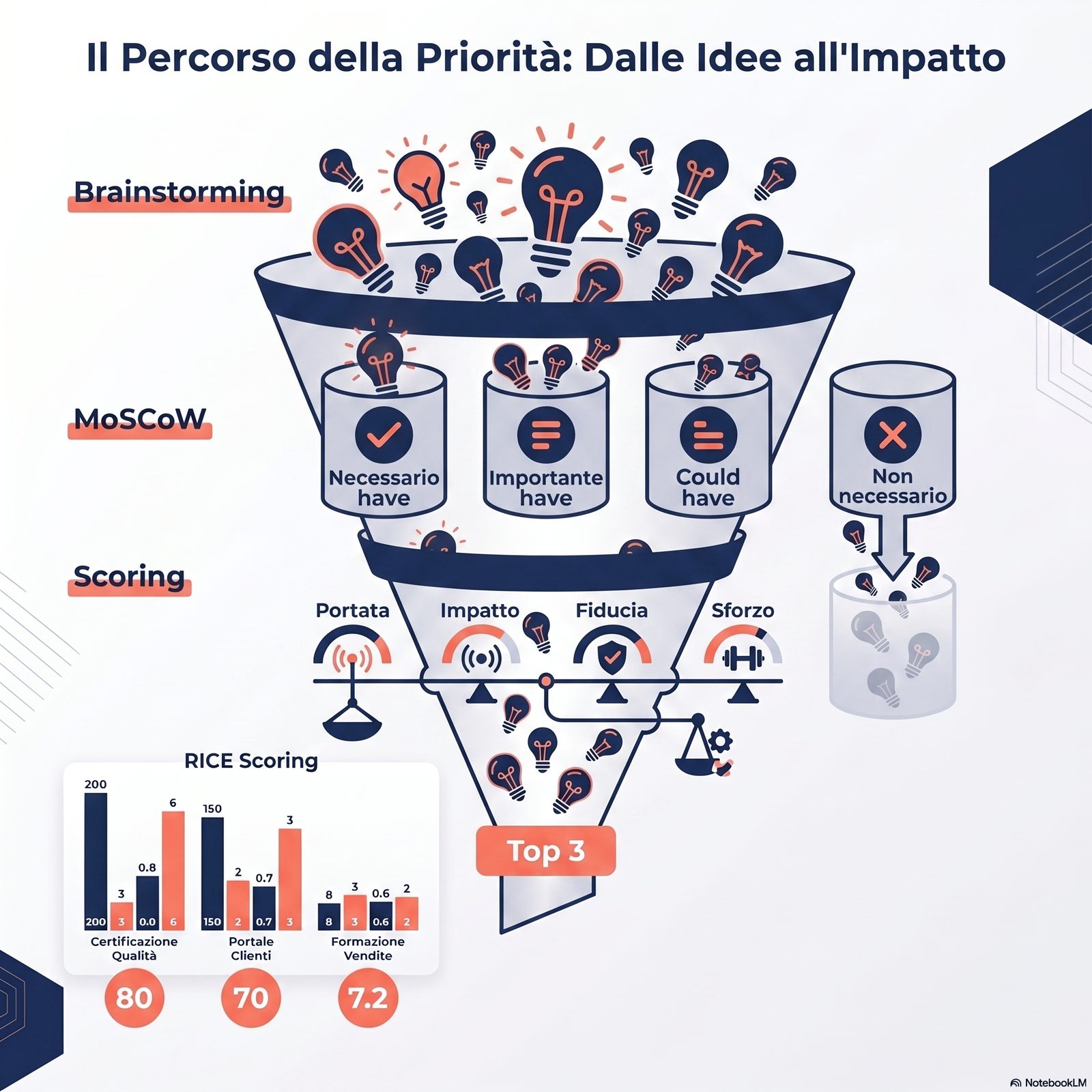
Eisenhower and Pareto work well for daily activities. But when the business owner has to choose between projects — the new product, opening a new location, investing in digital, entering a foreign market — more structured criteria are needed. Two frameworks established in product management help: MoSCoW (Must, Should, Could, Won't) classifies by level of necessity; RICE (Reach, Impact, Confidence, Effort) and its simplified version ICE force a comparable assessment across different alternatives. They are tools for thinking, not magic wands.
How many strategic decisions over the last 12 months were made by comparing projects on identical criteria, and how many "by feel"? Most small businesses choose by feel — not because the frameworks are missing, but because no one has ever turned them into one-page templates.
MoSCoW — classification by level of necessity:
- Must have: the project is essential for the continuity or survival of the business. Without it, the system does not work or is not compliant.
- Should have: the project is important and produces significant value, but its absence is not blocking in the short term.
- Could have: the project would bring an improvement, but it is nice to have, not necessary. It gets done if there are resources left over.
- Won't have (this time): the project is explicitly excluded from the current period. The fourth category is the one often missing from companies' strategic discussions: stating what you will not do is as much a decision as stating what you will do.
RICE — comparative scoring across projects:
The RICE formula combines four variables: Reach (how many people or business units are affected), Impact (intensity of the impact on each), Confidence (level of certainty about the estimate), Effort (resources needed in person-months or equivalent days). The score is R × I × C / E: a project with high reach, high impact and low effort gets a high score. The absolute value of the score is not relevant: what matters is the relative comparison between projects.
Example of RICE scoring for the owner of a 15-person manufacturing company, with three competing initiatives:
| Project | Reach | Impact | Confidence | Effort | RICE |
|---|---|---|---|---|---|
| New customer portal | 150 | 2 | 0.7 | 3 | 70 |
| Quality certification | 200 | 3 | 0.8 | 6 | 80 |
| Sales team training | 8 | 3 | 0.6 | 2 | 7.2 |
The numbers are estimates, not measurements. The value of the framework lies in forcing the comparison onto explicit criteria, not in the numerical result itself. The simplified ICE version (Impact, Confidence, Ease) drops the Reach variable, which is useful when the projects affect the same audience.
The peer-reviewed literature on MoSCoW and RICE is limited: they are described as operational frameworks widely used in product management, not as tools with scientifically proven evidence of effectiveness. Their value is structural: they force you to compare projects on identical criteria instead of deciding by subjective preference.
Weekly prioritization: the 30-minute protocol so the week does not run you
Decision frameworks only work if they have a moment in which to be applied. Most business owners do not lack criteria: they lack a standing appointment with themselves or with their leadership team to use them. Thirty minutes, once a week, are enough to turn Eisenhower, Pareto and RICE from posters into working mechanisms. Without that ritual, every framework dissolves in the Monday morning rush.
What would change if the first block on Monday were not "answer emails" but "choose the 3 things for the week"? The answer is not hypothetical — those who adopt a weekly prioritization protocol tend to finish fewer things, but the right ones, and to feel less like they are "always catching up."
Data from ISTAT, the Italian national statistics institute, on labor productivity show a structural gap in Italy compared with the most productive European countries: between 1995 and 2024, average annual growth in Italy was 0.3%, compared with 1.5% for the EU-27 average [7]. The Bank of Italy, for its part, documents that structured management practices — monitoring indicators, setting goals, incentives — are positively associated with productivity, and are less widespread among Italian firms where management remains family-based and local [8]. The weekly protocol is one of the mechanisms that works on this gap.
The 5-step protocol (total time: 25-35 minutes, Friday afternoon or Sunday evening):
Step 1 — Review of the week just ended (5 minutes). What was completed? What slipped, and why? Are there recurring patterns in interruptions or postponements? This step produces the week's learning.
Step 2 — Inventory of open projects and upcoming commitments (5 minutes). List, without filtering, all the projects in progress, the known deadlines for the following week, and pending tasks. This is not a final to-do list: it is the raw material to which you apply the framework.
Step 3 — Apply Eisenhower (or RICE for projects) (10 minutes). Sort the tasks in the inventory into the four quadrants. For owners of small companies (7-15 employees), this can be done alone. In a midsize company (80-100 employees), this step can involve the first line of managers with a short briefing.
Step 4 — Select the top 3 priorities for the week (5 minutes). No more than three. The limit is deliberate: three real priorities produce more value than ten apparent ones. The three priorities go into the calendar as protected blocks.
Step 5 — Block calendar time for the three priorities (5 minutes). The three priorities receive a specific time allocation in the following week's calendar. Without this step, the protocol remains a list, not a plan.
For a freelancer, the protocol is self-applied. In a small company, step 3 can include a brief alignment with a key team member. In a midsize company, steps 3 and 4 can become a 30-minute team session with the leadership team. For more on the operational side of weekly planning, the reference is the cluster on weekly planning. When the protocol identifies activities to delegate, the reference is the cluster on effective delegation to the team.
The reference pillar for the overall picture of the business owner's time is the guide to time management for business owners.
Three false criteria that lead to bad choices even with a system in place
Having a framework is not enough. Even people who have read Eisenhower and have used RICE for years sometimes keep choosing badly — not because they apply the method poorly, but because of three false criteria that slip into the method unnoticed. Recognizing them is the last step before priority management becomes a solid habit. As early as 1967, Drucker described these false criteria as "the temptations of the executive": they still hold today [5].
Which of the three false criteria has the most influence on the average business owner's calendar? It is not the one you think — and it is a surprise that concerns most people who run a business.
False criterion 1 — A preference for what is already familiar.
You favor what you know how to do well, not what has the most impact. A business owner who is strong in sales tends to spend time on sales activities even when the company's bottleneck is operational. A technical expert tends to work on technical problems even when the strategic priority is commercial. Drucker called it "the cult of efficiency": doing the wrong things well [5].
The warning sign: the activities you most enjoy spending time on are often not the ones that bring the most important result. The countermeasure is to apply the Pareto test to your activities over the last two weeks and check the correlation between time spent and impact produced.
False criterion 2 — Pressure from whoever speaks loudest.
You prioritize the request of the loudest customer or the most insistent team member, not the case that matters most to the company. The mechanism is documented by Vohs and colleagues [3]: decision fatigue favors choices that reduce immediate conflict, even at the expense of medium-term value. A customer who calls every day gets more attention than a strategic project that creates no visible pressure.
The warning sign: the week is dominated by specific people, not by criteria of importance. The countermeasure is to apply the Q2/Q3 filter of the Eisenhower matrix before responding to pressing requests: if the request is urgent but not important, handle it efficiently, do not prioritize it.
False criterion 3 — The illusion that "everything is urgent."
You treat every request as urgent because you have not set a criterion for telling real urgencies from perceived ones. Attention residue [1] accumulates over the day, reducing your ability to discriminate between real urgency and the pressure of the channel. By the end of the day, everything seems equally urgent because the mind no longer has the resources to tell the difference.
The warning sign: the week's list of "priorities" regularly exceeds ten items, and most of them get moved to the following week. The countermeasure is the weekly protocol (H2.6): classify with a cool head, before the week starts, instead of reacting in real time during the week.
Limitations and conditions of applicability
The decision frameworks described in this article were developed mainly in English-speaking organizational contexts and in large companies. Applying them to smaller organizations requires adjustments of scale: a RICE matrix with numerical variables makes sense if there are more than three competing projects and the resources are measurable. In smaller settings, a simplified MoSCoW classification produces the same value with less overhead.
The urgent/important distinction is exposed to cultural bias: in some organizational cultures, relational pressure systematically pushes toward Q3 (urgent for someone else, not important for the company). The matrix does not correct itself: it requires a conscious practice of applying it with a cool head.
The ISTAT [7] and Bank of Italy [8] data cited provide the structural context of the problem in Italy, not direct evidence of the frameworks' effectiveness; moreover, the Bank of Italy survey covers companies with at least twenty employees, is described by the authors as purely descriptive and does not measure how owners allocate their time. The cognitive evidence from Vohs et al. [3], Leroy [1] and Mark et al. [2] documents the mechanism that justifies using explicit criteria, but it refers to samples of knowledge workers that do not necessarily match the profile of a business owner.
The Pareto principle should be treated as a heuristic, not a law: the actual distribution of results across the activities of a specific company can vary significantly from the 80/20 ratio.
FAQ
How many decision frameworks should you use at the same time? No more than two in the same prioritization session. One framework for daily activities (Eisenhower or Pareto) and one for competing projects (MoSCoW or RICE) produce the most value with the least cognitive overhead.
Does weekly prioritization also work in periods of high operational volatility? Yes, with adjustments. In times of crisis or high unpredictability, the protocol is reduced to steps 1, 4 and 5 (review, selection of 1-2 top priorities, calendar blocking). The reduced structure keeps the principle of conscious choice alive even when the context is unstable.
What happens if priorities change in the middle of the week? The protocol allows for this: the priorities selected on Friday are the starting point, not an unchangeable contract. The skill lies in distinguishing legitimate changes of priority (a real crisis, an unexpected opportunity) from slippage caused by giving in to Q3 pressure.
How do you handle conflict between your own priorities and the team's? When the weekly protocol includes the first line of managers (in a midsize company), it produces an explicit alignment that reduces conflict. In smaller companies, sharing the week's three priorities with the team on Monday morning clarifies the context of requests and reduces Q3 pressure.
Operational summary
Priority management is a system of explicit criteria that decides instead of your mood. Eisenhower distinguishes urgent from important, Pareto identifies the few high-return activities, MoSCoW and RICE rank competing projects, and the 30-minute weekly protocol brings all this into real time. Without a ritual that applies them, frameworks remain posters; without vigilance over the three false criteria (familiarity, relational pressure, the illusion of urgency), even the ritual produces wrong choices.
Conclusion
Priority management is not a personal attitude: it is a system made of explicit criteria that decide instead of your mood. Eisenhower distinguishes urgent from important, Pareto identifies the few high-return activities, MoSCoW and RICE rank competing projects, and the weekly protocol brings all this into real time. Without a ritual that applies them, frameworks remain posters; without vigilance over the false criteria, even the ritual produces wrong choices.
If you want to go deeper into the logic of the four quadrants, there is a dedicated guide to the Eisenhower matrix; if you are looking for the execution techniques that apply once the priority has been chosen, you can read about time management techniques. The overall relationship between time, decisions and the business is covered in the pillar on time management for business owners.
When the day falls apart and the order decided with a cool head has to be suspended, the rules to set before the pressure arrives are on the page about working under pressure.
A company that truly manages priorities is not a company with fewer activities: it is a company where the hours worked go to the things that really move results. For a small business, it means closing the quarter having moved forward the two projects that mattered, not just the emergencies; for a freelancer, choosing the most valuable proposals instead of answering every request; for a midsize company, seeing the first line of managers decide without asking for confirmation on every perceived urgency. In Italy, where productivity has grown far more slowly than the European average for thirty years [7], priority management applied in a repeatable way is one of the concrete levers behind productivity growth — and the starting point is a 30-minute choice, once a week.
Sources and references
[1] Leroy, S. (2009). Why is it so hard to do my work? The challenge of attention residue when switching between work tasks. Organizational Behavior and Human Decision Processes, 109(2), 168-181. DOI: 10.1016/j.obhdp.2009.04.002
[2] Mark, G., Iqbal, S., Czerwinski, M., & Johns, P. (2016). Email duration, batching and self-interruption: Patterns of email use on productivity and stress. Proceedings of the ACM CHI Conference on Human Factors in Computing Systems.
[3] Vohs, K. D., Baumeister, R. F., Schmeichel, B. J., Twenge, J. M., Nelson, N. M., & Tice, D. M. (2008). Making choices impairs subsequent self-control: A limited-resource account of decision making, self-regulation, and active initiative. Journal of Personality and Social Psychology, 94(5), 883-898. DOI: 10.1037/0022-3514.94.5.883
[4] Pareto, V. (1906). Manuale di economia politica. Società Editrice Libraria, Milan.
[5] Drucker, P. F. (1967). The Effective Executive. Harper & Row, New York.
[6] Eisenhower, D. D., cited in Covey, S. R. (1989). The Seven Habits of Highly Effective People. Free Press, New York. (Reference to Eisenhower's speech at Northwestern University, 1954).
[7] ISTAT (2025). Misure di produttività — Anni 1995-2024. Statistiche report, December 12, 2025. https://www.istat.it/wp-content/uploads/2025/12/REPORT_PRODUTTIVITA_2024.pdf
[8] Baltrunaite, A., Formai, S., Linarello, A., & Mocetti, S. (2022). Ownership, governance, management and firm performance: evidence from Italian firms. Banca d'Italia, Questioni di Economia e Finanza no. 678, March 2022. https://www.bancaditalia.it/pubblicazioni/qef/2022-0678/QEF_678_22.pdf