
To schedule an activity (in Italian, calendarizzare) literally means to plan and set its precise dates sufficiently in advance [1]. The Italian verb belongs to administrative and parliamentary language, and that is where the dictionary records it, with its usage examples [1]; in business language, the operation includes the time slot as well as the date, and this narrower sense is the one used here. People who use it today mean a concrete operation: taking a task that existed only as an intention and fixing it in a time slot.
The article opens with a short clarification of terms: what scheduling means and how it differs from related terms such as automated scheduling, planning and booking. It continues with the operational method for scheduling realistically (without filling the day down to the last minute) and with a reasoned review of the tools, from digital calendars to paper planners.
ISTAT data on time use in Italy describe dense days for people in work: on average, employed people go through about 24 distinct episodes of activity and location over the day and spend almost three hours of it doing several things at once [4]. In this picture, scheduling is not an administrative detail: it is the point at which an intention becomes a commitment to yourself.
What remains to be understood is when this practice produces real order and when, on the contrary, it creates a saturated calendar that you stop looking at by Wednesday.
Apply the definition of scheduling to a real task
The word comes up constantly in operational meetings ("let's schedule the project," "it has to be scheduled by Friday") without its meaning ever being spelled out. It is worth starting from the definition: to schedule means to set the precise date of an activity in advance [1] and, in the operational sense adopted here, its time slot as well. From this follow the three operations this section describes: choosing what to schedule, deciding when, and fixing the commitment so that it can be consulted and changed.
How many tasks stay on a to-do list without ever getting a date and a time? In many cases they are more than half of the stated intentions, and the calendar alone shows precisely what will really happen and what won't.
The meaning of calendarizzare, the Italian verb for scheduling (from the Latin calendarium, originally a "book of credits, of due dates," derived from calendae [2]), belongs to Italian technical and administrative language, and the usage examples recorded by the dictionary mostly come from the parliamentary and institutional sphere: the scheduling of parliamentary business, of state visits, of the opening and closing of the hunting season [1]. In today's business language it refers to the operation of giving an activity a precise space in the calendar: not just a date, but a start time and an estimated duration.
The three minimum operations of effective scheduling:
-
Choose what to schedule. Not everything on the list deserves a block in the calendar. Schedule the tasks that require a dedicated block of time and don't depend entirely on other people. Tasks that depend on confirmation from a third party (a client, a supplier, a team member) enter the calendar only after that confirmation.
-
Estimate the duration. The estimate should include a margin over the time you perceive as necessary, for reasons related to the planning fallacy documented by research [3] (covered in the next section).
-
Place it in the right slot. Not all time slots are equivalent. Tasks that require high concentration belong in the early morning hours or at the time of day when your energy is usually highest; coordination or response tasks can take up lower-energy slots.
Disambiguation: scheduling, automated scheduling, planning, booking
In everyday Italian, the four corresponding terms coexist and are often used as synonyms. They are not:
- Scheduling vs automated scheduling: in Italian, schedulare is an anglicism from to schedule, imported from project management and software (scheduled builds, automated tasks). The Italian dictionary records it in two senses: in transportation, "organizing the schedule of a trip, especially by air," and in computing, "programming" [7]. Calendarizzare, scheduling in the sense used here, concerns human activities with a date and time, not necessarily automated ones.
- Scheduling vs planning: planning (pianificare) is the broader term: it includes analyzing priorities, estimating times, and the logical sequence of the phases. Scheduling is one of the operational outputs of planning: the moment when planned activities get a position in the calendar.
- Scheduling vs booking: agendare, roughly "to book," is more informal and usually refers to a single appointment ("let's book a call"). Calendarizzare has a more procedural tone and applies to a set of activities organized over time. Lexically, calendarizzare is accepted by Italian dictionaries with its administrative derivation [1], while agendare remains a colloquial usage that the Treccani dictionary does not list as a separate entry.
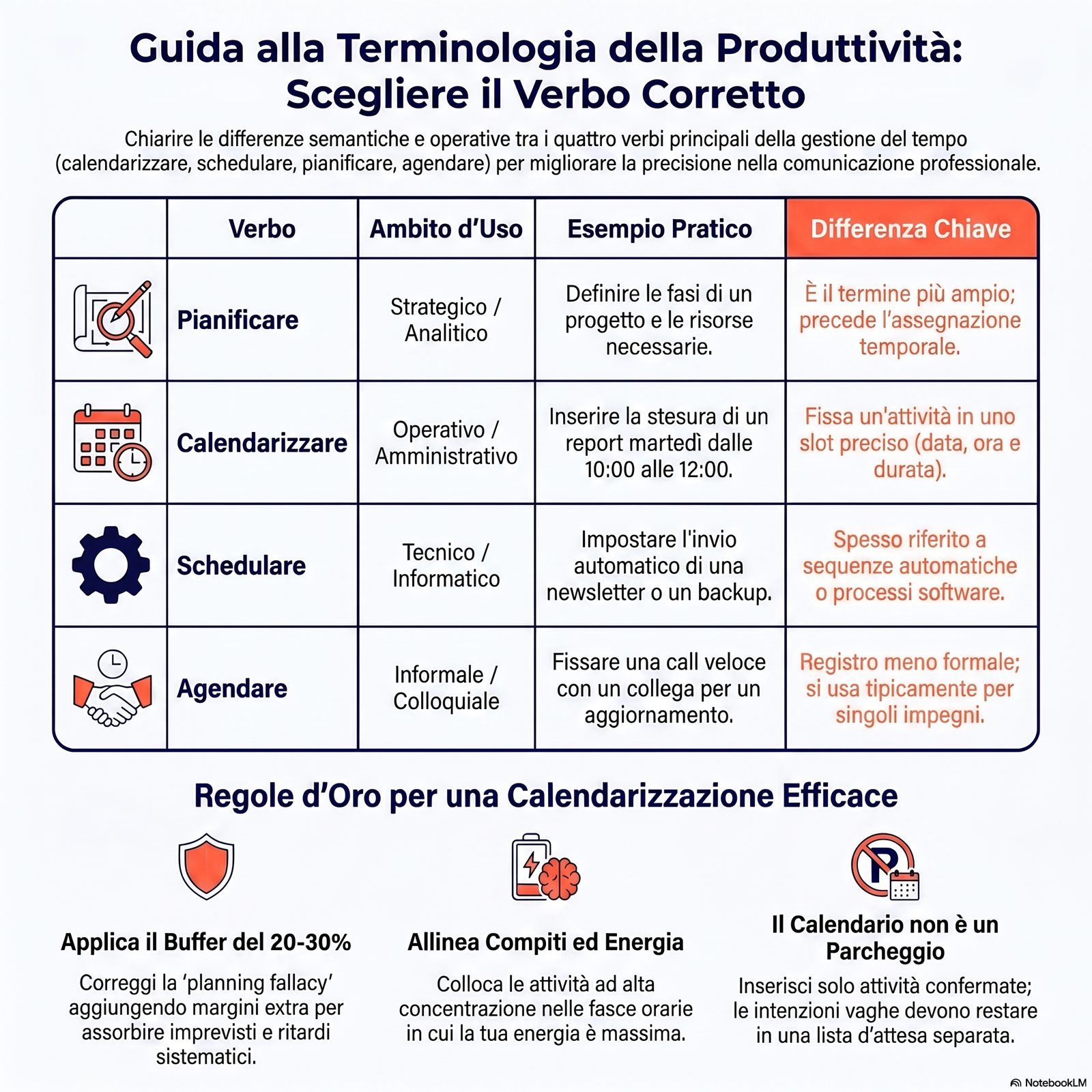
The method for scheduling realistically
Scheduling a task requires three decisions: what to put in, how much time to give it, and when to place it. Research on the planning fallacy (Buehler, Griffin and Ross, 1994) documented people's systematic tendency to underestimate the time needed to complete their own tasks by 30-40% [3]. This section proposes a four-step method that accounts for this predictable error and introduces calibrated time buffers.
Is a day scheduled down to the last minute really more productive than a day with explicit empty margins? Experimental evidence on completion times suggests the opposite: a saturated calendar tends to collapse at the first unexpected event.
The four steps of the method:
Step 1: Select the tasks that can be scheduled. Before opening the calendar, it is worth distinguishing between tasks that deserve a dedicated slot and those that stay on a waiting list. The calendar is for tasks that require a continuous block of time, have a defined deadline or a counterpart waiting for a result. Atomic tasks with no precise time constraint, which can be handled at any moment, stay on the list.
Step 2: Estimate the time with a buffer. For each selected task, estimate the duration naively (how long it seems to take), then add a 20-30% buffer on top of that estimate [3]. This is not excessive caution: it is the statistical correction of the systematic error documented by research. The density of the day measured by ISTAT in Italy (about 24 distinct episodes and almost three hours spent doing several things at once [4]) indicates that explicit margins in the calendar serve something that happens anyway, not a remote possibility.
Step 3: Place each task in a slot that matches the energy it requires. As early as 1967, Drucker observed that effective time management begins by recording where time actually goes, before changing how it is allocated [6]: a historical source, used here as a practical reference, not as experimental evidence. The operational principle is this: tasks that require high concentration (analysis, writing, design) belong in the hours of highest cognitive energy; coordination, response and routine tasks can take up the lower-energy slots.
Step 4: Weekly review. The calendar is not a static document. A weekly review, ideally at the end of the week or the start of the next, lets you check what was kept, what took longer than expected, and correct your estimates for the following cycles. Without a review, the calendar ages and stops reflecting reality.
Choose your scheduling tool based on your work context
The right tool for scheduling is not the one with the most features, but the one you actually look at. Eurostat's survey on discretion over working hours shows very different profiles for the self-employed and employees: in 2019, 65.0% of self-employed workers in the European Union said they decided their working hours entirely themselves, against 9.8% of employees, whose hours were set by the employer or the organization in 68.8% of cases [5]. This section compares the main options with explicit selection criteria.
Is the most sophisticated calendar still the right tool if you open it twice a week? There is no single operational answer: the right tool depends on the number of people involved and how often you consult it, not on the number of features available.
The table below compares the three main categories of tools:
| Category | Suited to | Advantage | Limitation |
|---|---|---|---|
| Shared digital calendar (Google Calendar, Outlook, Apple Calendar) | 3+ people to coordinate, frequent changes, operational delegation | Shareable in real time, editable from any device | Requires a connection, tends toward notification overload |
| Paper planner | 1 person, preference for physical media, few changes per week | No digital distractions, writing by hand improves memory | Not shareable, hard to change, can't be synced |
| Hybrid system (planner + digital calendar for shared appointments) | Settings with lots of independent work + some coordinated meetings | Combines the advantages of both | Requires discipline in keeping the two systems in sync |
The selection criteria, in order of priority:
- Number of people to coordinate: with just one person or no external coordination, a paper planner is acceptable; with three or more people, a shared digital calendar is necessary.
- Frequency of changes: if scheduled tasks change often during the week, digital makes updates easier; if the plan is stable, paper works just as well.
- How often you actually consult it: the tool you choose should be the one you habitually look at, not the one you would use in an ideal world. A paper planner opened every day is more effective than a digital calendar checked once a week.
If you want to go deeper into the technique of allocating time in homogeneous blocks, read the cluster on time blocking, which describes the method specifically.
How to integrate scheduling into weekly planning
On its own, scheduling has an operational limit: it turns intentions into time slots, but it doesn't guarantee that the tasks chosen are the right ones. Weekly planning is the moment when the calendar meets priorities: you decide what gets scheduled and what doesn't. This section describes how the weekly review, scheduling and the handling of commitments that come up during the week fit together.
Does it make sense to schedule tasks that, at the time of the weekly review, you are not sure you really want to tackle? The calendar is not a parking lot for vague intentions: it is the point of contact between priorities and available time.
The three-moment flow:
Moment 1: Weekly review (selecting priorities). Before opening the calendar for the following week, identify the tasks with the greatest impact on the goals for the period. This is the level of weekly planning: deciding what you want to happen, not how to allocate it. Selection comes before anything goes into the calendar.
Moment 2: Scheduling proper (allocating slots). The selected tasks get a slot in the calendar, with an estimated duration (including a buffer) and placement that matches the energy they require. This is the operational moment of scheduling described in the method section above. The distinction between urgent and important, which matters for prioritizing commitments, is covered in the cluster on managing commitments.
Moment 3: Handling new commitments on the fly. During the week, new commitments inevitably come in. Handling them on the fly means assessing each new commitment against the existing calendar: can it fit into the buffer you already planned? Does it require moving a task that is already scheduled? If you delegate part of your commitments, you need to assess whether the new one can actually be delegated. Turning the calendar into concrete day-by-day actions belongs to the level of the daily agenda.
The distinction between the weekly calendar and the daily agenda matters operationally: the weekly calendar decides what to do (selection and allocation), while the daily agenda turns it into concrete actions, often at a finer granularity (blocks of 30-60 minutes rather than half a day).
Common mistakes that make scheduling useless
A good share of abandoned calendars are not betrayed by the reader's discipline but by mistakes in the initial setup. Saturating the slots, mixing tasks of different kinds, scheduling things that don't depend on you: three distinct mistakes that produce the same outcome. This section describes them with concrete signals and gives the operational fix for each.
How many times is a calendar abandoned not out of laziness, but because the person who filled it in didn't realize they were scheduling the wrong tasks? In many cases the problem is not discipline in execution; it is the quality of the initial selection.
Mistake 1: Saturation (calendar 100% full, no buffer). How to recognize it: at the first unexpected event of the week, all the following tasks slip. Fix: explicitly reserve 20-25% of the slots as unassigned buffer. The need for a buffer follows from the systematic underestimation of time documented by Buehler and colleagues [3]; the percentage, on the other hand, is an operational criterion of our editorial team, because that study doesn't prescribe one. A buffer is not wasted time: it is the reserve that absorbs the unexpected without making everything else collapse.
Mistake 2: Mixing incompatible types of work. How to recognize it: sales calls and deep thinking alternate in the same time block, with constant interruptions. Fix: group similar tasks into consecutive blocks (all calls in one slot, all analytical work in another). This reduces the cognitive cost of context switching documented by the literature on attention residue.
Mistake 3: Scheduling tasks that depend on confirmation from others. How to recognize it: the calendar contains meetings, appointments and deliveries that have not yet been confirmed by the other party. Fix: tasks that depend on others go into the calendar only after confirmation. Until then, they belong to a "tentative calendar" or a waiting list, not to the week's plan.
Mistake 4: No weekly review. How to recognize it: Monday's calendar reflects last Friday's intentions, but not what came up over the weekend. Fix: set aside a weekly review session, even a short one of 15-20 minutes, to update the calendar based on what has emerged. Without a review, the calendar tends to become outdated and to lose credibility as a guiding tool.
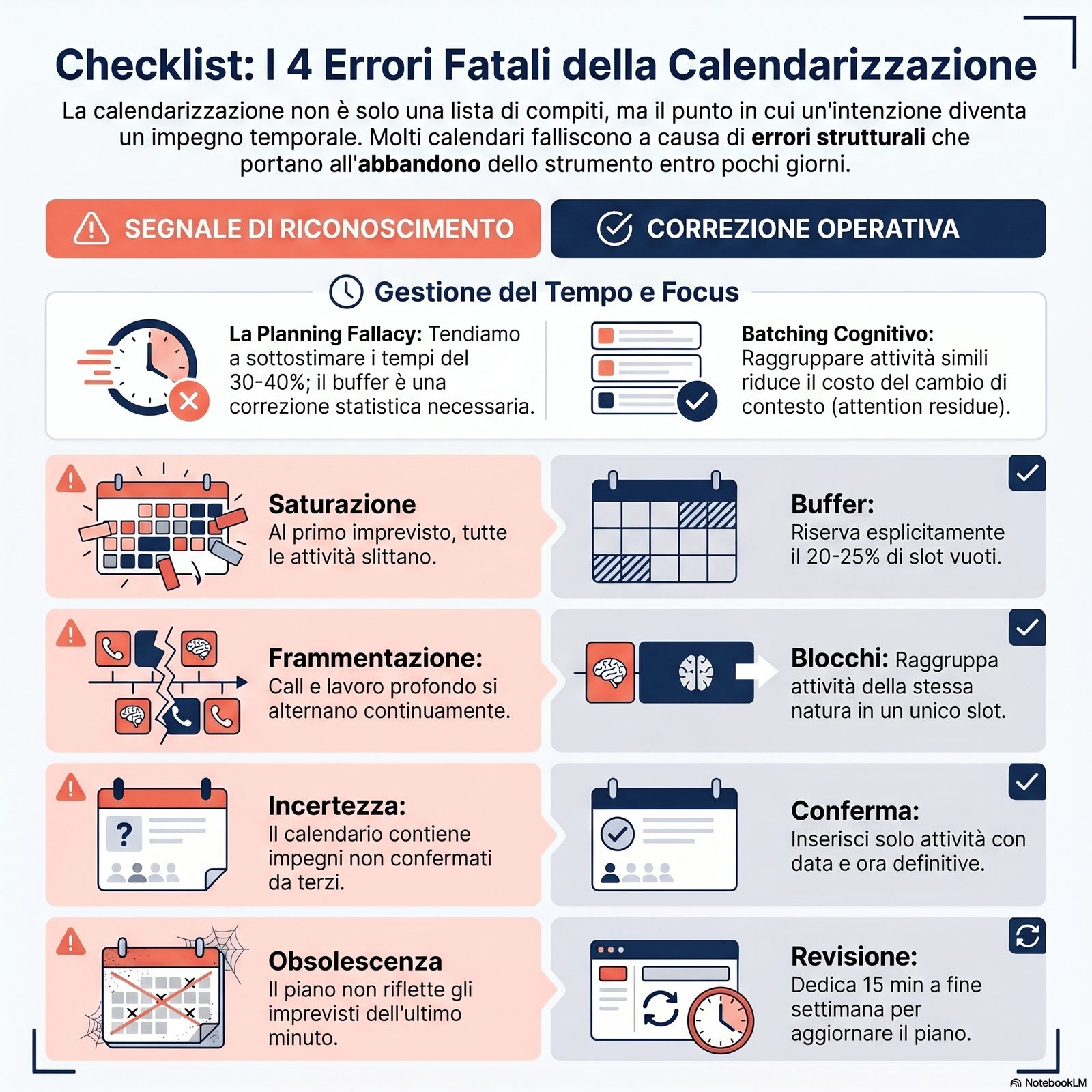
Limits and conditions of applicability
The method described here was developed from evidence on individual planning and time management. Some conditions limit its applicability:
- Highly unpredictable settings: in sectors where priorities change unpredictably every day (construction, events, emergency services), detailed scheduling tends to lose its usefulness within a few hours. In these settings, it is better to schedule only commitments with rigid constraints and leave more flexibility for the rest.
- Lexical sources vs evidence-based sources: the Treccani dictionary entries [1][2][7] are lexical sources, not evidence of the method's effectiveness. Claims about the operational effectiveness of scheduling rest on psychological research [3] and institutional data [4][5], not on lexical authorities.
- Scope of the ISTAT time use survey [4]: the data cited refer to the 2013-2014 wave and to all employed people in Italy, not just the self-employed. In the survey diary, work is recorded as a single episode, interrupted only by breaks: the survey therefore measures the density of the day, not the fragmentation within working time.
- Drucker as a historical source: the reference to Drucker [6] is explicitly a secondary, historical source. His observations are used here as practical guidance, not as experimental evidence.
- Individual variability: the estimate of the optimal buffer (20-30%) is derived from research on samples and points to systematic underestimation [3]. The precise value varies with the type of task and the individual's profile.
Frequently asked questions
In Italian, what is the difference between calendarizzare and schedulare? Schedulare is an anglicism from to schedule, recorded by the dictionary in transportation and in computing, where it means "to program" [7]. Calendarizzare is a term of Italian administrative origin, with a broader use that includes human, non-automated activities. In everyday business language the two terms are often used interchangeably, but schedulare keeps a more technical connotation.
How many tasks is it reasonable to schedule in a working week? There is no universal number: it depends on the average length of the tasks and on the hours available. The operational principle is that the total of scheduled tasks should not exceed 70-80% of the available time, keeping the remaining 20-30% as a buffer for the unexpected [3]. For a week of 40 actual hours, the indicative limit is 28-32 hours of scheduled tasks.
Can you schedule personal and work tasks together in the same calendar? Yes, and for many professionals and business owners it is the most effective choice. A single calendar that combines work and personal commitments gives a complete view of your real availability and avoids overlapping conflicts. The two areas can be separated visually with colors or overlaid calendars, without the need for separate tools.
What should you do when a scheduled task is not completed within its block? Reassess the unfinished task: does it need an additional block? Was the initial estimate too optimistic? Should it be delegated or dropped? In no case should it be left "hanging" in the earlier calendar slot: actively move it to the next available block or put it back on the waiting list with a new priority decision.
Operational summary
Scheduling tasks is the operation in which an intention takes an exact position in time: date, time slot, estimated duration. The meaning of the term (putting something in a calendar with a date and time) is lexically simple [1][2]; the operational effect depends on three choices that are not trivial: what to schedule, with what time margin (correcting the tendency to underestimate [3]), and on which tool.
The four-step method (selection, estimate with buffer, placement by energy level, weekly review) turns these three choices into a repeatable practice. The tool depends on the number of people to coordinate and how often you consult it, not on the richness of its features.
Scheduling is one of the outputs of weekly planning: the moment when the selected priorities get a position in the calendar. Without that upstream selection, the risk is scheduling the wrong tasks, which produces a calendar that is full but not necessarily productive.
Conclusion
Scheduling tasks is the act in which an intention takes an exact position in time. The meaning is simple (putting something in a calendar with a date and time), but the operational effect depends on three choices that are not trivial: what to schedule, with what time margin, and on which tool. Without these three choices the practice remains a cosmetic habit, with a day that is full in theory and disorganized in practice.
This article has dealt with the single operation of scheduling. The level above it, deciding what to schedule based on priorities, belongs to weekly planning and, more generally, to time management for business owners. If you want to go deeper into turning the calendar into concrete day-by-day tasks, you can also read the piece on the daily agenda.
In a working week with a calendar that is truly managed, the difference is not measured in minutes saved: it is measured in the number of decisions that no longer need to be renegotiated. Meetings have a time that fits their content, thinking work has dedicated space, and the unexpected finds real margins to fit into. It is the point at which the day stops being a sequence of emergencies and becomes a sequence of choices again.
Sources and references
[1] Treccani. Vocabolario online, voce "calendarizzare". https://www.treccani.it/vocabolario/calendarizzare/
[2] Treccani. Vocabolario online, voce "calendario". https://www.treccani.it/vocabolario/calendario/
[3] Buehler, R., Griffin, D., & Ross, M. (1994). Exploring the "planning fallacy": Why people underestimate their task completion times. Journal of Personality and Social Psychology, 67(3), 366-381. https://psycnet.apa.org/record/1995-09997-001
[4] ISTAT. I tempi della vita quotidiana. Lavoro, conciliazione, parità di genere e benessere soggettivo, Istituto Nazionale di Statistica, 2019 (2013-2014 Time Use Survey). https://www.istat.it/it/files/2019/05/ebook-I-tempi-della-vita-quotidiana.pdf
[5] Eurostat. Flexibility at work — statistics, Statistics Explained (2019 ad hoc module of the Labour Force Survey on work organization and working time), data extracted in September 2020. https://ec.europa.eu/eurostat/statistics-explained/index.php?title=Flexibility_at_work_-_statistics
[6] Drucker, P. F. (1967/2006). The Effective Executive. HarperBusiness. [Historical source — declared]
[7] Treccani. Vocabolario online, voce "schedulare". https://www.treccani.it/vocabolario/schedulare/