
Over a working day, commitments pile up from different sources: incoming requests, tax deadlines, team meetings, projects that are supposed to grow the business. At 7 p.m., scrolling through the calendar, you often realize that the truly important things have stayed at the bottom, crushed by the ones that seemed unable to wait.
Managing commitments is the practice of classifying your responsibilities and placing them in your calendar according to their urgency and importance, so that the important ones are not systematically pushed aside by the urgent ones.
It is not a matter of willpower but of method. There are practical criteria for telling apart what pushes from outside and what creates value over the medium term. There are practical ways to allocate both in your calendar so that they coexist without getting mixed up.
In this article you will find: a working definition of "commitment" and how it differs from an appointment, an activity and a task; Eisenhower's classic criterion, reread for people who work today; a method for designing a calendar that makes room for both categories; the mistakes that make important commitments slip out of the calendar.
The promise is a management system you can apply within your next working week, regardless of the size of your business.
Learn to recognize a commitment (and tell it apart from appointments, activities and tasks)
In everyday language, the word "commitment" covers four different things: a promise made to a client, an appointment with your accountant, an activity to carry out, a task on the to-do list. Treating them as one and the same is the first reason a calendar doesn't work. European labor force data show that in 2024 self-employed workers in Italy reported an average of 41.0 usual weekly hours in their main job, against 37.1 for employees [5]: for people who work for themselves, the problem is not a lack of available hours but the absence of criteria for choosing what to spend them on. This section offers a working definition of "commitment" and three clear boundaries so you don't confuse it with its close relatives.
How many of the commitments in today's calendar are really commitments, and how many are appointments, activities or tasks in disguise? In many calendars, the confusion between the four categories explains a significant share of the Friday evening overflows.
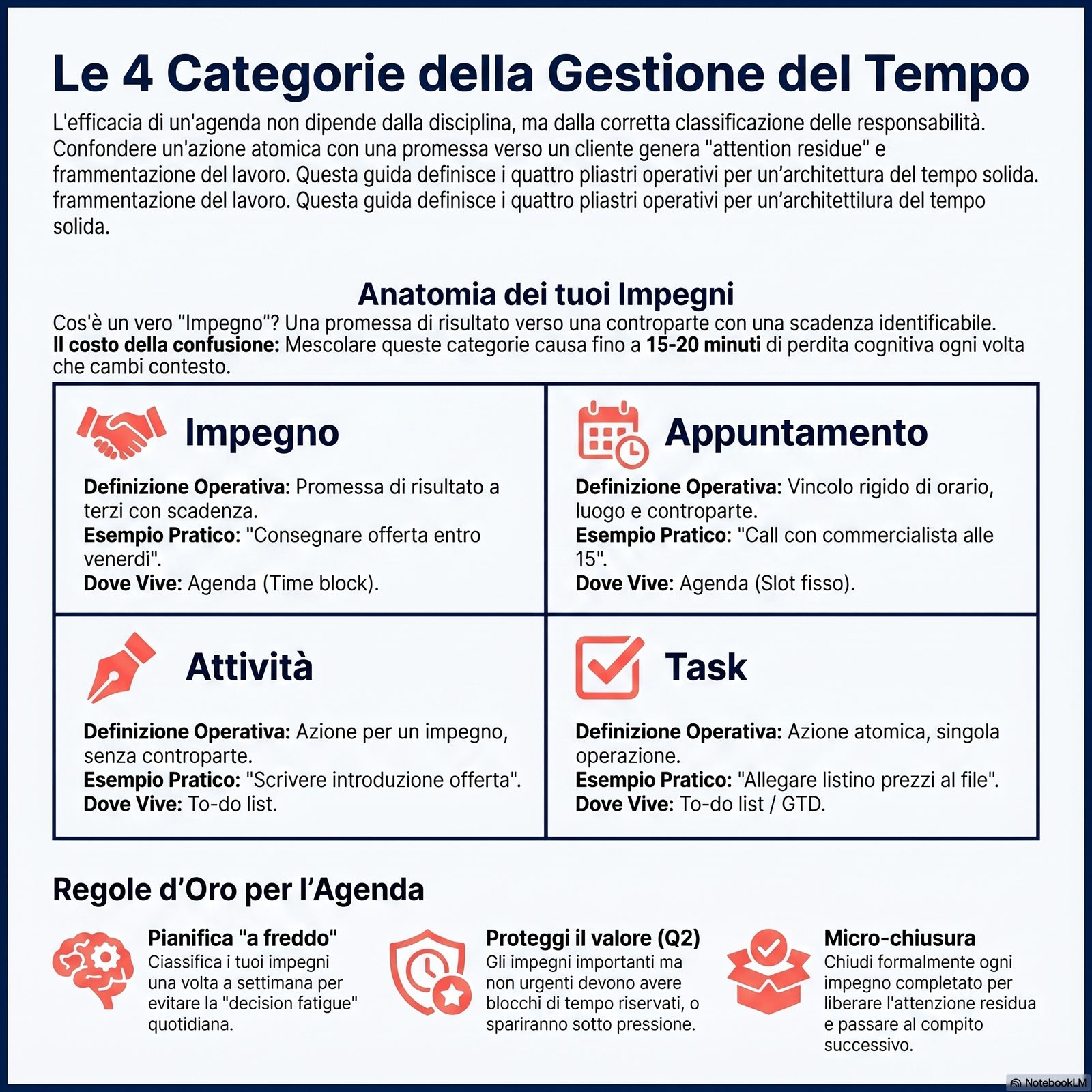
In practical terms, a commitment is a promise of a result to a counterpart (internal or external), with a recognizable outcome and an identifiable deadline. "Deliver the quote to the client Rossi by Friday" is a commitment. "Work on the quote" is not; it is an activity.
The table below clarifies the four categories and where each one lives:
| Category | Definition | Example | Where it lives |
|---|---|---|---|
| Commitment | Promise of a result to a counterpart, with a deadline | "Deliver the proposal to X by Friday" | Calendar (with a time block) |
| Appointment | Commitment with a fixed time, place and counterpart | "Call with the accountant at 3 p.m." | Calendar (fixed slot) |
| Activity | Action that contributes to a commitment, with no explicit counterpart | "Write the introductory section of the proposal" | To-do list / work block |
| Task | Atomic action, completed in a single step | "Attach the price list to the document" | To-do list / GTD system |
The distinction has direct operational consequences. If the to-do list contains commitments instead of tasks, it will always be too long and unmanageable. If the calendar contains activities instead of commitments, you will lack visibility on what you have actually committed to externally. If appointments and work blocks are mixed with no criterion, the day breaks into segments that are too short to produce quality work.
Self-employed workers in Italy report usually working almost four more hours per week, on average, than employees [5]: a margin that is not wasted for lack of tools, but for lack of selection criteria. The problem is not the number of hours available but how they are filled.
The urgent/important distinction, explicitly introduced into organizational literature starting from a 1954 speech by Eisenhower [1], provides the framework for tackling this problem. It is developed two sections below; the next section first introduces the cost of the confusion, to show why the criterion is worth using.
Calculate the cost of a calendar that mixes urgent and important
In 2009, researcher Sophie Leroy published a study in Organizational Behavior and Human Decision Processes that gave a name to a phenomenon familiar to anyone working with a packed calendar: attention residue [2]. When you move from one commitment to another without a clean close, part of your attention stays hooked to the previous one. The result is that performance on the new commitment drops, even if you subjectively feel fully present. Mark and colleagues (2016) [3] documented how the fragmentation of work in office settings is associated with interruption patterns that reduce the quality of the work produced. This section shows why a calendar that mixes urgent and important multiplies these costs.
How many truly productive minutes come out of a day in which every hour you switch from an urgent commitment to an important one and back? Experimental evidence suggests far fewer than you perceive, and the shortfall builds up invisibly.
A practical example: a business owner handles an urgent call with a supplier in the morning (Q1: urgent + important), then tries to get back to drafting a sales plan (Q2: important, not urgent). Attention residue [2] means that the first 15-20 minutes of work on the plan are cognitively weighed down by the unresolved details of the call. If this pattern repeats 4-5 times a day, the actual loss of productive work is considerable, even though the calendar looks full.
A quick diagnosis to recognize the problem in your own week: count the number of context switches in a typical day (transitions between activities of a different nature). If the number exceeds 8-10 transitions, the calendar is plausibly generating systematic cognitive costs that don't show up in the total hours worked.
The mixed calendar, where urgent and important items alternate with no criterion, is the structural cause of this pattern. It is not a problem of individual discipline: it is a problem of calendar architecture.
Classify commitments with the urgent/important matrix without mistaking pressure for value
On August 19, 1954, in a speech to the World Council of Churches in Evanston, Illinois, Dwight Eisenhower quoted the president of Northwestern College, distinguishing between urgent problems and important problems [1]. The line became the root of the so-called "Eisenhower matrix." But the way it is most commonly used today betrays its original insight: many people place in the "urgent and important" quadrant everything that creates immediate psychological pressure, regardless of the value it produces over the medium term.
What decides whether a commitment is important: who asks for it, or what it produces? The correct answer is the second, but everyday reflexes push toward the first.
The two axes of the matrix are distinct by definition and should be applied separately:
- Urgency: depends on the time available before the opportunity disappears or the damage becomes irreversible. It is external time pressure, independent of the commitment's value.
- Importance: depends on the commitment's impact on the business's medium- to long-term goals. It is an internal assessment, independent of the pressure the commitment creates.
The confusion arises because urgency and importance often overlap, but not always. A client calling with a complaint creates urgency (it has to be handled right away) and may be important (if you risk losing the client) or not important (if the complaint is minor and the client is low-value). Deciding which quadrant is right takes two separate questions, not an instinctive response to pressure.
The four quadrants with practical examples:
| Quadrant | Characteristic | Typical examples | Suggested action |
|---|---|---|---|
| Q1: Urgent + Important | High pressure + high value | Crisis with a key client, imminent tax deadline | Handle immediately |
| Q2: Important, not urgent | High value + low pressure | Developing the sales strategy, training, processes | Protected time block (top priority) |
| Q3: Urgent, not important | High pressure + low value | Unnecessary meetings, quick-reply emails | Delegate or reduce |
| Q4: Not urgent, not important | Low pressure + low value | Routine activities that can be automated | Eliminate or automate |
The critical point is Q2: important, non-urgent commitments are the ones that build the long-term value of the business, and they are also the first to get squeezed when Q1 pressure rises. If Q2 has no reserved time blocks in the calendar, in practice it tends not to exist.
Vohs and colleagues (2008) [4] showed experimentally that making repeated decisions over the course of the day reduces the quality of subsequent choices (decision fatigue). This means the urgent/important classification is more accurate when done in a calm moment, typically once a week during the planning session, and not in real time, under pressure.
Build a calendar that separates urgent and important (in 4 practical steps)
A classification matrix remains a theoretical exercise until it turns into a physical place in the calendar. The move from classification to calendar is where most time management systems break down. The solution is not to handle each commitment on the fly but to decide in advance, in a calm moment, where they go, reducing the number of choices to make during the day and therefore decision fatigue [4]. This section gives four practical steps to design a weekly calendar that makes room for both categories without one eating the other.
What happens to an important commitment that has no time block reserved in the calendar? It usually doesn't survive the pressure of the week. Deciding in advance is the prerequisite for actually doing it.
Step 1: Weekly inventory. On Sunday evening or Monday morning (depending on your preference), list all the week's commitments in a single list: confirmed appointments, commitments to clients or team members, activities on strategic projects, deadlines. The inventory is not a plan yet; it is the raw material to which you apply the classification. For a structured weekly planning system, see the cluster on weekly planning.
Step 2: Four-quadrant classification. For each commitment in the inventory, apply the two axes separately: urgent? important? The result is an assignment to one of the four quadrants. The classification is done in a calm moment, not in real time, precisely because decision fatigue [4] degrades the quality of decisions spread across the day.
Step 3: Physical allocation in the calendar. Blocks go into the calendar in this order: first Q2 (important, not urgent, because without explicit allocation they disappear), then Q1 (urgent and important, which usually make their own way in through the pressure they carry), then Q3 (urgent, not important, which ideally get delegated or compressed). Q4 items don't go into the calendar: they are eliminated or automated. The principle of time blocking by homogeneous contexts reduces attention residue [2]: consecutive blocks of the same type of work (all calls in the same time slot, all analytical work in another) preserve cognitive continuity.
Step 4: Closing review. On Friday afternoon, before wrapping up the week, check what stayed in the quadrant it was assigned to and what migrated. Q2 items that didn't happen are rescheduled for the following week, not abandoned. The daily calendar, in its day-to-day operational dimension, is covered in detail in the cluster on daily planning. For placing personal commitments, the ones that coexist with work, in your daily schedule, the cluster on organizing personal commitments is useful.

The 4 mistakes that break the separation between urgent and important (and how to avoid them)
Even a well-designed calendar gives way under pressure. That pressure, however, doesn't all come from outside: a significant share is generated by the habits of the person managing the calendar. There are recurring patterns that break the separation between urgent and important and send the calendar back to the initial chaos. Recognizing and neutralizing them before they settle into habits is an integral part of the system.
Which mistake does the most damage: answering everything immediately, or not setting the important blocks in the calendar? Usually the second, but the first is what makes the second seem reasonable.
Mistake 1: Treating every incoming request as urgent. The signal: the calendar fills up with responses to external requests, while your own Q2 commitments stay on the list with no block. The cause: confusing the speed of the channel (a flashing chat) with the priority of the commitment. The fix: apply the classification to incoming requests too ("is this request urgent? important?") before letting them into the calendar. For managing communication channels, see the cluster on managing the flow of information.
Mistake 2: Not reserving protected blocks for Q2. The signal: important, non-urgent commitments never get completed; they migrate from week to week without finding a place. The cause: Q2 never gets priority in allocation, because it creates no immediate pressure. The fix: allocate Q2 blocks first, before appointments and routine commitments. Without a protected block, a Q2 commitment is not really in the calendar.
Mistake 3: Classifying in real time instead of in a calm moment. The signal: on Monday morning, under the pressure of incoming requests, almost everything looks urgent and important. The cause: decision fatigue [4] lowers the quality of choices made under pressure, and the emotional reflex pushes everything toward Q1. The fix: reserve classification for the calm weekly session (Sunday evening or early Monday morning, before the operational day begins).
Mistake 4: Not closing completed commitments. The signal: commitments considered "done" stay on the list or in the calendar without a formal close. The cause: attention residue [2] doesn't fade automatically when the activity is completed; it requires an explicit act of closure (marking it as "done," filing it, communicating the result). The fix: at the end of each commitment, carry out a micro-close: update the status, notify the counterpart if needed, mentally release the block.
Limits and conditions of applicability
The system described here was developed from empirical evidence on individual cognition and the organization of time. Some conditions limit its applicability:
- Roles that require constant responsiveness: in some roles (customer service, emergencies, on-call shifts), continuous responsiveness is not a choice but a contractual requirement. The classification system is still useful for identifying the windows where planning is possible, but it doesn't remove the need to be responsive at the prescribed times.
- High week-to-week variability: in sectors where external priorities vary a lot (events, logistics, construction), the weekly classification may need more frequent review, even twice a week, to stay aligned with reality.
- Attention residue and the literature cited: Leroy [2] and Mark [3] conducted studies in specific settings (knowledge workers, office environments). Transferability to other work contexts is not automatic, but the cognitive mechanism of attention residue is documented well enough to justify caution when designing your calendar.
- Decision fatigue [4]: the effect is documented in experimental settings. Its practical application to classifying commitments is a plausible operational extension, stated here as such.
Frequently asked questions
How many times a week should you review the classification of your commitments? One weekly classification session (Sunday evening or Monday morning) is enough in most contexts. In weeks with high variability, it is worth adding a short Wednesday check to see whether some priorities have moved to another quadrant.
What should you do when everything seems urgent and important? When everything looks like Q1, the classification is probably happening under pressure, which is exactly the context in which decision fatigue [4] produces distorted assessments. The useful move is to stop and postpone the classification to a less pressured moment, or to apply an explicit rule: if you can't name the counterpart to whom you have taken on the responsibility, the commitment is probably not Q1.
Does the urgent/important matrix also work for personal commitments? Yes, with some adjustments. Personal commitments (family, health, relationships, learning) tend to land in Q2 (important, not urgent) and to be the first to disappear when work-related Q1 pressure rises. The cluster on organizing personal commitments addresses this specific issue.
How do you delegate Q3 commitments without losing control? Effective delegation of a Q3 commitment requires three elements: a clear definition of the expected result, the time by which it must be completed, and a verification mechanism (an agreed check-in or update). Without these three elements, delegation becomes abandoning the commitment, not distributing it.
Operational summary
Managing commitments is not an exercise in willpower but in calendar architecture. The distinction between commitment, appointment, activity and task creates the basic categories. The urgent/important matrix, with historical roots in Eisenhower's 1954 speech [1] and supported by research on attention residue [2] and decision fatigue [4], guides the classification. The weekly calendar, built in a calm moment and reviewed on Friday, is the physical place where these choices become reality.
The core idea is simple: an important commitment without a reserved time block is not really in your calendar. It is just an intention, exposed to the first pressure that comes along.
Conclusion
Managing commitments is not an exercise in willpower but in calendar architecture. The distinction between commitment, appointment, activity and task creates the four basic categories. The urgent/important matrix guides the choice. The weekly calendar, built in a calm moment and reviewed on Friday, is the physical place where these choices become reality.
An important commitment without a reserved time block is not really in your calendar. It is just an intention, exposed to the first pressure that comes along.
To widen the picture: the weekly separation of commitments rests on a broader priority system, developed in the article on managing priorities, and is translated onto the calendar through the practice of weekly planning. For a general overview of the topic, the pillar guide to time management for business owners is still useful.
When this architecture settles in, something concrete happens: by Friday evening the following week's calendar already exists. The important blocks are protected, appointments have their place, and incoming requests find dedicated slots instead of eroding everything else. The calendar stops being a container for emergencies and becomes a statement of what has value.
The hours don't increase. What increases is the share of hours spent on what, in a calm moment, you recognize as truly important. And it is on that share, not on the total number of hours, that almost everything else depends.
Sources and references
[1] Eisenhower, D. D. (1954). Address at the Second Assembly of the World Council of Churches, Evanston, Illinois, August 19, 1954. Public Papers of the Presidents. The American Presidency Project, UC Santa Barbara. https://www.presidency.ucsb.edu/documents/address-the-second-assembly-the-world-council-churches-evanston-illinois
[2] Leroy, S. (2009). Why is it so hard to do my work? The challenge of attention residue when switching between work tasks. Organizational Behavior and Human Decision Processes, 109(2), 168-181. DOI: 10.1016/j.obhdp.2009.04.002
[3] Mark, G., Iqbal, S. T., Czerwinski, M., Johns, P., & Sano, A. (2016). Neurotics can't focus: An in situ study of online multitasking in the workplace. Proceedings of the 2016 CHI Conference on Human Factors in Computing Systems, 1739-1744. DOI: 10.1145/2858036.2858202
[4] Vohs, K. D., Baumeister, R. F., Schmeichel, B. J., Twenge, J. M., Nelson, N. M., & Tice, D. M. (2008). Making choices impairs subsequent self-control: A limited-resource account of decision making, self-regulation, and active initiative. Journal of Personality and Social Psychology, 94(5), 883-898. DOI: 10.1037/0022-3514.94.5.883
[5] Eurostat. Average usual weekly hours worked in the main job by professional status, full-time/part-time employment and economic activity — Labour Force Survey, dataset lfsa_ewhun2. 2024 data, Italy, aged 15 and over: employees 37.1 hours, self-employed 41.0 hours. https://ec.europa.eu/eurostat/databrowser/view/lfsa_ewhun2/default/table?lang=en