
Is it better to have the same standard day every day, or to leave room for flexibility? There is no single answer: it depends on the kind of work the day contains, on the moment the company is in and on the time of day when the business owner's brain really performs.
Organizing your day means giving it a structure: blocks of time placed in specific time slots, with a clear boundary between what requires concentration and what requires responsiveness. This is not the same as planning your day — planning is the decision-making protocol that fills those blocks with specific content. Here we are talking about the frame, not the content.
Eurostat data on usual hours worked show that in Italy the working hours of self-employed people are among the longest of the entire working population: in 2024 they amounted to 41.5 hours a week against 36.2 for employees, rising to 45.3 hours for those who themselves have employees [5]. The problem is not the number of hours but how they are arranged: a poorly structured day produces fatigue before results.
This article presents four tested standard structures — intense-creative, balanced, commercial, operations — designed for different moments of the company and different business owner profiles. It closes with the most frequent mistakes, first among them copying someone else's day.
Three concepts not to confuse
Before getting into the substance, it helps to separate three terms often used as synonyms:
Organizing your day means defining the execution structure: which time blocks host which type of work. Planning your day is the decision-making protocol — what needs to be done today, in what order, according to which priorities. Planning fills what the structure has set up, and the two complement each other without replacing one another. The calendar (digital or paper) is instead the tool that holds appointments and commitments: it is the means, not the criterion for deciding what goes into the calendar and in which time slot.
Distinguishing organizing and planning your day so you can use them together
How many business owners write a to-do list every morning without ever having decided at what time of day their brain really performs? Planning without a structure is like packing a suitcase without knowing where you are going: everything seems useful, nothing is truly needed.
It happens that you have your day planned in detail — a precise task list, clear priorities — and reach the evening with half the work untouched. The opposite happens too: a well-structured week, with the right blocks at the right times, but empty of the content that really matters. The two are not the same thing, and one does not replace the other.
Confusing organizing with planning has a practical consequence: those who focus only on planning end up with an excellent task list, but no guarantee that the most important tasks will be tackled during the hours when the quality of work is highest. Those who focus only on structure have a solid frame but may not fill it with the right priorities.
The gap between the hours of the self-employed and those of employees recorded by Eurostat [5] describes a day that does not lend itself to an "employee-style" structure with fixed, predictable slots. That is exactly why a consciously designed structure — not one inherited out of inertia — is more useful, not less.
For the decision-making protocol that fills the structure, the reference reading is Daily planning. For the overall picture of time management for those who run a business, the reference pillar is Time management for business owners.
Building the day with four standard blocks
For how many hours a day does a business owner's brain really perform in deep work? Ericsson and colleagues report that the benefit of deliberate practice already diminishes beyond two hours a day and disappears beyond four, and that professional writers, free to organize their day as they prefer, stop at three or four hours of writing in the morning [7]. The two-to-three-hour range indicated here sits within that perimeter, which, however, was measured on musicians and writers and not on people running a business.
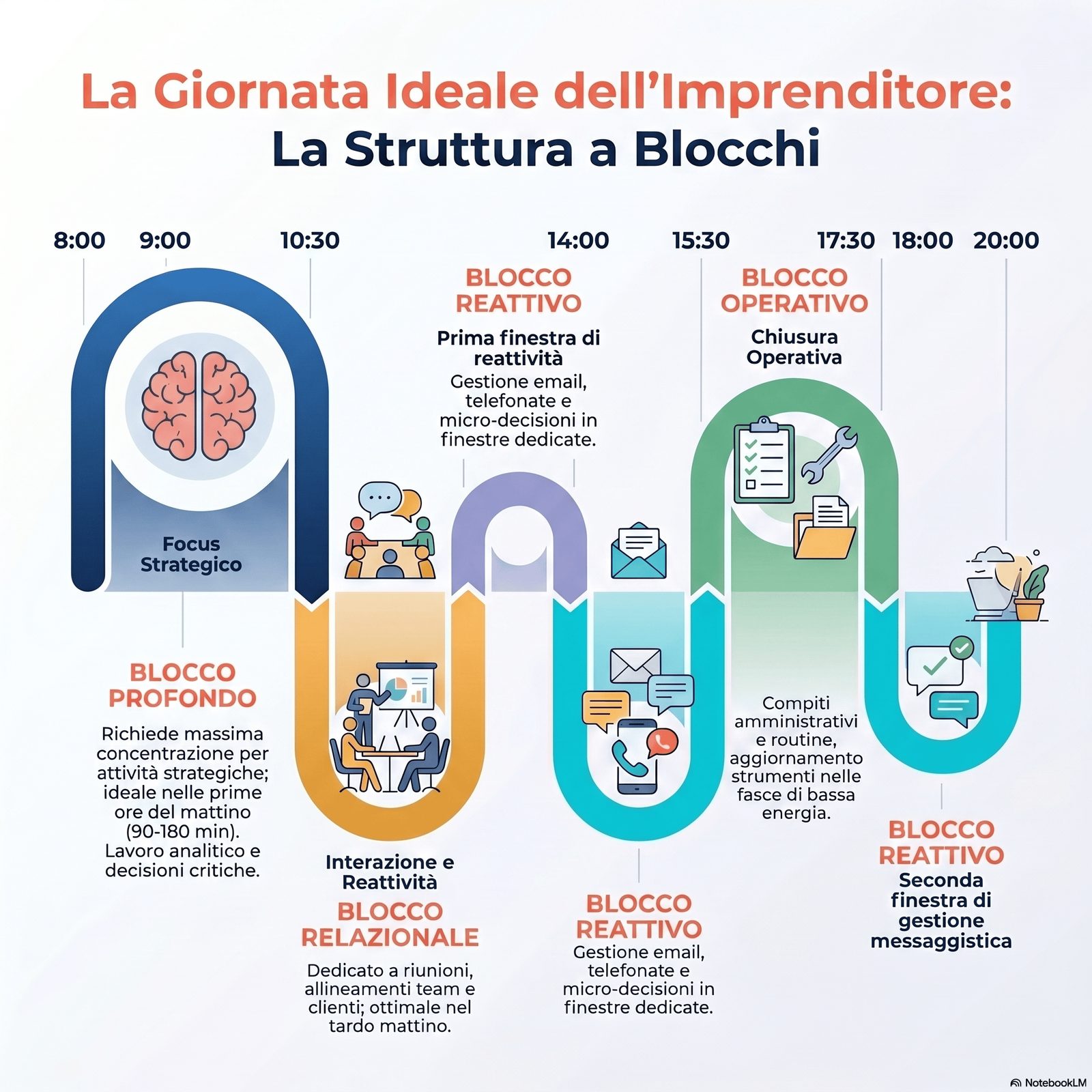
Research on circadian rhythms applied to cognitive performance shows that the human brain does not perform uniformly over the course of the day: deep concentration, strategic decisions, reactive exchanges and operational work have different windows of efficiency [1]. A business owner who places these four types of work in the same hours — or worse, mixed in the same slot — pays the price of attentional fragmentation [3]. The first step in giving the day a structure is recognizing the basic blocks and where they belong.
Deep block. It requires sustained concentration, analytical or strategic thinking, the production of complex content. It belongs in the first hours of the morning, when cognitive performance is generally at its peak for most chronotypes [1]. The effective duration is between 90 and 180 minutes: beyond this limit, the quality of thinking declines regardless of intention. For the operational dimension of uninterrupted work, the reference is Deep work: working in depth. The sign that the block has been badly placed: you enter the deep block after two hours of email and meetings, with your mind already fragmented.
Relational block. It includes meetings, meaningful conversations with the team or clients, decisions made one-on-one or in a group. It sits better in the late morning or early afternoon, after the concentration peak and before the mid-afternoon energy dip. The sign that the block is badly placed: meetings overlap with hours of analytical work, or multiply without a dedicated window.
Reactive block. Email, messages, phone calls, micro-decisions, follow-ups. Research by Kushlev and Dunn shows that concentrating email checking in dedicated windows — instead of spreading it across the whole day — reduces perceived stress and fragmentation [4]. Spreading the reactive block freely across the day does not increase availability: it increases cognitive noise. For strategies to manage the flow of information, the complementary reading is Managing the flow of information. The sign that the block is badly placed: email gets checked during the deep block.
Operational block. Administration, filing, small repetitive tasks, updating tools. It is best placed in low-energy slots — late afternoon — when high-level executive functions are less available but routine activities are not affected. The sign that the block is badly placed: administrative work keeps getting pushed back as "low priority" and piles up until it creates emergencies.
To go deeper into how to build and manage individual time blocks, the operational reference is Time blocking: how to organize your day in blocks.
Choosing the standard structure that fits the company's moment
Which of the four structures is working now, and which one would the company's current moment really need? Most business owners use the wrong structure for the right moment — and wonder why working twice as hard yields half the results.
There is no perfect standard day. There are structures that serve different goals, and the most widespread mistake is looking for the one "definitive" structure that works in every phase. A business owner launching a product lives a different day from one managing a team of sixty people in normal operating mode. Four standard structures cover most of the situations that come up in the life of a company. It should be added that cognitive performance varies not only by time of day but also by individual chronotype [6]: the time slots indicated are a guide and should be adapted to your actual biological rhythm.
Intense-creative structure. For thinking work and sustained production: a product launch, a business plan, a strategic repositioning, writing a foundational document. The deep block takes up the whole morning; the relational block is compressed into the late morning; the reactive block is concentrated in a single afternoon window; the operational block is kept to a minimum.
| Time slot | Type of work |
|---|---|
| 8:00 – 12:00 | Deep block (protected, non-negotiable) |
| 12:00 – 13:30 | Relational block (short meetings, alignments) |
| 14:30 – 15:30 | Reactive block (email, messages, follow-ups) |
| 15:30 – 17:00 | Operational block or a second deep block if energy holds |
Warning sign: if the intense-creative structure ignores the commercial block for more than one consecutive week, the risk is falling out of step with the market and clients.
Balanced structure. This is the "default" structure, the one to return to when there is no dominant priority and the day has to contain all four types of work in similar proportions. A balanced distribution, suited to normal management mode.
| Time slot | Type of work |
|---|---|
| 8:00 – 10:30 | Deep block |
| 10:30 – 12:30 | Relational block |
| 14:00 – 15:30 | Reactive block (two windows: morning and afternoon) |
| 15:30 – 17:30 | Operational block |
Warning sign: if the balanced structure disappears week after week under urgency, it means the priority filtering system is not working.
Commercial structure. For phases of intense business development, client coverage, entering new markets. The center of the day is devoted to meetings and calls; the reactive blocks are larger and spread out to capture incoming requests; the deep block is reduced and concentrated in the first hour of the morning.
| Time slot | Type of work |
|---|---|
| 8:00 – 9:30 | Deep block (reduced but protected) |
| 9:30 – 13:00 | Relational/commercial block |
| 14:00 – 16:00 | Reactive block + afternoon relational block |
| 16:00 – 17:30 | Operational block + sales follow-ups |
Warning sign: if the deep block disappears completely for more than three days, the sales pipeline moves forward but strategic capacity erodes.
Operations structure. For phases of consolidation, handling recurring emergencies, operational oversight of the team. The reactive block is concentrated in two dedicated windows (morning and afternoon) to handle the team's requests without them spreading across the whole day [4]; the deep block is reduced but covers the most complex operational decisions; the relational block is frequent but short.
| Time slot | Type of work |
|---|---|
| 8:00 – 9:00 | Morning reactive block (team, emergencies) |
| 9:00 – 11:00 | Deep block (operational decisions, analysis) |
| 11:00 – 13:00 | Relational block (operational meetings, supervision) |
| 14:00 – 15:00 | Afternoon reactive block |
| 15:00 – 17:00 | Operational block |
Warning sign: if the operations structure permanently replaces the balanced structure for more than a month, the business owner is managing operations instead of leading the organization.
The mistakes that make any structure fail (including copying an American CEO's day)
How many times has a structure been abandoned before it had time to really work? Six weeks is the minimum to judge a structure — almost nobody allows it.
A well-designed structure can fail for two opposite reasons: it is applied too rigidly, or it is not applied enough. Of the two, the first mistake is the more widespread.
1. Copying a famous entrepreneur's "morning routine." The 4:30 alarm, the run, the three hours of "deep work" before seven: these structures are designed for a specific chronotype, in a specific phase of a specific company, often in a cultural and climatic context very different from your own. Studies on cognitive rhythms show that performance varies by time of day and by individual chronotype [6]: forcing someone else's model means working against your biology, not with it. The structure should be designed starting from your own chronotype (morning or evening type), not from someone else's biography.
2. Confusing structure with rigidity. A structure is a recurring frame, not an identical sequence every day. A week that departs from the frame is not a failure: it is a signal to read. A day "broken" by an emergency does not invalidate the structure — it puts it to the test. If a structure never holds, it needs recalibrating; if it holds almost always, it works.
3. Changing structure every two weeks. Research by Lally and colleagues on habit consolidation documents that the median time for a new behavior to become automatic is about 66 days, with wide variability (from 18 to 254 days depending on complexity and context) [2]. Changing structure before it has consolidated prevents you from collecting real data on its effectiveness and feeds the cycle of "fresh starts" that produce no lasting change.
4. Not distinguishing deep blocks from reactive blocks. The "all the same" day — in which email, meetings and analytical work share the same hour — produces the attentional fragmentation documented by Mark and colleagues [3]: every switch from one type of activity to another generates a measurable cognitive cost, and none of the three kinds of work gets done well. Distinguishing between blocks is not an organizational luxury: it is the condition for each type of work to get the quality it deserves.
Limits and conditions of applicability
The standard structures proposed are operational guidelines, not universal protocols. Research on circadian rhythms and cognitive performance offers a robust scientific basis for the principle of standard blocks [1][6], but the exact time slots depend on individual chronotype, industry, team composition and the company's phase.
The structures described here are designed for business owners with a degree of autonomy over their own calendar. In contexts where the day is dominated by external factors — clients, suppliers, imposed deadlines — the room for application narrows. In these cases, it is realistic to apply the structure to only part of the day, not to the entire calendar.
A standard structure does not replace thinking about priorities: it is possible to have a perfectly structured day and fill it with the wrong activities. The structure is the frame; the content requires a separate priority management system.
Frequently asked questions
Do you need to use the same structure every day of the week? No. It is advisable to have a recurring reference structure, but to adapt it to the type of day expected: a day with many external meetings requires a different distribution from a day of independent work. What matters is that the choice is deliberate, not random.
What should you do when an emergency breaks the structure? An emergency breaks the frame, but does not eliminate it. After the emergency, you return to the structure planned for the day. If emergencies systematically break the structure more than two or three times a week, the problem is not the structure — it is the system for filtering requests.
How do you figure out your chronotype? Your chronotype can be estimated with standardized tools (such as Horne and Östberg's Morningness-Eveningness Questionnaire) or by observing empirically at what time of day you perform best on demanding cognitive tasks, when you are rested and without stimulants.
Operational summary
Organizing your day means designing the execution structure — the time blocks and where they sit — and keeping it separate from the planning protocol that fills it. The four basic blocks (deep, relational, reactive, operational) should be placed according to cognitive rhythms, not habit or imitation. The four standard structures (intense-creative, balanced, commercial, operations) correspond to different company phases and are changed according to the prevailing priority, not every two weeks. Mistakes to avoid: copying other people's structures without adapting them to your own chronotype, confusing structure with rigidity, changing before the structure has consolidated, letting reactive and deep work share the same time slots.
Organizing your day is not about choosing "the perfect standard day"; it is about recognizing that there is more than one and that each serves a specific moment of the company. Four structures cover the most recurrent situations — intense-creative, balanced, commercial, operations — and the most frequent mistake is applying the wrong one, or changing it before it has had time to settle.
The structure is the frame. Inside the frame you need a decision-making protocol to fill it: to go deeper into how to plan each day within a structure, see the dedicated article on daily planning. For the overall picture of time management for those who run a business, the reference is the guide to time management for business owners.
A well-structured day does not mean more hours at work: it means better-placed hours. The business owner who protects their deep block in the right windows, who concentrates responsiveness in a few dedicated slots and who adapts the frame to the company's moment works less and produces more. It is the difference between being busy and being effective — and, on a national scale, it is one of the differences that separate Italian productivity from that of more mature systems.
Sources and references
-
Schmidt, C., Collette, F., Cajochen, C., & Peigneux, P. (2007). A time to think: Circadian rhythms in human cognition. Cognitive Neuropsychology, 24(7), 755-789 — https://doi.org/10.1080/02643290701754158
-
Lally, P., van Jaarsveld, C. H., Potts, H. W., & Wardle, J. (2010). How are habits formed: Modelling habit formation in the real world. European Journal of Social Psychology, 40(6), 998-1009 — https://doi.org/10.1002/ejsp.674
-
Mark, G., Iqbal, S. T., Czerwinski, M., & Johns, P. (2016). Email duration, batching and self-interruption: Patterns of email use and their relationship with productivity. CHI '16: Proceedings of the 2016 CHI Conference on Human Factors in Computing Systems, 1717-1728 — https://doi.org/10.1145/2858036.2858262
-
Kushlev, K., & Dunn, E. W. (2015). Checking email less frequently reduces stress. Computers in Human Behavior, 43, 220-228 — https://doi.org/10.1016/j.chb.2014.11.005
-
Eurostat. Average usual weekly hours worked in the main job by professional status, full-time/part-time employment and occupation [lfsa_ewhuis], 2024 data — https://ec.europa.eu/eurostat/databrowser/view/lfsa_ewhuis/default/table
-
Schmidt, C., Collette, F., Reichert, C. F., et al. (2015). Pushing the limits: Chronotype and time of day modulate working memory-dependent cerebral activity. Frontiers in Neurology, 6: 199 — https://doi.org/10.3389/fneur.2015.00199
-
Ericsson, K. A., Krampe, R. T., & Tesch-Römer, C. (1993). The Role of Deliberate Practice in the Acquisition of Expert Performance. Psychological Review, 100(3), 363-406 — https://doi.org/10.1037/0033-295X.100.3.363 (the sustainable durations come from a review of training studies with practice from 1 to 8 hours a day and from the weekly diaries of 30 young violinists at the Hochschule der Künste in West Berlin and a group of pianists; the observation on writers is taken from the same review).