
Is it better to keep a single calendar for personal and work commitments, or two separate calendars that never talk to each other? There is no single answer — it depends on a variable that is often underestimated: the impact each commitment has on your fully focused time.
A "normal" working day contains the meeting with a client, an elderly parent's medical appointment, the call with the accountant, a parent-teacher meeting for your child, the supplier calling back in the afternoon. By evening, the business owner is left feeling they have been running all day without closing anything important. The cause is rarely the number of commitments itself: it is the way they follow and overlap one another. The observational study by Mark, Gonzalez and Harris [1], conducted on 24 knowledge workers at a US IT and accounting services company, documents that after an interruption an average of 25 minutes and 26 seconds passes before people return to the original task — a cost that multiplies when the day is fragmented by commitments of different kinds.
In operational terms, organizing personal and work commitments means mapping into a single calendar all the blocks of time that require your presence or a decision — whether they relate to work or to your private life — and ordering them by the impact each one has on the focused time in your day and week. It is not a rigid separation between office and home, it is not a chaotic merging of lists, and it is not a matter of discipline.
The article describes the principle of impact on focused time, proposes a 4-step protocol you can apply in 20 minutes on Sunday evening and points out the mistakes that make even a well-built calendar ineffective.
Map personal and work commitments without confusing their nature with their impact
The word "calendar" suggests a neutral tool, but the real practice of organizing mixed commitments hides conceptual choices that determine how well it works. Before the method, you need to define precisely what you are talking about: what a personal commitment is, what a work commitment is, and where they blur. The definition guides the rest of the article: without a clear distinction, every protocol collapses at the first calendar conflict.
How many "personal" commitments end up absorbing more work time than you estimated at the start of the week? For self-employed workers in Italy — 5,085,000 on average in 2024, according to the ISTAT Labour Force Survey [3] — the overlap between personal and work commitments is structural, not occasional.
Three distinctions that readers tend to confuse are worth clarifying:
- Personal commitment vs. private commitment: a personal commitment is any commitment that requires the presence or decision of a specific individual — it can also be a work commitment (a sales visit only the business owner can make). A private commitment concerns the intimate and family sphere (a medical appointment, your child's school, a family event). All private commitments are personal, but not the other way around.
- Professional commitment vs. work commitment: a professional commitment is any commitment tied to your role and work responsibilities, even if it happens outside standard hours (reading a contract in the evening, a meeting on Saturday). A work commitment in the strict sense is one that takes place during conventional working hours. Confusing the two categories leads you to underestimate the professional time you actually spend.
- Personal life vs. private life: personal life covers everything concerning the individual as a person (learning, sport, health, hobbies). Private life is the intimate and relational sphere (family, relationships, home). The two sets partly overlap.
The operational definition that guides the method: a commitment belongs in the integrated calendar when it requires the presence or a decision of the business owner — regardless of whether it is personal or professional. The organizing criterion is not the nature of the commitment, but its impact on the focused time available in the day.
Order commitments by their impact on focused time
Most calendars segregate commitments by category — "personal" on one side, "work" on the other — and end up not solving the real problem: the fragmentation of fully focused time. The CHI 2005 observational study by Mark, Gonzalez and Harris [1] measured that after each interruption an average of 25 minutes and 26 seconds passes before people return to the task, with a modest difference between external interruptions (22 minutes and 37 seconds) and internal ones (29 minutes and 1 second). A short parent-teacher meeting in the middle of a morning of financial analysis can cost more than three back-to-back work meetings at the end of the day. The operating principle that follows is grouping: you put commitments that require the same kind of attention into the same block, regardless of whether they are personal or professional.
Do three commitments of different kinds in the same morning cost more or less than three commitments of the same kind packed into two hours? The difference measured in research on the cost of interruptions [1] exceeds an hour of gross time, before even considering the effects on perceived stress.
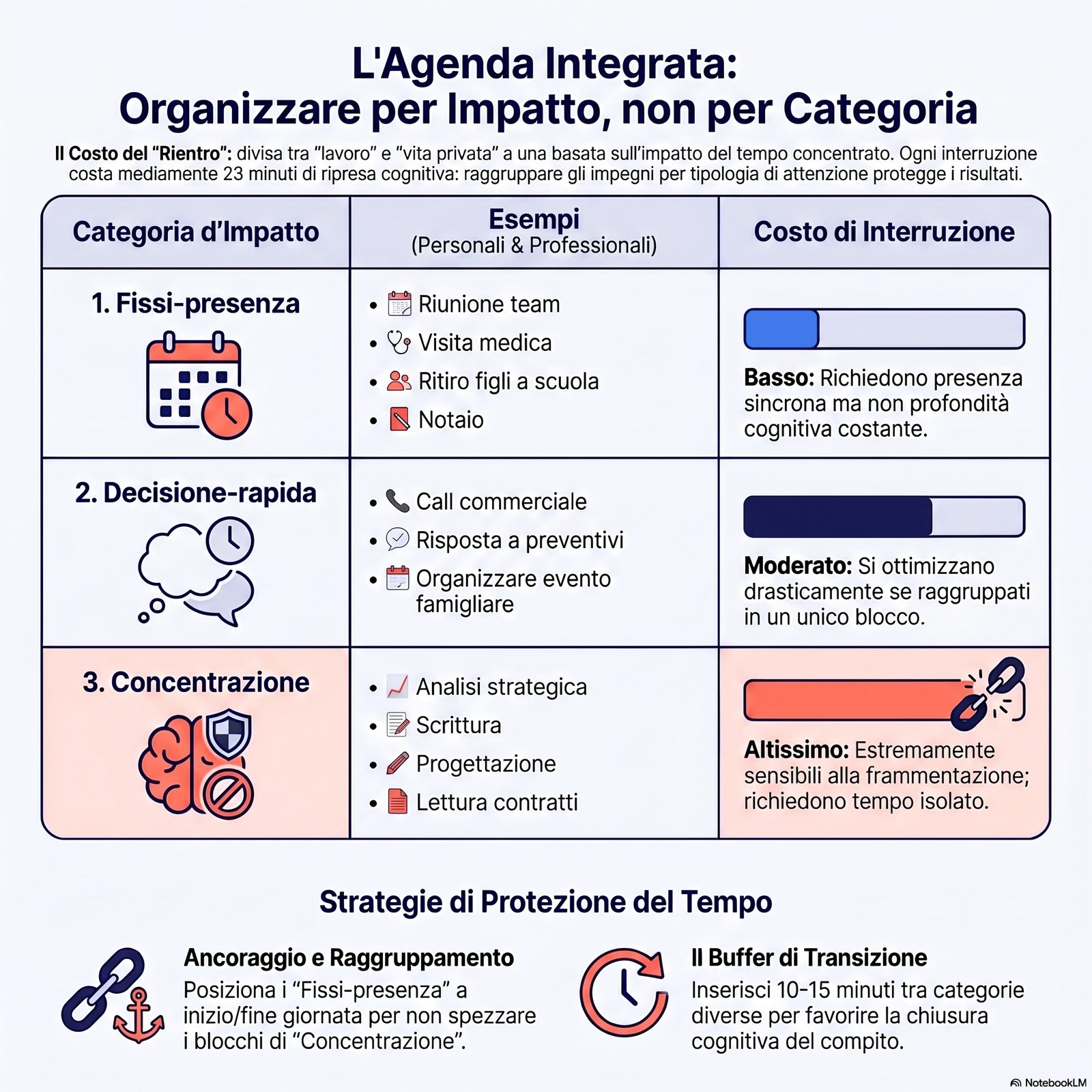
Commitments fall into three categories based on their impact on focused time:
Category 1 — Fixed presence. Commitments that require physical or synchronous presence at a set time, but not deep concentration: operational meetings, appointments, short medical visits, deliveries, travel. They cost little if planned in advance, because adding them to the calendar doesn't take concentration away from the other blocks. Mixed examples: team meeting (professional), picking up your child from school (private), signing a contract at the notary's office (professional).
Category 2 — Quick decision. Commitments that require attention and judgment but not sustained concentration: emails that need a considered reply, sales calls, reviewing proposals, operational assessments. They cost a moderate amount when scattered across the day; they are optimized when grouped. Mixed examples: call with the accountant (professional), replying to a quote you received (professional), organizing a family event (private).
Category 3 — Focus. Commitments that require continuous, uninterrupted blocks of time: strategic analysis, writing, design, reading complex contracts, high-impact decisions. These commitments are the most sensitive to fragmentation — every interruption generates the cost documented by Mark et al. [1]. Newport (2016) [5] — cited here as a popular reference, not as an independent scientific source — took up and popularized this evidence in the idea of "single-context time."
The share of time in "mandatory presence" (meetings, client work, synchronous activities) is not tracked by any official statistic, but it is often the part of the day that leaves no room for focus. Organizing commitments by impact, rather than by nature, is the way to protect the share of focused time that actually moves results.
The 4-step protocol to build an integrated calendar in 20 minutes
On Sunday evening, faced with the week's commitments, the business owner has two options: drop them into whatever gaps are available in the calendar at a glance, or build it by following a protocol that protects focused time. The 4-step protocol takes about 20 minutes the first time and less than 15 once it becomes routine. The result is a calendar in which the "personal" day and the "work" day are visible together, but don't get in each other's way.
How many minutes a week go into deliberately planning your commitments — and how many into frantically searching for a free slot? The typical ratio is heavily skewed against planning: every minute saved at the start tends to cost time during the week.
The 4 steps:
Step 1 — Mapping. List all the commitments for the coming week, personal and professional, without filtering first. The goal is to have full visibility before making any placement decision. Tool: a sheet of paper, a digital notepad, the back of a planner — any surface that lets you see everything together.
Step 2 — Classification by impact. For each commitment on the list, assign the category: fixed presence, quick decision, focus. This classification is the core of the protocol — and it replaces the "personal vs. professional" distinction as the ordering criterion. For a freelancer with many appointments, most commitments will be fixed presence; for a business owner in a strategic phase, focus requires significant protected blocks.
Step 3 — Anchoring fixed-presence commitments. Fixed-presence commitments that can't be moved (confirmed appointments, hard deadlines, commitments that depend on other people) go into the calendar first. They define the boundaries within which you plan everything else. Ideally, anchor them at the start or end of the day, or in time slots that don't "break up" potential focus blocks.
Step 4 — Grouping into blocks of the same kind. The remaining commitments are grouped by category: all the remaining fixed-presence commitments in adjacent slots, all quick decisions in one block, focus blocks in high-energy time slots (typically the morning). Between each transition from one category to another, plan a 10-15 minute buffer — the time needed to cognitively close one type of activity before moving to the next.
This protocol fits naturally with your weekly planning session — Sunday evening is the natural time both for the weekly review and for building the integrated calendar. Translating the weekly plan day by day belongs to daily planning, which completes step 4 at a daily level of detail.
European labor force data [4] show that in 2024 self-employed workers in Italy reported an average of 41.0 usual weekly hours in their main job, compared with 37.1 for employees — longer hours that already make the clear line between "work time" and "personal time" porous in reality. Integrated planning doesn't create this porousness: it acknowledges it and manages it.
Decide when to separate and when to integrate commitments
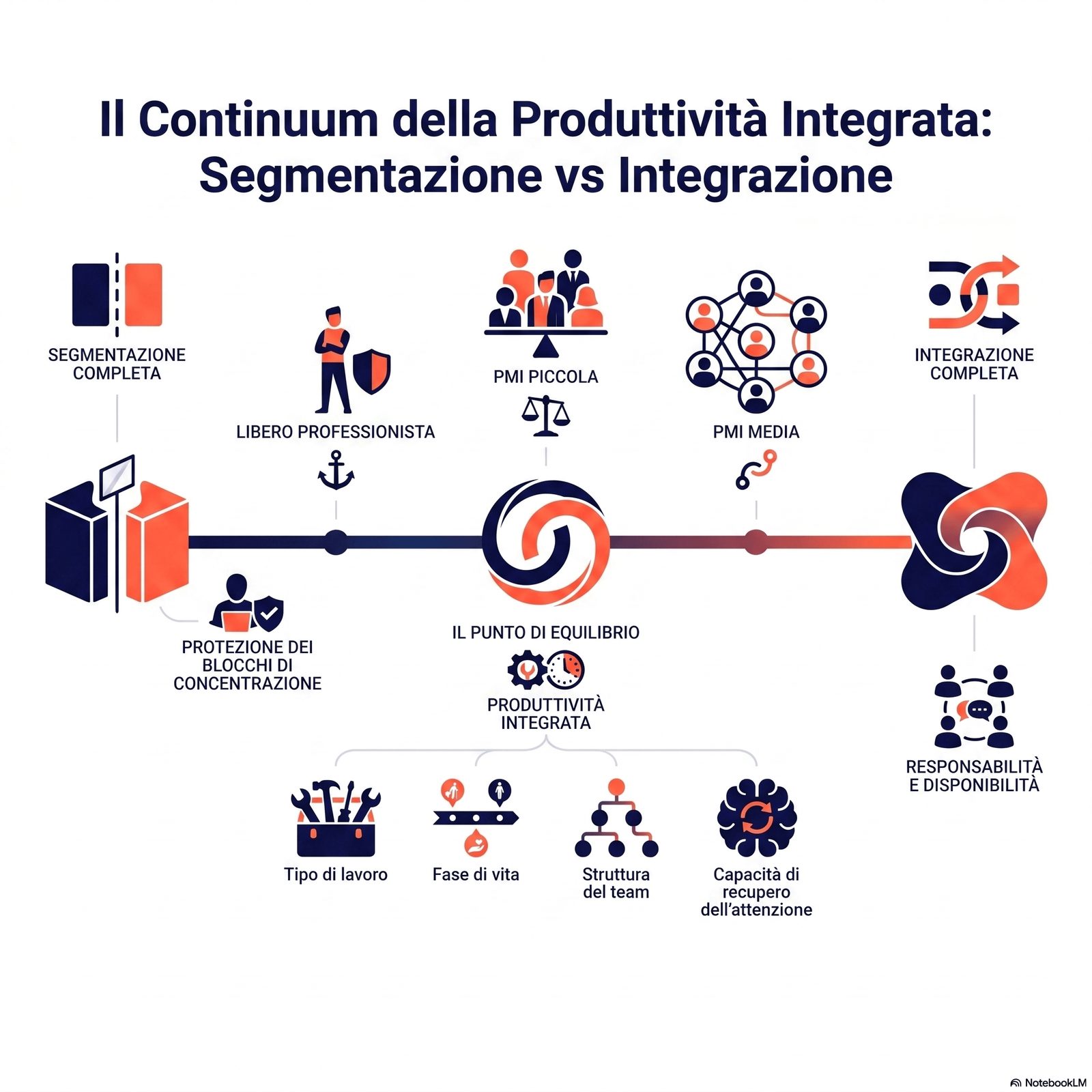
There is a sterile debate between those who argue that personal and professional life should be kept separate and those who argue they should be merged. Peer-reviewed research says that neither option is better in absolute terms: the point is to choose consciously where to stand on the continuum. The boundary theory of Ashforth, Kreiner and Fugate [2] describes an axis running from complete segmentation — sharp separation, costly transitions but less spillover between spheres — to complete integration — overlap, smooth transitions but more spillover. Each position has costs and benefits that depend on the type of work, the stage of life and the structure of the team.
Should a business owner with 80 employees and one with 10 team members stand at the same point on the continuum? Rarely — and standing at the wrong point for your context is one of the silent causes of personal inefficiency.
The choice between segmentation and integration depends on four variables:
Variable 1 — Type of work. Work that requires deep concentration benefits from segmentation: focus blocks are better protected when the boundaries between spheres are rigid. Relationship-based work (sales, management, training) tolerates integration better.
Variable 2 — Stage of life. Periods with intense family commitments (young children, elderly parents, recurring family events) make rigid segmentation costly and often impractical. In these periods, conscious integration — with explicit criteria about what spills into what — is more sustainable.
Variable 3 — Team structure. A founder without a team can afford sharper segmentation. A business owner with a team that requires their availability has a degree of integration structurally imposed by the responsibilities of the role.
Variable 4 — Ability to recover attention. Not everyone recovers from fragmentation at the same speed. Those who find it particularly costly to get back on track after an interruption (see Mark et al. [1]) benefit from stronger segmentation, even if it is organizationally complex.
The concept of integrated productivity — meaning an explicit, conscious choice of a point on the continuum, neither total fusion nor rigid separation — describes the position that optimizes both professional results and presence in your personal life. It is not a synonym for "work-life balance": it is a decision about how to design your time, based on the four variables described.
The difficulty of reconciling professional and personal commitments is not measured by any official statistic, but it shows up repeatedly among the self-employed: an unconscious choice of your point on the continuum produces costs that pile up without ever being accounted for.
The mistakes that make even the best-built calendar ineffective
The 4-step protocol only works if it isn't sabotaged by ingrained habits. Most calendars that are well built on Monday morning fall apart by Wednesday evening, often for recurring reasons. Recognizing the mistakes before they show up is the difference between a method that lasts a week and one that takes hold.
Why does a calendar carefully built on Sunday evening often fragment by Wednesday? In most cases the cause is not a genuine emergency, but one of the habits described below.
Mistake 1 — Mixing commitments of different kinds in the same block "for lack of time." Signal: calendar blocks contain mixed activities (focus + quick decisions + fixed presence) in the same slot. Fix: apply the impact principle — each block contains commitments of the same category, even if this means moving something to a later day.
Mistake 2 — Keeping personal commitments out of the work calendar "so as not to clutter it." Signal: double booking — the business owner accepts a 3 p.m. meeting without remembering their mother's medical appointment. Fix: a visible integrated calendar is the only way to avoid conflicts. Personal commitments that require presence or a decision belong in the calendar just as much as professional ones.
Mistake 3 — Anchoring fixed-presence commitments in the middle of focus blocks. Signal: a 30-minute medical appointment at 11 a.m. "destroys" two focus blocks (the one before and the one after), for a total of lost hours out of proportion to the actual length of the commitment. Cause: the cost of getting back on task documented by Mark et al. [1] multiplies when the fixed-presence commitment sits in the middle of a productive slot. Fix: anchor fixed-presence commitments at the start or end of the day, or at natural transitions between blocks.
Mistake 4 — Not planning transition buffers between blocks. Signal: delays cascade — running late on one commitment pushes back all the following ones. Cause: cognitive transitions between different categories take time (closing one task, preparing the next, moving physically or mentally). Fix: add a 10-15 minute buffer after each transition between different categories.
Mistake 5 — Not reviewing the calendar midweek. Signal: Sunday's plan doesn't survive Wednesday because the unexpected events that piled up in the first three days aren't reallocated. Fix: schedule a 5-10 minute micro-review on Wednesday morning — not to redo the plan, but to check whether the remaining commitments still follow the logic of blocks by impact. For handling individual commitments that come up along the way, the cluster on managing commitments offers specific criteria. The full picture of time management is available in the pillar on time management for business owners.
Limits and conditions of applicability
The method described is based on empirical evidence and a validated theoretical framework. Some conditions limit how directly it can be applied:
- Boundary theory [2]: the research by Ashforth, Kreiner and Fugate was conducted in North American organizational settings. The segmentation-integration continuum is a descriptive framework, not a prescription: it does not imply that any point on the continuum is better than the others in absolute terms.
- Mark et al. [1]: the figure of 25 minutes and 26 seconds is an average across 24 knowledge workers observed in a single US company, with a standard deviation above 54 minutes. It measures the time that passes before returning to the task, not the time needed to recover the same level of concentration — the figure should be used as an order-of-magnitude indicator, not as a precise universal measure.
- Newport [5]: cited as a popular reference, not as an independent scientific source. The empirical claims are anchored to Mark et al. [1] and to the literature on attention residue, not to Newport.
- ISTAT [3] and Eurostat [4] data: context data on the number of self-employed workers in Italy and their usual weekly hours. Used as evidence of the structural relevance of the problem, not as evidence of the effectiveness of the method described. Neither ISTAT nor Eurostat tracks how the working day is split between mandatory-presence activities and focused work: that classification remains an operational criterion proposed by the article.
- Individual variability: classifying commitments into three categories (fixed presence, quick decision, focus) is an operational approximation. Some commitments sit ambiguously between categories — the classification requires personal calibration over time.
Frequently asked questions
Is it always better to have a single calendar for personal and work commitments? Not necessarily. An integrated calendar pays off when the mix of different kinds of commitments is structural in your day — as it is for most business owners and freelancers. If you can keep a clear separation between days devoted to work and days devoted to your personal life, you can manage two separate calendars as long as you look at them together when you plan the week.
How do you handle urgent personal commitments that come up during the week? Urgent personal emergencies (family emergencies, health problems, unplanned events) belong to the buffer built into the protocol. If the buffer is already used up, they require a micro-review of the calendar to reallocate the commitments that were moved. The general rule is: an urgent unexpected event justifies moving lower-impact commitments, not canceling focus blocks, if possible.
Does the 4-step protocol also work if you have a team that handles part of the planning? Yes, with one adjustment: step 3 (anchoring fixed-presence commitments) also includes coordination commitments with the team. Step 4 (grouping) separates the blocks you manage on your own from those that require interaction with team members. The result is an integrated calendar that protects the business owner's focused time even with an active team.
How do you tell "integrated productivity" apart from "always on"? Integrated productivity — as a conscious choice of a point on the segmentation-integration continuum [2] — includes explicit boundaries: stated availability windows, criteria for when personal commitments enter the work calendar and vice versa, access rules for the team. "Always on" is the absence of any boundary — the extreme of total integration, with the related costs of spillover and stress.
Operational summary
Organizing personal and work commitments is not solved with two separate calendars, nor by indiscriminately merging their contents. The operating principle is classification by impact on focused time (fixed presence, quick decision, focus) rather than by the nature of the commitment.
The 4-step protocol — mapping, classification, anchoring, grouping — takes 20 minutes on Sunday evening and produces a calendar in which personal and work commitments coexist without getting in each other's way, because they are ordered by the kind of attention they require.
Choosing your point on the segmentation-integration continuum [2] — based on the type of work, your stage of life, your team structure and your ability to recover attention — is the frame within which the protocol operates.
Conclusion
Organizing personal and work commitments is not solved with two separate calendars, nor with the discipline of keeping "work at work and life at home." It is solved by recognizing that the real ordering criterion is not the nature of the commitment — personal or professional — but the impact it has on the focused time in your day. The 4-step protocol — mapping, classification, anchoring, grouping — is the operational translation of this principle. The most frequent mistakes, from mixed blocks to missing buffers, all share the same root: treating the calendar as a neutral container instead of a tool for leveraging attention.
If you want to go deeper into the weekly frame within which to build this integrated calendar, the guide to weekly planning describes the ritual for closing and opening the week; for the single day, daily planning collects the micro-protocols you can apply in the morning and at the end of the day.
A calendar truly built around its impact on focused time frees up, in an average week, a share of productive work that today is absorbed by fragmentation — time that becomes available again for the decisions that grow the business and for the moments that matter in your personal life. This is where integrated productivity stops being a formula and becomes a measurable result.
Sources and references
[1] Mark, G., Gonzalez, V. M., & Harris, J. (2005). No task left behind? Examining the nature of fragmented work. Proceedings of the SIGCHI Conference on Human Factors in Computing Systems (CHI '05), 321-330. Association for Computing Machinery — https://doi.org/10.1145/1054972.1055017
[2] Ashforth, B. E., Kreiner, G. E., & Fugate, M. (2000). All in a day's work: Boundaries and micro role transitions. Academy of Management Review, 25(3), 472-491.
[3] ISTAT. Annuario statistico italiano 2025 — Capitolo 8: Mercato del lavoro (Labour Force Survey, 2024 average: 5,085,000 self-employed workers). https://www.istat.it/storage/ASI/2025/capitoli/C08.pdf
[4] Eurostat. Average usual weekly hours worked in the main job by professional status, full-time/part-time employment and economic activity — Labour Force Survey, dataset lfsa_ewhun2. 2024 data, Italy, aged 15 and over: employees 37.1 hours, self-employed 41.0 hours. https://ec.europa.eu/eurostat/databrowser/view/lfsa_ewhun2/default/table?lang=en
[5] Newport, C. (2016). Deep Work: Rules for Focused Success in a Distracted World. Grand Central Publishing. [Secondary popular source — declared]