
Every working day in a company is crossed by dozens of interruptions. A notification, a question from the hallway, an urgent email, a colleague asking for a quick confirmation. The most cited observational study on the topic — conducted on 24 knowledge workers at a US IT and accounting services company — found that 77.2% of interrupted work was resumed on the same day, and that resumption came on average after 25 minutes and 26 seconds, with an average of 2.26 other activities carried out in the meantime [1].
Managing interruptions means the set of decisions and practices that let you distinguish between the demands that deserve an immediate response and those that can be deferred, filtered or made asynchronous, in order to preserve continuous blocks of cognitive attention.
This article does not offer binary solutions such as "just turn off notifications." That kind of advice works for a few hours, then gives way under operational reality. Instead, it offers four elements: a starting distinction, a taxonomy by impact and source, four matching strategies and a review of the most common mistakes.
Three terms not to confuse
Before getting into the substance, it helps to separate three concepts often used as synonyms:
An interruption has an external origin — a colleague, a notification, an incoming email. A distraction has an internal origin — a thought that takes you elsewhere, the curiosity that pushes you to open a browser tab. They are managed with different strategies: an interruption requires a filter on the outside world, a distraction requires work on the cognitive environment.
A notification is the technical vehicle of the interruption, not the interruption itself. A silenced notification does not generate an interruption; a perceived notification does. Confusing the two levels leads to superficial solutions ("I'll turn off notifications") that leave the problem intact — the underlying request arrives anyway, in another form.
A request is a legitimate, expected demand (a client who needs an answer within the day). An interruption is a request that arrives at the wrong moment. The same message can be a request or an interruption depending on when it is processed.
Classifying the 3 types of interruption that really weigh on your day
How many of the interruptions that hit a working day are really external, and how many are self-inflicted? Research by Mark and colleagues shows that 52% of interruptions have an internal origin, against 48% with an external origin [1] — which radically changes the kind of intervention that helps.
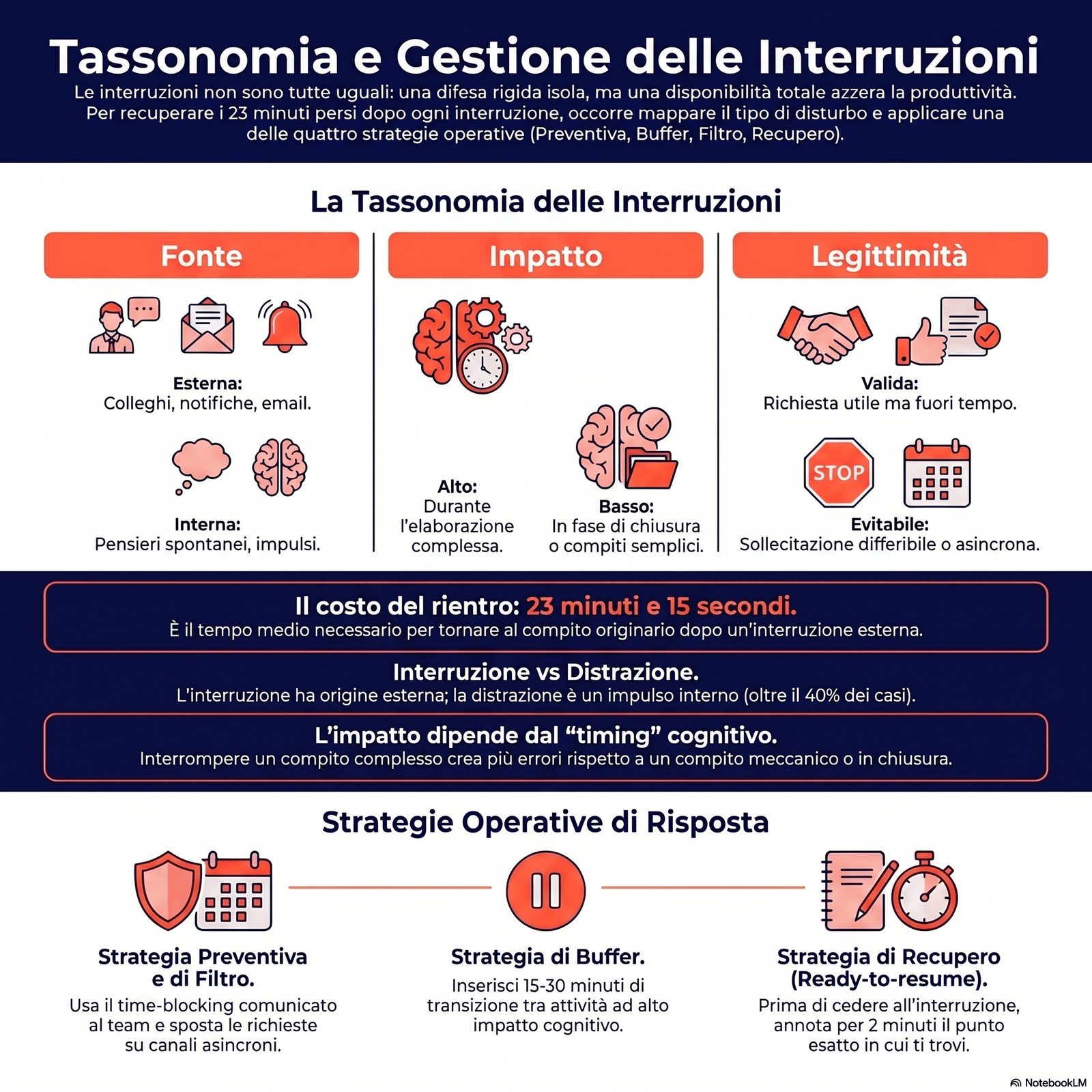
The study by Gloria Mark and colleagues on knowledge work shows a counterintuitive finding: returning to the original task, when it happens on the same day, comes on average after 25 minutes and 26 seconds, with an average of 2.26 other activities carried out in the meantime [1]. Not all interruptions weigh the same, however. Learning to distinguish the three main families — by source, by cognitive impact, by legitimacy — is the first step toward intervening where it matters.
Interruptions can be classified along three operational dimensions:
By source. External interruptions come from colleagues, clients, technology notifications and incoming communications. Internal interruptions — often underestimated — come from spontaneous thoughts, curiosity, the urge to check email or news. The distinction is crucial because effective strategies differ: external interruptions require a filtering system; internal ones require work on the cognitive environment and on attention habits. ISTAT data on the spread of digital communication tools in Italian companies show how much the entry channels have multiplied: in 2024, 47.3% of Italian companies with 10-249 employees used tools for remote meetings and 76.5% allowed remote access to email, documents and business applications, compared with 96.3% and 97.7% of companies with at least 250 employees [6].
By cognitive impact. The effect of an interruption is not constant: it depends on the cognitive phase in which it occurs. Research by Bailey and Konstan documents that interruptions during the processing of complex tasks — when cognitive load is high — produce errors, increased stress and longer recovery times compared with interruptions during a wrap-up phase or during mechanical tasks [3]. The 2016 Mark study adds that, in knowledge work, context switching occurs on average every 40-50 seconds and correlates with a worsening of perceived mood [2].
By legitimacy. Some interruptions correspond to valid requests that arrived at the wrong moment; others are demands that could be eliminated, deferred or made asynchronous without any loss of value. The distinction between the two does not depend on the stated urgency (often overestimated) but on the real need for a synchronous response at that moment.
The taxonomy is not meant to judge the interruption or whoever causes it: it is meant to choose the appropriate response strategy. The same request from a team member may require an immediate response in one case and a deferred response in another — the criterion is the cognitive moment, not the sender. For the broader frame of an effective work method, the reference is Effective work method.
Applying 4 strategies to manage interruptions by type
Which strategy should you apply first when the day is already compromised by dozens of interruptions? The counterintuitive answer: not the preventive one, but the recovery one — because it is the only one that acts on damage already done.
Each family of interruptions has its own strategy. It is not about choosing the "best" one but about applying the one that fits the type. The four strategies — preventive, buffer, filter, recovery — cover the most frequent situations in knowledge work.
Preventive strategy. It applies before the interruption happens, and it acts on avoidable interruptions. The operating principle is to make your unavailability visible and predictable: time blocks communicated to the team (e.g., "from 9 to 11 I don't answer messages and I'm not reachable"), "open office" windows for accumulated requests, time blocking of deep cognitive tasks on the shared calendar. For the detailed protocol on building time blocks, the reference is Time blocking: how to organize your day in blocks. When it applies: before the start of the focused work session. Mistake it prevents: requests that arrive predictably during the block, which can be reduced with an explicit rule.
Buffer strategy. It applies to protect high-impact cognitive phases by inserting a transition between different activities. It rests on the evidence from Bailey and Konstan [3]: an interruption costs more during processing and less during a wrap-up or transition phase. In practice, it means inserting 15-30 minutes of buffer between meetings and blocks of analytical work, and ending each session with a brief note of where you had got to — to lower the cost of getting back in. For the dimension of deep cognitive work, the reference is Deep work: working in depth. When it applies: when planning the day, before it even starts. Mistake it prevents: cognitive sessions that have reached an advanced processing state being interrupted by back-to-back meetings with no margin.
Filter strategy. It turns a synchronous interruption into an asynchronous request, reducing the number of demands that require an immediate response. In practice: redefine channels by type of urgency (phone for real emergencies, email for requests with a response within 24 hours, company chat for non-urgent requests answered in the afternoon window), and align the team on the expected response times for each channel. Research by Czerwinski and colleagues documents that systems that separate channels by perceived urgency reduce unnecessary synchronous interruptions [5]. For structured management of information channels, the reference is Managing the flow of information. When it applies: as a system rule, communicated to the team and reviewed every 3-6 months. Mistake it prevents: all requests arriving on the same channel with the same stated urgency, forcing you to assess priority every time.
Recovery strategy. It applies when the interruption has already happened, to reduce attention residue — the phenomenon documented by Leroy whereby part of your attention stays hooked on the previous task even after switching to the request [4]. The practice, called a "ready-to-resume annotation" in Leroy's study, consists of spending 2-3 minutes, before responding to the interruption, noting where you had got to and the next planned step in the suspended task. This small act reduces cognitive residue and shortens the time it takes to get back in. When it applies: immediately after an interruption has happened, before responding. Mistake it prevents: returning to the original task after 20+ minutes without knowing exactly where you were.
Integrating the 4 strategies into the work week
How much focused time can a business owner who runs a team really afford? Ericsson and colleagues, reviewing training studies with practice durations between one and eight hours a day, report that beyond four hours a day the additional benefit disappears, and that it already diminishes beyond two [7]. This ceiling was measured on musicians in training and on learning tasks, not on people running a business: it indicates how much deliberately effortful work is sustainable each day, not how much of the calendar should be filled.
The four strategies work if they become a weekly architecture, not a series of one-off interventions. The individual technique matters less; the consistency with which it is applied matters more. It is better to start from the week — not from the single day — because focused work requires predictability for the people working around you.
A typical weekly architecture for someone who manages their own calendar might look like this:
- 2-4 weekly blocks of focused work (90-120 minutes each), communicated on the shared calendar as non-negotiable.
- 2 daily availability windows for accumulated requests (e.g., 9:00-9:30 and 3:00-3:30 p.m.), in which you can answer messages, emails and requests from the team.
- 1 fixed weekly synchronous slot for requests that need direct discussion — a short meeting (20-30 minutes) that consolidates accumulated questions and reduces interruptions spread across the week.
The structure is indicative: it should be adapted to the context. For those who work alone with clients, the blocks coincide with production time; the availability windows correspond to client response slots. For those leading a team of 7-15 people, communicating the blocks to the team is the condition for the architecture to work: a private rule cannot be respected by people who do not know it. For those managing more complex structures, synchronizing blocks across interdependent roles reduces conflicts between availability and concentration.
The ISTAT data on the spread of digital channels in Italian companies — where email is now joined, in shares that grow with company size, by remote meetings and document sharing [6] — confirm that an explicit architecture is not optional: it is the necessary response to a work environment that, without rules, tends to spread requests evenly across the whole day, with no distinction of cognitive moment.
The hardest part is not technical: it lies in making your availability architecture visible and predictable, and in communicating it not as a personal preference but as an operating condition of the organization. Meetings that consolidate accumulated requests should be framed within the broader system of company communication: the reference for this aspect is Effective business meetings.
Common mistakes in managing interruptions
Why do interruption management strategies last two weeks on average before being abandoned? Almost never because of personal weakness: more often because they are not type-based — they apply the same response to different interruptions, and lose effectiveness.
Managing interruptions fails more often because of mistakes in application than mistakes in method. Knowing the relapse patterns is part of the skill, not an add-on.
Mistake 1 — Eliminating instead of classifying. The most common response to interruptions is reductive: "I'll turn off notifications," "I'll close the door," "I won't answer in the morning." Without a taxonomy by source, impact and legitimacy, you end up applying the same response to all interruptions — losing the valid ones and failing to eliminate the avoidable ones. A system that totally eliminates external interruptions can work for a few hours, but it disconnects the professional or business owner from the flow of legitimate requests, generating a queue of urgent matters that builds up and blows out of control. Operational fix: classify by type before choosing the response.
Mistake 2 — Defending the block, ignoring recovery. Attention focuses on the preventive strategy — protecting blocks — overlooking the fact that interruptions happen anyway, and that attention residue [4] remains the main damage when it is not managed. A block that is defended but interrupted does damage similar to an undefended block if the recovery strategy is not applied. Operational fix: make the "ready-to-resume annotation" an automatic practice every time an interruption occurs, regardless of the preventive strategy in place.
Mistake 3 — Not communicating the rule to the team. Preventive strategies — time blocks, availability windows, channel rules — fail if the team does not know they exist. A private rule is, by definition, a rule the team cannot respect: not because they do not want to, but because they do not know it. Operational fix: explicitly communicate your availability architecture to the team at the start of each week, and explain it in terms of collective benefit (fewer mutual interruptions, better decisions) rather than individual preference.
Limits and conditions of applicability
The strategies described are most effective in contexts where the business owner or professional has a reasonable degree of autonomy over how their day is organized. In roles highly dependent on external stimuli — customer service, crisis management, roles that require continuous operational coverage — the room for application narrows significantly.
The research cited [1][2][3][4][5] mainly concerns knowledge work in English-speaking settings: transferability to self-employed work and to smaller companies is plausible but not directly documented with the same precision. The resumption-time data (25 minutes and 26 seconds [1]) are averages with strong individual variability — the standard deviation exceeds 54 minutes — and they measure the time that passes before returning to the task, not the time needed to regain the same level of concentration. The widely circulated figure of "23 minutes and 15 seconds," usually attributed to the same authors, appears neither in [1] nor in [8]: the two published measures are 25 minutes and 26 seconds for overall resumption and 21 minutes and 28 seconds for self-initiated resumptions [1].
The weekly architectures proposed are operational guidelines, not universal protocols: they need to be adapted to the specific context (industry, team size, prevailing type of work) and require a calibration period of a few weeks before their effectiveness can be assessed.
Frequently asked questions
Are internal interruptions (distractions) managed with the same strategies? No. Internal distractions require different work: reducing opportunities for distraction in the environment (browser, notifications, visual stimuli), and practices of voluntary attention. The strategies described in this article — preventive, buffer, filter, recovery — are calibrated mainly on external interruptions.
How do you communicate your availability architecture to the team without seeming inaccessible? The key is to present it as an organizational rule, not a personal preference. Specifying availability windows assures the team that requests will be handled; defining channels by urgency shows how to reach the manager when there is a real need. Accessibility is measured not by continuity but by predictability.
What is the minimum size of a focused work block to get a measurable cognitive benefit? The literature does not indicate a universal threshold. As an operational guideline, blocks shorter than 45-60 minutes make it hard to reach states of deep processing; blocks longer than 90-120 minutes without breaks tend to produce a drop in cognitive quality. The effective window is individual and depends on the type of task.
Operational summary
Interruptions are classified by source (external/internal), cognitive impact (high during processing, low during wrap-up) and legitimacy (a valid request at the wrong time / an avoidable demand). Each category has a matching strategy: preventive (communicated blocks, availability windows), buffer (transitions between high-impact activities), filter (synchronous request → asynchronous via a dedicated channel), recovery (noting the point of suspension before responding). The strategies become effective when they are integrated into a weekly architecture communicated to the team. The most frequent mistakes: eliminating without classifying, neglecting recovery, not communicating the rule.
Managing interruptions is not based on eliminating them, but on classifying them. Distinguishing by source, by cognitive impact and by legitimacy lets you choose — case by case — the right strategy: preventive when the interruption is avoidable, buffer when the cognitive phase is high-impact, filter when the request can become asynchronous, recovery when the interruption has already happened. It is a change of stance: from the illusion of total control to a realistic architecture of focused time.
The four strategies become effective when they are integrated into a coherent week and communicated to the team, not when they remain private rules. The hardest part is not technical — it lies in making your availability architecture visible and predictable, because only then can others respect it.
To explore the link with deep cognitive work, the reference readings are Deep work: working in depth and Time blocking: how to organize your day in blocks. The connection with governing company channels is covered in Managing the flow of information.
A business owner who manages interruptions by type recovers focused cognitive time that would otherwise be lost in slow, partial recoveries. This is not a spectacular benefit in the short term — but applied systematically, it reshapes the quality of the decisions made, the depth of the intellectual work produced and, as a result, the structure of the results achieved. The difference between a reactive organization and a focused organization is measured, in the end, in protected minutes.
Sources and references
-
Mark, G., Gonzalez, V. M., & Harris, J. (2005). No Task Left Behind? Examining the Nature of Fragmented Work. Proceedings of the SIGCHI Conference on Human Factors in Computing Systems (CHI 2005), 321-330 — https://doi.org/10.1145/1054972.1055017
-
Mark, G., Iqbal, S. T., Czerwinski, M., Johns, P., & Sano, A. (2016). Neurotics Can't Focus: An In Situ Study of Online Multitasking in the Workplace. Proceedings of the 2016 CHI Conference on Human Factors in Computing Systems, 1739-1744.
-
Bailey, B. P., & Konstan, J. A. (2006). On the need for attention-aware systems: Measuring effects of interruption on task performance, error rate, and affective state. Computers in Human Behavior, 22(4), 685-708.
-
Leroy, S. (2009). Why is it so hard to do my work? The challenge of attention residue when switching between work tasks. Organizational Behavior and Human Decision Processes, 109(2), 168-181.
-
Czerwinski, M., Horvitz, E., & Wilhite, S. (2004). A diary study of task switching and interruptions. Proceedings of the SIGCHI Conference on Human Factors in Computing Systems (CHI 2004), 175-182.
-
ISTAT (2025). Imprese e Ict — Anno 2024. Press release, January 17, 2025. Rome: Istituto Nazionale di Statistica (Italian National Institute of Statistics) — https://www.istat.it/comunicato-stampa/imprese-e-ict-anno-2024/
-
Ericsson, K. A., Krampe, R. T., & Tesch-Römer, C. (1993). The Role of Deliberate Practice in the Acquisition of Expert Performance. Psychological Review, 100(3), 363-406 — https://doi.org/10.1037/0033-295X.100.3.363 (the four-hours-a-day threshold comes from a review of training studies with durations between 1 and 8 hours a day; the direct studies concern 30 young violinists at the Hochschule der Künste in West Berlin and a group of expert and amateur pianists, assessed with a one-week diary).
-
Mark, G., Gudith, D., & Klocke, U. (2008). The Cost of Interrupted Work: More Speed and Stress. Proceedings of the SIGCHI Conference on Human Factors in Computing Systems (CHI 2008), 107-110 — https://doi.org/10.1145/1357054.1357072 (lab experiment with 48 participants: interrupted tasks were completed in less time and without loss of quality, but with more stress, frustration, time pressure and effort; the paper reports no recovery time).