
Introduction
The peer-reviewed evidence of the last twenty years suggests a distinction less comfortable than either position. Some techniques pass experimental testing and show consistent effects on attention, errors, and quality of work. Others are effective popularizations with little direct evidence. Others still — multitasking above all — are presented as accelerators and turn out to be brakes.
The scenario is familiar. A day that started with four clear priorities ends with the feeling that not a single one was completed. It happens everywhere, regardless of size: to the freelancer juggling calls and invoices; to the owner of a small business squeezing urgent decisions in between operational meetings; to the owner of a mid-sized company who, even with a team of assistants, struggles to close the strategic file. In Italy, self-employed workers made up 19.1% of people in employment aged 15-64 in 2024, compared with an EU-27 average of 13.0%, and among member states only Greece recorded a higher share [9]: the problem affects a wide audience.
In this article, a time management technique means a replicable operational tool for allocating the time spent executing tasks that have already been chosen. It does not choose priorities — that is the job of a decision-making framework — and it is not a personal habit. It is an execution pattern that can be applied across different days.
The article presents the criteria for choosing a technique, the five techniques most studied by research along with their limits, how to combine them without overloading your day, and the anti-patterns disguised as shortcuts.
The starting hypothesis is simple. You do not adopt a technique because it is popular: you adopt it when it solves a specific problem for the person using it.
Learning to choose a time management technique: 4 practical criteria
Adopting whatever technique is most popular at the moment is the shortcut that every year produces new cycles of enthusiasm followed by abandonment. The peer-reviewed evidence shows that each technique solves a specific problem — fragmentation, cognitive scatter, decision overload — and works little or not at all when applied to a different problem. This section clarifies what a time management technique really is (compared with a method, a habit, or a decision-making framework) and sets out four practical criteria for choosing one deliberately.
In Italy, ISTAT time-use data show that work done outside usual hours and places involves 21.1% of people in employment, for an average of one hour and thirty-five minutes, and is concentrated mainly among self-employed professionals and business owners [8]. How many of the techniques you adopted in the last year were chosen on the basis of a measured problem, and how many by imitation?
It is worth setting three boundaries. A work method is a broader category: a method is a system of recurring choices about what to work on, when, and under what conditions. A technique is one of the tools within the method. A method without techniques remains theoretical; a technique without a method is a fragment. A habit is a behavior automated at the psychological level. A technique is structural: you apply it consciously to the task, regardless of how automatic it has become. A decision-making framework — such as the Eisenhower matrix (https://blog.prodability.com/matrice-eisenhower/) — concerns "what to do first," not execution: time management techniques come into play after the framework has already selected the tasks.
The four criteria for choosing a technique deliberately:
1. Type of problem to solve. Each technique is designed for a specific constraint: internal fragmentation (Pomodoro), scatter due to lack of structure (Time Blocking), the cost of switching context between different tasks (Batching), overload from unsorted open tasks (GTD). Identifying the dominant constraint of your day is step zero.
2. Prevailing type of task. Techniques based on short protected blocks (Pomodoro, 25 minutes) suit modular execution tasks. Techniques based on long blocks (Time Blocking, Deep Work) require tasks that benefit from sustained concentration. Batching applies to repeatable administrative tasks.
3. Context constraints. A context with a high frequency of external interruptions (clients, an unstructured team) is not compatible with rigid Time Blocking. Before adopting a technique, you need to estimate how many external interruptions are beyond your individual control.
4. Cost of adoption and maintenance. Every technique takes minutes a day to sustain. GTD, for example, requires weeks of break-in and a fixed weekly review that, if skipped, brings down the entire system. Choosing a technique whose maintenance cost exceeds the expected benefit is the most frequent cause of abandonment.
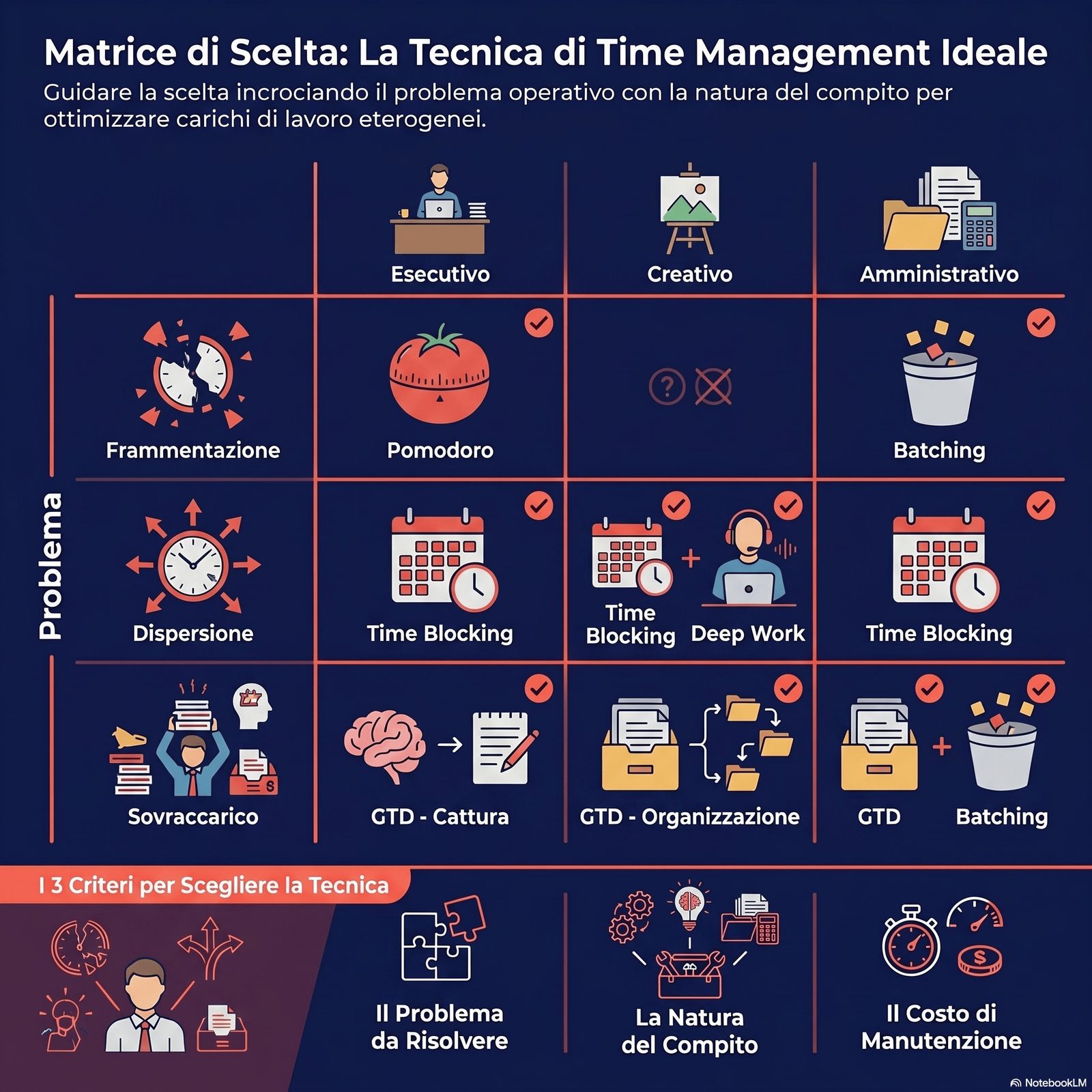
Choosing among 5 time management techniques: what they solve and under what conditions
Five techniques dominate the applied literature and real-world practice: Pomodoro, Time Blocking, Batching, GTD, and Eisenhower. They are neither equivalent nor interchangeable — they solve different problems, with different kinds of supporting evidence, and with limits that are rarely stated. In this section each technique is presented in a comparable format (problem solved, evidence, conditions of applicability, limits), followed by a summary table. The Eisenhower matrix is mentioned as a decision-making framework and referred to its dedicated article: it belongs to choosing priorities, not to execution.
Which of these techniques actually responds to the problem you observe in your days, and which one did you adopt out of inertia? The evidence supports the mechanism underlying each technique more than it supports the technique in its popular form.
Pomodoro Technique: working in protected 25-minute blocks
Francesco Cirillo formalized the technique in the late 1980s in a technical manual [6]. The setup is simple: 25-minute work blocks, 5-minute breaks, a cycle of four blocks followed by a long break (15-30 minutes). The timer — originally shaped like a tomato — enforces the boundary between the work block and the break.
Problem solved. Fragmentation caused by internal interruptions: the urge to check email or your phone, the mental drift from one task to another.
Supporting evidence. Indirect. The mechanics of protected blocks are consistent with the evidence from Bailey and Konstan (2006) [3], who document in controlled experiments how interruptions increase the error rate, lengthen completion times, and worsen affective state. There are no randomized controlled trials on the Pomodoro Technique as such: the evidence concerns the underlying principle (protected blocks), not the specific 25-minute duration.
When to use it. Well-defined execution tasks that require continuous attention for 25-30 minutes: reviewing a document, drafting short texts, coding or numerical analysis.
Limits. The 25-minute duration is arbitrary — Cirillo used what he had on hand. Deep creative work can suffer from being interrupted after 25 minutes, especially while getting into flow. The technique suits a "modular execution" work style better than long-form conceptual work.
Time Blocking: pre-allocating calendar time by category of work
Time Blocking has no single founding author: it is a practice found in various personal productivity systems. The principle is to assign calendar blocks in advance to homogeneous categories of work, protecting your concentration windows from reactivity.
Problem solved. Scatter caused by unassigned "dead time": the day fills up with reactive work because no window was pre-allocated to deep work or to specific tasks.
Supporting evidence. Indirect. Pre-allocation reduces the number of transitions during the day, and the evidence from Mark, Gudith, and Klocke (CHI 2008) [1] and from Bailey and Konstan (2006) [3] shows that every transition carries a cognitive cost measurable in recovery time and quality of thinking.
When to use it. Days with less than 30% mandatory reactive time. Especially useful for roles that alternate deep work and administrative work in separate blocks.
Limits. It requires a realistic estimate of time per task: underestimating destroys the block. In contexts with heavy external interruptions (sales, direct client management, a family business with an always-open door), a rigid block can frustrate team members. There are adaptive variants (flexible timeboxing), but at that point the technique's rigidity fades.
Read next: time blocking definition.
Batching: grouping similar tasks to reduce the cost of context switching
Batching groups tasks of the same nature into a single block of time, reducing the number of cognitive transitions during the day.
Problem solved. The cognitive cost of moving between tasks of different kinds: every context switch triggers the attention residue mechanism documented by Leroy (2009) [2].
Supporting evidence. Direct on the mechanism. Leroy (2009) [2] shows empirically that moving from task A to task B leaves part of your attention hooked on A, reducing performance on B. Mark, Gudith, and Klocke [1] and Bailey and Konstan [3] confirm the cost of interruption from a different angle. Batching is the practical translation: keeping tasks of the same type together reduces the number of transitions and therefore the cumulative cost.
When to use it. Administrative work (email, invoices, approvals), outgoing communications, meetings with members of the same team. It suits profiles with mixed workloads that can be grouped by category.
Limits. It works poorly when tasks depend on external responses arriving at different times. Extreme Batching (answering email only once a week) can create friction with clients and team members who expect same-day replies.
GTD (Getting Things Done): offloading tasks from memory to an external system
David Allen formalized the method in the first edition in 2001, revised in 2015 [7]. The founding principle is to capture every input (email, call, idea, request) in a trusted external system and then process it through five phases: capture, clarify, organize, reflect, engage.
Problem solved. Cognitive overload from open tasks: the Zeigarnik effect causes unfinished tasks to produce intrusive thoughts that occupy working memory and reduce the ability to concentrate.
Supporting evidence. Indirect but robust. Masicampo and Baumeister (2011) [5] show that formulating a written plan for a goal not yet completed reduces the cognitive effects of the Zeigarnik effect. The evidence validates the cognitive mechanism that GTD activates (capture + clarify + organize), not the whole method as a system.
When to use it. Roles with a high number of simultaneous open tasks and little control over the incoming flow: business owners, managers, professionals with multiple clients.
Limits. High adoption cost: weeks of break-in to build trust in the external system. The weekly review, the linchpin of the method, is often skipped, and the whole system gradually collapses. Without the review, GTD becomes an unused archive.
Eisenhower matrix: telling urgent from important (with the limits of the concept)
The distinction between urgent and important has a precise history: it is attributed to a speech by President Eisenhower in 1954. The "matrix" is a later popularized formulation, treated in this article as a generic decision-making tool.
Problem solved. Chaotic prioritization among tasks of different kinds.
Nature of the tool. It is not a time management technique in the strict sense: it is a decision-making framework concerned with "what to do first," not with execution. It is included in the comparison because it is often confused with operational techniques.
Full treatment. The dedicated guide is the article on priority management. Here we offer a summary that serves the comparison.
Limits. The "urgent vs. important" judgment is not objective: without explicit criteria, the matrix reproduces the subjective perception of the moment. It should be applied with a cool head, not under pressure, to remain an analysis tool.
Summary table of the 5 techniques
| Technique | Problem solved | Evidence | When to use it | Main limits |
|---|---|---|---|---|
| Pomodoro | Internal fragmentation | Indirect ([3]) | Execution tasks of 25-30' | Long creative work |
| Time Blocking | Scattered time | Indirect ([1][3]) | Days <30% reactive | Heavy external interruptions |
| Batching | Context switching | Direct on mechanism ([2]) | Administrative work | External dependencies |
| GTD | Open-task overload | Indirect but robust ([5]) | Many open tasks | Adoption cost |
| Eisenhower | Priorities (not execution) | Conceptual | Chooses what to do first | Subjective judgment |
Combining 2-3 techniques without overloading your day: the principle of non-redundancy
Adopting Pomodoro, Time Blocking, Batching, and GTD all in the same week is the most effective way to stop using any of them within three weeks. Every technique has a maintenance cost (minutes a day to stay in the system), and the costs add up nonlinearly. The rule that emerges from practice: choose at most two complementary techniques (one for the macro structure, one for micro-execution) plus, if needed, a decision-making framework such as the Eisenhower matrix for choosing priorities upstream.
In an average week, how many of the techniques you have adopted are actually carried out according to their protocol, and how many have become decorative? A technique used halfway is not half effective: often it is not effective at all.
Three combinations that work:
(a) Time Blocking (macro) + Pomodoro (micro). Time Blocking builds the structure of the day by allocating windows by category of work. Pomodoro governs execution within each window, protecting the blocks from internal interruptions. The combination works for roles with structurable execution work and little pressure from external interruptions.
(b) GTD (capture/clarify/organize) + Time Blocking. GTD manages the incoming flow and keeps the list of open tasks clean. Time Blocking turns that list into calendar slots. The combination works for roles with many mixed open tasks that then need to be carried out in predetermined windows. For choosing priorities upstream, see priority management.
(c) Eisenhower (priorities upstream) + Batching (execution of similar tasks). The matrix selects what goes into the day (Q1 and Q2), and Batching groups the selected tasks by similar nature. The combination works for roles with a heavy administrative load and medium decision-making complexity.
Two combinations that cancel each other out:
Pomodoro + rigid Time Blocking on the same task. If a Time Blocking block lasts 90 minutes and Pomodoro interrupts it every 25 minutes, the timer signal creates an interruption inside the protected block. The double constraint reduces depth of concentration instead of increasing it.
GTD at full speed + a new parallel system. Introducing a second capture system while GTD is already running produces duplication and distrust in the primary system. The typical result is abandoning GTD within four to six weeks.
To explore how delegating to a team member can free up the upstream time that the techniques then work on, see the cluster on effective delegation to your team.
Recognizing the shortcuts that make time management worse
Some practices are presented as accelerators and turn out to be measurable brakes. Multitasking is the most widespread and the best documented: heavy multitaskers with digital devices perform worse on tasks that require filtering out distractions and switching tasks [4]. Along with multitasking, at least three other practices fall into the same category: "reply right away" as a rule, chasing notifications as an implicit priority, and adding a new technique every time the previous one falls short.
How much of the perceived speed of a multitasking day is real speed, and how much is agitation? Mark and colleagues [1] show that people who are interrupted compensate by speeding up — but pay for it with stress and mental workload. Speed is paid for in quality.
Anti-pattern 1 — Multitasking.
The term "multitasking" covers two different phenomena worth telling apart. True multitasking — simultaneously performing two tasks that require cognitive attention — is cognitively impossible for most intellectual tasks. What actually happens in practice is rapid task-switching: you alternate between tasks, paying each time a cost in recovery time and attention residue [2]. The study by Ophir, Nass, and Wagner (PNAS 2009) [4] showed that "heavy media multitaskers" perform significantly worse on cognitive filtering tasks: the finding is correlational, not causal, but the direction is unmistakable. The practical fix is to identify the tasks that require sustained attention and protect them with dedicated blocks before moving on to anything else.
Anti-pattern 2 — "Reply right away" as a rule.
Turning every incoming message into an immediate task destroys protected blocks and produces cumulative attention residue. The evidence from Mark, Gonzalez, and Harris [11] on the time that passes before returning to the original task (on average 25 minutes and 26 seconds, across 24 knowledge workers observed in the workplace) multiplies in proportion to the number of interruptions to reply. The practical fix is to set predefined response windows — one or two daily Batching sessions for email and messages — and make these windows known to key team members and clients.
Anti-pattern 3 — Notifications as an implicit priority.
Every notification that comes in without a prior filter transfers control of priorities from the business owner to whoever sends the notification. Time management technique systems assume that priority is decided upstream by a decision-making framework: if the notification replaces that framework, the technique loses effectiveness regardless of its quality. The practical fix is to turn off notifications during protected blocks and define a single "red" channel for real emergencies.
Anti-pattern 4 — Adding a new technique in response to the failure of the previous one.
The real problem is rarely the technique chosen. More often it is: (a) the lack of an initial selection criterion (the technique was adopted by imitation, not for an identified problem); (b) overload from combining several techniques without a principle of non-redundancy; (c) the lack of a periodic review of the system (you keep applying a technique even when the context has changed). Adding a fifth technique to an already saturated system does not solve the underlying structural problem.
Limits and conditions of applicability
The techniques described in this article were developed and studied mainly in English-speaking contexts among knowledge workers. Their transferability to smaller companies and other work settings is qualitative, not quantitative: the documented cognitive mechanisms (attention residue, cost of task switching, Zeigarnik effect) are general, but the specific numerical values (25 minutes and 26 seconds before returning to the task, n=24 participants [11]) should be treated as orders of magnitude, not as exact benchmarks.
Techniques based on rigid blocks (Time Blocking, Pomodoro) work best in contexts where the individual has a reasonable degree of control over their own calendar. In contexts with heavy, uncontrollable external interruptions (retail, skilled trades, real-time customer service), applying them requires significant adaptation or the choice of more flexible techniques such as Batching.
GTD requires a start-up phase with an investment of time and attention that may be incompatible with peak operational periods. It is best started during periods of relative organizational calm.
The Eisenhower matrix, like any prioritization tool, is exposed to the risk of "classification bias" under stress: decision fatigue tends to push tasks toward Q1 (urgent and important) even when they are not. Classification should be done with a cool head, preferably during the weekly planning ritual.
FAQ
Can a time management technique be applied without first defining priorities? Technically yes, but with unsatisfactory results. Execution techniques operate on tasks that have already been selected: applying them to an unfiltered list produces efficiency in carrying out activities that may not be relevant. Selecting priorities comes before choosing the technique.
Which technique best suits a freelancer with multiple clients and projects? GTD responds well to a high volume of mixed inputs. If the adoption cost is too high, a light combination of Batching (for email and communications) and Time Blocking (for deep work) produces similar results with less maintenance.
Do you need a specific app to apply these techniques? No. All the techniques described can be applied with analog tools (a notebook, a paper planner) or with general-purpose software (calendar, spreadsheets). Dedicated apps can make adoption easier, but they are not a prerequisite.
How long does it take before you can judge whether a technique works? Lally and colleagues, following 96 participants for 12 weeks, measured a median of 66 days — about nine and a half weeks — for a daily behavior to become automatic, with a range from 18 to 254 days [10]. Hence a horizon of at least 8-10 weeks of continuous application before forming a sound judgment: assessments in the first two weeks are almost always premature.
Is it possible to change technique over time? Not only is it possible, it is often advisable. Working conditions change (team size, type of project, time of year), and the optimal technique changes with them. A systematic approach includes a periodic review of the technique adopted, not just of how it is applied.
Key takeaways
The five techniques most studied by research — Pomodoro, Time Blocking, Batching, GTD, Eisenhower matrix — are not equivalent: they solve different problems and have different kinds of supporting evidence and specific limits. The choice is made in four steps: identify the dominant constraint of your day (fragmentation, scatter, overload, chaotic decisions); check the prevailing type of task; estimate the level of uncontrollable external interruptions; weigh the cost of adoption and maintenance against the expected benefit.
Effective combinations respect the principle of non-redundancy: one technique for the macro structure, one for micro-execution, and possibly a decision-making framework upstream. Combinations that cancel each other out add a second constraint instead of removing one.
The anti-patterns to avoid — multitasking, replying right away, unfiltered notifications, adding techniques in response to failure — have direct experimental support in the sources cited here [1][3], which the individual time management techniques do not. Avoiding the anti-patterns often pays off more than optimizing the technique.
Conclusion
Time management is not solved by adopting whatever technique is most popular at the moment. It is solved by choosing the right tool for the problem you observe — fragmentation, scatter, overload, chaotic decisions — and leaving everything else out of your day. The five most studied techniques (Pomodoro, Time Blocking, Batching, GTD, Eisenhower) are not equivalent: they have different target problems, different kinds of supporting evidence, and specific limits that should be stated. A technique works when it responds to a real problem; it stops working when it is combined with others without criteria or when its maintenance costs more than its benefit.
For business owners the stakes are high — all the more so in a country like Italy, where the share of self-employment is among the highest in Europe [9]: the owner's time is a scarce resource with measurable aggregate effects. If you want to explore the strategic framework around a business owner's time, the reference is the pillar guide on time management for business owners. For the upstream decision about priorities — which comes before any technique — the references are the Eisenhower matrix and the dedicated article on priority management.
A day that is truly managed is not a full day: it is a day in which what matters gets completed, what is urgent does not replace what is important, and the tools you have adopted do the work in place of willpower. When this condition stabilizes — not on an isolated day but as a weekly trend — time stops being the business owner's stated problem and becomes the quiet infrastructure supporting the decisions that really move the company.
Sources and references
[1] Mark, G., Gudith, D., & Klocke, U. (2008). The Cost of Interrupted Work: More Speed and Stress. Proceedings of the SIGCHI Conference on Human Factors in Computing Systems (CHI 2008), pp. 107-110. ACM. https://doi.org/10.1145/1357054.1357072
[2] Leroy, S. (2009). Why is it so hard to do my work? The challenge of attention residue when switching between work tasks. Organizational Behavior and Human Decision Processes, 109(2), pp. 168-181. https://doi.org/10.1016/j.obhdp.2009.04.002
[3] Bailey, B. P., & Konstan, J. A. (2006). On the need for attention-aware systems: Measuring effects of interruption on task performance, error rate, and affective state. Computers in Human Behavior, 22(4), pp. 685-708. https://doi.org/10.1016/j.chb.2005.12.009
[4] Ophir, E., Nass, C., & Wagner, A. D. (2009). Cognitive control in media multitaskers. Proceedings of the National Academy of Sciences (PNAS), 106(37), pp. 15583-15587. https://doi.org/10.1073/pnas.0903620106
[5] Masicampo, E. J., & Baumeister, R. F. (2011). Consider it done! Plan making can eliminate the cognitive effects of unfulfilled goals. Journal of Personality and Social Psychology, 101(4), pp. 667-683. https://doi.org/10.1037/a0024192
[6] Cirillo, F. (2018). The Pomodoro Technique: The Life-Changing Time-Management System. London: Virgin Books. (Technical manual first published by the author in 1992.)
[7] Allen, D. (2015). Getting Things Done: The Art of Stress-Free Productivity (Revised Edition). New York: Penguin Books.
[8] ISTAT (2019). I tempi della vita quotidiana. Lavoro, conciliazione, parità di genere e benessere soggettivo. Rome: Italian National Institute of Statistics (data from the 2013-2014 Time Use Survey). https://www.istat.it/wp-content/uploads/2024/02/ebook-I-tempi-della-vita-quotidiana.pdf
[9] Eurostat. Employed persons by professional status — Labour Force Survey, dataset lfsa_egaps, 2024 data. Luxembourg: Eurostat. https://ec.europa.eu/eurostat/databrowser/view/lfsa_egaps/default/table
[10] Lally, P., van Jaarsveld, C. H. M., Potts, H. W. W., & Wardle, J. (2010). How are habits formed: Modelling habit formation in the real world. European Journal of Social Psychology, 40(6), pp. 998-1009. https://doi.org/10.1002/ejsp.674 (96 participants followed for 12 weeks on a simple daily behavior; median of 66 days to automaticity, range 18-254 days.)
[11] Mark, G., Gonzalez, V. M., & Harris, J. (2005). No Task Left Behind? Examining the Nature of Fragmented Work. Proceedings of the SIGCHI Conference on Human Factors in Computing Systems (CHI 2005), pp. 321-330. ACM. https://doi.org/10.1145/1054972.1055017