
The difference takes shape before the peak, in the few lines written when there was nothing to decide in a hurry.
Working under pressure means completing decisions and tasks in a window narrower than the work would require, with a visible consequence if the window closes.
It happens in a professional practice with two team members, in a family business with fifteen employees and in an organization with a hundred: the scale of the damage changes, not the mechanism.
Calm on critical days is not a character trait: it is the effect of a few rules written when there is no pressure. Who can declare an emergency, what gets put on hold, who decides in place of whoever is missing.
This article walks through the five rules to set in advance (who declares the emergency, what gets suspended, who decides in someone's absence, which information is enough, how the day is closed) and the mistakes that make them useless.
Learning to tell a critical day from pressure that never lets up
Two weeks that look alike can hide different problems, and the difference lies in frequency.
Episodic pressure is a peak: a delivery moved forward, a machine breakdown, a person missing on the wrong day.
Continuous pressure is a condition: the peak is the ordinary week and the quiet day is the exception.
The distinction has a documented reference: the European framework agreement of October 8, 2004 observes that individuals can cope with short-term pressure, whereas "when exposed to intense pressure over a prolonged period, they have great difficulty in coping" [3].
The two situations call for different responses (prepared rules for the first, a review of how work is organized for the second), and confusing them leads you to treat an organizational problem as a problem of people's resilience.
Three terms help keep them apart, because they are the ones most often mixed up with "pressure."
Urgency is about when: the Treccani Italian dictionary defines it as "the fact or condition of being urgent; a situation that requires immediate and rapid intervention" [1].
In a company the core remains and the object changes: not an emergency rescue, but a request that jumps the order already decided.
Workload is about how much: a sustainable workload concentrated into three days gives the same signals as a workload that is too large, and the two conditions are corrected in different ways.
Work-related stress is a possible effect, not the cause: the documentation of INAIL (Italy's national workplace insurance institute) reports it as described by the same agreement, that is, a "state which is accompanied by physical, psychological or social complaints or dysfunctions and which results from individuals feeling unable to bridge a gap with the requirements or expectations placed on them" [2].
The same source specifies that in Italy the subject is addressed with a technical-organizational approach, which assesses objective stimuli and the effects on the workforce as a whole [2].
That is the direction of this article, which deals with how work is organized: which decisions can be taken out of the critical day before it arrives.
Who can declare an emergency, and what counts as a real one
As long as urgency has no declared owner, the critical day gets rewritten by whoever is loudest; when the criterion and the names are written down in advance, the same request meets an order that has already been decided.
In many companies urgency has no owner: it is declared by whoever speaks loudest or whoever has the client on the phone at that moment.
The rule to write in advance has two parts and fits on half a page.
The first defines what counts as an emergency: a request is urgent when postponing it produces a verifiable external consequence (a penalty, a stopped line, a missed delivery) within a declared window.
Everything else is important, and important things have a place in the calendar, not a place right now: it is the distinction of the Eisenhower matrix, applied to whoever invokes urgency.
The second part names, by role, the few people who can declare it. This reduces the number of emergencies and makes visible who generates the most: an organizational piece of information, not a judgment.
In the European ESENER 2024 survey (41,458 establishments with at least five employees in 30 countries, May-October 2024), time pressure was reported as a risk factor by 43% of establishments in the EU-27 [4].
The order in which you establish what comes first remains a matter of priority management: the emergency rule only says who can override it, and under what conditions.
The stop list: what gets suspended when the day falls apart
When the day falls apart, the question that eats up the most time is not what to do but what to stop doing, and deciding it in the moment means hastily comparing activities that had never been compared before.
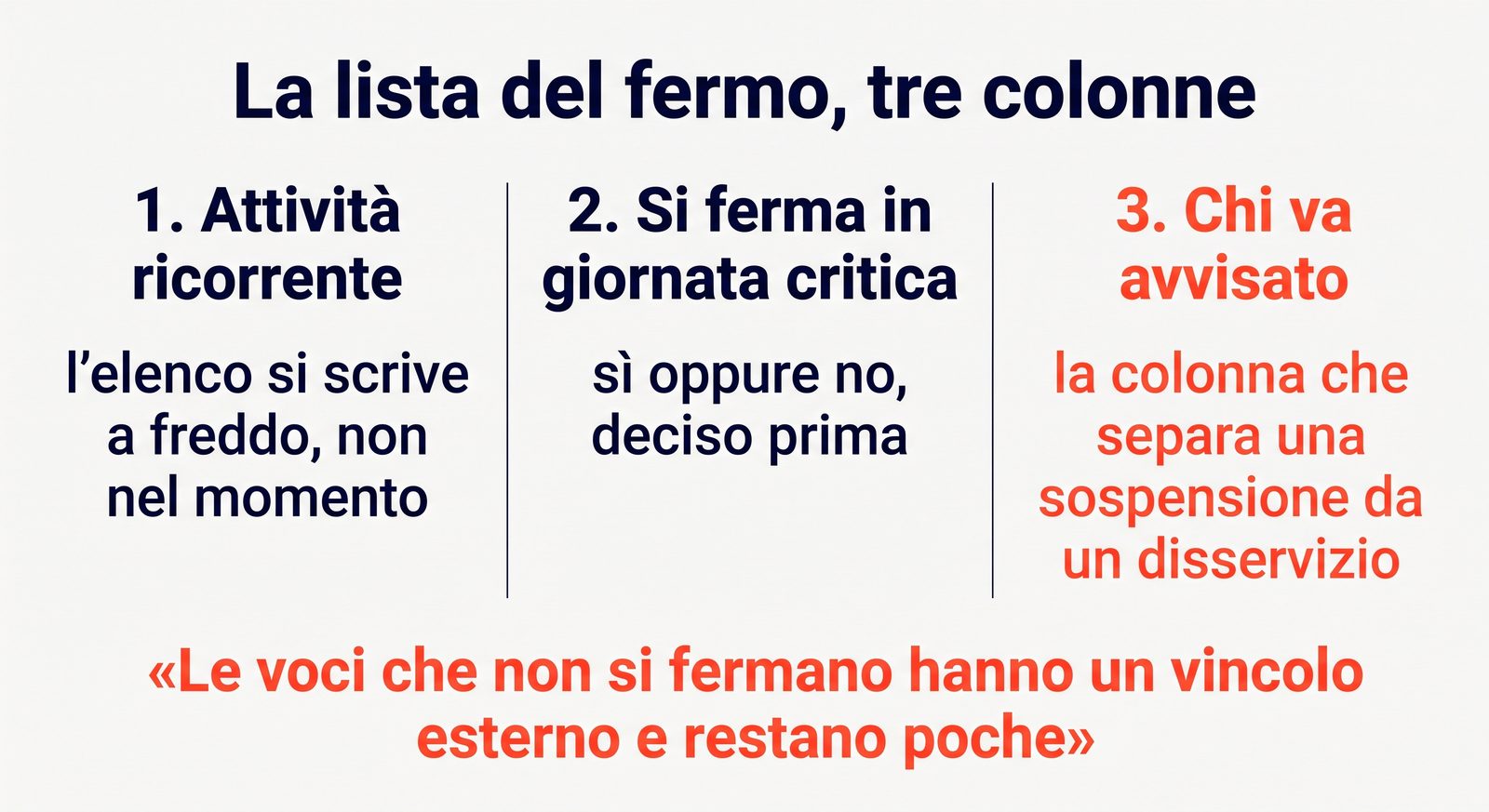
The stop list is a sheet written in advance, with three columns: the recurring activity, whether it stops on a critical day, who needs to be notified.
| Recurring activity | Stops on a critical day | Who needs to be notified |
|---|---|---|
| Weekly alignment meeting | yes | the participants, by the morning |
| Second-level check on batches already verified | yes | quality manager |
| Reply to quotes with an agreed date | no | — |
| Task with a legal deadline | no | — |
The items that do not stop have an external constraint (safety, tasks with deadlines, commitments already made with a date) and there are few of them.
The items that stop are the majority: internal alignments, second-level checks on steps that have already been checked, updates to documents that will stay closed that day.
The third column separates a suspension from a service failure: if the notice does not go out, the stopped activity becomes someone else's problem two days later.
The list is written once and reread when something structural changes, not after every bad day.
A useful side effect shows up on ordinary days: some items in the "stops" column never come back, because nobody downstream was looking for them.
Who decides when the decision-maker is away: emergency delegation
The unavailability of the person who decides (a sick day, a business trip, a phone with no signal) is a structural rather than an occasional issue in Italian companies.
According to ISTAT's 2023 Permanent Census of Enterprises (a sample of about 280,000 Italian companies with 3 or more employees, 2022 data), the units controlled by an individual or a family numbered over 820,000, 80.9% of all companies with at least 3 employees [5].
In the same survey, management "is in most cases entrusted to the business owner or to a member of the owning family," and among these individually or family-controlled units, an internal or external manager is used in 1.4% of cases, 0.8% in the 3-9 employee bracket [5].
The figure describes ownership and management, not critical days. But where decisions are concentrated in one person, that person's absence weighs more than any workload peak, and what matters becomes what was decided beforehand.
The rule to write in advance takes three lines: the substitute for each area (who decides on purchasing, who on deliveries, who on staff), the scope within which they decide alone, with a spending or commitment threshold, and the commitment not to reopen those decisions on return.
The last line holds up the other two, because a decision that gets reopened teaches people not to make any more.
A hypothetical scenario, in a family-run manufacturing company with about twenty employees: the business owner splits time between the desk and the shop floor, a client asks to move a shipment forward with a penalty at stake, and that day the owner's phone is off.
Without a written rule, the shipment waits for the owner's return; with three lines set months earlier, the production manager decides within the agreed threshold and reports it in the evening.
It is the logic of effective delegation, moved from ordinary work to the day when the usual decision-maker is missing.
Which information is enough to decide under pressure
Under pressure the problem is not a lack of information: it is that you do not go looking for it.
A study published in Scientific Reports in 2022 gave 99 participants a repeated choice task between four options, over 40 rounds of 20 trials, with and without a time limit [7].
With limited time, participants "reduced uncertainty-directed exploration, were less value-directed, and repeated choices more often" [7].
Translated into company work: at the peak, the choice tends to fall back on the one made last time, regardless of whether it was the best.
The countermeasure is not to ask for more attention, but to reduce in advance what needs to be looked at.
For the two or three decisions that recur on critical days (moving a delivery forward, stopping a job, accepting unscheduled work), you write a three-line template: the two or three data points to look at, where to find them, which value changes the answer.
Anything that does not appear in those lines goes into the next review, not into that day's decision.
For new decisions the template does not exist, and recognizing this is already a rule: what is not recurring gets deferred by a few hours, when the window allows.
The line between deferring and putting off decisions lies in the time of return: a deferral has one written down, putting off does not.
Closing the critical day in fifteen minutes, so it doesn't repeat
A critical day that closes without leaving a trace tends to repeat itself identically.
The close is fifteen minutes, not a meeting, and produces three lines on a single sheet: what caused the day to fall apart, what was stopped and whether the notice went out, which decision was made in a hurry and by whom.
The first line should be written in the most concrete form possible: not "too much work," but "the supplier confirmed the date the day before."
The value of these lines is not in the single day: it is in the sheet reread after three months.
The logic is that of the preliminary assessment of work-related stress risk, where sentinel events (sick leave, employee turnover, formal complaints) are read against a baseline, for example the average of the last three years for that homogeneous group, and not as isolated episodes [6].
If the same cause appears on six critical days out of ten, it is not an unforeseen event: it is how the work is organized, and the lever lies upstream, in how to reduce unforeseen events.
If instead the causes are different each time, the rules written in advance are doing their job, and maintenance comes down to rereading them.
The mistakes that make rules decided in advance useless
Five recurring mistakes cancel out the preparation work.
- Writing the rules during the critical day: a rule decided in the moment inherits that moment's priorities; the fix is to block an hour in the calendar during an ordinary period.
- Listing emergencies instead of writing the criterion: a list of cases does not cover the next case and ages quickly; the fix is a one-line definition, with the external consequence and the time window.
- Naming a substitute without a scope: someone who does not know how far they can decide prefers to wait, and the absence stops the day as before; the fix is the threshold written next to the name.
- Treating continuous pressure with the tools for a peak: the critical-day rules applied to every day become the norm, and the review of how work is organized gets postponed; the fix is to count critical days over a quarter.
- Suspending without notifying: the stopped activity comes back as a complaint or as a block downstream, and the stop list loses credibility the second time it is used; the fix is the third column.
A sixth mistake contains all the others: writing the rules once and never rereading them.
Rules written in advance are only as good as their last review.
Limits and conditions of applicability
The ISTAT and ESENER figures are sample averages over large populations: they describe a picture, they do not prove a causal link between concentrated decision-making and difficulties on critical days.
The Scientific Reports study is a laboratory experiment on a repeated choice task: it supports a mechanism (under time limits people explore less and repeat more), not a prediction about a company case.
The family business scenario is hypothetical, thresholds included: it shows the procedure, not an achievable result.
In roles with structural reactive exposure (customer service, switchboard, emergency response, on-call duty), the incoming request is the work itself: there the stop list loses much of its meaning and the lever is shift sizing.
The assessment of work-related stress risk is a formal requirement with its own roles and procedures [6]: this article deals with how work is organized and does not replace that assessment or professional advice.
FAQ
Are working under stress and working under pressure the same thing?
No: pressure is a working condition, while work-related stress is a possible effect on the people exposed to it, described by the European framework agreement of October 8, 2004 as the result of some individuals feeling unable to meet the demands placed on them [2].
The rules described here act on the working condition, not on the effect.
How can you tell whether pressure is episodic or continuous?
By counting critical days over a quarter and noting the concrete cause each time.
Different causes point to a peak; the same cause coming back points to a problem in how work is organized, which critical-day rules will not absorb.
How many people should be able to declare an emergency?
Few, and named by role, not by hierarchy.
The practical criterion is that the list fits on one line and that anyone not on it has to go through someone who is, with a reason that fits the written definition.
Where should you start if there is no written rule yet?
With the stop list: it is the only one of the five that produces an effect from the first critical day without requiring agreements with others.
The others require a conversation, and should be tackled at an ordinary moment.
Operational summary
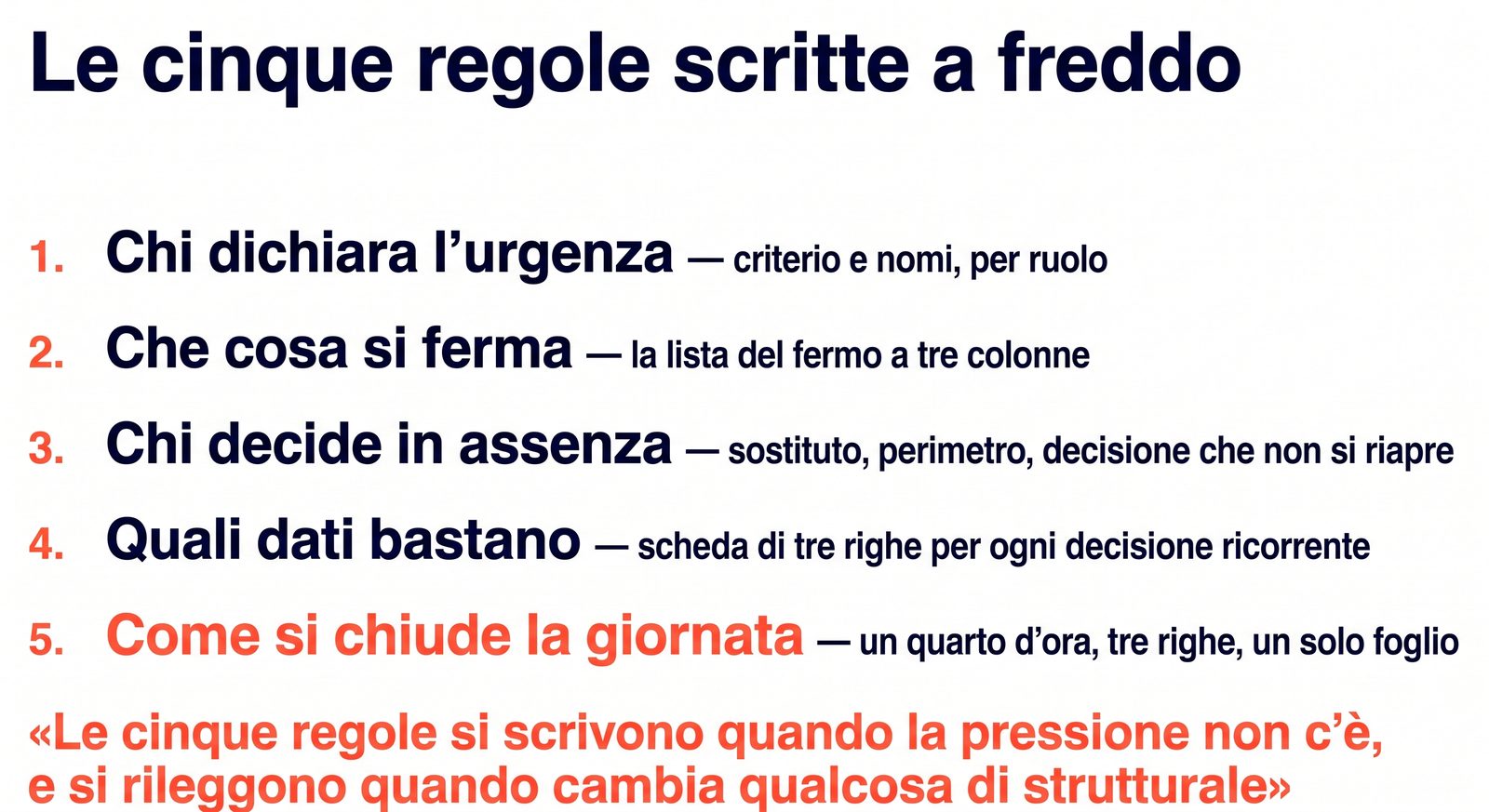
Managing pressure at work starts with recognizing whether it is a peak or a condition, because the levers are different: for the peak, you prepare five rules when there is no pressure.
The first establishes what counts as an emergency (a verifiable external consequence within a declared window) and who can declare it, by role.
The second is the stop list: recurring activity, whether it is suspended, who needs to be notified.
The third names the substitute for each area, with the scope within which they decide alone and the commitment not to reopen those decisions on return.
The fourth reduces in advance the information needed for recurring decisions, because under time limits people tend to repeat the previous choice.
The fifth closes the day in fifteen minutes, and the sheet reread after three months tells you whether the rules are enough or whether the problem lies upstream.
Conclusion
Calm on difficult days is not a character trait: it is the account of a few decisions made when there was nothing to decide in a hurry.
Who declares the emergency, what gets suspended, who decides in someone's absence, which data are enough, what stays written at the end of the day: five rules that take up two pages and get reread a couple of times a year.
When the count shows that critical days are the rule and not the exception, the path changes direction: the point is no longer to decide better in a hurry, but to reduce what arrives without warning, as in how to reduce unforeseen events.
When instead time is lost to a constant stream of inputs more than to volume, the lever is managing interruptions.
After two or three cycles of rereading, the conversation on a critical day changes subject: no longer who is right about what comes first, but which line of the list applies and who has been notified.
It is a difference that shows from the outside too: the client gets an answer even when the usual contact person is missing, and in the evening what remains is a three-line sheet instead of a list of backlog.
Sources and references
[1] Istituto della Enciclopedia Italiana, "urgènza", Vocabolario on line Treccani. Available at: https://www.treccani.it/vocabolario/urgenza/
[2] Clerici, P. (Contarp), "Definire e valutare lo stress lavoro correlato", series Conoscere il rischio — Fattore umano, INAIL, May 16, 2019. Available at: https://www.inail.it/content/dam/inail-hub-site/documenti/2015/10/Fattore_Umano_Definire%20e%20valutare%20lo%20stress_Mag%202019.pdf
[3] European employer and worker confederations (UNICE/UEAPME, CEEP, ETUC), "Accordo europeo sullo stress nei luoghi di lavoro", October 8, 2004, §3 "Descrizione dello stress e dello stress da lavoro". Italian text consulted in the Olympus database, Osservatorio per il monitoraggio permanente della legislazione e giurisprudenza sulla sicurezza del lavoro, Università degli Studi di Urbino Carlo Bo. Available at: https://olympus.uniurb.it/index.php?option=com_content&view=article&id=2509:accordo-europeo-8-ottobre-2004-stress-nei-luoghi-di-lavoro&catid=54&Itemid=139
[4] EU-OSHA, European Agency for Safety and Health at Work, "First findings of the Fourth European Survey of Enterprises on New and Emerging Risks (ESENER 2024)", February 7, 2025 (41,458 establishments with at least five employees in 30 countries, survey May-October 2024). Available at: https://osha.europa.eu/sites/default/files/documents/first-findings-esener-2024_EN.pdf
[5] ISTAT, "Censimento permanente delle imprese 2023: primi risultati", press release of November 14, 2023 (sample of about 280,000 companies with 3 or more employees, survey November 2022 – March 2023, reference year 2022). Available at: https://www.istat.it/it/files/2023/11/REPORTCensimprese.pdf
[6] Clerici, P. (Contarp), "Il percorso di valutazione del rischio stress lavoro correlato", series Conoscere il rischio — Fattore umano, INAIL, April 2019. Available at: https://www.inail.it/content/dam/inail-hub-site/documenti/2015/10/Fattore_Umano_Percorso%20valutazione%20SLC_Apr%202019.pdf
[7] Wu, C. M., Schulz, E., Pleskac, T. J., Speekenbrink, M., "Time pressure changes how people explore and respond to uncertainty", Scientific Reports, vol. 12, article 4122, March 8, 2022. DOI: 10.1038/s41598-022-07901-1. Available at: https://pmc.ncbi.nlm.nih.gov/articles/PMC8904509/