
Introduction
The Eisenhower matrix is a four-quadrant grid that crosses two variables — urgency and importance — to sort tasks and decide what to do, what to schedule, what to delegate, and what to drop. The tool has been cited in hundreds of management books since 1989 [6] and is probably the best-known prioritization framework in the world.
And yet, for many people who have tried it, it ends up in a drawer within two weeks. Not because the logic is wrong, but because tasks get classified on autopilot, under pressure, and with criteria that confuse perceived urgency with a real deadline.
This article does not just explain the matrix. It clarifies the terms that make it useless when they are confused (urgency vs. deadline, importance vs. relevance, quadrant 2 vs. deep work), walks through the four recurring mistakes that make it fail, and provides a practical template built for a weekly routine.
The reading level is practical: no academic references for their own sake, and every concept is tied to a concrete choice faced by anyone who plans their own time or a team's time.
Using the Eisenhower matrix beyond the four-quadrant grid
How many of the day's "fires to put out" match a real deadline, and how many match perceived pressure? Made with a cool head, this distinction radically changes what ends up in quadrant 1 in most cases.
The distinction between urgent and important was not born in 1989 with a management book, but on August 19, 1954, when Dwight D. Eisenhower publicly quoted a former university president [1]. The four-quadrant visual that today is called the "Eisenhower matrix" came thirty-five years later, in The 7 Habits of Highly Effective People [6]. Knowing who said what helps separate the principle (solid) from the popularized form (simplified). This section sets the working definition, distinguishes urgency, deadline, importance and relevance, and prepares the ground for using the tool without trivializing it.
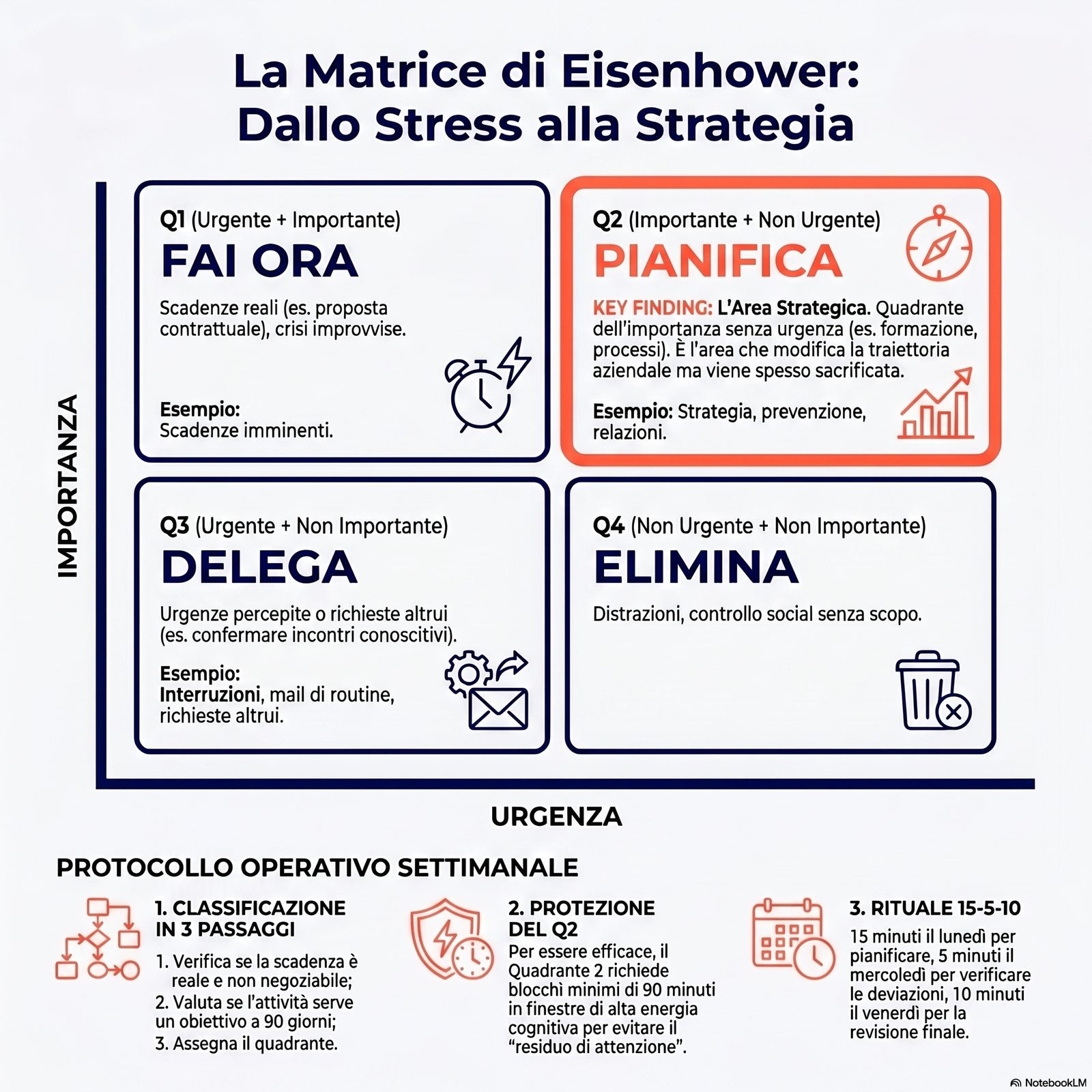
Working definition of the matrix. Two axes — urgency and importance — create four quadrants:
- Q1 (urgent + important): do it now. Crises, imminent deadlines, problems that need immediate attention.
- Q2 (not urgent + important): schedule it. Strategic work, training, relationships, prevention. This is the quadrant that changes your trajectory over the medium term.
- Q3 (urgent + not important): delegate it. Requests that seem urgent but do not contribute to personal or business goals.
- Q4 (not urgent + not important): drop it. Low-value activities, habitual distractions, unproductive routines.
As early as the 1960s, Peter Drucker distinguished efficiency (doing things right) from effectiveness (doing the right things) [2]. The Eisenhower matrix is a tool for increasing effectiveness: it does not ask you to do more, it asks you to choose better what deserves your time.
Three pairs of terms to tell apart before using the tool.
Urgency vs. deadline. A deadline is a verifiable time variable (a date and time after which there is an objective consequence); urgency is a subjective perception fueled by external pressure, anxiety, or someone else's request. A deadline two weeks away is not urgent; a client's request for something "by tonight" may have no real deadline at all. Confusing the two terms is the main cause of an artificially inflated Q1.
Importance vs. relevance. Relevance is contextual (a task can be relevant in one meeting and irrelevant in another); importance is strategic, anchored to medium- and long-term goals. A task that is relevant in the short term — promptly replying to a comment on social media — may matter little for your 90-day goals. According to Drucker [2], importance is measured against goals: everything else is irrelevant for classification purposes.
Quadrant 2 vs. deep work. Deep work is a way of working (protected, uninterrupted concentration); quadrant 2 is a category of tasks (important and not urgent). Quadrant 2 work is often done in deep work mode, but the two do not coincide: a strategic phone call with a partner can be Q2 without being deep work.
To explore time management techniques that complement the matrix, see the guide to time management techniques.
Telling the matrix apart from the Eisenhower method so it survives past week two
When people search for the "Eisenhower method," do they want the four-quadrant grid or the process that makes it work every week?
The matrix is the drawing.
The method is the discipline that keeps it alive past the second week.
The matrix is the four-quadrant visual; the Eisenhower method, in current usage, refers to the process that keeps it running — setting criteria, classifying, deciding the action, and redoing the classification at regular intervals.
Confusing the two leads people to judge as "ineffective" a tool that in fact was never applied as a process, only drawn once.
The rest of this article — the classification protocol, managing quadrant 2, the weekly template — is a practical description of the method, not just of the matrix.
A useful way to fix the distinction is to think of the matrix as a snapshot of a single moment and of the method as the film you get by retaking that snapshot every week, with the same criteria.
The distinction between efficiency and effectiveness mentioned in the previous section [2] applies here too: classification does not create value the first time you do it, but when it becomes a repeated process with stable criteria.
In practice, the jump from matrix to method shows up in an operational detail: people who stop at the matrix fill in the grid once and consult it as long as it holds up, while people who apply the method plan a second moment from the start to redo the classification, not just to reread it.
This is the difference the article returns to later, when one-off use appears among the four mistakes that lead people to shelve the tool after a few weeks.
In this sense, the classification protocol described in the next section is the first concrete application of the method: not an alternative to the matrix, but the mechanism that turns it from a drawing into a repeatable process.
Learning to place a task in the four quadrants without ambiguity
What happens when the same task ends up in three different quadrants within a single week? The problem is not the matrix but the lack of explicit classification criteria — and most people who use it never notice.
The matrix does not fail when it is drawn. It fails when you have to decide which quadrant gets "reply to an important client's email asking for a quote by Friday." Without shared criteria, the same task lands in Q1 one day, in Q2 another, and in Q3 the day after. This section proposes a three-step classification protocol — check the deadline, assess strategic importance, assign the quadrant — designed to reduce room for subjective interpretation.
A 3-step classification protocol.
Step 1 — Check the deadline objectively. Is there a date after which concrete, verifiable consequences occur? If so: what is the date, who bears the consequence (the client? the company?), and is the consequence negotiable? If the answer to "negotiable consequence" is yes, the urgency is lower than it looks. If there is no real deadline, perceived urgency is almost always a sign of external pressure or anxiety, not of a genuine immediate need.
Step 2 — Assess strategic importance. Does the task contribute directly to a goal for the next 30-90 days? If so, it is important. If not, it is relevant but not important — it goes in Q3 or Q4. Drucker suggests anchoring this assessment to written goals, not to how things feel in the moment [2]: whatever is not written down among your goals tends to feel important only because it is visible.
Step 3 — Assign the quadrant. Combine the results: real deadline + high importance = Q1; no deadline + high importance = Q2; perceived deadline + low importance = Q3; neither = Q4.
Concrete classification examples.
"Send a contract proposal a prospect asked for by Monday" — real deadline (Monday), high importance (potential contract) → Q1.
"Update the onboarding process for new team members" — no deadline, high importance (structural impact) → Q2.
"Reply to a supplier asking you to confirm an introductory meeting next month" — perceived urgency (a courteous reply), low importance (no direct goal) → Q3.
"Check competitors' social feeds without a specific analysis goal" → Q4.
For the link with delegating Q3 tasks, see the article on effective delegation to your team.
Recognizing in real time whether a task is urgent, important, both, or neither
What happens when a request comes in mid-morning and there is neither the time nor the calm to apply the full protocol?
Urgent and important are not the same question: they are two questions in sequence, and the order in which you ask them changes the answer.
In the thick of the day, there is not always room for the full classification protocol.
Two questions in sequence — "what happens if I don't do this by today?" and "does this bring me closer to a goal for the next 90 days?" — allow a first classification on the fly, to be confirmed later with a cool head.
The test does not replace the 3-step protocol: it isolates its two variables — real deadline and strategic importance — and reduces them to two questions you can check in a few seconds, with no paper or calendar in front of you.
The first question isolates the deadline: if not replying by today has no verifiable consequence, the urgency felt during the phone call is almost always higher than the real one.
The second question isolates importance and anchors it to your reference goals instead of to the pressure of the moment [2]: if responding to the request does not bring you closer to a goal for the next 90 days, the task remains relevant in the short term but not important for classification purposes.
In Italy, the ISTAT permanent census of businesses finds that 80.9% of Italian companies with at least 3 employees are controlled by an individual or a family, and that in these companies management almost always remains in the hands of the business owner or a member of the owning family: hiring an internal or external manager applies to 3.2% of those with 10-49 employees, 10.0% of medium-sized companies, and 21.2% of large ones (2022 data) [7].
In such a concentrated decision-making structure, classifying an incoming request cannot be delegated to a middle level: it falls on the same person who, at that moment, is overseeing the work in progress.
The owner of a small manufacturing business with 7-15 employees who receives a client's phone request mid-morning for a confirmation on a supply order "by today" can apply the two questions without leaving the shop floor: the answer, reached in a few seconds, decides whether the request is handled right away or deferred to the midweek review.
The result of this on-the-spot test is not final: it remains a provisional classification, to be confirmed in the midweek check set out later in the 15-5-10 routine, when the pressure of the moment has passed and the assessment can once again be made with a cool head.
What the test actually protects is the time that each incoming request threatens to take away from important, non-urgent work — the quadrant covered in the next section.
Turning quadrant 2 into the space where medium-term productivity is won
How many hours last week ended up in quadrant 2, and how many of them had been scheduled in advance and not moved afterward? In most calendars, Q2 takes up less than 15% of declared time — and this explains much of the feeling of "running without getting anywhere."
Quadrant 2 — important and not urgent — is where the activities that change a company's trajectory over the medium term are concentrated: redesigning a process, training a person, strategic thinking, building systems. Yet it is the quadrant that gets sacrificed systematically. The reason is not only cultural: research on attention residue [4] shows that Q2 work requires protected blocks of time, because the damage from interruptions grows nonlinearly with the complexity of the task. This section explains how to size and protect Q2 without turning it into a pointless calendar exercise.
The scientific basis for protecting Q2.
In her study on attention residue (2009) [4], Sophie Leroy documents that when you switch from one task to another, part of your attention stays hooked on the previous task. This cognitive residue degrades performance on the new task. Q2 tasks — complex and non-urgent by nature — are the most sensitive to this effect: an interruption during strategic planning or while training a team member carries a proportionally higher cognitive cost than one during the reading of an email.
Mark and colleagues (2005) [5] put the average time before returning to an interrupted task at 25 minutes and 26 seconds, measured by observing 24 knowledge workers in the workplace. Every unmanaged interruption during a Q2 block therefore erodes not only the minutes of the interruption itself but also the recovery time that follows.
Three operating rules to safeguard Q2.
Rule 1 — Minimum 90-minute blocks. Q2 tasks rarely produce value in 20-30 minute windows. A minimum 90-minute block — entered in your calendar as a non-negotiable appointment — is the threshold below which many strategic activities do not reach the necessary depth.
Rule 2 — Placement in high cognitive energy windows. Executive functions — planning, evaluation, complex decision-making — have efficiency windows that vary by individual and by time of day. The Q2 block belongs in your sharpest hours, not in leftover time.
Rule 3 — Protection declared to the team. A private rule of unavailability that is not backed by explicit communication to the team gets ignored. It helps to define in advance which windows are reserved for Q2 work and to communicate them, making them predictable for the people working around you.
Using the matrix template as a weekly operating tool
What separates people who use the matrix once from those who use it for twelve months? Not personal discipline, but three fixed moments in the calendar — and the difference between the two profiles is worth hours of work recovered every week.
The Eisenhower matrix works when it becomes a ritual, not a decorative exercise. Filling it in once produces a snapshot that is out of date within 48 hours. The template that accompanies this article is built for weekly planning: Monday morning (15 minutes) for classification, Wednesday (5 minutes) for a check, Friday (10 minutes) for wrap-up and realignment. This section describes what the template contains, how to fill it in, and what conditions make the ritual sustainable over time.
Template structure (fillable PDF, free access).
The template includes four areas — one per quadrant — with room for 5-8 tasks each. For each task you record: task name, time estimate, deadline if any, and status (to do / in progress / done). A separate section holds the weekly review notes: what moved from one quadrant to another, what did not make it into the plan and why.
The 15-5-10 routine.
Monday morning (15 minutes): classify the week's tasks into the four areas, using the 3-step protocol described in the previous section. Block time for Q2 tasks before anything else.
Wednesday (5 minutes): a quick check. How many Q1 tasks have been added compared with the plan? How many Q2 tasks have been sacrificed? The Wednesday check is not planning, it is a signal: if Q1 has grown significantly, there is an issue with the classification criteria to review on Friday.
Friday (10 minutes): wrap-up and realignment. Count what was done by quadrant, note what slips to the following week, and revise the importance criteria if Q1 was consistently overloaded.
Three conditions that make the ritual sustainable.
Fixed time in the calendar. Monday morning planning works only if it is in the calendar with the same rigidity as a meeting with an important client. Routines done "when there's time" never stick.
Integration with other tools. The matrix does not replace your system for managing daily tasks: it steers it. Classified tasks go into your calendar or your existing task management tool.
Monthly review of the criteria. Once a month, it is worth rereading your urgency and importance criteria: goals change, and the criteria have to stay current. A task that was Q2 four weeks ago may have become Q1, or vice versa.
For a closer look at the broader context the matrix fits into, the guide to priority management develops the selection criteria in more depth. For the big picture of time management for people who run a business, see the article on time management for business owners.
Recognizing the 4 mistakes that make the Eisenhower matrix fail
Which of the four mistakes is easiest to spot in your own last two weeks of work? Almost always three of the four are present at the same time — and that is why the matrix gets shelved as "a trick that doesn't work."
The Eisenhower matrix fails because of four recurring mistakes, and none of them concerns the grid itself. They concern how urgency and importance are assessed, when the matrix is filled in, and what happens to quadrant 4 in real calendars. This section lines up the four mistakes, anchors them to the evidence (decision fatigue [3], attention residue [4], cost of interruptions [5]), and proposes a practical fix for each.
Mistake 1 — Confusing perceived urgency with a real deadline.
When everything ends up in Q1, Q1 explodes and stops being manageable. The mechanism is simple: every external request is perceived as urgent, regardless of the real deadline. The result is that Q2 is gradually emptied — not because strategic work is less important, but because Q1 absorbs all the available time.
Research on the costs of interruption shows that every unplanned switch between tasks has a measurable cognitive cost [5]: an artificially inflated Q1 produces a high number of these switches, increasing stress without increasing productivity.
Practical fix: apply the 3-step protocol described in the previous section, with an explicit test of the real deadline before classifying any task as urgent.
Mistake 2 — Filling in the matrix when you are suffering from decision fatigue.
A matrix filled in on Friday evening after an intense week reflects the emotional pressure of the moment, not a clear-headed assessment. The 2008 study by Vohs and colleagues [3] documents that decision quality drops measurably after hours of accumulated choices: decision fatigue produces systematically distorted classifications, with a tendency to overestimate urgency and to place tasks in Q1 or Q4, skipping any reflection on Q2 and Q3.
Practical fix: fill in the matrix with a cool head, on Monday morning, before opening your email. The 15-minute Monday morning ritual exists precisely for this: to guarantee a moment of classification under optimal cognitive conditions.
Mistake 3 — Treating Q4 as a holding area instead of an operating category.
Q4 tasks tend to survive in the calendar week after week because "someone has to do them." In reality, Q4 is the category of candidates for elimination or automation, not for postponement. If a task stays in Q4 for three consecutive weeks, it is a sign that it does not contribute to any goal and that the time spent on it is wasted.
Practical fix: in the Friday review, revisit Q4: every task that has been there for more than two weeks is explicitly assessed — drop it, automate it, or reconsider its classification.
Mistake 4 — Treating the matrix as a one-off exercise.
Filled in and forgotten is the most common pattern. A matrix used once produces a useful snapshot but does not change behavior. The weekly structure with three moments (Monday-Wednesday-Friday) and the monthly review of criteria is the difference between a tool and a habit.
Practical fix: put the three matrix sessions in your calendar as fixed appointments, with the same rigidity as an external meeting, for at least six consecutive weeks. Research on habit formation indicates that behaviors become stable over time only through consistent repetition in a fixed context.
Limits and conditions of applicability
The Eisenhower matrix is an individual classification tool: it works best for people who manage their own calendar autonomously or are responsible for choosing their own priorities. In highly prescriptive contexts (employees with assigned tasks, execution roles with no decision-making autonomy), the matrix loses part of its usefulness because classification has no immediate operational consequences.
Source [6] (Covey) is treated in this article as a secondary historical reference on the spread of the tool, not as scientific evidence. The quantitative evidence refers to the effects of the underlying mechanisms (decision fatigue, attention residue, cost of interruptions), not to the Eisenhower matrix as such: there are no randomized controlled trials that test the matrix directly.
The urgency/importance distinction depends on how clear your reference goals are: people without written 30-90 day goals struggle to classify importance consistently. In that case, the first step is not the matrix but defining your goals.
FAQ
How many tasks should the matrix contain in a week? There is no fixed number. A practical rule: if Q1 contains more than 5-6 tasks, your urgency criteria need revisiting. If Q2 is empty, the method is not working. The matrix is useful when Q2 is the most populated quadrant in terms of allocated time, even if not in terms of number of items.
Does the matrix work for teams or only for individuals? It works for both, but it requires shared importance criteria. A team without common goals struggles to classify tasks consistently. In a team, the moment of collective classification can itself become a useful alignment ritual.
How do you handle a task that swings between Q1 and Q2 depending on the day? Classification should be done with a cool head, once a week, not renegotiated every day. If a task swings back and forth, it is a sign that your urgency criteria are not clear enough. The 3-step protocol helps stabilize the classification.
Does a paper template work as well as a digital one? Yes, often better. A paper matrix physically visible on your desk reminds you that the categories exist without requiring you to open an app. The choice of format depends on the user's preferences: what matters is that it stays visible throughout the week.
Key takeaways
The Eisenhower matrix works when the urgency and importance criteria are defined with a cool head (using the 3-step protocol), the matrix is filled in at the right time (Monday morning, before opening your email), and the 15-5-10 weekly ritual is respected like a fixed appointment. The four mistakes — an inflated Q1, filling it in under decision fatigue, Q4 as a holding area, one-off use — can all be diagnosed and corrected. Quadrant 2, protected with blocks of at least 90 minutes placed in high cognitive energy windows, is the lever that changes your trajectory over time.
Conclusion
The Eisenhower matrix is not a trick, and it is not a decorative grid. It is a classification tool that works when the urgency and importance criteria are defined with a cool head, applied with a protocol, and revisited within a weekly ritual. None of the three conditions can be taken for granted, and the absence of any one of them explains most cases of abandonment.
The breaking point is not the framework: it is the classification. The four recurring mistakes — confusing perceived urgency with a deadline, filling it in under decision fatigue, treating Q4 as a holding area, using the matrix only once — can all be diagnosed. Once they are corrected, quadrant 2 starts filling up with activities that genuinely change your medium-term trajectory.
To go deeper into the context the matrix fits into, it is also worth reading the guide to priority management and the article on time management techniques — both provide complementary tools that the matrix alone does not cover.
A calendar in which quadrant 2 is protected and quadrant 4 is eliminated is not a fuller calendar: it is a calendar in which every week leaves time for the decisions that, twelve months from now, will make the difference between a company that grows and a company that just keeps running. Across an entire economy, a more deliberate allocation of time translates into a productivity margin that today goes unrealized — one that research on decision fatigue and attention residue [3][4] suggests can be quantified.
Sources and references
[1] Eisenhower, D. D. (1954). Address at the Second Assembly of the World Council of Churches, Evanston, Illinois, August 19, 1954. Public Papers of the Presidents of the United States. The American Presidency Project, UC Santa Barbara. Available at: https://www.presidency.ucsb.edu/documents/address-the-second-assembly-the-world-council-churches-evanston-illinois
[2] Drucker, P. F. (1967). The Effective Executive. Harper & Row, New York. ISBN 978-0-06-083345-9.
[3] Vohs, K. D., Baumeister, R. F., Schmeichel, B. J., Twenge, J. M., Nelson, N. M., & Tice, D. M. (2008). Making choices impairs subsequent self-control: A limited-resource account of decision making, self-regulation, and active initiative. Journal of Personality and Social Psychology, 94(5), 883-898. DOI: 10.1037/0022-3514.94.5.883
[4] Leroy, S. (2009). Why is it so hard to do my work? The challenge of attention residue when switching between work tasks. Organizational Behavior and Human Decision Processes, 109(2), 168-181. DOI: 10.1016/j.obhdp.2009.04.002
[5] Mark, G., Gonzalez, V. M., & Harris, J. (2005). No task left behind? Examining the nature of fragmented work. Proceedings of the SIGCHI Conference on Human Factors in Computing Systems (CHI '05), 321-330. DOI: 10.1145/1054972.1055017
[6] Covey, S. R. (1989). The 7 Habits of Highly Effective People. Free Press, New York. ISBN 978-0-7432-6951-3. [Secondary historical reference on the spread of the framework; not cited as scientific evidence.]
[7] ISTAT (2023). Censimento permanente delle imprese 2023: primi risultati. Statistiche report, November 2023, Table 2 (year 2022, companies with at least 3 employees controlled by an individual or a family). Available at: https://www.istat.it/it/files/2023/11/REPORTCensimprese.pdf