
A workday contains, on average, dozens of incoming requests, meetings called by others, deadlines inherited from the day before and tasks that multiply as devices come on. Without a daily planning protocol, the calendar gets filled by whatever arrives, not by what matters. Buehler, Griffin and Ross [1] documented how people systematically underestimate the time needed to complete their tasks by 30-40%. Well-done daily planning is the everyday correction to that underestimate.
In operational terms, daily planning means the protocol that decides what goes into your calendar over the next 8-10 hours: a fixed sequence of three micro-decisions — selecting the priority tasks, assigning them to a time block, setting a margin for reacting — that takes place at the start of the day and lasts 10-15 minutes. It is not the list of things to do, it is not a calendar packed with appointments, it is not a personal morning routine.
The article describes the three-block protocol, the rules for selecting tasks, how to defend focus blocks and the most common mistakes. The method works for independent professionals, managers and business owners of companies of different sizes, and comes with a free downloadable template.
Learning to recognize when the day is really planned
A planned day differs from a "full" day in one operational detail: by the end of the morning you know for certain which decisions were made and which were postponed. This section opens with a grid of three indicators to tell whether the day was truly planned or merely "filled", and draws a precise line between the decision protocol and the tools that record it.
How many of the operational decisions you made yesterday went through a conscious act of planning, and how many simply "happened"? On many days the ratio is less than one in ten — and the cost doesn't show on the calendar, it shows on the margins at the end of the month.
A day is planned, in an operational sense, when it meets three verifiable indicators:
- The day's priority tasks were identified before the operational day began. Not during the first meeting, not while reading emails at 9:30 — but in a dedicated 10-15 minute session, preferably before switching on your communication channels.
- Each priority task has a time block assigned in the calendar. Not "I'll do it when I have time" — but "I'll do it from 10 to 11:30, protected block". Gollwitzer's research on implementation intentions [2] shows that assigning an action to a specific time slot significantly increases the likelihood that it gets completed.
- There is an explicit buffer for the unexpected. At least 20-25% of the available hours are not assigned to specific activities — they serve to absorb the inevitable interruptions without making the day's plan collapse.
ISTAT data indicate that 45.0% of self-employed workers in Italy have to revise their work schedule at least once a week because of client requests or changes in workload, and a further 18.5% at least once a month [5]. For many, the problem isn't a lack of hours — it's the absence of criteria to govern them.
It's worth clarifying four distinctions that readers tend to confuse with daily planning:
- Daily planning vs weekly planning: the two tools work on different horizons (24 hours vs 7 days) and play complementary roles. Weekly planning produces the framework (goals, roles, workloads for the week); daily planning is the everyday landing inside that framework — it doesn't replace it.
- Daily planning vs organizing your day: planning is the decision protocol that establishes what goes into the calendar and with what priority; "organizing your day" is the resulting execution structure (sequence of blocks, transitions, micro-breaks). Planning comes before organizing; the two are not the same thing.
- Daily planning vs daily schedule: the schedule is the tool (digital or paper) where decisions are written down; planning is the decision practice that generates those entries. A full schedule is not the same as a planned day.
- Daily planning vs morning routine: the morning routine is a fixed, repetitive ritual (the same sequence of actions every day: coffee, reading, exercise); daily planning is a decision that changes every day about the operational content of the day. They can coexist, but they are not the same thing.
Calculating the hidden cost of unplanned days
The cost of an unplanned day isn't visible in real time: it shows up in the number of tasks pushed to the next day, in the meetings called to "get aligned" and in the overload at the end of the week. This section lines up three documented mechanisms — underestimating time, the loss from interruptions and task switching — and describes their cumulative effect on available hours.
What would happen to weekly productivity if every day you recovered even just 45 minutes of continuous focused work? In many professional settings that recovery amounts to a full day every two weeks — and the cost of getting it is just fifteen minutes in the morning.
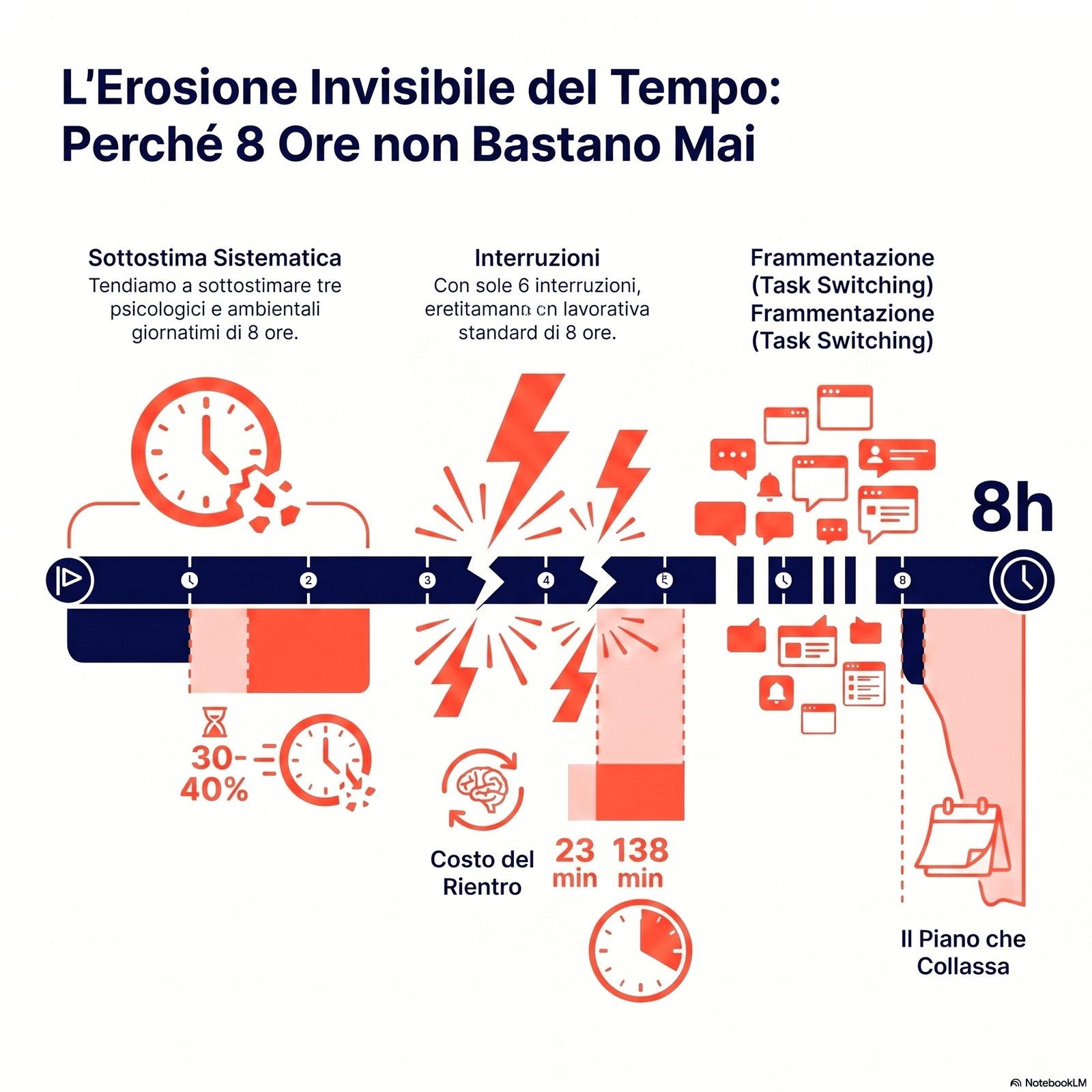
Mechanism 1 — Systematic underestimation of time. Buehler, Griffin and Ross [1] documented experimentally that people tend to underestimate the duration of their tasks by 30-40%. Applied to a day with six planned activities, this tendency systematically produces a day in which two or three activities find no room. Without explicit buffers and without a correct estimate, the plan collapses regardless of the planner's discipline.
Mechanism 2 — The loss from interruptions. Mark, Gonzalez and Harris [3], observing 24 knowledge workers in the workplace, documented that after an interruption an average of 25 minutes and 26 seconds passes before they return to the previous task. In a day with six interruptions, the time to return alone can exceed two hours — hours that don't appear on any calendar, but that explain the feeling of having worked all day without producing what you had planned.
Mechanism 3 — The cost of task switching. Mark et al. (2016) [6] documented that in the work settings most exposed to digital stimuli, the time of continuous attention on an application can drop to a few dozen seconds. In these settings, planning your blocks isn't an optimization option — it's the minimum condition for producing cognitively complex work.
The three mechanisms combine. A day without a plan, with six interruptions and naive estimates, produces an erosion of useful time that can be substantial. Fifteen minutes of daily planning doesn't eliminate interruptions and doesn't change the planning fallacy — but it provides the structure to absorb them without losing control of the day.
The three-block protocol to plan your day in 15 minutes
This section describes the core protocol of the article: three micro-decisions carried out in a fixed sequence at the start of the day. Selecting high-value tasks (3-5 items, no more), assigning them to a specific time slot (protected block, operational block, reaction block) and setting the margin for reacting to the unexpected. The free downloadable template — available on the page with no sign-up — reproduces the protocol on a single A4 page and takes 10-15 minutes to fill in.
Why can a 15-minute protocol structure 8 hours of work when a detailed to-do list often can't? There is only one difference: the to-do list lists, the protocol decides.
Gollwitzer's research (1999) [2] on implementation intentions — statements of the form "when X happens, I will do Y in place Z" — shows that assigning an action to a specific time slot and context significantly increases the likelihood that the action is completed, compared with a simple intention ("I want to do Y"). The three-block protocol applies this principle to daily planning.
Protected block (60-120 minutes, placed in the first hours of the day). It contains the most cognitively demanding activity of the day — the task that requires sustained concentration and that, if not done in this time slot, risks never finding room. The protected block is uninterruptible by choice: no active notifications, no replies to emails, no incoming calls. For an independent professional it might be drafting a sales proposal; for a business owner, reviewing a strategic decision; for a startup founder, product work.
Operational block (90-180 minutes, during the morning or early afternoon). It contains coordination, response and day-to-day management activities — team meetings, emails that require a structured reply, sales calls, operational decisions. The operational block is more flexible than the protected one but is still scheduled: it is not the day's "leftover time", it is a space with a start and an end.
Reaction block (20-30% of available hours, spread out or concentrated in the afternoon). It is not assigned to specific activities. It is the buffer that absorbs the unexpected events documented by the research of Buehler et al. [1]: urgent interruptions, unplanned requests, the task that turns out to take longer than expected. Without this block, the day's plan is formally precise but structurally fragile.
The rules for choosing the right tasks: what goes into the 15 minutes of planning
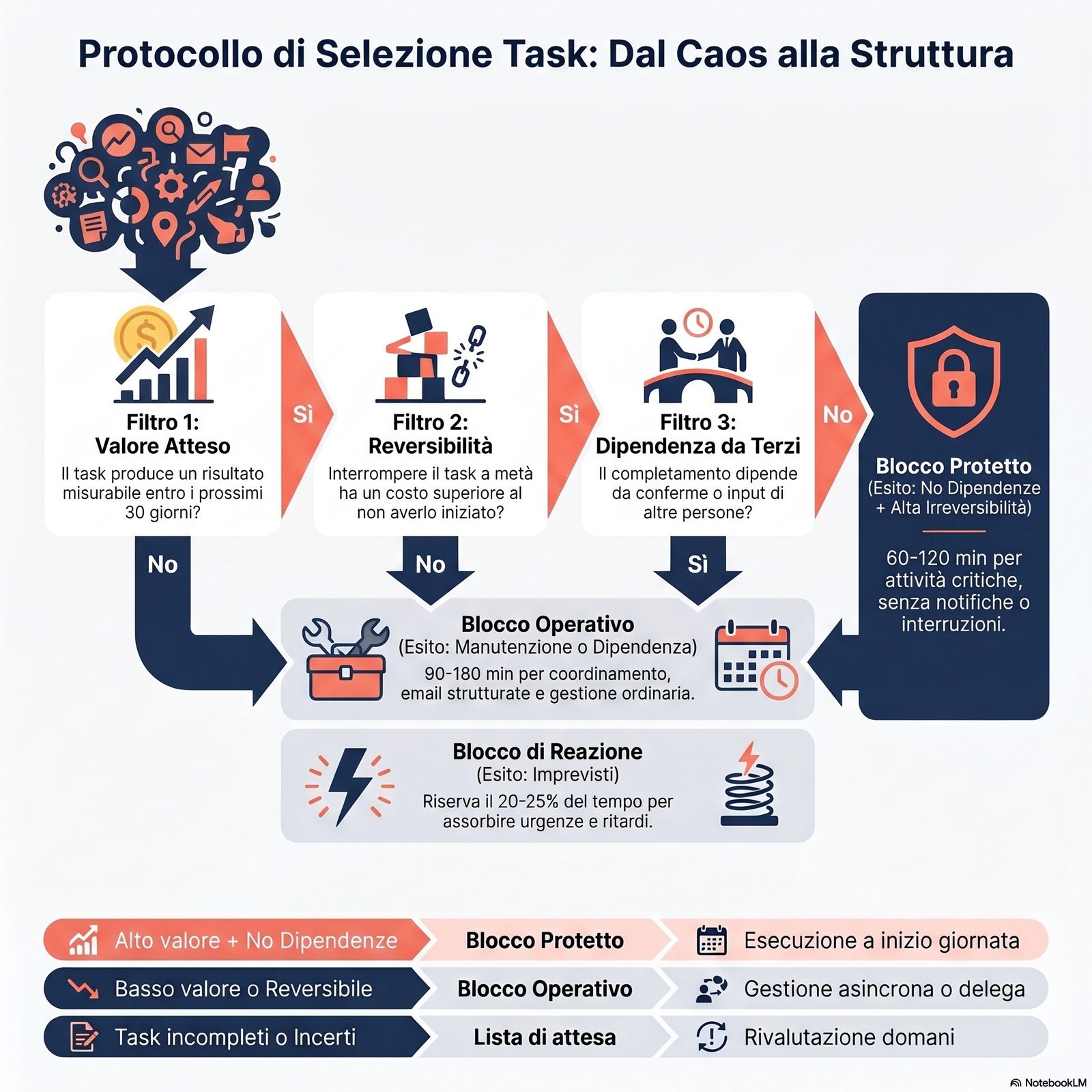
Daily planning fails more often in selection than in execution: a list of fifteen planned tasks is a list that generates frustration, not one that produces results. This section presents three selection filters you can apply in 60 seconds — the task's expected value, the reversibility of the decision, dependence on others — and shows how to reduce a starting list to 3-5 high-yield items.
How many of the tasks planned this morning will generate concrete value within 30 days, and how many are maintenance activities that could be delegated or eliminated? On unfiltered days the ratio rarely exceeds 1 to 4.
The three selection filters:
Filter 1 — The task's expected value. The question is: if this task were completed today, what measurable result would it produce in the next 30 days? Tasks that don't generate an identifiable result within this horizon belong to maintenance work, not to the protected block. They shouldn't be eliminated — they should be placed in the operational block or delegated.
Filter 2 — Reversibility of the decision. Some actions, once started, require continuity: stopping them halfway costs more than never having started them. These are the priority actions in planning — the ones that require a continuous block that can't be reassigned. Fully reversible or interruptible actions can be spread across the margins of the day.
Filter 3 — Dependence on others. A task that depends on another person's confirmation, reply or presence doesn't belong in the protected block — it can stall for external reasons, regardless of the planner's commitment. It should be placed in the operational block, with an alternative ready in case the external dependency isn't resolved.
Managing incoming requests — which systematically challenge the planned selection — is covered in depth in the cluster on managing commitments. If you want to go deeper into the discipline of assigning time blocks, the reference is the cluster on time blocking.
How to defend planned blocks from interruptions
Well-done daily planning is worth little if the blocks aren't defended: a plan riddled with interruptions and context switching produces the same results as an unplanned day. This section describes three defenses that work without special tools — signaling availability, concentrated reaction windows, notification rules — and points out which interruptions shouldn't be blocked, because they are a legitimate part of the role.
Which interruptions are an integral part of a business owner's role, and which erode the value of planning with nothing in return? The distinction isn't made through personal discipline; it's made with two rules of engagement defined before the day begins.
Mark et al. (2016) [6] documented that in work settings most exposed to digital channels, continuous attention time can shrink significantly. Mark, Gonzalez and Harris [3] show that after each interruption an average of 25 minutes and 26 seconds passes before returning to the previous task. These data don't imply that interruptions should be eliminated — they imply that the cost of every interruption during a protected block is much higher than it seems in the moment.
Defense 1 — Explicitly signaling your availability. The protected block doesn't work if the team doesn't know it exists. A stated rule — "from 9 to 10:30 I don't reply to messages; for real emergencies there's channel X" — is more effective than any technical notification setting. Signaling isn't an act of isolation; it's a statement of future availability.
Defense 2 — Concentrated reaction windows. Instead of responding to interruptions as they arrive, it's advisable to concentrate responses in two or three fixed time windows (for example, 10:30-11:00 and 3:00-3:30 p.m.). This approach — supported by Kushlev and Dunn's research on checking email [7] — reduces the cumulative cost of switching without eliminating your availability.
Defense 3 — Distinguishing legitimate interruptions from erosive ones. Some interruptions belong to the role: a significant customer crisis, a supplier with an urgent problem, a decision that can't wait. These interruptions justify opening the block. Other interruptions don't belong to the role — they are requests that could be handled asynchronously, or decisions others could make on their own. The distinction should be made before the day, not in the moment of pressure: two or three explicit criteria for a "legitimate interruption" remove the need to decide case by case under pressure.
The mistakes that hollow out daily planning (and how to avoid them)
The most common mistakes in daily planning aren't about method, they're about application: a protocol carried out without selection criteria, blocks that are planned but not defended, abandoning the ritual after the first few days of practice. This section lines up five concrete mistakes and offers, for each one, a correction you can apply the next morning.
How many attempts at daily planning are abandoned within the first week, and how many after the first month? Most fail not for lack of method, but because the ritual is never protected the way you would protect a meeting with a client.
Mistake 1 — Overcrowding the blocks. The signal: the morning plan contains eight or more tasks in the protected block. The correction: apply the limit of 3-5 daily priority tasks, spread across the three blocks. If there are more than five candidate tasks, select them with the three filters (expected value, reversibility, dependence on others).
Mistake 2 — "Blind" planning with no reference to the weekly plan. The signal: daily planning happens without looking at the week's goals. The correction: the first step of the protocol is to open the weekly plan and check which stated goals need progress that day. Weekly planning is the framework within which daily planning operates — without a framework, the day tends to respond to external stimuli rather than internal goals.
Mistake 3 — No buffer. The signal: the day's plan takes up 95-100% of available hours. The correction: explicitly set aside 20-25% of the time as a reaction block. A 20% buffer on an 8-hour day amounts to 90-100 minutes — which seems like a lot on paper, but the systematic underestimation of time documented by Buehler and colleagues [1] makes it prudent to keep them aside. The percentage, on the other hand, is an operational criterion from our editorial team: that study documents the estimation error; it doesn't prescribe a buffer share.
Mistake 4 — Equating planning with the calendar. The signal: the day is considered planned because the calendar is full. The correction: check whether the blocks in the calendar correspond to tasks selected with the criteria described, or whether they were added in response to external requests. A full calendar is not the same as a planned day.
Mistake 5 — Giving up at the first unexpected event. The signal: the protocol is abandoned in the first week the day doesn't go as planned. The correction: Lally and colleagues [4] documented that forming a habit takes a median of 66 days of regular repetition. The first 30 days of practice produce an imperfect plan — improvement comes with repetition, not with immediate perfection. The ritual should be protected the way you protect any appointment with an outside party.
Limits and conditions of applicability
The protocol described was developed from empirical evidence on individual planning. Some conditions limit its applicability:
- Settings that demand constant responsiveness: in roles that require continuous availability (customer support, emergency management, operational shifts), the morning protected block may be structurally impossible. In these settings, it's advisable to adapt the protocol to lower-traffic time slots, even if they don't coincide with the start of the day.
- Teams in their start-up phase: in a team's first months, mutual interruptions tend to be more frequent and often necessary. The protocol for defending blocks requires the team to understand and accept the access rules — a process that is built over time, not imposed from above.
- Evidence on implementation intentions [2]: Gollwitzer's research concerns the formation of action intentions in general, not business planning specifically. Transferability to the context of managers and business owners is plausible given the underlying cognitive mechanism, but it is not the subject of specific study in the sources cited.
- Data on interruptions [3][6]: the studies by Mark et al. were conducted in knowledge work settings, mainly in North America. The figure of 25 minutes and 26 seconds to return after an interruption is an average from a specific sample of 24 people, with a standard deviation above 54 minutes, and it measures the time that passes before returning to the task, not the time needed to recover the same level of concentration — it is not universally replicable in all work settings.
Frequently asked questions
How many tasks is it reasonable to put in the protected block? Research on implementation intentions [2] and operational experience converge on a number between one and three tasks for the protected block. A single long task (90-120 minutes) is preferable to three short tasks in a row — every transition carries a cognitive cost of getting back on track [3].
What should you do if the day has already departed from the plan by 9:30? The plan isn't a rigid contract — it's a default structure to be updated. If a significant unexpected event takes over the protected block, planning responds reactively: it assesses which tasks in the plan can be moved to the next day, which belong to the reaction block, and updates the plan explicitly (not by silently abandoning it).
Does daily planning also work for people who work in teams with many recurring meetings? Yes, with one adjustment: the protected block should be placed in a time slot that doesn't overlap with recurring meetings. If meetings take up the first two hours of the morning, the protected block moves to the early afternoon or to the end of the meetings. The principle — a continuous, uninterruptible block for priority cognitive work — still holds.
What tool is most effective for managing the daily plan? The template you can download from the page works on paper or in digital form. The choice of tool is secondary to the consistency of the ritual: a paper planner opened every morning is more effective than a digital app checked three times a week.
Operational summary
Daily planning is the 10-15 minute protocol that, carried out every morning before opening your communication channels, turns a day exposed to external stimuli into a sequence of blocks oriented toward the planner's goals.
The three-block protocol — protected block (high-value, uninterruptible cognitive work), operational block (coordination and management), reaction block (a buffer for the unexpected, 20-25% of available hours) — applies the evidence on implementation intentions [2] and on the planning fallacy [1] in a structure you can repeat every day.
Selecting tasks (filters: expected value, reversibility, dependence on others) and defending blocks (signaling availability, concentrated reaction windows) are the two practices that turn the plan from intention into execution. Consolidating the ritual takes about 66 days of practice [4].
The template you can download from the page is the fillable version of this system, available for free.
Conclusion
Daily planning doesn't add time to the day: it adds control. Fifteen minutes of structured protocol, carried out regularly, turn eight hours exposed to other people's requests into a sequence of blocks oriented toward the founder's decisions. The value isn't in the list; it's in the fixed sequence of three micro-decisions — select, allocate, add margin — that gives you back control of your calendar every morning.
The cumulative effect is measurable over the medium term. A planned day produces traceable decisions; a week of planned days reduces the company's dependence on the founder's reactivity; a quarter of continuous practice changes the share of strategic time compared with operational time.
If you want to anchor your daily plan to a longer-range framework, the natural next read is weekly planning: without a designed week, planning a single day risks remaining tactical. If instead you want to go deeper into the time-blocking discipline that supports the protocol, the reference is time blocking. The systemic picture is available in the pillar on time management for business owners.
A business owner who truly plans their days doesn't work more: they reach Friday less tired, with clearer decisions and a noticeably shorter list of postponed tasks.
Sources and references
[1] Buehler, R., Griffin, D., & Ross, M. (1994). Exploring the "planning fallacy": Why people underestimate their task completion times. Journal of Personality and Social Psychology, 67(3), 366-381.
[2] Gollwitzer, P. M. (1999). Implementation intentions: Strong effects of simple plans. American Psychologist, 54(7), 493-503.
[3] Mark, G., Gonzalez, V. M., & Harris, J. (2005). No task left behind? Examining the nature of fragmented work. Proceedings of the SIGCHI Conference on Human Factors in Computing Systems (CHI '05), 321-330. ACM — https://doi.org/10.1145/1054972.1055017
[4] Lally, P., van Jaarsveld, C. H. M., Potts, H. W. W., & Wardle, J. (2010). How are habits formed: Modelling habit formation in the real world. European Journal of Social Psychology, 40(6), 998-1009.
[5] ISTAT (2020). L'organizzazione del lavoro in Italia: orari, luoghi, grado di autonomia — Anno 2019. Labour force survey, 2019 ad hoc module. Istituto Nazionale di Statistica (Italian National Institute of Statistics), September 29, 2020. https://www.istat.it/it/files/2020/09/Report-organizzazione-lavoro-Istat-Eurostat-29-09-2020.pdf
[6] Mark, G., Iqbal, S. T., Czerwinski, M., Johns, P., & Sano, A. (2016). Neurotics can't focus: An in situ study of online multitasking in the workplace. Proceedings of the SIGCHI Conference on Human Factors in Computing Systems (CHI '16), 1739-1744. ACM.
[7] Kushlev, K., & Dunn, E. W. (2015). Checking email less frequently reduces stress. Computers in Human Behavior, 43, 220-228 — https://doi.org/10.1016/j.chb.2014.11.005