
Introduction
A familiar scene. A freelance professional closes the office at eight in the evening feeling they have worked all day and finished nothing substantial: the calendar shows dozens of emails read, two phone calls, a draft stuck halfway. A business owner with twelve employees keeps the office door permanently open, because "otherwise nobody comes by": every question costs five minutes of interruption, and there are thirty questions a day. The owner of a mid-sized company with about a hundred people lives in back-to-back meetings that fill the calendar from nine to seven: the real work, the kind that requires thinking, slips to ten at night.
All three share a common problem. The hours of the day when deep thinking is possible — analyzing a contract, writing a strategy, designing a process — are fragmented by interruptions the individual does not control.
Deep work is the organizational setup that makes possible the experience of deep concentration Csikszentmihalyi described as "flow" [4]. It is not an individual mental quality, it is not discipline, it is not talent: it is a structured protocol for protecting cognitive time.
This article presents the operational definition, the four protocols you can apply in your company, the environment and calendar elements you need, the techniques for social defense and the mistakes that hollow out the practice. The level is operational. It is written for those willing to treat concentration as an organizational skill, not a personal gift.
Setting up the conditions for deep work when willpower is not enough
The common feeling — "I can't concentrate like I used to" — is the symptom of an organizational phenomenon, not an individual failing. In 2024, people employed in Italy worked an average of 36.0 actual hours per week, in line with the EU-27 average of 35.8 [7]; Italian productivity per hour worked, however, grew by an average of 0.4% a year between 1995 and 2023, against 1.5% for the EU-27 [8]. Working time is not the scarce variable: the value produced within those hours is — and part of that value is lost to fragmentation. Deep work is the operational framework that repositions concentration from a personal virtue to organizational infrastructure.
How many of the working hours in your week are actually protected from external interruptions? In a typical business owner's day, windows of concentration longer than ninety consecutive minutes are often fewer than one. The problem is not the individual: it is the calendar.
In this article, deep work means the organizational setup that protects windows of deep cognitive work — the hours when the mind can produce complex thinking, non-trivial analysis and strategic decisions. It should be distinguished from four terms readers tend to confuse it with.
Concentration is a momentary mental quality — the state of attention "here and now." Deep work is the protocol that makes it systematic. The flow state (Csikszentmihalyi [4]; documented at work by Rivkin, Diestel and Schmidt [6]) is a subjective psychological experience of total immersion, the outcome deep work tends to make more likely. Deep work is the setup; flow is the effect. Productivity is a broader concept (output per unit of time): deep work is a specific practice within productivity, not a substitute for it. Isolation is an occasional consequence of deep work (closing the door, silencing the phone), not deep work itself: anyone who fears "becoming antisocial" is mistaking the means for the end.
Willpower is not enough because the mechanism of attention residue — documented by Leroy (2009) [2] — progressively erodes the capacity to concentrate with every switch between tasks. It is not a matter of character: it is a measurable cognitive effect. The fix is not "trying harder"; it is building a system that reduces the number of switches.
Calculating the cost of task switching before protecting focus hours
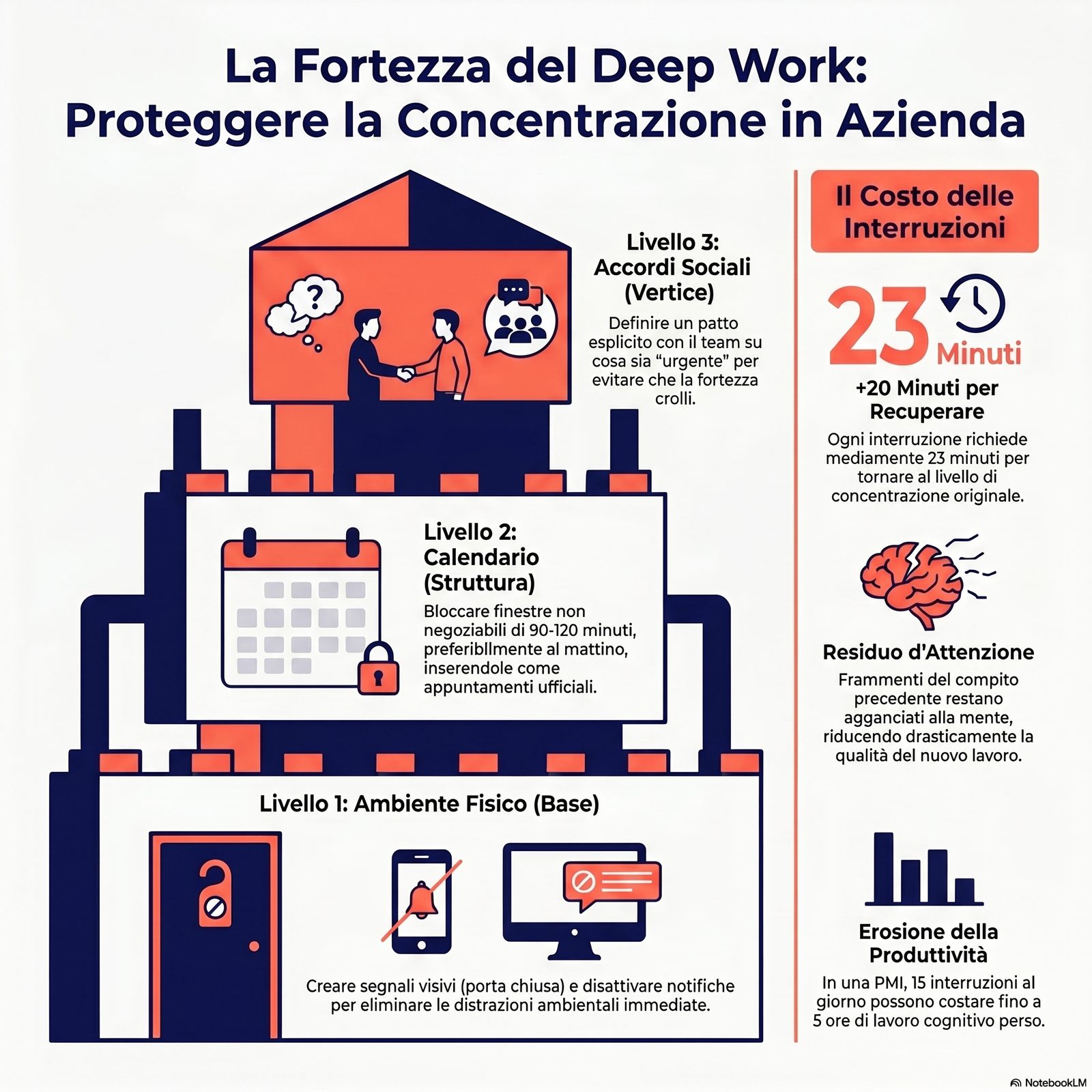
Three studies converge on a counterintuitive finding: the cost of context switching is not linear in time lost, but exponential in the quality of thinking. Mark, Gonzalez and Harris (CHI 2005), observing 24 knowledge workers in their workplace, measured that after an interruption an average of 25 minutes and 26 seconds passes before they return to the original task [1]; the lab experiment by Mark, Gudith and Klocke (CHI 2008) adds that interrupted tasks were completed in less time and without loss of quality, but with a measurable increase in stress, frustration, time pressure and effort [9]. Leroy (OBHDP 2009) isolated the mechanism: attention residue leaves part of your attention hooked on the previous task, reducing performance on the new one [2]. Ophir, Nass and Wagner (PNAS 2009) showed that habitual multitaskers are worse, not better, at cognitive filtering tasks [3]. Together, these three studies make a calculation possible: what does a day of interruptions actually cost?
How much does each request presented as "just a minute" cost, in equivalent hours per week? Using the CHI 2005 data as a qualitative reference [1], the order of magnitude is easily 6-10 hours of deep thinking lost per week. That is a day and a half of real work that never comes back.
An exercise to estimate your weekly cost of task switching:
For three consecutive days, write down every interruption you experience: who it came from, through which channel, how much time it took. At the end of the three days, count the number of interruptions per day. Apply Mark's multiplier as an order of magnitude (not as an exact benchmark): each interruption removes at least 20 minutes of useful deep thinking from the current activity, between recovery time and attention residue. With 15 interruptions a day (a low average in an open-door small company), the estimated cost is 300 minutes a day — five hours — of cognitive work reduced to adequate quality instead of deep quality.
A note on method. Mark's CHI 2005 data [1] refer to n=24 knowledge workers in a US office setting. The mechanism described — the time that passes before returning to the task, the increase in stress [9] — transfers qualitatively to similar settings elsewhere, but the figures should be used as an order of magnitude, not as an exact benchmark for your own situation.
Ophir, Nass and Wagner's finding [3] is correlational: people who do a lot of task switching perform worse on filtering tasks, but the causal link is still debated. The signal is consistent with the other evidence; it is not direct proof.
The four deep work protocols applied to your business
There is no single way to do deep work. The taxonomy of four protocols — monastic, bimodal, rhythmic, journalistic — is popularly associated with Newport's (2016) popular writing, which systematized them as practical categories; the evidence of effectiveness lies in the studies on attention residue and context switching [2][1]. Each protocol has a different organizational cost and benefit. The skill here is choosing the one that fits your scale — freelance professional, small company, mid-sized company — not mechanically applying whichever is in fashion.
Which concentration protocol fits a calendar packed with clients, suppliers and team? The least adopted answer — the rhythmic one — is also the most sustainable. The most coveted — the monastic one — is practical for very few active business owners.
Monastic protocol. Extended periods of isolation (weeks or months) devoted to a specific project. Good fit: a freelance professional building a product, an author, a senior consultant in a research phase. Organizational cost: prolonged absence from the market and from clients. Benefit: exceptional-quality output on complex projects. In an active company, this protocol is only practical in extraordinary phases (a product launch, a strategic restructuring).
Bimodal protocol. Alternating between periods of intense concentration (weeks or months) and normal operating periods. Good fit: business owners of companies with 7-15 people and marked seasonality (businesses with a low season), or with annual-cycle products. Cost: the team must be able to operate with relative autonomy during operating periods. Benefit: it allows complex projects without abandoning day-to-day operations.
Rhythmic protocol. Fixed daily windows of deep work, typically early in the morning (6-9 or 7-10). It is the protocol with the highest applicability-to-benefit ratio for the average company. It requires no periods of absence and fits into a normal operating day. Good fit: business owners of companies with 80-100 people, with dense calendars and no way to isolate themselves for weeks. Cost: it requires discipline in protecting the morning window and explicit agreements with the team.
Journalistic protocol. The ability to move quickly in and out of deep work in any available window — 45 minutes between two meetings, a late hour in the evening. Good fit: people with long experience of deep concentration, able to switch the mode on at will. Not recommended as a starting point: it takes years of practice, and it is often adopted as a shortcut by those who cannot protect fixed windows, with unsatisfying results.
| Protocol | Typical target | Duration | Cost | Benefit |
|---|---|---|---|---|
| Monastic | Creative freelance professional | Weeks | Absence from the market | Exceptional output |
| Bimodal | Company with seasonality | Alternating weeks | Team autonomy | Complex projects |
| Rhythmic | Mid-sized company, dense calendars | 2-3 hours/day | Fixed discipline | High applicability-to-benefit ratio |
| Journalistic | Experienced senior | Variable | High expertise required | Maximum flexibility |
Building the deep work perimeter: space, calendar and agreements with the team
Mark, Voida and Cardello (CHI 2012) took email away from a group of workers for five days: task switching frequency dropped, heart rate variability improved, perceived concentration increased [5]. The operational lesson is not "remove email permanently," which is impractical in a company. The lesson is that the deep work fortress is built on three overlapping levels: the physical environment (the space where you work), the calendar (the protected hours over time) and the social rules (the explicit pact with the team and team members). Without all three levels, deep work remains an intention.
Which of the three levels — physical, calendar, social — is the one that never really gets built? In most cases it is the third. The calendar gets blocked, the door gets closed, but the pact with the team is never stated. Deep work collapses at the first urgent question.
Defending your focus hours: how to say "no" without shutting the company down
The best-designed fortress falls at the first urgent request from an important client or a business partner. Defending your focus hours is not about saying "no" curtly: it is about offering, every time, a workable alternative. The skill here is linguistic and relational, and it is built with three substitute formulas that move the urgency without creating friction. The underlying principle is that deep work does not survive unless it is negotiated and visible.
How many "urgent" requests are truly blocking? When triage is clear and the answer is offered as an alternative, the share of requests that are actually blocking drops significantly. Most urgency is an effect of total availability, not of real need.
Formula 1 — Active deferral. Instead of "I can't right now," an effective phrasing is: "I'll get back to you at 11 with the full attention this deserves." The deferral is precise (it says when), positive (it signals full attention) and does not create the perception of being ignored.
Formula 2 — Transparent triage. With the team: "Focus block until 10. If the request blocks today's current work, flag it as BLOCKING; otherwise it will be handled in the next available window." This formula makes the person asking responsible for assessing the real urgency, reducing unnecessary requests.
Formula 3 — Directed delegation. "For this kind of request, [specific person] has all the information needed and can go ahead without me." This formula assumes there is someone with the authority and information to handle the request — which points back to the work of delegation and team structure.
The case of the strategic client deserves separate treatment. A client who calls during the block cannot receive a generic automated message. An acceptable approach: communicate your availability windows in advance (e.g., "I'm available for calls from 10 to 12 and from 3 to 5") and keep a visible emergency channel. Most clients respect stated windows if they are communicated proactively.
Four mistakes that hollow out the practice of deep work (and how to spot them early)
The practice of deep work fails far more often because of recurring patterns than because of low motivation. Four mistakes in particular hollow out the fortress from within: overwhelming the window with disguised shallow tasks, isolating the practice as a founder's privilege, measuring deep work in hours instead of output, and applying a protocol that does not fit your context. Recognizing them in advance saves months of frustrated attempts and "it doesn't work for me."
Which of these four mistakes is the hardest to recognize in yourself? The second. Extending the practice to the team means giving up the individual privilege of concentration, and almost no business owner does it on the first try.
Mistake 1 — Filling the window with shallow work.
The protected window is used to read email "with focus," or to work on a report while answering Slack in the background. It is deep work only on the calendar, not for the brain: attention residue [2] is present even when the interruption is self-inflicted. The warning sign is that, at the end of the window, you cannot point to a concrete output you produced. The fix is to define, before the window, what output you want to produce and to check it at the end of the session.
Mistake 2 — Founder's privilege.
Only the business owner protects their hours; the team has no way to do the same. The result is that the founder's deep work is fed by the team's permanent reactive work, and the team cannot produce thinking in turn. A company's best decisions and products require concentration at every level, not just at the top. The fix is to extend the practice as an organizational policy: protected focus windows for key roles, with clear access rules for interruptions.
Mistake 3 — Measuring in hours, not output.
"I did two hours of deep work today" is not a measure of productivity. The right metric is what was produced in those hours: a finished document, a decision made and documented, an analysis completed and shared. Measuring in hours rewards completing the time window, not the quality of thinking.
Mistake 4 — A protocol that does not fit the context.
A freelance professional who tries the monastic protocol (weeks of isolation) risks losing clients who need them to be reachable. The owner of a mid-sized company who tries the journalistic protocol (moving quickly in and out of concentration in any window) fails for lack of the required expertise. Choosing the protocol is part of the skill: go back to the section on the four protocols to realign your choice with your context.
Limits and conditions of applicability
The scientific evidence cited in this article mostly concerns knowledge workers in English-speaking settings. The sample of Mark, Gonzalez and Harris (CHI 2005) [1] is n=24 participants in a US office: the numerical values (25 minutes and 26 seconds before returning to the task, with a standard deviation above 54 minutes) should be treated as orders of magnitude, not as precise benchmarks.
Deep work applies best to complex cognitive work (analysis, strategic writing, design, decision-making). For work with a strong relational component (sales, customer care, direct supervision), total protection of the window is structurally incompatible with the role. In these cases, the rhythmic protocol with shorter windows (60-90 minutes) is often the most that is practical.
The Eurostat [7] and ISTAT [8] data provide structural context on Italy's productivity gap, but they do not establish a causal link with the absence of deep work: they are system-level data, not direct evidence of the protocol's effectiveness for the individual business owner.
FAQ
Do you need to tell clients about your deep work practice? It depends on the level of availability expected in your industry. In many cases, stating availability windows (e.g., "I reply to emails by 4 p.m. every working day") is enough. For clients with a strong expectation of immediate response, proactive communication reduces frustration and stabilizes expectations.
How long does it take for deep work to produce visible results? Rhythmic practice (90-120 minutes in the morning) shows the first effects in terms of output within 2-3 weeks. The feeling of cognitive fluency — entering deep mode quickly — takes 8-12 weeks of continuous practice.
Is deep work compatible with remote work? Yes, and remote work often offers better conditions for Level 1 (physical environment). The challenge shifts to Level 3 (social agreements): without physical proximity, communicating your windows of unavailability requires explicit protocols on digital channels.
Operational summary
Deep work is organizational infrastructure made of three levels — environment, calendar, social rules — that protects the hours when deep thinking is possible. Peer-reviewed evidence converges on one point: the cost of context switching is high, measurable and recurring; willpower alone does not neutralize it. The right protocol depends on the scale of the company: rhythmic for the average company and the active freelance professional, bimodal for companies with seasonality. The most frequent mistakes — windows filled with shallow work, individual privilege, measuring in hours, an ill-fitting protocol — can be recognized before they take hold.
Conclusion
Deep work is not a personal virtue, and it is not a time management trend. It is organizational infrastructure made of three levels — environment, calendar, social rules — that protects the hours when deep thinking is possible. Twenty years of peer-reviewed evidence converge on one point: the cost of context switching is high, measurable and recurring; willpower alone does not neutralize it. What neutralizes it is a protocol, chosen to fit the scale of the company and defended with explicit formulas.
The operational thread is simple: measure your own cost of task switching, choose a compatible protocol, build the fortress on all three levels, defend it with negotiating language, and avoid the recurring failure patterns.
To widen the picture, it is also worth reading the reference pillar on an effective work method, which places deep work within a broader system of time and priority management. On the interruptions side, the guide on managing interruptions goes deeper into specific triage techniques. For the broader frame of a business owner's time, the reference pillar is time management for business owners.
When a company truly protects its focus hours, something changes beyond the individual calendar: strategic projects stop slipping into the evening, complex decisions mature in reasonable time, and thinking becomes part of working hours again instead of a late-night leftover. It is at this scale that productivity — as the Italian data above show — has ground to recover.
Sources and references
[1] Mark, G., Gonzalez, V. M., Harris, J. (2005). No Task Left Behind? Examining the Nature of Fragmented Work. Proceedings of the SIGCHI Conference on Human Factors in Computing Systems (CHI 2005), 321-330. ACM. https://doi.org/10.1145/1054972.1055017
[2] Leroy, S. (2009). Why is it so hard to do my work? The challenge of attention residue when switching between work tasks. Organizational Behavior and Human Decision Processes, 109(2), 168-181. https://doi.org/10.1016/j.obhdp.2009.04.002
[3] Ophir, E., Nass, C., Wagner, A. D. (2009). Cognitive control in media multitaskers. Proceedings of the National Academy of Sciences (PNAS), 106(37), 15583-15587. https://doi.org/10.1073/pnas.0903620106
[4] Csikszentmihalyi, M. (1990). Flow: The Psychology of Optimal Experience. Harper & Row.
[5] Mark, G., Voida, S., Cardello, A. V. (2012). A Pace Not Dictated by Electrons: An Empirical Study of Work Without Email. Proceedings of the SIGCHI Conference on Human Factors in Computing Systems (CHI 2012). ACM.
[6] Rivkin, W., Diestel, S., Schmidt, K.-H. (2018). Which daily experiences can foster well-being at work? A diary study on the interplay between flow experiences, affective commitment, and self-control demands. Journal of Occupational Health Psychology, 23(1), 99-111. https://doi.org/10.1037/ocp0000039
[7] Eurostat. Average actual weekly hours worked in the main job — Labour Force Survey, dataset lfsa_ewhan2, 2024 data. https://ec.europa.eu/eurostat/databrowser/view/lfsa_ewhan2/default/table
[8] ISTAT (2025). Misure di produttività — Anni 1995-2023. Statistiche Report, January 9, 2025. Istituto Nazionale di Statistica (Italian National Institute of Statistics). https://www.istat.it/comunicato-stampa/misure-di-produttivita-anni-1995-2023/
[9] Mark, G., Gudith, D., Klocke, U. (2008). The Cost of Interrupted Work: More Speed and Stress. Proceedings of the SIGCHI Conference on Human Factors in Computing Systems (CHI 2008), 107-110. ACM. https://doi.org/10.1145/1357054.1357072