
The answer depends on one thing only, and it isn't the character of the person doing the rereading.
Micromanagement is control exercised over the way a piece of work is done, after that work has been entrusted to someone else, at a level of detail the person checking would not apply to their own work.
It concerns the leader of an established company who still signs every quote, the department manager who redoes their team members' deliverables, and the self-employed professional who can't deliver anything without double-checking it all.
In Italy the ground makes it more common than it seems: 80.9% of Italian companies with at least three employees are controlled by an individual or a family, and in these companies management is entrusted to a manager in 1.4% of cases [1].
Micromanagement is not a character flaw: it is the space control occupies when the standard isn't written down. Without acceptance criteria and agreed checkpoints, checking shifts to the "how" and finds nowhere to stop.
The sections that follow draw the line between micromanagement and supervision, count the signs, trace them back to the gaps that produce them, measure their cost and walk the way out, one step at a time.
Where supervision ends and micromanagement begins
Whoever is accountable for a result has the right to check it: the problem begins when the check changes its object.
Micromanagement concerns the way the work is done, not its outcome.
The systematic review published in BMC Medical Education in 2023 describes it as supervision characterized by excessive, unproductive control and attention to detail [5].
The same review catalogs the recurring behaviors in the literature: tight control, scrutiny of the smallest details of work practices, decisions that are not left to the people doing the work [5].
Three terms get confused with this one, and telling them apart matters before any remedy.
Supervision is the job of the person accountable for the result to the client or to the regulations: it stays legitimate as long as it is applied to the outcome and to agreed deadlines.
Training support is close control with an expiry date: in the first weeks of a new hire it is training, twelve months later it is something else — the boundary is the onboarding process that states when it ends.
Centralized decision-making — what everyday language calls a controlling boss, or a controlling business owner when it concerns the person who founded the company — is the fact that decisions stay with a single person.
Centralizing decisions and controlling how they are carried out are two different things, which often coexist in the same person but are corrected with different levers.
The first is corrected with a role map and with decision-making delegation; the second with written criteria and checkpoints.
This article focuses on the phenomenon: how to recognize it and how to dismantle it in an organization that already has it.
How to design the check when a piece of work is handed off for the first time is the subject of delegating without losing control, which starts from the other end of the same problem.
Once it's clear what you are looking at, what remains is how to recognize it without arguing about intentions.
Four signs of micromanagement you count instead of interpreting
Arguing about intentions doesn't get you far, because people who over-control are usually convinced they are doing their job.
The four signs that follow have the advantage of being countable: you measure them over one week of work, without needing to attribute motives.
Systematically rewriting other people's work. The document comes back redone instead of corrected, and the share of rewritten deliverables stays high even after months.
How to count it: out of ten deliverables from the last month, how many were redone by the person who assigned them.
Approval at every step. Work moves forward in fits and starts, because each phase waits for a go-ahead that concerns the method, not the outcome.
How to count it: how many times an activity stopped while waiting for an answer only one person could give.
The never-ending status meeting. The daily check-in starts out as a way to coordinate and becomes the place where you verify that everyone is proceeding the expected way.
How to count it: how many hours a week go into meetings whose agenda is the progress status.
Vacations when everything stops. It is the clearest sign because it is already measured: the number of decisions left pending during two weeks of absence.
The national picture in Italy makes these signs less exceptional than they seem.
Of all employed people in Italy, only 40.0% answer "can always influence" regarding the methods and techniques of their work, and 38.7% regarding the order of their tasks (Inapp Survey on the Quality of Work, 6th edition, 2025) [3].
Among Italian employees, 83.6% do work that is under the direct supervision of a superior [3].
Widespread supervision is not, in itself, the phenomenon described here: it becomes so when it changes its object, and the four signs serve precisely to establish whether that has happened.
The organizational gaps that produce a controlling boss
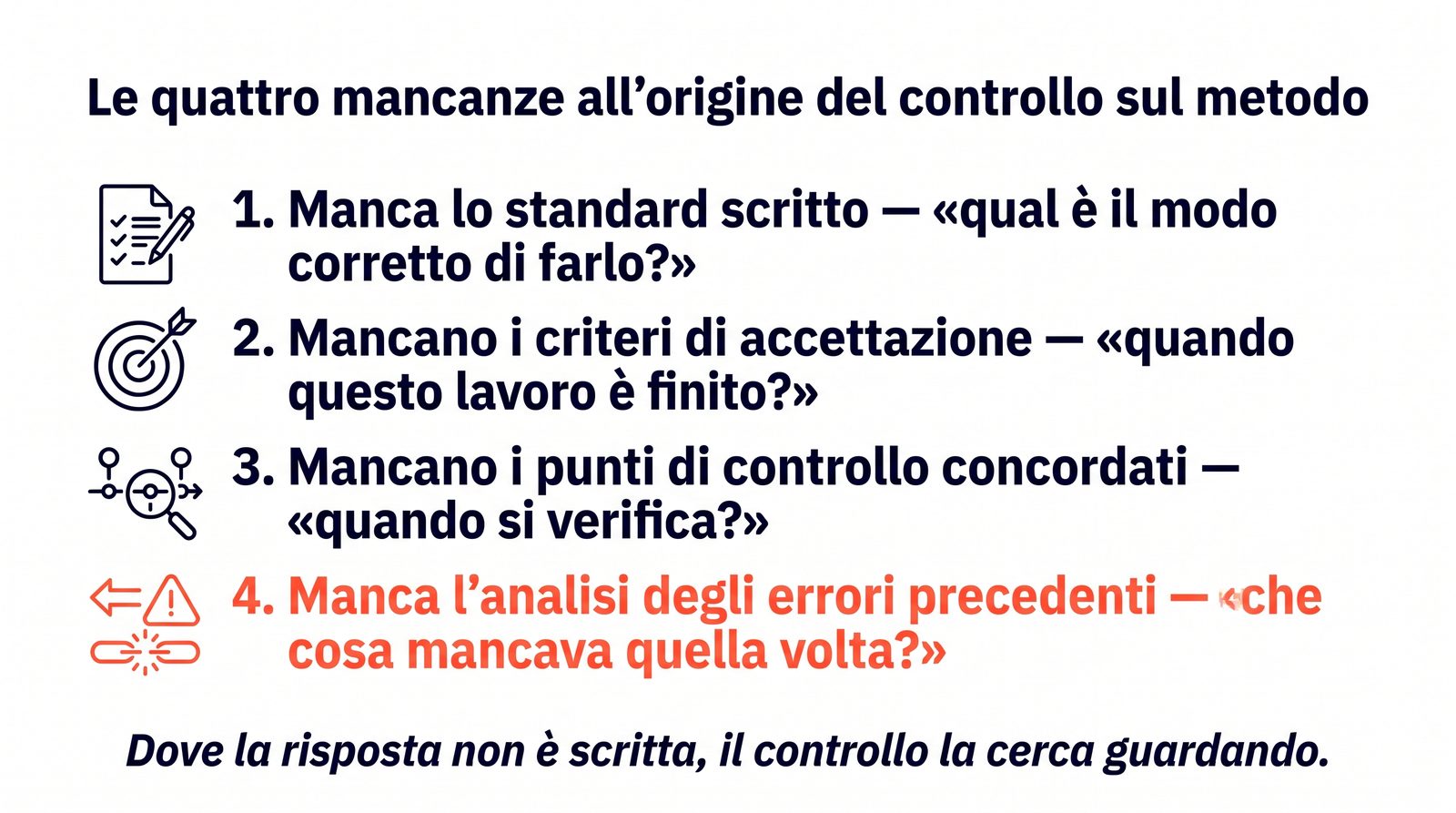
Control over the "how" is not a matter of style: it is what is left when the standard hasn't been written down.
Explaining the phenomenon with the personality of the person in charge has a practical flaw: if the cause is character, there's nothing left to fix.
The four gaps that follow, on the other hand, can be written down on a sheet of paper.
There is no written standard. When the correct way to perform a task lives only in the head of the person who has done it for years, the only channel left to pass it on is watching while it's being done.
Control over the method then becomes the substitute for an operating procedure to refer to.
There are no acceptance criteria. Without a rule that says when a piece of work is finished and acceptable, judgment stays subjective and the person doing it can't close it out on their own.
There are no agreed checkpoints. If it hasn't been established in advance when the check happens, the check happens at any moment: the frequency of control adapts to the anxiety of the person checking, not to the risk of the activity.
Previous mistakes have not been analyzed. A mistake that hasn't been analyzed remains proof that without oversight things go wrong, and each repetition strengthens that belief.
These four gaps have a structural root that Italian data make visible.
In Italian companies under individual or family control with up to 9 employees, management is entrusted to a manager, internal or external, in 0.8% of cases, and in those with 10 to 49 employees in 3.2%; 80.9% of Italian companies with at least 3 employees are controlled by an individual or a family, up from 75.2% in 2018 (Istat, Permanent Census of Enterprises, 2022 data) [1].
In an organization like this, the working method coincides with the method of whoever built it, and it hasn't been written down because until now there was no need.
The Bank of Italy observes, based on survey data and controlling for sector, region and size, that Italian family businesses make less use of work teams and involve lower hierarchical levels less in decision-making [4].
These are correlations, not a causal link: they say where the phenomenon is more likely, not why it happens in a single company.
A case built for illustrative purposes shows the whole mechanism, in an eighteen-person machine shop in an industrial district in Emilia: the owner has set up the machining of special parts for twenty years, the acceptable tolerances live in his experience rather than on a template, and every new part passes through his hands before it goes to the client.
It isn't distrust of the department head hired two years earlier: it's that the criterion for saying "this is fine" exists in only one head.
The owner's time and team members' initiative: the cost of micromanagement
The bill arrives under two separate items, and the second is the one you notice late.
The first item is the time of the person checking. Every approval requested is an interruption taken from a single person's day, and it piles up on activities someone else was already carrying out.
The cost isn't the sum of the minutes: it's the fact that those minutes come out of the one calendar that should be dealing with clients, margins and decisions postponed for months.
How much they really weigh only shows when you measure them the way you measure a role's workload: as long as approvals remain a feeling, they also stay out of the count of hours.
The second item is the initiative of the people doing the work. People who see their work rewritten stop proposing how to do it, and the next proposal never comes.
Along with proposals, reporting stops too: it is the mechanism described under psychological safety, where silence comes not from character but from the cost that whoever speaks up faces.
The Italian figures describe ground that is already not very fertile.
In Italy, 25.6% of employed people say they have little or no influence over the order and content of their work, and autonomy over both drops from 93.8% among employers to 38.6% among fixed-term employees (Istat, Labour Force Survey, 2019 ad hoc module) [2].
Among Italian employees, only 24.0% say they often find their superiors willing to listen when they have ideas or projects to develop [3].
Then there's a third item, which presents itself as a technology problem but is organizational.
Of Italian companies, 17.1% cite difficulty monitoring and evaluating employees' results among the obstacles to remote work; considering the three organizational obstacles surveyed, 35.8% report at least one, with shares above 40% among small and medium-sized companies [1].
A company that can't evaluate a result without seeing the person who produces it has a criteria problem, not a connection problem.
The long-term consequences on people's retention are covered separately under the causes of employee turnover and in the levers of team member motivation.
Once the cost is counted, the question becomes practical: where do you start.
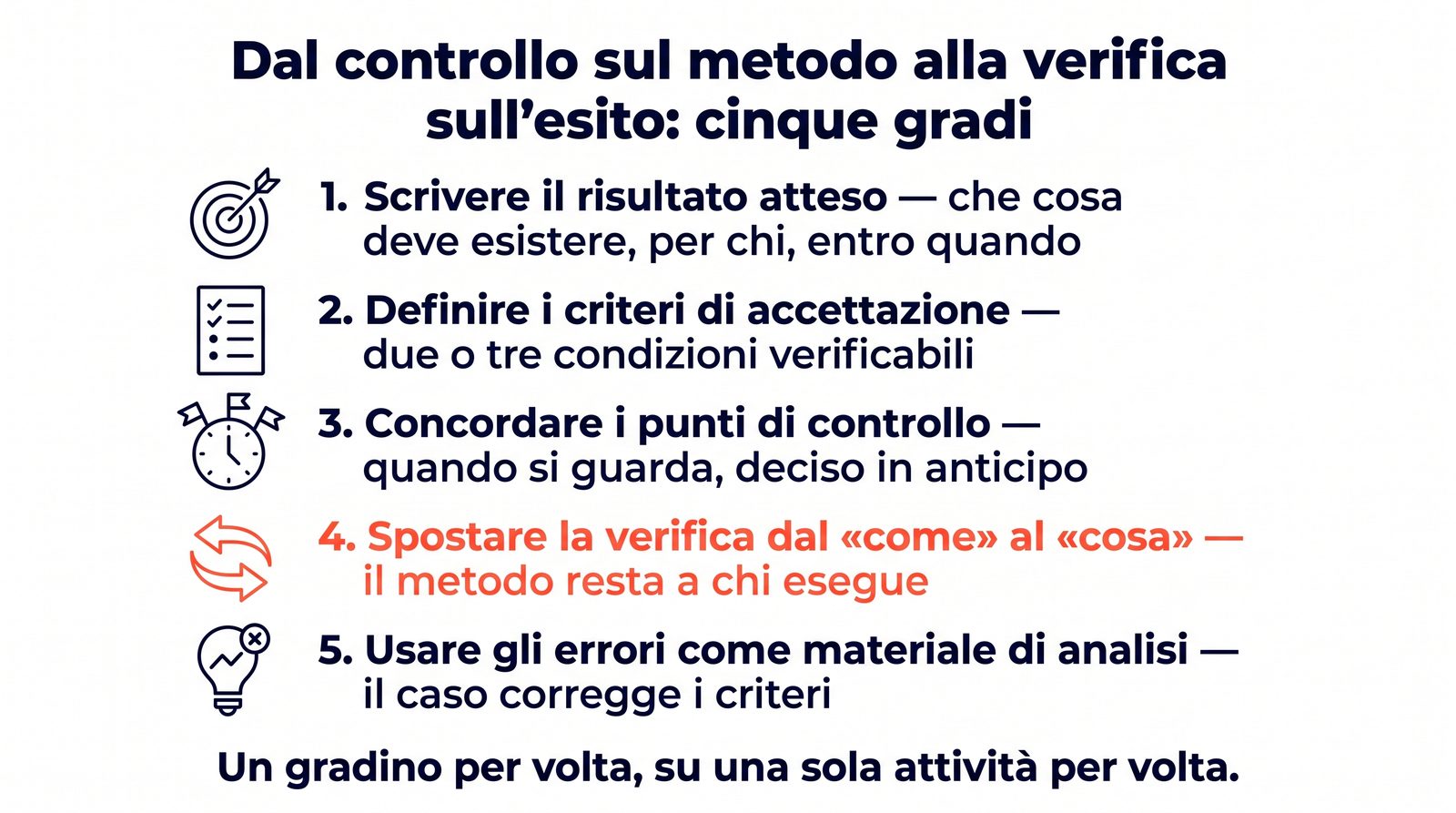
The five-step ladder out of micromanagement without leaving a void
Stopping all at once is the quickest way to prove to yourself that the control was needed.
The ladder that follows is climbed on one activity at a time, in order, and each step produces a short document that stays.
First step: write down the expected result. One sentence saying what must exist at the end of the work, for which recipient and by when — without a word on how to get there.
This step has a diagnostic function: if writing that sentence turns out to be hard, the problem was the result, not the team member.
Second step: define the acceptance criteria. These are the two or three verifiable conditions that let the person doing the work say on their own "it's done" — a tolerance, a format, a cross-check against another document.
An acceptance criterion is verifiable when two different people, applying it to the same work, reach the same verdict.
Third step: agree on the checkpoints. You establish in advance when you look — a third of the way through the work, before delivery to the client — and outside those moments the work proceeds.
It is the difference between effective delegation and permanent authorization: the frequency of checking is decided based on the risk of the activity, not on the mood of the moment.
Fourth step: shift the check from the "how" to the "what." At the agreed points you look at the outcome against the criteria from the second step, and the method used to get there remains the business of whoever did the work.
When the outcome complies but the method differs from the expected one, the different method is information to gather, not a deviation to correct.
Fifth step: use mistakes as material for analysis. A mistake that becomes a case to discuss feeds the method; a mistake that becomes a fault feeds control.
Research on work teams documents the mechanism: people who fear being judged incompetent tend not to bring to light the mistakes that would let the group correct itself [6].
The tool for the fifth step already exists and is described elsewhere: the 5 whys technique for a single chain, root cause analysis for the more serious cases.
On what can be handed off and in what order, the complete path is in the guide to delegation in the workplace and in the piece on how to delegate without losing control.
Once you've climbed the ladder, what remains are the typical slip-ups of people climbing it for the first time.
The most common mistakes when trying to stop micromanaging
The five mistakes that follow can be recognized in advance, because each has a symptom that comes before the damage.
Going from total control to absence in a day. The announcement "starting tomorrow, everyone decides for their own part" removes control without having built the criteria that replace it, and the first piece of work that goes wrong brings the situation back to square one, with one more argument.
The early symptom: the ladder in the previous section was skipped from the third step on.
Announcing the change instead of writing it down. A statement made in a meeting lasts as long as the meeting; an acceptance criterion written on half a page stays available when the doubt actually arises.
Agreeing on checkpoints and then not showing up. Skipping the agreed check teaches that agreements hold only as long as whoever proposed them remembers them, and sends the person doing the work back to seeking reassurance at the wrong times.
Reading the first mistake as proof that control was needed. In the first months visible mistakes tend to increase, because decisions surface that used to be made elsewhere: it is the normal condition of the transition, not its failure.
The early symptom: the conversation about the mistake starts with "who" instead of "what was missing."
Shifting control onto tools. The dashboard open all day, after-hours messages and requests for constant updates reproduce surveillance with a different interface.
A measurement tool is meant to check results at set deadlines: when how often you consult it exceeds how often the data changes, the object of the check has gone back to being the "how."
On what to measure without slipping back into counting activities, the references are business performance indicators and the criteria for giving feedback to team members.
Limitations and conditions of applicability
The two literature sources have scopes that don't coincide with the article's.
The 2023 review covers clinical supervision in healthcare and training settings [5]: the description of the behaviors is transferable, the frequencies measured in that context are not.
The team study covers 51 groups in a single US manufacturing company [6]: it documents a mechanism, not a frequency measured in Italian companies.
The Bank of Italy data are correlations controlling for sector, region and size [4]: they indicate where the phenomenon is more likely, not why it happens in a single company.
The Istat surveys have reference years — 2022 for company structure [1], 2019 for autonomy at work [2] — that differ from their publication year.
There are also cases in which close control is not a flaw to correct: regulatory verification requirements, activities subject to certification, tasks with safety risks, the first weeks of a new hire.
In these conditions the five-step ladder applies to the steps that fall outside the requirement.
The article deals with the organizational dimension of the phenomenon, not the psychological one: it offers no guidance on the personal reasons behind the need for control.
FAQ
What does micromanagement mean?
Micromanagement is control exercised over the way a piece of work is done, after that work has been entrusted to someone else, at a level of detail the person checking would not apply to their own work.
The literature describes it as supervision characterized by excessive, unproductive control and attention to detail [5].
In Italian business usage the term circulates in its English form, with no common Italian equivalent.
How do you tell a controlling business owner from one who only checks results?
The difference lies in the object and timing of the check, not in its intensity.
People who check results look at the outcome at deadlines set in advance and against written criteria; people who centralize look at the method at any moment, and the criterion stays in their head.
A quick test: if the check can be done by reading a document rather than watching a person, the object is the result.
Are there situations in which close control is justified?
Yes, and recognizing them keeps you from fixing what works: regulatory verification requirements, activities subject to certification, tasks with safety risks.
It is also justified in the first weeks of a new hire, where, however, it's called training support and has a stated end date.
How long does it take to stop micromanaging?
It depends on how many activities are involved, because the ladder is climbed one activity at a time.
A complete cycle on a single activity usually takes a few weeks: the time it takes to go through two or three real deliverables.
In the first months visible mistakes tend to increase, because decisions surface that used to be made elsewhere.
Practical summary
The phenomenon is diagnosed over one week of work, by counting four facts: deliverables redone instead of corrected, activities stalled waiting for a go-ahead, hours of meetings whose agenda is the progress status, decisions left pending during the last extended absence.
If the four counts are high, the cause to look for isn't character: it's an unwritten standard, a missing acceptance criterion, a checkpoint not agreed or a mistake not analyzed.
The remedy is applied to one activity at a time, starting with the one that requires the most approvals today.
Write the expected result in one sentence, without saying how to achieve it.
Set two or three verifiable acceptance criteria: two different people applying them must reach the same verdict.
Agree in advance on when the checks happen, and outside those moments the work proceeds.
At the agreed moments, look at the outcome against the criteria, and the method stays with whoever did the work.
The mistakes that surface become the material for correcting the criteria.
The end-of-path check is already on the calendar: two weeks of absence in which you count how many decisions stalled.
Conclusion
Micromanagement is not a matter of character, and that is why it can be dismantled: control over the "how" occupies the space left empty by a standard that hasn't been written down.
Where there are verifiable acceptance criteria and checkpoints agreed in advance, the check has an object and a deadline, and it stops expanding.
The four signs are for diagnosis and are counted over one week of work; the five-step ladder is for the remedy and is climbed one activity at a time, starting with the one that requires the most approvals today.
On the scope of what can be handed off and how to hand it off, the natural next step is the guide on how to delegate effectively.
When instead the knot is upstream — who decides what, even before who carries it out — the previous step is defining role responsibilities.
After a few months of written criteria, the week of the person in charge changes its makeup.
Requests for approval decrease because the answer is already written down, and conversations shift from progress status to the choices only the person in charge can make.
Team members go back to proposing how to do the work, because the how is theirs again.
And two weeks of vacation become useful information instead of a risk to manage: how many decisions stalled measures how much of the method has really left a single head.
Sources and references
[1] Istat, "Censimento permanente delle imprese 2023: primi risultati", November 14, 2023 (reference year of the data 2022; about 280,000 responding companies, representative of 1,021,618 companies with at least 3 employees). Available at: https://www.istat.it/comunicato-stampa/censimento-permanente-delle-imprese-2023-primi-risultati/ — PDF: https://www.istat.it/it/files/2023/11/REPORTCensimprese.pdf
[2] Istat, "L'organizzazione del lavoro in Italia: orari, luoghi, grado di autonomia", Labour Force Survey, 2019 ad hoc module, September 29, 2020 (employed people aged 16 and over, Italy). Available at: https://www.istat.it/it/files/2020/09/Report-organizzazione-lavoro-Istat-Eurostat-29-09-2020.pdf
[3] della Ratta-Rinaldi, F., "Lo smart work in Italia: evidenze dall'Indagine Inapp sulla Qualità del lavoro 2025", Inapp Working Paper no. 154, Istituto nazionale per l'analisi delle politiche pubbliche, September 2026 (6th Survey on the Quality of Work, worker sample, estimates calibrated on the Istat Labour Force Survey for Q1 2025). Available at: https://oa.inapp.gov.it/server/api/core/bitstreams/5b69d4aa-fca3-4530-86f5-f7fde7e714e2/content
[4] Baltrunaite, A., Brodi, E., Mocetti, S., "Assetti proprietari e di governance delle imprese italiane: nuove evidenze e effetti sulla performance delle imprese", Questioni di Economia e Finanza (Occasional Papers) no. 514, Bank of Italy, October 2019 (management practices: Survey of Industrial and Service Firms 2010, 887 observations). Available at: https://www.bancaditalia.it/pubblicazioni/qef/2019-0514/QEF_514_19.pdf
[5] Lee, J., Ahn, S., Henning, M. A., van de Ridder, J. M. M., Rajput, V., "Micromanagement in clinical supervision: a scoping review", BMC Medical Education, vol. 23, no. 563, 2023, DOI 10.1186/s12909-023-04543-3 (12 studies included). Available at: https://pmc.ncbi.nlm.nih.gov/articles/PMC10410949/
[6] Edmondson, A., "Psychological Safety and Learning Behavior in Work Teams", Administrative Science Quarterly, vol. 44, no. 2, 1999, pp. 350-383 (51 teams, 427 respondents, office furniture manufacturing company with about 5,000 employees). Available at: https://web.mit.edu/curhan/www/docs/Articles/15341_Readings/Group_Performance/Edmondson%20Psychological%20safety.pdf