
Delegating effectively means handing another person not just the execution, but also the decision and the responsibility, within a clear scope. It isn't a single act; it's a process with distinct stages.
In Italy, in companies controlled by one person or one family, management is in most cases in the hands of the business owner or a member of the owning family: in 2022 an internal or external manager was brought in at 0.8% of those with 3-9 employees, 3.2% of those with 10-49, 10.0% of medium-sized companies and 21.2% of large ones [1]. The figure points to an opportunity more than a judgment.
The sections below lay out the 5-step process, the handoff tools and the most common mistakes.
Before getting into the process, it helps to draw a clear line between three terms that are often confused. Assigning a task transfers only the execution: the "doing." Delegation also transfers the decision about how to do it and responsibility for the result. A duty is structural and part of the team member's role — it's in the job description; delegation, by contrast, is situational and concerns tasks that formally belong to the person delegating. Finally, an operating instruction describes how to do something: replacing delegation with a string of operating instructions produces dependence, not autonomy.
Recognizing when a task is truly delegable
Not every task weighing down your calendar is ready to be delegated. Some require upfront decoding — of the context, the constraints, the quality criteria — that whoever has been doing them for a long time takes for granted. Recognizing how mature a task is serves as the first filter against delegations doomed to fail.
Which task is truly ready to be delegated, and which needs decoding first? Delegating a task that still lives "entirely in your head" produces two jobs instead of one.
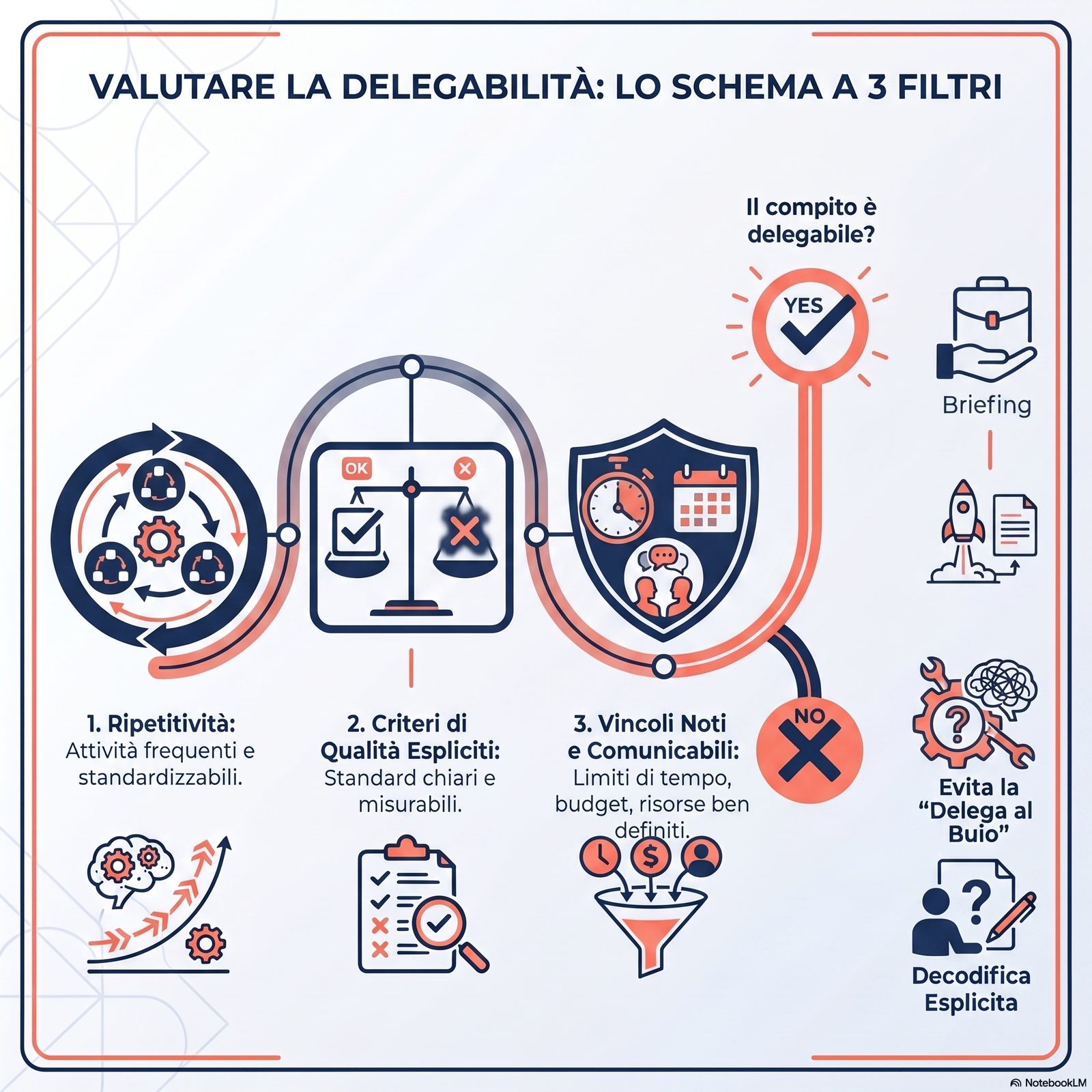
To assess whether a task can be delegated, it helps to apply three criteria in sequence.
Repetition. If the task recurs over time with similar logic, the person who takes it on can build cumulative learning. A task that changes radically every time it comes up, on the other hand, demands a cognitive presence that's hard to delegate in the early stages.
Explicit quality criteria. A task is delegable when the person assigning it can describe — in advance — what a good result looks like compared with an inadequate one. Making those criteria explicit is part of managerial and management skills, which Italian companies list among the skills most in need of improvement (23.3%) [2]. If the criteria exist only in the delegator's head, the task first needs explicit decoding.
Known, communicable constraints. Every task operates within limits — of budget, contacts, deadline, tone. If these conditions can be passed on in an understandable way, the task is transferable. If they're tacit or change without notice, delegation exposes the team member to mistakes that aren't theirs.
Applying these three criteria doesn't require a formal assessment of every task. In practice, it's enough to ask: can I describe a good result? Are there constraints the team member doesn't know about? Does the task follow a repeatable logic? If every answer is yes, the delegation can go ahead.
Choosing the right person for the right task
The "most available" person isn't automatically the "best suited" one. Crossing current skill level, room to grow and workload already assigned gives you a simple matrix that's rarely made explicit. The question isn't only who can do it, but who can do it and grow.
On what criteria do you choose who receives a delegation when resources are limited? Picking the most experienced person is a form of non-decision that holds back everyone else's growth.
Choosing the right person runs along two axes. The first is current skill relative to the task: you don't need every skill, you need the minimum so the person doesn't start from zero and knows when to ask. The ability to work independently and problem solving were rated highly important for 42-43% of the hires Italian companies planned in 2024 [3]. The second is the workload already assigned: delegating to someone who's already maxed out isn't development, it's moving a problem around. Operating workloads are often unevenly distributed, with key people structurally overloaded.
A 2×2 matrix — skill (high/low) on the horizontal axis, available capacity (high/low) on the vertical axis — helps steer the choice quickly:
- High skill, light workload: preferred candidate for urgent or complex tasks.
- High skill, heavy workload: avoid unless it's a top priority; risk of burnout and a drop in quality.
- Low skill, light workload: preferred candidate for development tasks with adequate timelines.
- Low skill, heavy workload: rule out, unless intensive coaching is already planned.
Linking to the company's job descriptions helps at this stage: checking the formal responsibilities of the role keeps you from delegating tasks that are already part of the job, which creates implicit expectations or conflicts over who "should have been doing it already" (read next: how to build a job description).
The guiding principle remains one: the best delegation is the one that helps the recipient grow within a scope the delegator has already defined, not the one that finds the team member "who can already do everything."
Building a briefing that actually transfers the decision
An effective briefing doesn't describe "how to do it"; it describes "what we want to achieve" and the constraints to respect. A briefing built around instructions leaves the team member with the execution and keeps the decision with the delegator. Shifting the focus is the difference between blind execution and autonomy.
How much time is worth investing in the initial briefing to cut down on later back-and-forth? A well-prepared briefing can save many hours of corrections down the line.
An effective briefing is built on four elements.
1. A clear goal. Not "do this," but "the result we're after is X, by date Y, because it serves Z." Describing the goal includes what will be achieved and why it matters.
2. Explicit constraints. Budget, contacts, tone of voice, non-negotiables. Communicating them in advance prevents mistakes the team member couldn't have avoided.
3. Quality criteria. What does a good result look like compared with an adequate one? What minimum thresholds must be met? This is the point skipped most often, and the one that most often causes dissatisfaction.
4. Decision scope. What the team member can decide on their own and what they have to report before acting. Defining the scope isn't a lack of trust; it's the clause that lets autonomy work.
A fictional example, stated as such: if you delegate handling the reply to an unhappy customer, an instruction-centered briefing says "reply today and apologize." A results-centered briefing says "the goal is to win back the customer's trust, the tone is professional but warm, you can offer a discount of up to 10% without asking for approval, and above that threshold you check with me first."
The time invested in the initial briefing pays off in the intermediate steps: a team member who understands the goal and the constraints interrupts less, makes better decisions and delivers results closer to expectations.
Setting checkpoints without sliding into micromanagement
Monitoring a delegation typically swings between two extremes: no checks at all (with surprises at the finish line) and constant control (which erodes the autonomy you handed over). There's a middle path made of checkpoints agreed on upfront, not improvised. The cadence depends on the task and on the team member's maturity.
How often should you check a delegated task without hollowing out the delegation itself? A check every two days on a weeklong task isn't monitoring, it's taking the delegation back.
The key distinction is between process checks and result checks.
A process check verifies that activities are moving in the right direction: have the suppliers been contacted? Is the draft in progress? This kind of check is useful for long or high-risk tasks, but should be used sparingly: too many process checks signal distrust in the team member's method.
A result check verifies that the intermediate or final milestone has been reached against the agreed criteria. It's the kind of check that best respects the autonomy you've transferred.
A rough table for calibrating cadence:
| Type of task | Duration | Recommended check cadence |
|---|---|---|
| Short, recurring task | 1-3 days | Final check on the result |
| Medium task with distinct phases | 1-2 weeks | 1 process check midway + final check |
| Long, complex task | 2+ weeks | Weekly process check + result check per phase |
| First attempt by a new team member | any | More frequent checks, then taper off |
Checkpoints should be agreed on in the briefing, not announced while the work is underway. A surprise check isn't monitoring, it's an interruption. The strategic frame of delegation as a system — not as a one-off — is covered in depth in the guide to delegation in business as a framework.
Read next: the signs of micromanagement and the ladder to get out of it, for when control has already shifted from the result to the method.
Closing the delegation: feedback, learning, taking it back
The closing stage is where you find out whether the delegation produced only a completed task or reusable learning as well. Final feedback, framed around the quality criteria agreed in the briefing, turns the episode into a routine. Without a close, every delegation starts over from scratch.
What separates a close that produces learning from one that only produces "done"? A poorly closed delegation is a task that will land back on the delegator's desk.
Effective final feedback is structured in three steps.
What went as planned. Name explicitly the behaviors and results that met the agreed criteria. Specific — not generic — recognition reinforces the pattern that works.
What went differently. Not "what you got wrong," but "where a deviation from the criteria occurred and why." Analyzing the deviation is neutral: it serves to understand whether the briefing was incomplete, whether the task was more complex than expected, or whether there are skills to develop.
What changes next time. An operating agreement on how the team member will handle the next similar situation. This step turns a single experience into a lasting skill.
For team routines that fold the closing of delegations into moments of collective alignment, it helps to build effective recurring practices (read next: how to make business meetings effective).
Handoff tools: what to write down and what to say out loud
Part of a delegation can be carried by documents (scope, quality criteria, deadlines); another part requires conversation (context, nuance, aligning expectations). Picking the wrong channel, in either direction, is a frequent cause of misunderstandings. The working rule is simple: what can be verified goes in writing, what requires listening goes out loud.
How much of a delegation should be put in writing, and how much works better in conversation? A spreadsheet doesn't replace a conversation, but an undocumented conversation evaporates within 48 hours.
What goes in writing:
- Goal and deadline
- Explicit constraints (budget, contacts, thresholds)
- Quality criteria for the result
- Decision scope (what the team member can decide on their own)
- Agreed checkpoints with dates
What calls for a conversation:
- Background and reasons for the delegation
- Relational nuances (how to work with a particular contact)
- Aligning mutual expectations
For team tools that support documenting delegation in broader settings, the link with team practices is covered in how to delegate effectively within a team.
Common mistakes in operational delegation
The most common delegation mistakes aren't about technique, they're about process: rushed choice of recipient, briefings focused on "how to do it," monitoring that's absent or oppressive, closes that never happen. Recognizing them is more useful than memorizing them, because they take different forms depending on the size of the company. Tackling them takes honesty more than method.
Which of these mistakes costs more: delegating to someone who isn't ready, or not delegating at all? Both lead to the same outcome — a founder held hostage by day-to-day operations.
The six most frequent mistakes, each with its micro-fix:
1. A briefing focused on "how to do it" instead of the result. The team member executes without understanding why, doesn't take initiative when needed, and delivers results that are technically sound but disconnected from the real goal. Fix: rewrite the briefing starting from the goal and the quality criteria, not from the sequence of steps.
2. Choosing the recipient by availability, not suitability. It produces an overloaded team member and a half-finished job. Fix: apply the skill/workload matrix before assigning.
3. No agreed checkpoints. It creates silence until final delivery, with surprises that are hard to manage. Fix: define the checks in the briefing, with cadence and subject.
4. Taking the task back at the first snag. It tells the team member the delegation was conditional. Fix: distinguish deviations that call for intervention from those that are part of normal learning.
5. Failing to close the delegation. The final feedback never happens, the episode doesn't turn into learning, and the next delegation starts from zero. Fix: plan the closing conversation as part of the process, not as an optional extra.
6. Confusing delegation with task assignment. The team member executes but doesn't decide — and every variation needs a new authorization. Fix: spell out the decision scope in the briefing.
Limits and conditions of applicability
The five-step process described in this article works best in settings where roles are reasonably well defined and team members have a baseline of operational autonomy. In very small teams (2-3 people) or in a company's startup phase, structured delegation can be out of proportion to how simple the tasks are: in that case, applying the essentials is enough — a clear goal, a decision scope, final feedback.
The sources cited in this article (ISTAT, the Excelsior information system) describe Italian companies as a whole: governance, skills reported as important or in need of improvement, skills required of new hires. They're a contextual reference, not an absolute benchmark: conditions in each organization vary significantly by industry, maturity and internal culture.
This article focuses on individual delegation (from one person to another). For delegation at the team and process level, the dynamics change considerably: the article on effective delegation in teams explores that dimension.
FAQ
How many delegations can you manage effectively at the same time? There's no universal number: it depends on the complexity of the tasks and the maturity of the team members involved. A reasonable working estimate is 3 to 5 active delegations for one person who manages them with regular checks. Beyond that threshold, monitoring tends to deteriorate or become superficial.
What should you do if a team member misses checkpoint deadlines? A missed check is a signal in itself: it may point to overload, a misunderstanding of the agreement or misaligned priorities. Before reading it as negligence, it's worth checking the team member's working conditions. If the problem persists, revisit the initial agreement — don't add more checks.
Does delegation also apply to creative tasks or tasks that call for a lot of judgment? Yes, with one variation: the decision scope and quality criteria should be described more broadly. "Find an original angle for the presentation, as long as it fits the brand's tone and works for a technical audience" is a delegating briefing even for a creative task.
How do you handle delegation with a team member who keeps asking for confirmation? This behavior often signals an initial briefing that said too little about the decision scope. The fix is to redo the briefing, spelling out what the team member can decide on their own — rather than answering every request for confirmation, which otherwise settles into a habit.
Is it worth formalizing delegations in writing even in small teams? In small teams, a simplified version (a written message with goal, constraints and checks) is enough and brings real benefits: it reduces after-the-fact misunderstandings and creates a shared record.
Practical summary
Delegating effectively isn't a gesture, it's a five-step process: check that the task can be delegated (repetition, explicit quality criteria, known constraints), choose the recipient based on skill and available capacity, build a briefing that transfers the goal and the decision scope, agree on checkpoints in the briefing itself, and close with structured feedback that produces learning. Written tools and conversations are combined according to the nature of the content.
Every neglected step has a cost: a task delegated without a clear briefing comes back with unwanted variations; missing monitoring brings surprises; a missing close wipes out the learning. The cumulative cost of poorly managed delegations is the main obstacle to the founder stepping out of day-to-day operations.
Conclusion
Delegating effectively isn't a single gesture, it's a staged process: recognize whether a task is ready, choose who can do it and grow, build a briefing that transfers the decision, set checkpoints that don't hollow out autonomy, and close with feedback that produces learning. Skipping one of these stages is the most common route to delegations that bounce back.
The thread that ties them together is the distinction between transferring execution and transferring responsibility. The first is only temporary relief; the second is what actually frees up the delegator's time. To frame delegation as a strategic as well as an operational choice, it's also worth reading the guide to delegation in business as a framework and, on the team-practice side, how to make business meetings effective.
A business where delegation really works is one where the founder steps out of day-to-day operations without fear, team members make decisions within clear scopes, and mistakes become data rather than drama. It's a calmer way of working with more sustainable growth, open to organizations of any size, as long as delegation stays a process and not a one-off.
Sources and references
[1] ISTAT, "Censimento permanente delle imprese 2023: primi risultati", Statistiche report, Table 2 (year 2022, companies with at least 3 employees controlled by an individual or a family). Available at: https://www.istat.it/it/files/2023/11/REPORTCensimprese.pdf
[2] ISTAT, "Formazione nelle imprese — Anno 2020", Statistiche report, December 30, 2022. Available at: https://www.istat.it/it/files/2022/12/REPORT-formazione-imprese.pdf
[3] Unioncamere — Italian Ministry of Labor, Excelsior information system, "La domanda di professioni e di formazione delle imprese italiane nel 2024". Available at: https://excelsior.unioncamere.net/sites/default/files/pubblicazioni/2024/Domanda_professioni_formazione_imprese.pdf