
Feedback to team members is a short conversation in which you describe an observed behavior, the effect it produced and what you are asking the person to confirm or change in the future. It's not a personal judgment; it's a work tool.
A study of 1,092 Italian workers shows a positive correlation between team members' willingness to seek and use feedback and the quality of the feedback environment they perceive in their company [1]. The finding points more to an opportunity than to a judgment.
The following sections clarify structure, wording, timing and common mistakes.
Before going further, it helps to clarify three pairs of terms that are often confused. Feedback describes an observed behavior and the effect it produced; a judgment labels the person ("you're careless," "you're competent"). The first opens room for action, the second closes it. Replacing feedback with a judgment is the fastest way to trigger defensive reactions. Feedback asks you to look at a behavior together and agree on what changes; an instruction says "do it this way." One develops autonomy, the other replaces it — confusing the two produces micromanagement disguised as feedback. Finally, a formal performance review is a recurring event with criteria agreed in advance; feedback is a short, frequent, situational conversation. They reinforce each other only if they stay distinct.
Stay descriptive: separate observed behavior from interpretation
Effective feedback starts by describing what you observed — facts, words, actions — not what you inferred. "You sent the email without the file attached" is a description; "you're careless" is an interpretation. Confusing the two is the most frequent cause of defensive reactions that shut the conversation down.
What changes between saying "you're careless" and saying "I noticed yesterday's email arrived without an attachment"? A single interpretation presented as fact is a conversation that ends before it begins.
The distinction between description and interpretation is applied in practice through three paired examples.
Example 1. Interpretation: "You're not precise in your work." Observable description: "Last week's report was missing the third-quarter data, which was on the checklist we agreed on."
Example 2. Interpretation: "You're defensive in meetings." Observable description: "In the last two meetings, when objections were raised about the proposal, you responded before the objection had been fully stated."
Example 3. Interpretation: "You're not proactive." Observable description: "In the March project, the three additions the client requested arrived only after I explicitly asked for them, not on your own initiative."
In each case, the observable description — unlike the interpretation — lets the team member deal with a fact, not with a judgment about who they are. The practical consequence is that the team member can respond with information ("I hadn't received that checklist") rather than with defenses ("it's not true that I'm not precise").
To place feedback in the broader context of the manager–team member relationship, the article on how to manage your people provides the strategic framework.
Build the SBI structure: Situation, Behavior, Impact
The SBI structure — situation, behavior, impact — reduces the sequence of effective feedback to three essential steps. The business press describes it as one of the most useful techniques for keeping feedback anchored to facts, avoiding the interpretations that trigger defensiveness [2]. The structure doesn't make you rigid; it supports the person speaking.
Which of the three elements is most often skipped in feedback given "on the fly"? Skipping the situation means saying "it happened that..." without anchoring it to the fact.
The SBI model breaks down into three steps, with a complete example.
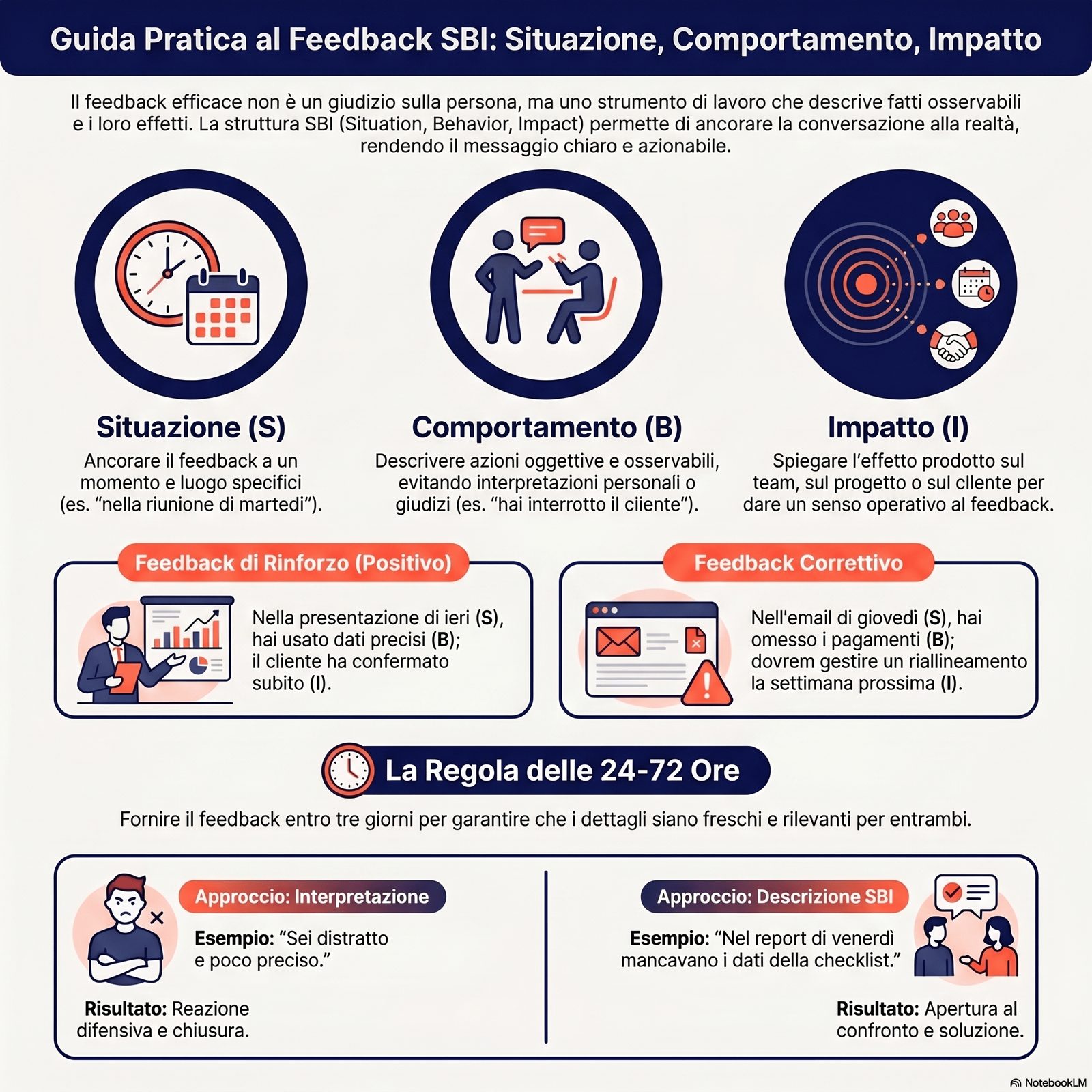
Situation. When and where the behavior occurred. Not "often" or "sometimes," but a specific reference: "in Tuesday's meeting" or "in the report delivered on Friday." The situation anchors feedback to reality and prevents generalizations.
Behavior. What the team member did or didn't do, described in observable terms. Not "you handled it badly," but "you interrupted the client three times before they finished speaking."
Impact. What effect the behavior produced: on the other person, on the project, on the team, on how you are perceived externally. The impact is the "why it matters": without this part, the behavior seems like a matter of style, not an operational problem.
Version for positive feedback: "In yesterday's presentation (situation), you answered all the technical objections with precise data (behavior). As a result, the client confirmed the proposal right away, without a second meeting (impact)."
Version for corrective feedback: "In Thursday's email to the supplier (situation), you left out the payment terms we had agreed on (behavior). The supplier confirmed without that information, and we'll have to sort out a realignment next week (impact)."
The SBI structure isn't a rigid script: it's a sequence that helps the person speaking not to skip the steps that make feedback useful. It can be used in 2 minutes or in 10, depending on how complex the behavior is.
Choose the right moment without putting feedback off forever
The ideal moment for feedback is as close as possible to the event, in a setting where the team member is ready to listen. Waiting for the "year-end review" turns feedback into archaeology. Waiting for "the perfect moment" turns it into no feedback at all.
How long can you put off feedback before it loses value? Feedback given three months later is a grievance, not a tool for growth.
The working rule is: within 24–72 hours of the event, in a non-public setting and not immediately after a moment of high emotional tension.
Within 24–72 hours because the specific details — situation, exact behavior, observable impact — are still fresh for both of you. After that window, memory gets reconstructed and feedback risks turning into a discussion about what really happened, before you even get to what to do differently.
Not in public because feedback in front of a group — even if well phrased — triggers shame and defense mechanisms that make the conversation harder. The exceptions are explicit positive feedback in front of the team, which also has a collective reinforcing effect.
Not immediately after a moment of high emotional tension because the willingness to listen is reduced. If a mistake has just surfaced dramatically, it's wise to wait a few hours before opening the feedback conversation — not to avoid it, but to have it at a time when it can be processed.
Structure the feedback conversation in three phases: opening, content, closing with a shared commitment
Once you've chosen the right moment, how do you open the conversation without letting it slide into a reprimand or a hasty formality?
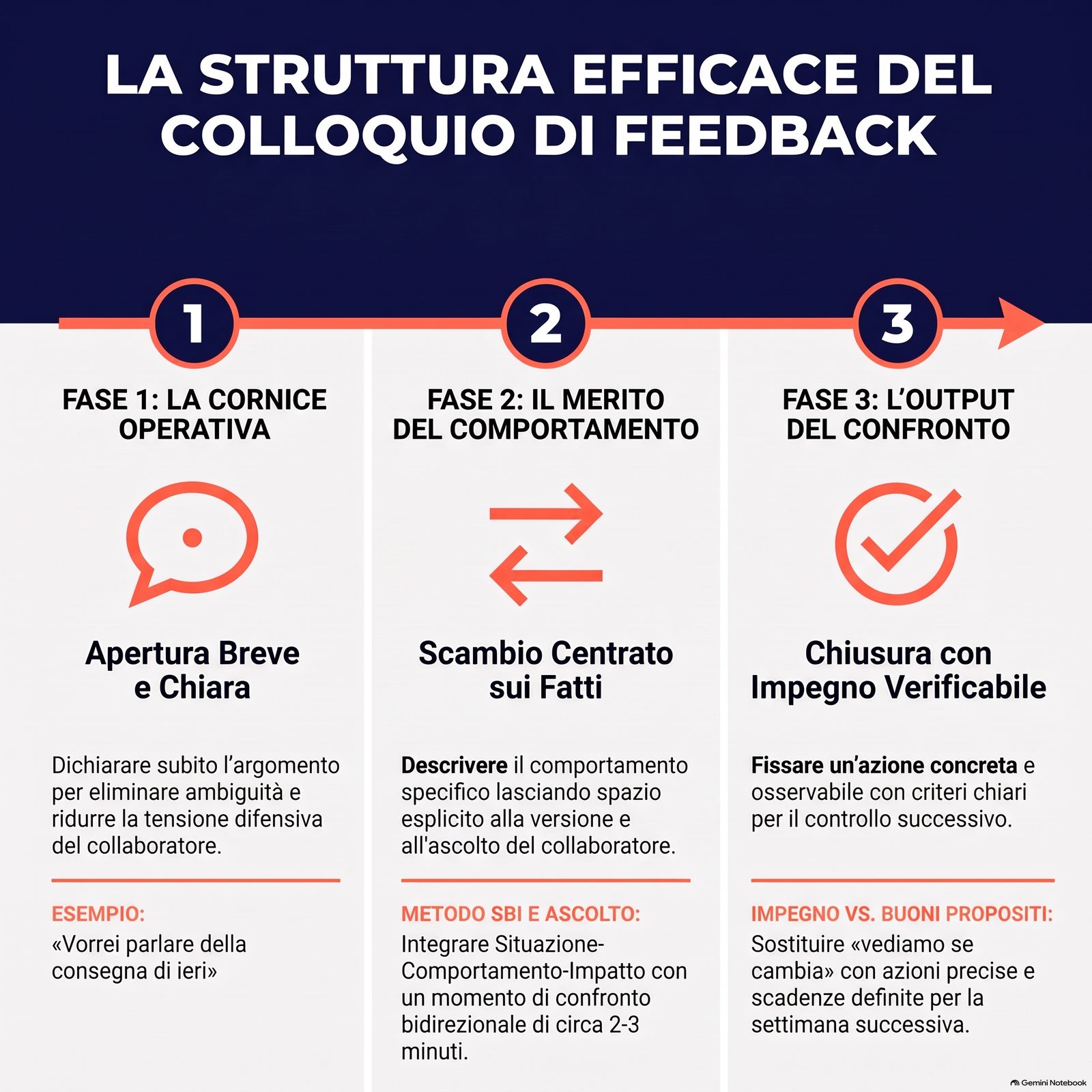
The sequence of the conversation — opening, exchange focused on the behavior, closing with a verifiable commitment — matters as much as the content of the message: a recognizable structure reduces the team member's defensive tension.
A well-run feedback conversation follows a recognizable three-part sequence: a brief opening that states the subject of the conversation, an exchange focused on the behavior with room for the team member's side of the story, and a closing that sets a verifiable commitment for the following period.
In a manufacturing company where the department manager splits time between the shop floor and the office, the same sequence can be applied in 5–10 minutes beside the production line, with no need for a dedicated meeting room.
Skipping the opening or the closing phase is among the most common mistakes: the conversation turns into a list of observations with no shared landing point.
This skill is part of everyday entrepreneurial leadership, not an exceptional event reserved for formal review meetings.
The previous section on the right moment and the section on the SBI structure answer two different questions: when to speak and what to say once the conversation is open.
The opening-exchange-closing sequence answers a third question that comes even earlier: how you enter the conversation and how you leave it, regardless of the specific content described with the SBI method.
The opening lasts a few seconds and has only one job: to state the subject of the conversation before getting into the details.
A sentence like "I'd like to talk about yesterday's delivery" removes ambiguity and reduces the defensive reaction that arises when the team member doesn't know where the conversation is going.
Skipping this step and starting directly with the description of the behavior has the same effect as a sudden interruption, even when the content that follows is correct.
The exchange focused on the behavior is where the situation-behavior-impact structure described in the previous section fits, with explicit room for the team member's side of the story.
This room is not the same as the four-step listening sequence covered later in this article: that sequence concerns how to phrase the open question after the feedback, while here the three-phase sequence only defines the time frame in which that question fits.
The same SBI content is more or less effective depending on where it sits in the sequence: delivered without an opening, the team member receives it as a surprise criticism; delivered without a closing that sets a commitment, it remains a dangling observation that no one knows what to do with.
The closing sets a verifiable commitment for the following period, not a list of good intentions.
A verifiable commitment has an implicit or explicit deadline and a criterion for telling, the next time, whether it was met.
"Let's see if it changes with the next delivery" is weaker than "with the next delivery, check that the attachment is complete before sending," because the second statement indicates what to look for.
In practice, the three phases compress into a few minutes: a one-sentence opening, a two- or three-minute exchange on the specific behavior, a closing that sets a single concrete action for the following week.
The same sequence applies to the owner of a professional practice discussing with a team member how a client deadline was handled: same structure, regardless of the industry.
In a family business, where the line between professional and personal relationships is thinner, the opening phase carries even more weight: stating the subject of the conversation prevents a team member who is also a relative from reading the feedback as a judgment on the relationship rather than on the behavior.
The same sequence also reduces the cognitive load on the person giving feedback, whether the content is a criticism or recognition.
It's precisely the relative weight of positive and corrective observations, within the same sequence, that determines the balance covered in the next section.
Balance positive and corrective feedback without a numerical formula
A team where only corrective feedback circulates experiences every conversation as preparation for the worst. A team where only positive feedback circulates sees the value of both crumble. Balance isn't a numerical ratio; it's the discipline of also naming what works, when it works.
Which kind of feedback do organizations most often underinvest in? Positive feedback given out of politeness is worth less than specific feedback given late.
Distinguishing between two kinds of positive feedback helps you avoid drifting toward generic compliments.
Reinforcing positive feedback. It describes a specific behavior and its positive effect, using the SBI structure. This is the feedback that consolidates a way of working: "How you handled the difficult client yesterday (situation) — you listened without interrupting and restated the objection before answering (behavior) — changed the tone of the conversation, and we closed with an agreement (impact)."
Polite positive feedback. Generic, not anchored to a specific behavior: "You're always very professional," "you do a great job." It has a limited effect on reinforcing the desired behavior and, if used often, also reduces the weight of corrective feedback.
Underinvesting in specific positive feedback is common because people who manage others tend to step in on problems and take for granted what works. Explicitly naming what works — with the same precision used to describe what needs correcting — is a discipline built over time.
For the connection with company culture as a system that supports or hinders feedback, see the article on how to build a company culture.
Make room to listen to the team member without diluting the message
After you've given the feedback, listening to the team member isn't giving in; it's checking for understanding. An open question — how does the team member see it? what happened from their point of view? — narrows the distance without watering down the message. The opposite risk is just as real: listening that turns into preemptive justification.
How much open questioning is needed after feedback without emptying it of meaning? Asking "What do you think?" right after giving feedback invites the team member to defend themselves, not to reflect.
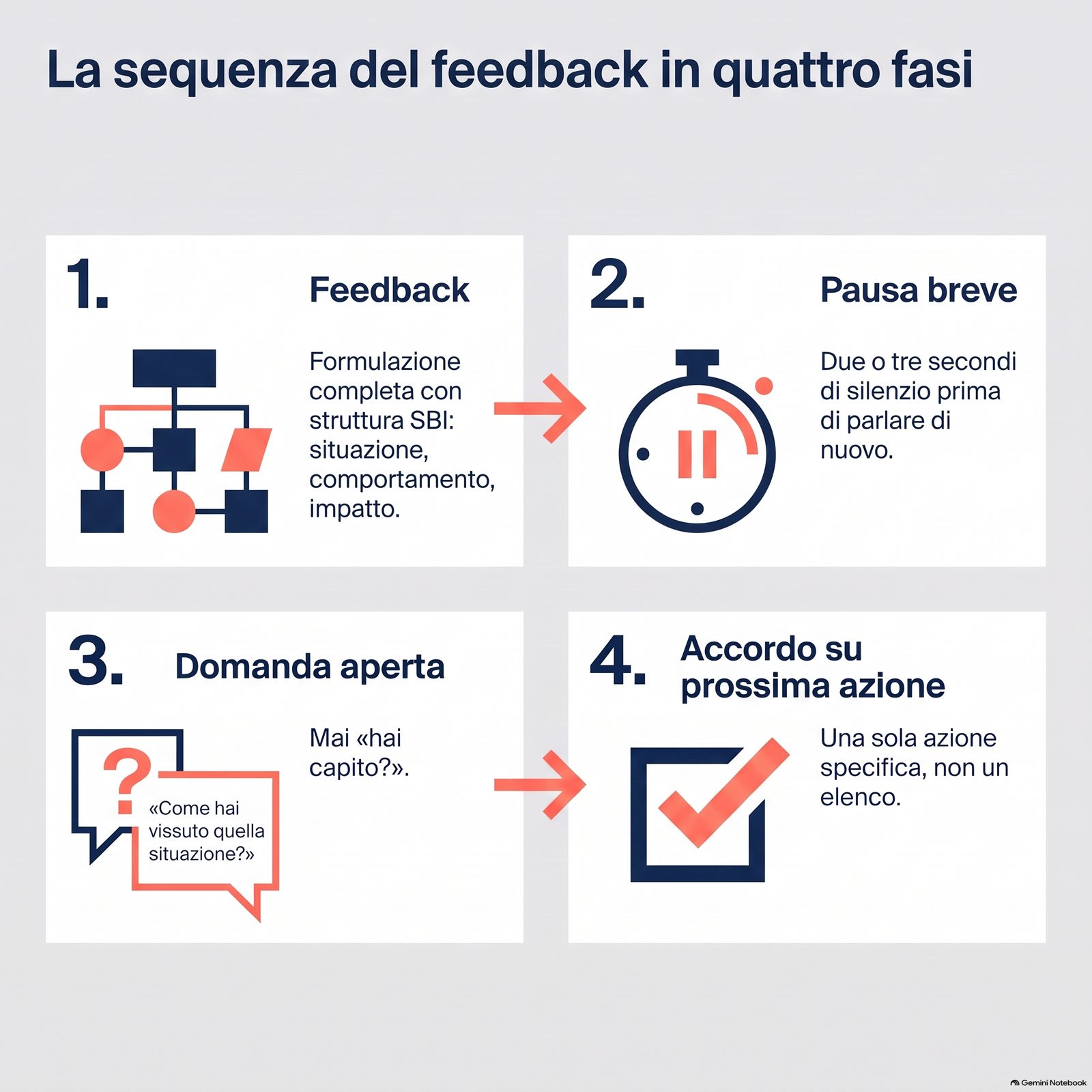
The working sequence has four steps.
Feedback. You deliver the complete feedback using the SBI structure, without interruptions and without asking for feedback while you're delivering it.
Short pause. Two or three seconds of silence before the open question. The pause lets the team member process what they've heard. It's the hardest moment for the speaker to manage, but the most useful for the listener.
Open question. Not "Did you understand?" (closed) or "What do you think?" (too generic), but a calibrated question: "How did you experience that situation?" or "How did you read that moment?" The question should invite reflection, not defense.
Agreement on the next action. Feedback closes with something concrete: what changes the next time a similar situation comes up. The agreement shouldn't be a list: one specific action is worth more than five vague commitments.
For the connection with the formal review that complements situational feedback, the article on how to structure performance reviews explores that dimension in depth.
Read next: psychological safety and the first thirty seconds after someone raises an issue, for the opposite case — when it's the team member who brings up a problem and your response decides whether they'll bring up others.
Recognize and correct common mistakes in giving feedback to team members
The most frequent mistakes in giving feedback aren't about technique; they're about posture: slipping into personal judgment, accumulating observations and unloading them all at once, choosing the wrong moment, unbalanced alternation of positive and corrective feedback, avoiding feedback so as not to "spoil the atmosphere." Recognizing them is more useful than memorizing them, because they show up in different forms depending on the relationship. Addressing them takes honesty more than method.
Which mistake costs more: giving feedback too bluntly or not giving it at all? Both extremes produce the same outcome — a team member who doesn't know what they need to do better.
The six most common mistakes, each with a quick correction.
1. Slipping into personal judgment. "You're disorganized" instead of "in project X, the handoff steps hadn't been defined." Correction: before any feedback, check whether the sentence describes a behavior or labels a person.
2. Accumulating observations and unloading them all at once. "Bundled" feedback — three months of observations in a single conversation — produces overwhelm and defensiveness. Correction: give smaller, more frequent feedback, close to the event.
3. Choosing the wrong moment. Giving feedback in public, immediately after an emotional event or when the team member is clearly busy. Correction: respect the 24–72 hour window and check availability before starting.
4. Only corrective feedback. Team members learn to recognize the behaviors to avoid but not those to repeat. Correction: apply the same descriptive precision to reinforcing positive feedback.
5. Avoiding feedback so as not to "spoil the atmosphere." The problem doesn't disappear; it builds up. When it surfaces, it's harder to deal with, and the relationship has lost the trust needed to handle it well. Correction: separate feedback from confrontation — the first is a conversation, the second is an escalation.
6. Not closing with an agreement. The feedback ends with the description of the problem, without an agreement on what changes. Correction: always close with a question about the next action: "What will you try to do differently the next time you're in this situation?"
Rephrase the most common mistakes: phrases to avoid and practical alternatives in feedback to team members
Is knowing which mistakes to avoid enough to find the right words when you're actually talking to the team member?
Knowing the theory and phrasing the right sentence under pressure are two different skills: directly comparing the mistaken phrase with the alternative phrase helps fix the language pattern before you really need it.
The situations that lead to the mistakes described in the previous section almost always come back with the same words.
Rephrasing a few recurring sentences in advance reduces the risk of falling back into judgment when the conversation gets more delicate.
Comparing the phrasing to avoid with the alternative phrasing makes visible, sentence by sentence, the difference between describing a behavior and labeling a person — the same distinction introduced in the article's first section, applied here to concrete, ready-to-use examples.
In a family business with long-standing team members, moving from a habitual judgment ("you don't try hard enough") to a precise description of the behavior is often the change that unlocks conversations that have been put off for months.
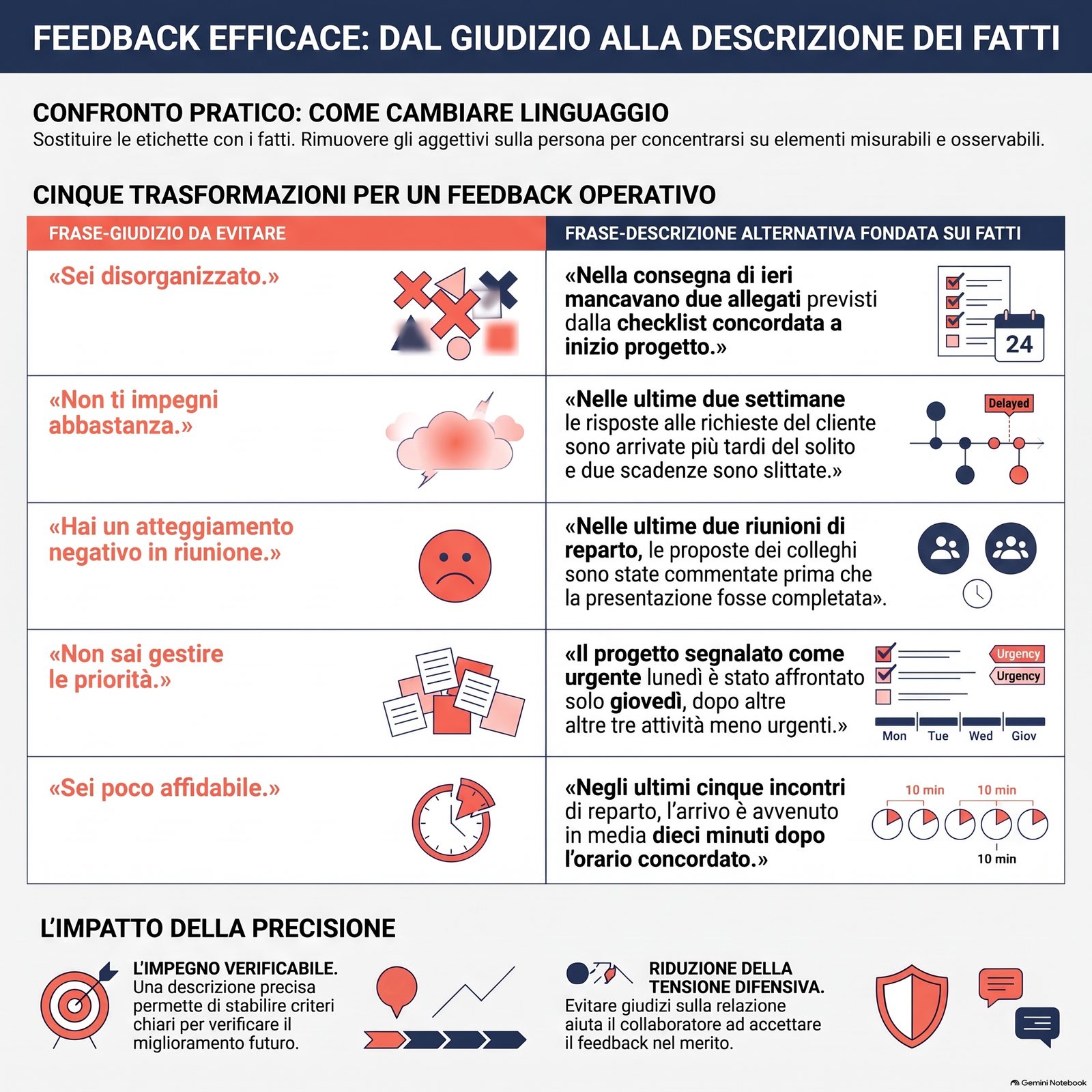
The five pairs below aren't a list of mistakes to recognize in the abstract: they're ready-made sentences to use in place of the habitual one, just as it's about to come out.
Each pair draws on one of the two patterns already introduced in the article: the distinction between description and interpretation, or the situation-behavior-impact structure.
| Phrase to avoid | Practical alternative |
|---|---|
| "You're disorganized." | "Yesterday's delivery was missing two attachments required by the checklist agreed at the start of the project." |
| "You don't try hard enough." | "Over the last two weeks, replies to the client's requests came in later than usual and two deadlines slipped." |
| "You have a negative attitude in meetings." | "In the last two department meetings, colleagues' proposals were commented on before the presentation was finished." |
| "You can't manage priorities." | "The project flagged as urgent on Monday was only tackled on Thursday, after three other less urgent tasks." |
| "You're unreliable." | "At the last five department meetings, arrival was on average ten minutes after the agreed time." |
What the five alternatives have in common is the absence of adjectives about the person: none of the phrasings on the right uses terms like "disorganized," "negative" or "unreliable"; they are replaced by a reference to a datable, verifiable fact.
This change in language takes practice because the judgment sentence is often shorter and quicker to say than the description, especially under time pressure.
Preparing in advance two or three of these alternatives for the mistakes that occur most often in your own context — not the whole list, only the ones that really recur — shortens your reaction time when the situation comes up again.
Repeated over time, language that labels the person instead of describing the behavior erodes the trust needed for the team member to accept even feedback that is correct on the merits.
The relationship between perceived climate and intention to stay with the company is one of the factors discussed in the in-depth article on the causes of employee turnover, where recurring managerial language appears as an element associated with disengagement, not as an isolated, proven cause of voluntary departures.
The five pairs proposed cover the most recurrent patterns observed in the mistakes described above; they don't cover every possible situation: there remain the limits of context in which even the most correct phrasing isn't enough on its own.
Limitations and conditions of applicability
The SBI structure described in this article is an operating model widely used in management practice, presented here as a support tool without commercial references to specific training organizations. Its effectiveness depends on the quality of the underlying relationship between the person giving and the person receiving feedback: in contexts of strong mutual distrust, no technical structure is enough on its own.
The sources cited refer to Italian workers and companies, and the sample was not built specifically around small businesses. The correlation between feedback orientation and the quality of the feedback environment [1] is indicative evidence. Cultural, industry and company-size variables significantly influence the effect of feedback practices.
This article deals with individual feedback — from a manager to a team member. Group feedback, peer review and other participatory formats have their own logic, which falls outside the scope of this text.
FAQ
Is feedback always given in private? Corrective feedback, yes, without exception. Positive feedback can also be given in public — with the same SBI structure — because it has a collective as well as an individual reinforcing effect. But even then, it's wise to check whether the team member is comfortable with public recognition.
How do you give feedback to an older or more experienced team member? The SBI structure works regardless of seniority. What changes is the tone: with a senior team member, it helps to state your point of view explicitly and then ask for their reading, without presenting the feedback as a final verdict. The open question is even more important in these cases.
What should you do if the team member gets angry or cries? An emotional response is normal, especially for corrective feedback on behaviors the person is very attached to. The practical response is: stop, acknowledge the reaction without minimizing it, and suggest picking up the conversation later. Don't push ahead.
How often should you give feedback? There's no universal cadence: it depends on the team's operating pace and the team member's maturity. A practical guideline is that no relevant behavior — positive or corrective — should go without feedback within the week in which it occurs.
Practical summary
Giving effective feedback to team members requires you to stay descriptive (separating behavior from interpretation), use a three-step structure (situation, behavior, impact), choose the right moment within 24–72 hours of the event, balance reinforcing positive feedback and corrective feedback with the same precision, make room for listening with an open question after a pause, and close with an agreement on the next action. Every missing element reduces the tool's effectiveness.
Conclusion
Giving feedback to team members isn't about passing judgment; it's about offering a shared reading of a behavior and its effect: describe before you interpret, use a structure that supports the speaker (situation, behavior, impact), choose a moment close to the event, balance positive and corrective feedback without numerical formulas, and make room for listening without diluting the message.
The thread that ties these elements together is the difference between talking at a person and talking with a person. The first closes, the second opens. To place feedback within the broader review process, it's also worth reading how to structure performance reviews and, more broadly, how to manage your people.
An organization where feedback circulates with method is one where team members know what to improve before the problem gets big, difficult conversations stop being put off, and trust between managers and the team is built on facts rather than impressions. It means a calmer posture and more solid internal growth, within reach of organizations of any size.
Sources and references
[1] Elena Lo Piccolo, Marco Giovanni Mariani, Gerardo Petruzziello, "Italian Validation of the Feedback Orientation Scale: Psychometric Properties and Cultural Adaptation", Behavioral Sciences, 2025, DOI 10.3390/bs15121740. Available at: https://pmc.ncbi.nlm.nih.gov/articles/PMC12729375/
[2] Gianluca Rizzi, "Feedback in azienda, perché resta una sfida per i manager", Il Sole 24 Ore — Management, May 5, 2026. Available at: https://www.ilsole24ore.com/art/feedback-azienda-perche-resta-sfida-i-manager-AIUwpLsC