
It happens to people who work alone, to those who lead a small group, and to those who coordinate dozens of people: the planning system that worked well a year ago now creaks, weeks end behind schedule, priorities slip, but nothing seems "broken" enough to justify a review. You keep going until the strain becomes background noise.
A work method is not a one-time acquisition. It is a system that wears out over time: the workload changes, the tools change, the people you work with change, and established routines gradually stop delivering the same value. Research on habit formation shows that a routine takes a median of 66 days to become stable [1], but no study claims that, once stable, it stays effective forever.
This article offers an operational point of view: your work method should be treated as a system to maintain, with a deliberate review cycle every 6-12 months. You will see how to tell an update from a radical change, which signals indicate that the method is losing effectiveness, how to structure a review cycle, which criteria to use to choose the type of intervention, and which common mistakes turn maintenance into a formal, not very useful exercise.
Recognizing why a work method degrades even when it works
Most work methods are not abandoned by choice, but by erosion. A client changes, someone joins the team, a supplier introduces new software, and the system that held up well starts to creak quietly. Recognizing how degradation works is the first step to avoid confusing "a method that no longer works" with "a method that needs maintenance."
How long can a work method last before it starts to lose effectiveness? None of the studies cited in this article measures how long a work method stays effective: the 6-12 month limit given here is an operational criterion of the editorial team, that is, the threshold beyond which it is worth revisiting the method before its stated performance and its real performance start to diverge.
Before going further, it helps to clear up three common confusions that complicate the diagnosis:
- Updating the method is different from changing it radically. An update acts on elements of the existing system — rhythms, priority criteria, tools; a change replaces the overall framework. A change is rare and is justified only after discontinuous events (a new role, a new industry, a deep reorganization). Confusing the two leads either to wasting energy on unnecessary revolutions, or to touching nothing when something is actually needed.
- Updating the method is not introspection. An update is an operational intervention on measurable artifacts — calendar, priority list, weekly rhythm. Introspection is passive reflection without changing the system: useful as a starting point, insufficient as an end point.
- Updating the method is not the same as upgrading your tools. An update concerns rules, rhythms and criteria — the "how." An upgrade concerns apps, devices, software — the "with what." A new tool does not guarantee a better method: it often amplifies the flaws of the existing one.
The degradation mechanism does not require a traumatic event. Research by Verplanken and Wood documents that even a relatively small change of context — a new team member, a different office, updated software — is enough to break established habits faster than people realize [4]. Degradation is almost always gradual and invisible: that is why the signals have to be looked for actively, not waited for.
Eurostat data on usual hours worked show that in Italy self-employed workers carry a markedly heavier workload than employees — 41.5 hours a week versus 36.2 in 2024, and 45.3 hours for those who themselves have employees [3]: a condition that makes the degradation of the method a structural risk, not an exception.
Using the signals that show a method needs updating
How many of the degradation signals are visible right now, in the current week? In organizational practice, people who work independently or coordinate a team often recognize more than one, but attribute them to a "busy period" rather than to the method.
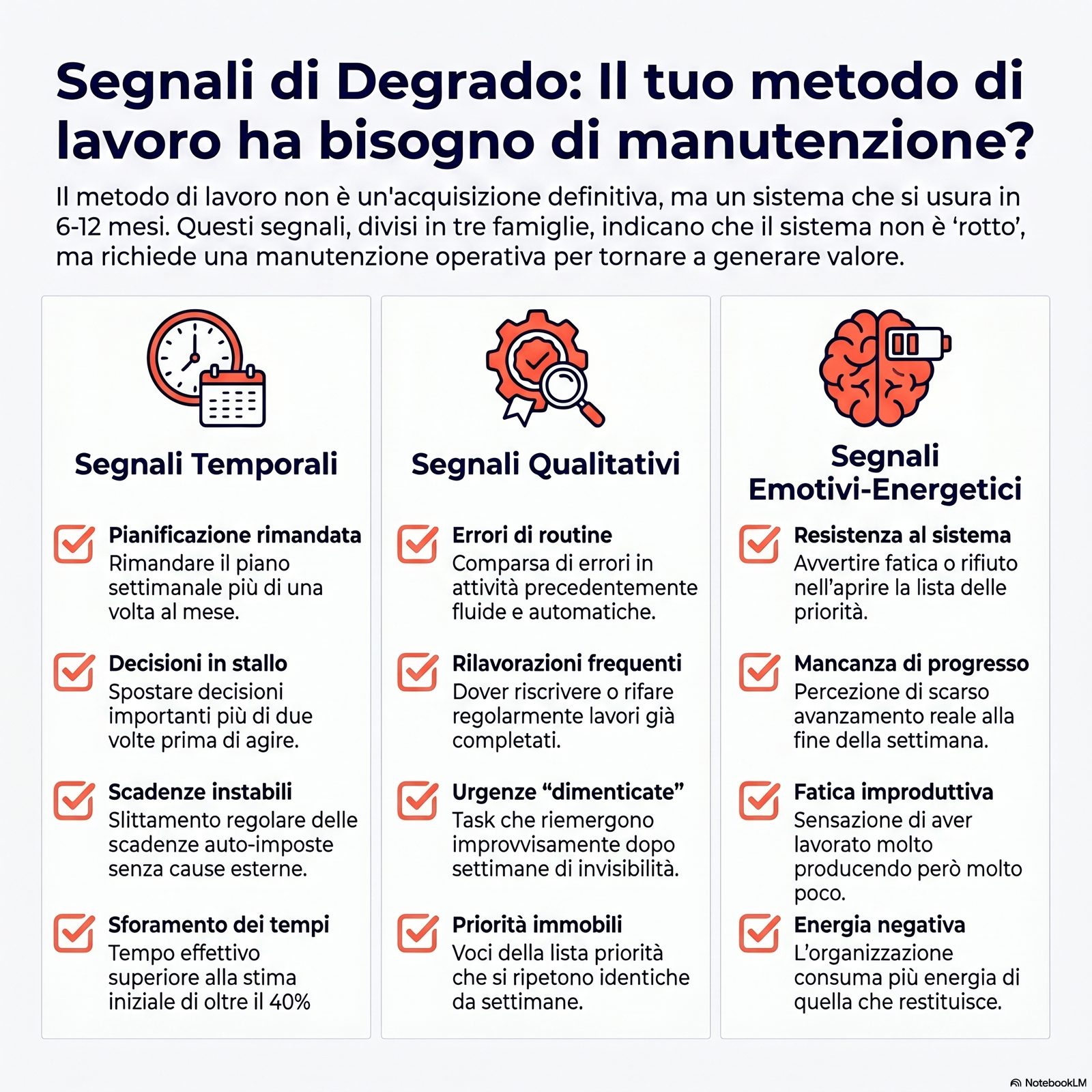
The question "does my method still work?" cannot be answered by gut feeling. There are observable signals, which fall into three families, that let you move from a generic judgment ("I've been struggling lately") to an operational diagnosis ("the bottleneck is in the weekly planning step").
Family 1 — Time signals. Indicators that emerge from comparing what was planned with what actually happened:
- Is weekly planning postponed more than once a month?
- Are important decisions moved more than twice before being made?
- Do self-imposed deadlines slip regularly with no external reason?
- Does the actual time spent on an activity systematically exceed the initial estimate by more than 40%?
Family 2 — Quality signals. Indicators that emerge from the quality of the work produced:
- Do errors appear in activities that used to be smooth and automatic?
- Do you often find yourself rewriting or redoing work you had already completed?
- Do forgotten tasks resurface urgently after weeks of invisibility?
- Does the priority list contain items that have stayed identical for several weeks?
Family 3 — Emotional and energy signals. Indicators that emerge from your subjective response to your work system:
- Do you feel resistance to opening the priority list or the weekly plan?
- Is the feeling of "progress" at the end of the week absent or greatly reduced?
- Does the day end with the feeling of having worked a lot and produced little?
- Does your personal organization seem to take more energy than it gives back?
Signals in two or three families at the same time indicate that the degradation is systemic, not isolated. Signals in a single family, by contrast, suggest a localized update. This distinction is the entry point for choosing the type of intervention [4].
The method review cycle: 4 phases so you don't improvise
How often should a work method undergo a formal review? The cadence proposed here — a long annual cycle and a light quarterly check — is an operational criterion of the editorial team: beyond twelve months, the stated method and the method actually practiced tend to drift apart, but no source measures how that happens.
Without a review structure, good intentions to "review the method" run out within a week. The cycle below proposes four phases, each with a concrete output and a maximum time. It is not a certified methodology: it is the minimum skeleton that peer-reviewed research on continuous improvement identifies as common to systems that hold up over time [2].
| Phase | Input | Activity | Output | Maximum time |
|---|---|---|---|---|
| 1. Data collection | Data on actual vs. planned time, list of signals from the last 4-12 weeks | Compare estimated and actual time on 5-10 recurring activities; map the signals by family | Documented observational picture | 60 minutes |
| 2. Reading the signals | Observational picture | Classify the signals by family; identify the families with the most active signals; locate the main bottleneck | Diagnosis of the friction point | 30 minutes |
| 3. Deciding on the intervention | Diagnosis + criteria (see section 4) | Choose the type of intervention (targeted fix, focused, systemic, replacement); define the 1-3 concrete changes to adopt | Intervention plan with specific changes | 30 minutes |
| 4. Verification | Changes adopted | Check at 30-60 days whether the previously active signals persist | Confirmation or revision of the intervention | 20 minutes |
Phase 1 — data collection — is the one most often skipped. Starting a review without data on how you actually use your time means working on impressions, which tend to reflect the mood of the most recent week rather than a representative picture. For a structured protocol for collecting data on how you use your time, the operational reference is Time audit: how to analyze how you use your time.
Phase 3 — deciding on the intervention — requires distinguishing what to change in the method from what to deepen in individual practices. For example, if the diagnosis points to a deficit in deep analytical work, the problem may be one of method (the deep work block is not protected) or of practice (the concentration techniques used are not effective): the reference for the second hypothesis is Deep work: working in depth.
Targeted update or systemic review: how to choose
How many method reviews actually turn into radical changes when that is not necessary? A common mismatch between the perceived problem and the intervention adopted emerges in the absence of a formal diagnosis [5].
Not every difficulty requires the same type of intervention. Changing the entire framework when updating the weekly routine would have been enough is just as risky as continuing to patch a system that is no longer adequate. The following table provides a selection criterion based on three observable variables.
The three input variables:
- Number of active signal families (1, 2, or all 3)
- Presence or absence of a relevant discontinuous event (change of role, reorganization, new industry, significant change in the team)
- Age of the current method (less or more than 12 months in use)
| Active families | Discontinuous event | Method age | Recommended intervention |
|---|---|---|---|
| 1 | No | Any | Targeted update — change one or two specific elements (e.g., weekly rhythm, priority tool) |
| 2 | No | < 12 months | Focused review — reexamine the areas with active signals, keep the rest |
| 2-3 | No | > 12 months | Systemic review — reexamine the entire framework without necessarily replacing it |
| Any | Yes (relevant discontinuous event) | Any | Replacement — redefine the method from scratch, starting from the new goals and constraints |
Replacement is the only legitimate response when the discontinuous event is large in scale: going from freelancer to business owner with a team, a merger, a radical change of industry. In all other cases, the principle is to intervene on the minimum necessary and verify before expanding. The reference for the structure of the method to be updated is Effective work method: the operational guide.
Building the review into your work week
How much time does it take, in an average week, to keep your method up to date? Less than 30 minutes a week, spread out regularly: this is the time budget the article proposes as an operational criterion, not a figure drawn from a study.
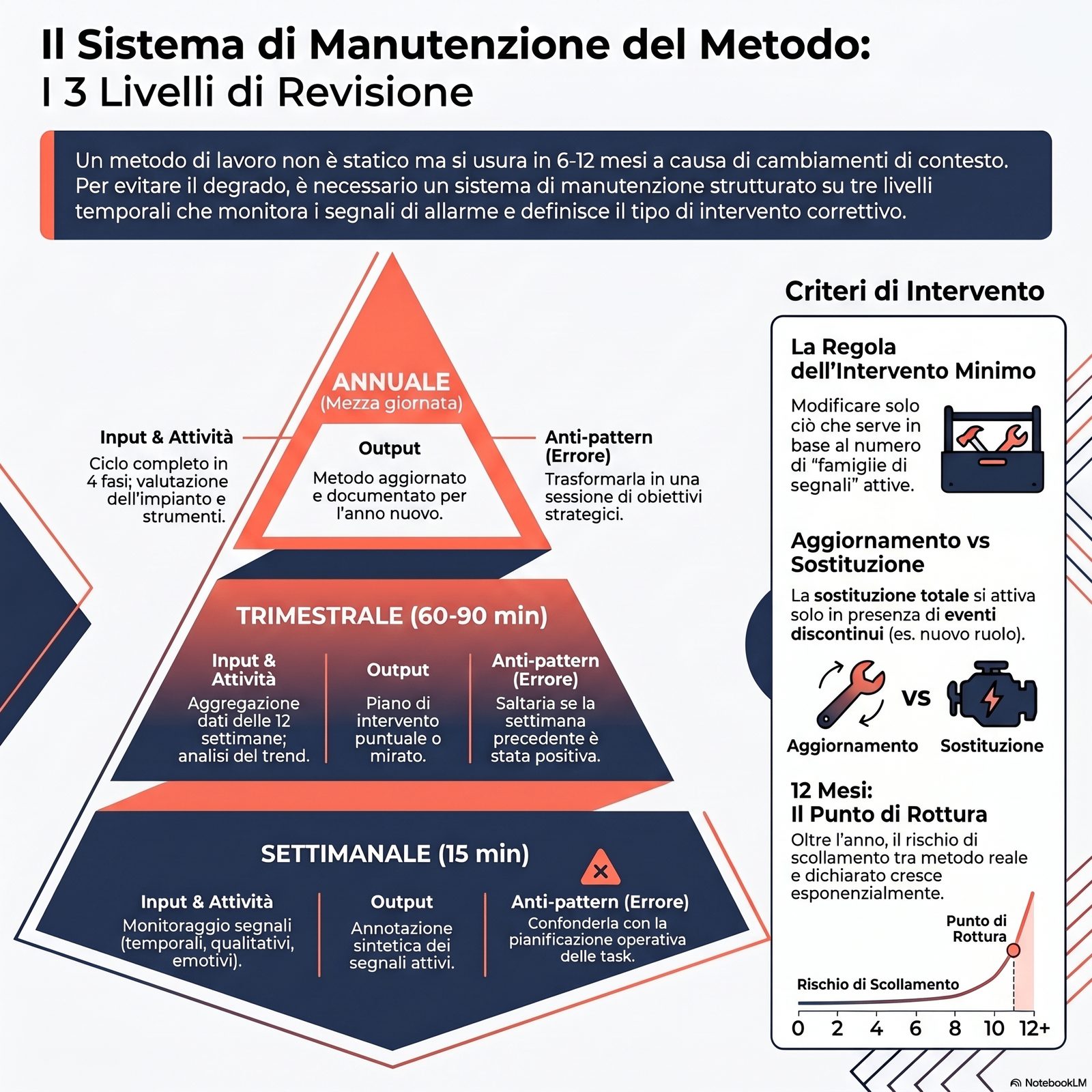
A method review that does not find space in the week is a review that will not happen. Integration happens on three nested levels, calibrated to avoid overload and to work both for a professional working alone and for a team of 10-15 people.
Weekly check — 15 minutes, at the end of every week. Goal: check which signals from the checklist were active during the week. Activity: go through the list of signals by family; note those present; compare with previous weeks. Output: a brief note (signals absent / signals present / new signals). Anti-pattern: turning the weekly check into an operational planning meeting — they are two distinct activities that must be kept separate.
Quarterly review — 60-90 minutes, every 3 months. Goal: read the data collected over the 12-13 weeks and assess whether the signals are stable, improving or getting worse. Activity: aggregate the weekly notes; go through phases 1-2 of the review cycle (data collection and reading the signals); identify any targeted or focused interventions. Output: a quarterly intervention plan (if needed) or confirmation that the method holds up. Anti-pattern: skipping the quarterly review if the previous week seemed positive — the quarterly review is for recognizing trends, not for reacting to individual weeks.
Annual review — half a day, every 12 months. Goal: assess the overall framework of the method, including tools, rhythms and priority criteria, in light of the year's changes. Activity: run the full 4-phase cycle; decide the type of intervention using the table in section 4; plan the changes for the next quarter. Output: an updated method, with documentation of the changes adopted and the review date. Anti-pattern: turning the annual review into planning the year's goals — here too, the two activities are separate.
For managing the time allocated to review activities, the reference pillar is Time management for business owners. For the company-level parallel — how to institutionalize continuous improvement across the organization — the in-depth reading is Continuous improvement in your company: how to make it systemic.
Common mistakes when updating your method (and how to avoid them)
What is the most expensive mistake when updating your work method? Often it is not doing the wrong thing, but changing tools while believing you have changed the method [4].
Updating a method is a delicate intervention: some mistakes are so common they seem almost inevitable. Recognizing them in advance reduces the risk of turning useful maintenance into a fragile revolution.
1. Confusing a tool upgrade with a method update. Switching productivity apps, buying a new notebook, moving to a different note-taking system: none of these actions changes the method, they only change the medium. Research documents that new tools tend to amplify existing habits — including dysfunctional ones [4]. Prevention mechanism: before changing tools, identify exactly which problem of the method the tool would solve; if the answer is not precise, the problem is in the method, not in the tool.
2. Replacing everything instead of updating (the "clean slate" effect). The tendency to throw away the existing framework and start from scratch is common, especially after a difficult period. It is rarely necessary and almost always expensive: a radical change also wipes out the parts of the system that worked, and requires a new consolidation period. Prevention mechanism: use the table in section 4 before deciding the type of intervention; replacement is the option of last resort, not the default.
3. Starting the review without collecting data. A review based on impressions reflects the emotional state of the last week, not the actual trend of the method. It is a systematic bias: busy periods look like method problems, quiet periods look like confirmation that it works [2]. Prevention mechanism: carry out at least a minimal time audit before any review — even just five days of simple tracking are more reliable than an impression.
4. A one-time review without scheduling the next one. An isolated review, even a well-executed one, does not create a maintenance system: it creates an event. The literature on continuous improvement indicates that systems that hold up over time have institutionalized review routines, not episodic ones [2]. Prevention mechanism: at the end of every review, put the date of the next review on the calendar before closing the session.
5. Copying someone else's method without adapting it to your context. The method of a business owner with a 30-person team in a scale-up phase does not transfer to an independent professional in a consolidation phase. Individual variables — type of work, team size, company stage, chronotype — are decisive [1]. Prevention mechanism: use other people's methods as a repertoire of ideas to evaluate, not as protocols to replicate; every change should be tested in your own context before you make it stable.
Limits and conditions of applicability
The proposed review cycle is calibrated for professionals and business owners with a reasonable degree of autonomy over how they organize their work. In contexts where the structure is defined from outside — companies with rigid procedures, highly dependent roles — the room for application narrows.
The sources used [1][2][4] come from different fields (habit psychology, operations management, behavioral psychology): combining them is an operational choice, not a theoretically consistent one in a disciplinary sense. The principles extracted are robust, but of the two numbers cited, only one comes from a measurement: the 66 days to consolidation are the median found by Lally and colleagues [1], with a range from 18 to 254 days. The 6-12 months for the review, by contrast, are an operational criterion of the editorial team, not a measured median.
Source [5] (Tonchia & Quagini) comes from a business context and is applied here to the individual level by analogy: the guidance on the criteria for choosing the intervention is operational but does not derive from studies specifically on updating a personal method.
Frequently asked questions
How long does it take to update a work method? It depends on the scale of the intervention. A targeted update (e.g., changing the weekly rhythm) becomes stable in 4-6 weeks. A systemic review requires a full 3-month cycle to assess its effectiveness. A complete replacement can take 3 to 6 months before it is fully up and running.
Can you update your method on your own, or do you need outside support? Most targeted updates and focused reviews can be handled on your own, with the tools described in this article. Outside support is useful when the degradation is systemic and the diagnosis is hard to make without critical distance, or when the replacement concerns a team's method, not a single person's.
How do you tell a method that doesn't work from a particularly busy period? The key is persistence: the signals of a "busy period" disappear when the workload returns to normal; the signals of a degraded method persist regardless of how intense the work is. If the signals in the checklist are present both in busy weeks and in normal weeks, the problem is in the method, not in the workload.
Operational summary
A work method degrades over time because of contextual factors (changes in workload, people, tools) that erode established routines. The signals of degradation fall into three families (time, quality, emotional and energy), and classifying them guides the choice of the type of intervention: targeted, focused, systemic or replacement. The review cycle has four phases (data collection, reading the signals, decision, verification) and is built into the week on three levels (weekly 15 min, quarterly 60-90 min, annual half a day). The most common mistakes are confusing tool with method, replacing everything without a diagnosis, starting the review without data, and not scheduling the next review.
A work method is not won once and for all. It is a living system, exposed to changes in context, and like all living systems it requires deliberate maintenance. Recognizing the signals of degradation, telling an update from a change, choosing the type of intervention based on a few observable criteria, scheduling the review instead of leaving it to chance: it is in these skills, more than in the initial choice of method, that the difference lies between a work system that lasts and one that runs out in a few months.
The key point: there is no "definitive" method, only a maintained one. A formal review within 12 months, with three nested levels (weekly, quarterly, annual), is the minimum infrastructure to keep the system from slipping without anyone noticing.
To explore the structure of the method you are updating, see Effective work method: the operational guide and, for the company-level parallel on procedures, Continuous improvement in your company: how to make it systemic.
A person — or a team — who adopts a maintenance routine for their method does not go through periodic "start over from scratch" crises. They keep continuity, recognize the need to adjust before the cost of not adjusting becomes visible, and reach phases of growth or change with a system already ready to evolve. On a broader scale, a work culture that treats its method as a system to be maintained — and not as a permanent acquisition — is one of the levers, still underused, for bringing stated productivity and real productivity together.
Sources and references
-
Lally, P., van Jaarsveld, C. H. M., Potts, H. W. W., & Wardle, J. (2010). How are habits formed: Modelling habit formation in the real world. European Journal of Social Psychology, 40(6), 998-1009 — https://doi.org/10.1002/ejsp.674
-
Anand, G., Ward, P. T., Tatikonda, M. V., & Schilling, D. A. (2009). Dynamic capabilities through continuous improvement infrastructure. Journal of Operations Management, 27(6), 444-461 — https://doi.org/10.1016/j.jom.2009.02.002
-
Eurostat. Average usual weekly hours worked in the main job by professional status, full-time/part-time employment and occupation [lfsa_ewhuis], 2024 data — https://ec.europa.eu/eurostat/databrowser/view/lfsa_ewhuis/default/table
-
Verplanken, B., & Wood, W. (2006). Interventions to break and create consumer habits. Journal of Public Policy & Marketing, 25(1), 90-103.
-
Tonchia, S., & Quagini, L. (2010). Performance Measurement: Linking Balanced Scorecard to Business Intelligence. Springer.