
The two readings lead to opposite decisions: change the people, or change the way work is done.
In business language, a proactive person is one who works with methods that help them perceive problems, trends or future changes in advance, so as to plan the appropriate actions in time [6].
It is a question asked by the owner of a family business, by the manager who is the first to receive a report from the floor and by the professional who works with two team members.
Italian companies rate the ability to work independently as highly important in 41.4% of the hires planned for 2025, and in the same year 79.6% of positions are associated with standard solutions and procedures [4].
The gap between those two numbers is the subject of this article.
Proactivity is not a trait to look for when hiring: it is a behavior that the organization makes worthwhile or costly. The useful question is not where to find proactive people, but what shuts down the initiative of the people you already have.
The article pins down the meaning of the term and its boundaries, lists the signs that initiative has stalled, reconstructs the calculation that comes before it and describes five organizational levers.
What proactivity at work really means, and what to distinguish it from
Are gladly doing what you are asked and taking the initiative the same disposition?
They are two different things, and the second has a precise definition in the organizational literature: proactive behavior is anticipatory action taken to have an impact on oneself or on one's environment [2].
In research on personal initiative the attributes become three — being self-starting, looking ahead, persisting in the face of obstacles — and the opposite is the reactive approach, that of someone who waits to be told what to do [1].
The reference review adds the point that matters most to whoever leads: proactivity is not a noun but an adverb, because almost any behavior can be carried out reactively or proactively [2].
The same check on incoming material is routine if someone prescribed it, and initiative if the person doing it decided to do it after the second defective batch.
This leads to three distinctions that are often confused in companies, and that each time come back to the same question: who decided when to act.
Proactivity is not willingness. A willing person gladly carries out what they were asked to do, but the goal still belongs to whoever set it: initiative begins where the person acting sets the goal themselves [1].
Proactivity is not problem solving on request. Solving an assigned problem well is executive competence; noticing it while it is still a nameless anomaly is something else.
Proactivity is not response speed. A department that responds in ten minutes is extremely fast and at the same time reactive, because the moment it acts is decided by whoever calls.
How to recognize the signs that initiative has stalled
How can you tell that initiative in a group has stopped, before you see it in the results?
The five signs below can be observed in an ordinary week of work.
Questions come in about decisions already within reach of the person asking. If someone asks permission to order a spare part worth a few tens of euros, the information is not about the person: the margin was never stated, and when in doubt, people ask.
Problems arrive when they are already costly. The anomaly had been visible for weeks to whoever was working on the part, and became reportable when it became a complaint.
Why a report stops before it arrives is the subject of psychological safety; here the focus is the next step up, that is, moving before the request arrives.
Proposals repeat identically months apart, or stop altogether. Repetition says the first one had no visible outcome; silence says the conclusion has been drawn.
The person in charge is the only one proposing improvements. Meetings open with the business owner's ideas and continue with checking their feasibility, and other proposals don't make it into the room.
Routine decisions wait for the decision-maker to come back. In Italy this sign carries structural weight: running the company is mostly in the hands of the business owner or a family member, and bringing in an internal or external manager concerns 1.4% of companies with at least three employees controlled by an individual or a family [5].
Where a single person decides, the margin of those who work is defined by what that person has let through, not by the organizational chart.
Taken on its own, each of the five carries little weight: what counts is how many recur in the same month, because a recurrence belongs to the way of working and an episode to the week in which it happened.
What makes proactivity worthwhile: the calculation people make
What goes through a person's mind in the seconds when they decide whether to move or stay put?
Proactivity is not a trait to look for when hiring: it is a behavior that the organization makes worthwhile or costly, and every team member redoes the calculation at every opportunity.
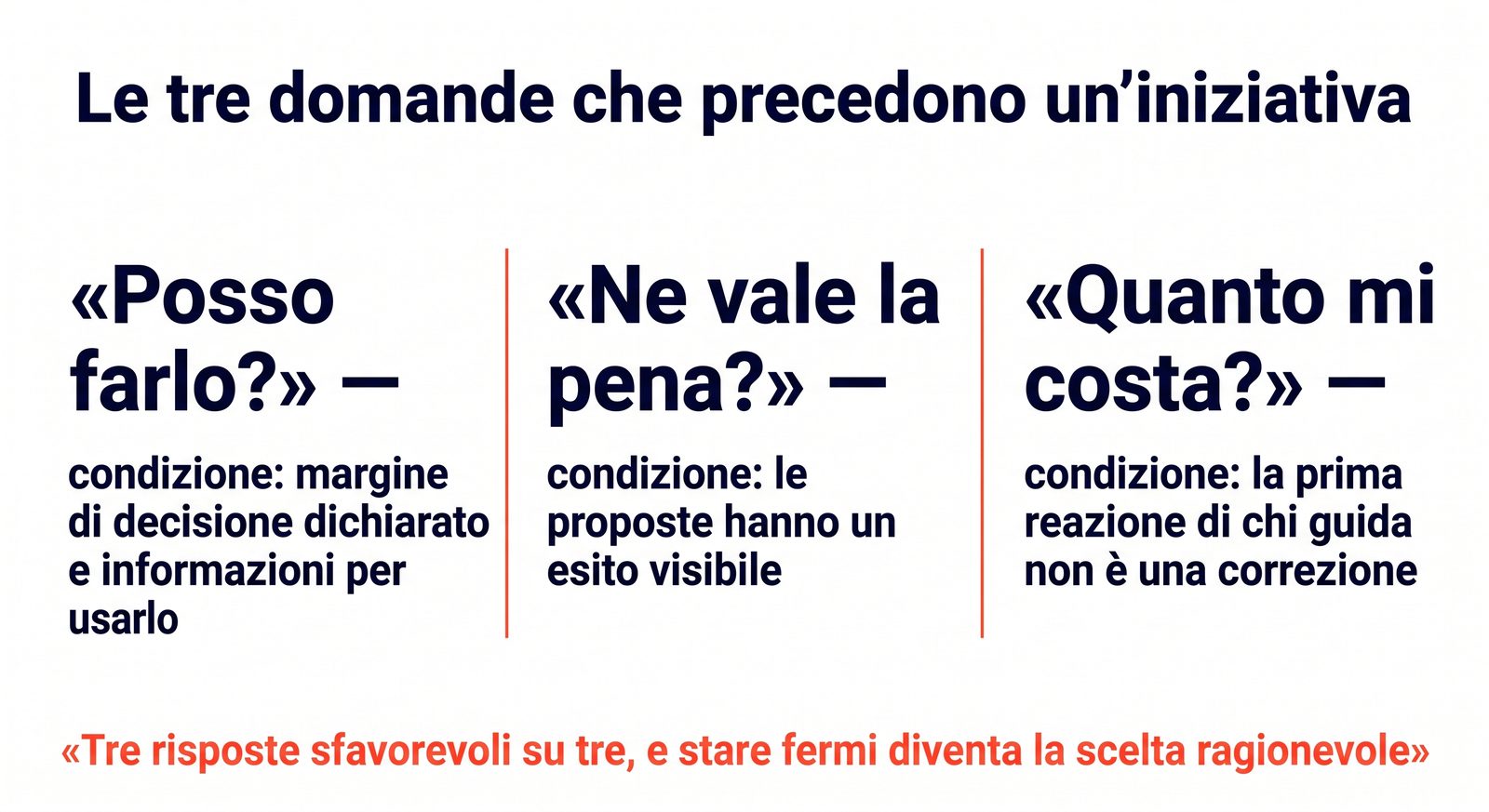
The most cited review describes three motivational states that precede a proactive action, and in a company they become three questions: can I do it, is it worth it, what will it cost me [3].
The last one weighs the most, because initiative carries a high psychological risk for whoever takes it: changing the situation exposes you to resistance and skepticism [3].
Those who act on their own initiative are judged for the choice, because a self-initiated action is hard to attribute to circumstances: when responsibilities are not stated, the safest way to protect your image becomes avoiding initiative [2].
This is not a cautious temperament, it is arithmetic: if the credit goes to the group and the mistake has a name, the balance for whoever moves stays in the red.
In family businesses the bill has one more line, because the chain of command coincides with the family: proposing a change of supplier or production cycle means questioning the choice of someone who also has the last word on your own position, and the cost doesn't end on the day you speak up.
The mechanism feeds on itself: when control and complexity at work stay low, the belief that you can make a difference drops, initiative declines and the job gets redesigned more narrowly.
The authors of the longitudinal study call it a vicious circle, and point to where it breaks: on job characteristics and on that belief together, not on stated motivation [1].
Five organizational levers to grow proactivity in your company
What can you change in the way work is done so that initiative becomes possible with the same headcount?
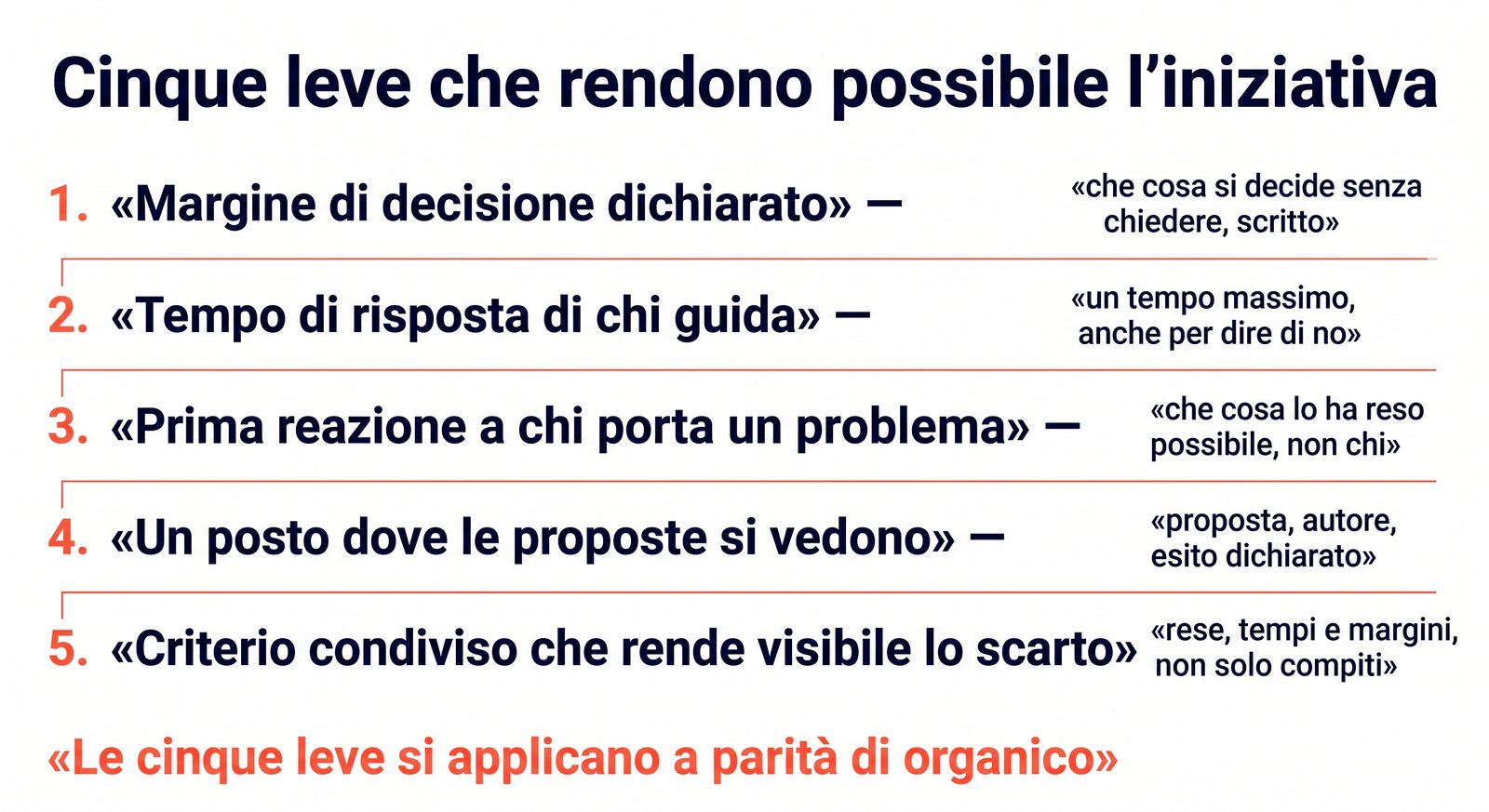
1. The stated decision margin. You need a written line for recurring cases — up to what amount you can order without asking, what scrap you can stop on your own — because a margin that lives in the head of whoever leads produces requests for permission, not initiative.
A written margin remains a minority practice: among small Italian companies, 35.2% report that in 2021-2022 they had not adopted any practice to attract or retain qualified staff [5].
2. The response time of whoever leads. A request left hanging for days teaches that asking is pointless, whereas a stated maximum time — even forty-eight hours, even just to say "we're keeping things as they are for now" — changes the calculation of whoever has the next proposal in hand.
3. What happens in the first few minutes to whoever brings a problem. The first reaction is read as a rule: if you start with who made the mistake, the lesson concerns the next silence, and the shape of the conversation is the subject of feedback to team members.
4. A place where proposals land and can be seen. You need a visible list with three pieces of information per row — what, who, what was decided — and the outcome must be written down even when it is negative, as in the article on improvement proposals.
5. The criterion that makes the deviation visible. Someone who doesn't know the reference point cannot notice that something departs from it, and without a deviation there is nothing to anticipate.
This means sharing the numbers that define the work — expected yield, standard time, job margin — and not just the tasks, because jobs with more control and more complexity produce more initiative over time [1].
It is the infrastructure on which effective delegation rests: without a transferred criterion, the margin stays on paper.
Initiative within known boundaries: how to keep it from turning into disorder
How do you tell initiative that moves the work forward from initiative that throws it into disarray?
The objection from whoever leads is legitimate: giving people margin means ending up with people doing as they see fit, and in production that costs money right away.
The distinction is not about how wide the margin is, but about whether the margin is known before the action: being proactive means moving within stated boundaries, and four conditions make them explicit without new procedures.
- Scope stated in advance: the decision has been identified as belonging to that role.
- Known criterion: whoever acts knows what reference point they are choosing by — a yield, a deadline, a margin.
- Action announced to those involved: a change that affects other people's work is communicated beforehand, not discovered afterward.
- Reversible or measurable effect: if there is no going back, the decision moves up a level.
Skipping one produces exactly the case the objection fears: the technician who changes a machine parameter without saying so, and the defect that shows up two batches later becomes an investigation instead of a correction.
The reverse also holds, which the authors flag as a possible effect to be verified rather than a measured result: every initiative "rocks the boat," people who take many of them can be tiring for colleagues and managers, and in jobs designed in a rigidly executive way initiative might bring no benefit at all [1].
Where the margin is narrow for sound reasons — technical standards, safety, certified quality — the boundary doesn't widen: it gets stated more clearly.
What remains is the dividing line observed in studies on consequences: initiative perceived as useful to the organization is rewarded, while initiative perceived as opportunistic or harmful is penalized [2].
Making public the criterion by which an initiative will be judged is the cheapest way to move it into the first category.
The most common mistakes when asking for more initiative
The mistakes that follow ask for the behavior and leave untouched the conditions that make it costly.
Looking for proactivity in hiring and not in the work. The gap mentioned at the start can be read in full in the same survey: against the independence required in 41.4% of planned hires, only 12.2% of positions call for creative solutions and 8.2% for innovative ones [4].
The same company that asks for a spirit of initiative in its job posting designs the role around codified tasks, and then blames the gap on the quality of the candidates.
Asking for proposals to arrive already solved. The filter demands technical expertise for a report that only required attention, and shifts the cost of the analysis onto whoever saw the problem first.
Announcing an open door without touching the margin. An invitation to come forward doesn't change the calculation of whoever weighs the cost: what changes it is a line stating what can be decided without asking.
Recognizing the emergency solved and not the problem avoided. Whoever fixes a visible mess receives public gratitude; whoever prevented it has no stage on which to appear.
Treating it as a matter of individual motivation. Initiative moves with working conditions, not with exhortation, and a team member described as lacking initiative is usually responding to a margin that was never stated to them.
Declaring the value instead of practicing it. "Spirit of initiative" written among the company values changes neither the response time nor the spending limit, which are the two items a team member does the math on: the gap between stated values and daily practice is the subject of company culture.
Limits and conditions of applicability
The international sources have precise scopes: the longitudinal study followed 268 people across four waves in 1990s East Germany, a context of transition that the authors describe as particular [1]; the other two references are theoretical reviews, not surveys of a sample [2] [3].
The relationships described remain statistical associations, not causal links, and run in both directions: work fuels initiative and initiative changes the work [1].
The Italian data measure companies' statements, not observed behavior — skills required and decision-making scope of planned hires [4], stated practices and management structure [5] — and serve as context, not as proof of the mechanism.
This article takes an organizational angle: it concerns the working conditions that make initiative feasible, not personality psychology or aptitude assessment of candidates, which have their own tools and professionals.
FAQ
What does proactivity at work mean?
It refers to acting ahead of a problem or an opportunity, with the intention of producing an effect rather than responding to a request that has already arrived [2]; the recognized attributes are three: being self-starting, looking ahead, persisting in the face of obstacles [1].
What is the difference between proactivity and disorderly initiative?
The dividing line is the boundary known before the action: stated scope, explicit criterion, communication to those involved, reversible or measurable effect.
An initiative that meets these conditions remains manageable even when the outcome is wrong.
Can proactivity be taught?
The available evidence indicates that it grows when working conditions change — decision margin, complexity, available information — and not through exhortation [1].
Training works on the belief that you can make a difference, but on its own it leaves the perceived cost untouched.
What are some examples of proactivity at work?
An operator who stops a batch because the scrap departs from the known reference point, without waiting for the final inspection.
A manager who warns the customer about a delay before the customer has to ask, within the margin that was stated to them.
Operational summary
Proactivity at work is anticipatory action within known boundaries, and it is distinct from willingness, problem solving on request and response speed, which are actions triggered by others.
Its absence can be recognized from observable signs: permission requested for decisions already within reach, problems that arrive when they are already costly, proposals that repeat identically or stop, routine decisions that wait for the decision-maker to come back.
Behind the silence is a calculation redone at every opportunity — can I do it, is it worth it, what will it cost me — and with three unfavorable answers, staying put is reasonable.
The five levers that shift it can be applied with the same headcount: a margin stated in writing, a maximum response time, a first reaction that separates the problem from the blame, a visible place where proposals get an outcome, a shared criterion that makes the deviation recognizable.
Conclusion
Proactivity is not a trait to look for when hiring: it is a behavior that the organization makes worthwhile or costly.
As long as the margin stays implicit, responses are slow and proposals end up in a conversation that goes nowhere, staying put is reasonable — and the bill arrives as problems that show up when they are already costly.
The five levers described act on that calculation without changing the people: state what can be decided without asking, respond within a stated time, separate the problem from the blame, give proposals a visible outcome, share the criteria that make a deviation recognizable.
If you work on this ground, you are also working on the conditions that keep people in the company, described in the article on employee motivation, and on the real transfer of responsibility covered in the guide to delegation in business.
To receive the next in-depth articles, you can sign up for the newsletter.
The change shows up in the calendar of whoever leads, before it shows up in the perceived climate.
Routine authorizations stop moving up a level, because the limit is written down and using it no longer requires justification.
Anomalies enter conversations while they are still small, and the hours that went into chasing them become available again for the work no one else can do.
Sources and references
[1] Frese, M., Garst, H., Fay, D., "Making Things Happen: Reciprocal Relationships between Work Characteristics and Personal Initiative in a Four-Wave Longitudinal Structural Equation Model", Journal of Applied Psychology, vol. 92, no. 4, 2007, pp. 1084-1102, DOI 10.1037/0021-9010.92.4.1084 (four-wave longitudinal study, N=268, East Germany). Postprint from the University of Potsdam institutional repository, read at: https://d-nb.info/1218372907/34
[2] Grant, A. M., Ashford, S. J., "The Dynamics of Proactivity at Work", Research in Organizational Behavior, vol. 28, 2008, pp. 3-34, DOI 10.1016/j.riob.2008.04.002 (theoretical review). Full text read at: https://faculty.wharton.upenn.edu/wp-content/uploads/2013/04/GrantAshford2008-ROB-proactivity.pdf
[3] Parker, S. K., Bindl, U. K., Strauss, K., "Making Things Happen: A Model of Proactive Motivation", Journal of Management, vol. 36, no. 4, 2010, pp. 827-856, DOI 10.1177/0149206310363732 (theoretical review). Full text read in the University of Warwick WRAP repository: https://wrap.warwick.ac.uk/id/eprint/53066/1/WRAP_Strauss_Making.pdf
[4] Unioncamere and Ministero del Lavoro e delle Politiche Sociali, "La domanda di professioni e di formazione delle imprese italiane nel 2025", Sistema Informativo Excelsior, 2025 (total planned hires in 2025: 5,807,270; mandatory-response survey within the Italian National Statistical Program). Available at: https://excelsior.unioncamere.net/sites/default/files/pubblicazioni/2025/Domanda_professioni_formazione_imprese.pdf
[5] ISTAT, "Censimento permanente delle imprese 2023: primi risultati", statistical report, November 14, 2023 (reference year 2022; universe of 1,021,618 companies with at least 3 employees). Available at: https://www.istat.it/comunicato-stampa/censimento-permanente-delle-imprese-2023-primi-risultati/ — PDF: https://www.istat.it/it/files/2023/11/REPORTCensimprese.pdf
[6] Istituto della Enciclopedia Italiana, entry "proattivo", Vocabolario della lingua italiana Treccani. Available at: https://www.treccani.it/vocabolario/proattivo/