
Internal communication in a company is the system of channels, rituals and rules — explicit or implicit — through which people exchange operational information, decisions and warning signs. It is not the sum of the tools adopted; it is the way they combine.
The European ESENER survey finds that in Italy only 8% of establishments report the presence of the risk factor "poor communication or cooperation within the organization," compared with 18% across the EU-27 average [3]. The gap shows how rarely internal communication is seen as an organizational factor, and it points to an opportunity more than a judgment.
The next sections cover channels, rituals, indicators and common mistakes.
Map existing channels before adding new ones
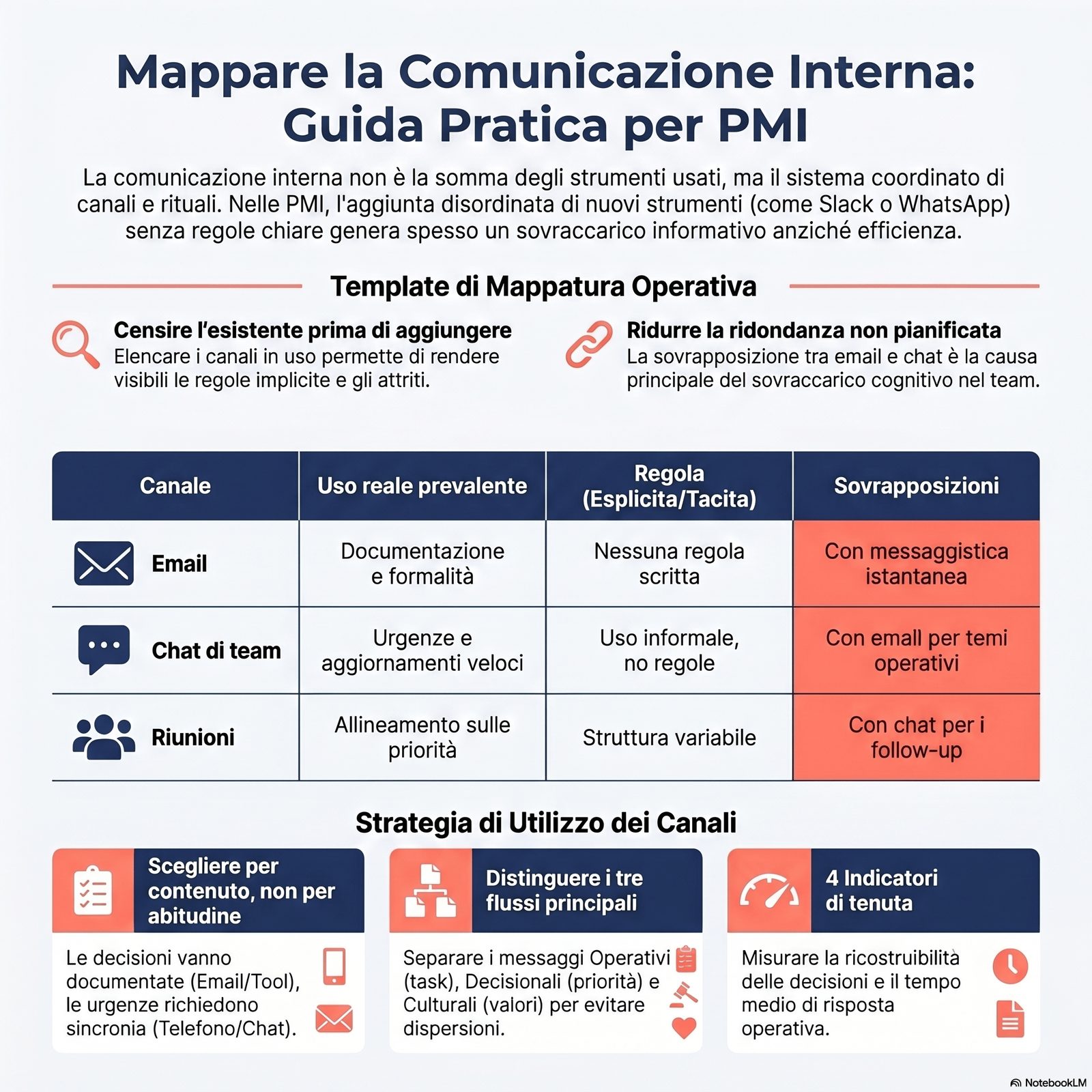
Adding a channel "because it's missing" without first taking stock of what is already in use is the most common cause of communication chaos. The Italian national statistics office (ISTAT) survey on enterprises and ICT records growing adoption in Italy: the share of companies with at least 10 employees whose staff access email, documents or business software remotely rose from 73.2% in 2022 to 76.9% in 2024, while remote meeting tools are used by 47.3% of small and medium-sized companies and 96.3% of large ones [1]. The growth in tools, however, is rarely accompanied by structured mapping. Mapping means listing each channel, its main use, its unwritten rules and its overlaps.
How many internal communication channels are really in use in a 30-person company? "Let's add Slack so we can stop using email" is a sentence that regularly ends with both tools still active.
Channel mapping can be done on a simple sheet with four columns.
| Channel | Main actual use | Explicit or tacit rule | Overlaps |
|---|---|---|---|
| Formal communications, documentation | No written rule | With instant messaging | |
| Team chat | Urgent matters, quick updates | Informal use, no rule | With email for operational topics |
| Weekly meeting | Alignment on priorities | Variable structure | With chat for follow-up |
| Phone | Blocking urgent issues | Used for escalation | With chat |
The value of mapping is not producing a document; it is making visible what is implicit. Often the simple act of listing the existing channels is enough to identify the overlaps and unwritten rules that create friction. In most cases, the solution is not adding a tool but clarifying the rules for the ones you already have.
To frame channel mapping within a broader process of systemizing the organization, the link to business systemization offers a wider framework.
Choose the channel based on content, not habit
Every type of content has a natural channel: an operational decision should be written down and searchable, a nuance should be conveyed by voice, an urgent issue needs immediate synchronous contact. Mixing up channels — asking for deep alignment via chat, communicating strategic decisions by email — produces misunderstandings and after-the-fact reconstructions. The operating rule is simple: first decide what, then where.
What criterion should you use to decide where a decision, a nuance or an urgent issue goes? A sensitive decision sent via chat is a decision that will have to be discussed again within 48 hours.
A "content type × appropriate channel" matrix helps make the implicit rule explicit.
| Content type | Appropriate channel | Why |
|---|---|---|
| Operational decision to be documented | Email or searchable written tool | Must remain traceable over time |
| Blocking urgent issue | Phone or synchronous messaging | Requires an immediate response |
| Relational nuance | Voice (meeting or one-on-one) | Requires tone, listening, calibration |
| Progress update | Asynchronous chat | Not urgent, doesn't require an immediate response |
| Strategic communication | Dedicated meeting | Requires full mental presence |
The rule is not mechanical: there is hybrid content, and there are situations where context outweighs the category. But having the matrix as a shared reference — even informally — significantly reduces information loss and after-the-fact misunderstandings.
For the structure of the meetings that carry decision-making content, the article on how to run effective business meetings goes deeper into operating practices.
Build recurring rituals that replace "stop-and-start" communication
Recurring rituals — a weekly team meeting, a monthly alignment, a quarterly check — reduce the pressure on asynchronous channels by absorbing many of the "one-off" interactions. ISTAT's permanent census of enterprises in Italy records that 21.8% of companies with activities that could potentially be done remotely fear a negative impact on the efficiency of production processes and on interactions and communication among staff [2]: this is the ground that fixed rituals work on. A ritual is predictable; stop-and-start communication is scattered.
How many recurring rituals can a company sustain without them becoming an extra burden? A calendar full of meetings is not organization; it is a statement that the written tools aren't working.
An effective recurring ritual is built on four elements.
Cadence and duration. The cadence depends on the team's operating speed: a sales team may need a weekly alignment; an operations team with few variables can work with a monthly one. The duration should be set in advance — 20 minutes, 45 minutes — and respected. A ritual that systematically runs over is a ritual that will be boycotted.
Specific goal. Each ritual serves one purpose: deciding, updating, aligning or solving. "Catch-all" rituals that try to do everything at once are the ones most often perceived as useless.
Written output. Each ritual produces a documented output — the decisions made, the week's priorities, the actions and who owns them. Without written output, the ritual shrinks to an interaction that fades away.
Repeatable structure. A fixed format — same opening, same sequence, same close — lowers the cognitive cost for participants and makes the ritual scalable.
Distinguish operational, decision-making and cultural communication
Three different flows run through a company: operational (what needs to be done today), decision-making (why things are done this way) and cultural (how we work here). Treating them as the same thing overcrowds the wrong channels. Recognizing which level each message belongs to lets you choose the appropriate channel and cadence.
What changes when you recognize that a piece of information is cultural, not operational? Treating a strategic decision as an addition to the daily checklist is the fastest way to make sure it never lands.
The table of the three flows with typical examples clarifies the distinction.
| Flow | Characteristic | Typical examples | Preferred channel |
|---|---|---|---|
| Operational | Immediate, contingent | Assigned tasks, status updates, urgent issues | Chat, operational email, task management tools |
| Decision-making | Structural, directional | Priority choices, evaluation criteria, new policies | Dedicated meeting + written document |
| Cultural | Slow, pervasive | Shared values, company stories, recognition | All-hands meeting, direct communication from leadership |
The most common mistake is sending decision-making and cultural information through operational channels: it gets lost in the daily flow and never lands. A strategic decision communicated as a line of chat carries the same weight as a status update — and meets the same fate.
The cultural flow has rules of its own: it can't be delegated to a tool; it requires the voice of someone with organizational authority and credibility. For the broader framework of building company culture, the link to the article on how to build a company culture provides the necessary picture.
Measure how well internal communication holds up with simple indicators
Measuring internal communication doesn't mean counting emails. It means tracking signs that it holds up: whether decisions can be reconstructed, the average time to get an operational answer, the perceived clarity. These soft indicators often get little attention.
Which indicators tell you whether internal communication is holding up? "We talk a lot" is not an indicator of good communication; it is often a symptom of the opposite.
Four operational indicators, measurable without complex tools.
Reconstructability of decisions. Two weeks later, can someone who wasn't at the meeting where a decision was made reconstruct it from the available documents? If not, decision-making communication is insufficient.
Average operational response time. How long does it take, on average, for someone to get an answer to an operational request? If the time is systematically longer than 24 hours, there is a problem with channel coverage or information load.
Perceived clarity (gathered in one-on-ones). In one-on-ones with team members, does uncertainty about "who decides what" or "where to find this information" come up often? The frequency of these questions is an indirect but reliable indicator.
Perceived information overload. Do team members say they "can't keep up with everything"? Perceived overload usually goes hand in hand with a proliferation of channels lacking priority rules.
To integrate these indicators into a broader measurement system, the article on business KPIs offers complementary tools.
Recognize and fix recurring mistakes in internal communication
The most common mistakes in internal communication are not about tools; they are about design: adding channels without retiring the old ones, sending decisions via chat, rituals that are too long or too infrequent, confusing operational and cultural flows, having no indicators of how well communication holds up. Recognizing them is more useful than memorizing them, because they come back in different forms depending on the size of the company. Tackling them takes design more than tools.
Which mistake costs more: too many channels or too many rituals? Both extremes produce the same outcome — people saying they "don't know where to find what."
The five most recurring mistakes, each with a small fix.
1. Adding channels without removing the old ones. Every new tool adopted without retiring obsolete ones increases cognitive load. Fix: every time you adopt a new channel, define explicitly which use of the old one it replaces.
2. Sending structural decisions via chat. An important decision sent as a message among dozens of operational updates doesn't get processed with the right attention. Fix: identify a dedicated channel or ritual for decision-making communication, and stick to it.
3. Rituals that are too long or lack a fixed structure. They create a sense of wasted time and gradual abandonment. Fix: set a fixed duration and a structured agenda for each ritual; respect the end time.
4. Confusing the operational flow with the cultural flow. Recognition messages, company stories and shared values lose weight when communicated via chat. Fix: reserve cultural communication for dedicated moments — even brief ones — in leadership's own voice.
5. No indicators of how well communication holds up. Internal communication gets evaluated only "when something goes wrong." Fix: introduce the four operational indicators described in the previous section and track them quarterly in one-on-ones with team members.
Limits and conditions of applicability
The system described in this article — channel mapping, content/channel matrix, structured rituals, three flows, indicators of how well communication holds up — is designed for organizations with at least 5–10 people who work together regularly. In settings of 2–3 people, informal communication is naturally more fluid and such an elaborate structure would be disproportionate.
The sources cited (ISTAT, EU-OSHA) describe the tools available and the recognition of organizational risks in companies — in Italy and across the EU — not the effectiveness of the rituals described here. The concern about an impact on internal interactions [2] was measured for activities that could potentially be done remotely: applying it to fully on-site teams requires specific checks.
The guidance on appropriate channels for different types of content consists of operational orientations, not universal rules: the organization's cultural context, the team's maturity and established habits significantly influence what works in a given case.
FAQ
How many recurring rituals are sustainable for a team of 10 people? A reasonable practical guideline is 2–3 fixed rituals (a weekly operational one, a monthly alignment, a quarterly review). Beyond that threshold, the calendar becomes an obstacle more than a tool. The quality of a few well-designed rituals matters more than quantity.
How do you convince a team to adopt channel rules when habits are already entrenched? The most effective path is not to impose new rules but to make them visible. Starting with a participatory mapping of existing channels lets the team recognize the problems on its own. Rules that emerge from that process are followed much more readily than rules handed down from above.
Does cultural communication work in hybrid teams too? Yes, but it takes more intentionality: in hybrid settings, the cultural signals conveyed in person don't automatically reach those working remotely. It requires dedicated moments that explicitly involve every member of the team, regardless of location.
Do you need a specific digital tool to manage internal communication? No. In many cases, the problem is not the absence of the right tool but the absence of clear rules for using the tools you already have. Before adopting a new tool, it helps to check whether the problem can be solved with clearer rules for the existing ones.
Operational summary
Internal communication in a company works when three elements come together: channels chosen based on content type (not habit), recurring rituals that absorb scattered interactions, and a conscious distinction between operational, decision-making and cultural flows. The starting point is mapping what already exists — before adding anything — and introducing four simple indicators that signal whether the system is holding up. Without these elements, internal communication produces noise instead of clarity, regardless of how many tools are adopted.
Conclusion
Internal communication in a company is not the sum of the tools adopted; it is the way different channels, rituals and flows combine. Mapping what is already in use before adding new tools, choosing the channel based on content, building recurring rituals that absorb "stop-and-start" interactions, distinguishing operational flows from decision-making and cultural ones, measuring how well it all holds up with simple indicators: these are five moves that reduce noise without sacrificing transparency.
The thread that ties these elements together is the difference between "communicating more" and "communicating better." The first multiplies channels; the second designs what goes where. To frame the collective side of working things through together, it's also worth reading how to run effective business meetings and, for the broader framework, how to build a company culture.
A company where internal communication really works is a company where decisions can be reconstructed months later, people know where to look for what they need, and meetings are for deciding, not for recovering lost information. It is a calmer organizational posture and a more solid operational efficiency — within reach of organizations of any size.
Sources and references
[1] ISTAT, "Imprese e ICT — Anno 2024", Istituto Nazionale di Statistica, 2024. Available at: https://www.istat.it/comunicato-stampa/imprese-e-ict-anno-2024/
[2] ISTAT, "Censimento permanente delle imprese 2023: primi risultati", Statistiche report. Available at: https://www.istat.it/it/files/2023/11/REPORTCensimprese.pdf
[3] EU-OSHA — European Agency for Safety and Health at Work, "Third European Survey of Enterprises on New and Emerging Risks (ESENER 2019) — Overview report", Table 5. Available at: https://osha.europa.eu/sites/default/files/esener-2019-overview-report.pdf