
Movimprese data show that in 2024, 322,835 new businesses were registered in Italy against 285,979 closures, for a net balance of 36,856 units, a slowdown compared with 2023 [2]. The Eurostat picture confirms it: a significant share of European businesses do not make it past their fifth year of activity [4].
Starting a business means going through a precise sequence: validating demand, choosing the legal structure, raising capital, defining the business model, and reaching your first revenue in a sustainable way.
This pillar page walks through each of these steps with references to public sources and Italian and European academic research, without promises and without shortcuts.
Distinguish starting a business from formally setting up a company
Starting a business is not the same as getting a VAT number: it is a path that begins with a verified idea and ends — formally — only with the first sustainable revenue. In 2024, 322,835 businesses were entered in the Italian Business Register [2], but a significant share did not survive their first three years [4]. It therefore makes sense to look at the phenomenon as a sequence, not a single administrative act.
When do you really become a business owner: when you appear in the business register or when your first customer pays? A notary's stamp does not make a market; the market is measured in cash collected.
In operational terms, "starting a business" means a trajectory in three distinct and overlapping phases: a pre-formal phase in which the idea is tested on the market before setting up the company; an incorporation phase in which the administrative acts are completed (articles of incorporation, entry in the business register, VAT registration, social security positions); and a commercial activation phase that ends with the first significant revenue, meaning a volume of revenue that allows the business to continue on an economic basis. ISTAT's definition of an "active enterprise" includes the actual generation of value added, not mere legal existence [1].
It helps to draw a clear line between starting a business and three neighboring concepts that are often confused in everyday language. Starting a business is not the same as getting a VAT number: the VAT number is one of the administrative tools that can accompany the start (for some forms it is the only formal act required), but it implies neither validation of the model nor market activity. Nor is it the same as incorporating a company: incorporation (a notarial deed, entry in the register) is a specific procedure that applies to some legal forms, while a sole proprietorship follows a leaner path. Finally, it does not overlap with founding an innovative startup, a specific regulatory category defined in Italy by MIMIT, the Ministry of Enterprises and Made in Italy [6], with precise requirements (technological business purpose, R&D spending, team requirements) that do not apply to new businesses in general.
Italian figures show the gap between the formal act and an active business. In 2024, registrations in the Italian Business Register totaled 322,835, but closures reached 285,979, leaving a modest net balance marked by one of the lowest birth rates of the last twenty years [2]. Eurostat business demography surveys show that, across the EU, a significant share of new businesses do not make it past their fifth year of activity [4]. The distance between registration and sustainable operation is therefore a structural phenomenon, not an exception.
Read as a sequence, starting a business becomes a path you can manage phase by phase, not an event you hand off to the notary. The first step in the sequence, before any administrative act, is checking that there is a market willing to pay.
Validate the idea before incorporating the company
Validating the idea is the filter that separates a hunch from a commercially verifiable model. It is the step that moves the test from the level of intentions to that of observable buying behavior. A minimum validation protocol includes defining the problem, identifying paying segments, and testing willingness to pay.
How many real potential customers do you need before calling an idea "validated"? Three friendly conversations are not validation: three pre-orders are.
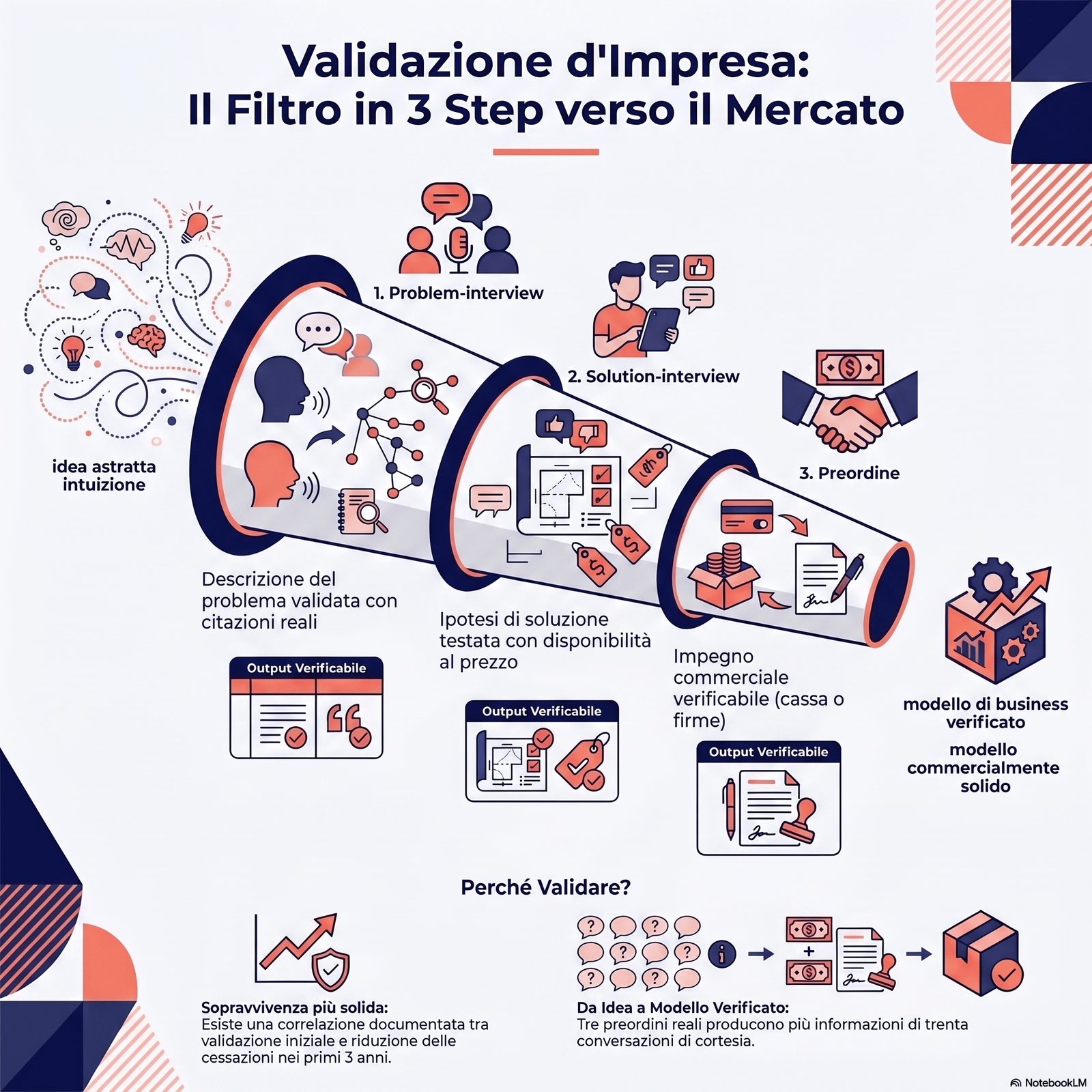
A practical validation protocol for anyone starting a business is organized into three sequential steps, each with a verifiable output.
1. Problem interview (output: a validated problem description). You hold 8-15 conversations with people from the target segment, focused on the potential customer's current behavior: what they do today to solve the problem, how much time or money they spend on it, which alternatives they have considered and rejected. You do not describe the solution you would like to sell: you listen. The output is a restatement of the problem from the segment's point of view, with real quotes.
2. Solution interview (output: a tested solution hypothesis). You present a descriptive version of the proposed solution to a subset of the people interviewed, collecting specific reactions: what would be useful, what is unnecessary, how much they would be willing to pay. The price question should be asked concretely ("how much would you pay for this today?"), not abstractly.
3. Pre-order or letter of intent (output: a verifiable commercial commitment). The definitive test is a concrete commitment: advance payment, a signed letter of intent, a waitlist sign-up with a deposit. The difference between "interesting" and "validated" is the willingness to commit. Three real pre-orders produce more information than thirty polite conversations.
Italian public statistics measure how many businesses survive, not the method by which they were started: of the businesses born in Italy in 2021, 62.8% were still active three years later [1]. There is therefore no institutional survey that quantifies the effect of early validation on survival, and claims on the subject should be treated as working hypotheses, not evidence. The operational criterion remains: validation reduces the number of decisions made without data.
A point of method: validation is not a single phase that closes, but an attitude that accompanies the first 18-24 months of activity. Hypotheses about segment, price, and channel should be rechecked every quarter in the first two years, because market responses often change the initial model.
For the full validation protocol, with checklists and examples, also read how to validate a business idea before you start.
Choose the legal structure that fits your risk and capital
The legal structure is not a formality: it affects personal liability, taxation, and the ability to access outside credit. Movimprese data show that in Italy in 2024, limited companies were the only legal form to grow in net terms (+60,959 units, or +3.25%), while partnerships and sole proprietorships ended the year down [2]. A rational choice starts from three questions: how much personal risk is sustainable, how many partners are involved, and how much starting capital is available.
When does a sole proprietorship make sense, and when is it better to set up a limited liability company? A sole proprietorship is fast but exposes your personal assets: a limited liability company costs more and, in exchange, builds a legal barrier.
In Italy, by far the most common legal forms for people starting a business today are four: the sole proprietorship (possibly under the flat-rate tax regime), the simplified limited liability company (SRLS), the ordinary limited liability company (SRL), and the general partnership (SNC). A comparative summary guides the choice on four parameters; the figures refer to the Italian system.
| Form | Personal liability | Minimum capital | Indicative annual costs | Main tax profile |
|---|---|---|---|---|
| Sole proprietorship (flat-rate regime) | Unlimited, on personal assets | None | €1,500-3,000 | 5%-15% substitute tax on revenue (with coefficients) |
| Simplified LLC (SRLS) | Limited to share capital | €1 up to < €10,000 | €3,500-6,000 | IRES corporate tax 24% + regional IRAP |
| Ordinary LLC (SRL) | Limited to share capital | €10,000 (25% paid in) | €4,000-7,000 | IRES corporate tax 24% + regional IRAP |
| General partnership (SNC) | Unlimited and joint among partners | None | €2,500-4,500 | Pass-through taxation (partners' IRPEF income tax) |
The figures are indicative and vary by Chamber of Commerce, region, and accounting complexity: they should be checked case by case with an accountant.
Unioncamere's Movimprese data show that in 2024 there were 115,729 registrations of limited companies in Italy, with a positive balance of 60,959 units, against a negative balance for partnerships (-13,721) and sole proprietorships (-10,058) [2]. The figure signals a trend toward forms that limit personal liability, but it does not mean a limited company is always the best choice: for activities with low operational risk and modest revenue, a sole proprietorship under the flat-rate regime often remains more efficient.
A rational choice starts from three questions, to be answered before meeting the notary or the accountant.
How much personal risk is sustainable? If the business involves significant investments, debts to third parties, or multi-year contracts with onerous clauses, exposing your personal assets (home, family savings) as a sole proprietorship or general partnership becomes hard to accept. A limited liability company provides a legal barrier — not an absolute one (with signed personal guarantees or management violations, the corporate veil can be pierced) but a significant one in most ordinary situations.
How many partners are involved? On your own, a sole proprietorship or a single-member LLC are both viable. With two or more partners, an LLC is almost always preferable to a general partnership because, in addition to limited liability, it regulates governance, partner entries and exits, and profit distribution in a structured way.
How much starting capital is available? With less than €10,000 of immediately available capital, the simplified LLC remains an entry route. Above that threshold, the ordinary LLC offers more flexibility (variable capital, the possibility of non-cash contributions, easier access to bank financing).
On the regulatory side, the Italian reference framework is the Civil Code (articles 2247 and following for partnerships, 2247 and 2462 and following for limited companies). Any preferential regimes (the flat-rate regime, the regime for returning workers, MIMIT incentives for innovative startups [6]) require a careful check of the requirements at the time of starting. Once the form is defined, the next step is building the economic model that will make the business sustainable.
Build the business model and the financial plan
The business model briefly describes who pays, for what, how often, and with what margin left after costs. The Bank of Italy's 2023 Invind survey reports that the gross operating margin of Italian businesses in their first three years is on average lower than that of mature businesses [3]. This pillar page guides you through filling in a Business Model Canvas as a summary tool (PDF available as a free downloadable resource at the end of the article).
Which numbers tell you whether a business model "holds up" before you start? A break-even beyond 24 months is not a plan: it is a bet that requires patient capital.
The most widely used summary tool for describing a business model is the Business Model Canvas, a nine-block structure that lets you see the key choices on a single page. Here are the nine blocks and how to question them in practice.
- Customer segments. Who actually pays? Not who uses the product, but who signs the contract. For a training school, the segments might be "companies paying for their employees" and "professionals paying for themselves." They are different segments.
- Value proposition. Which specific problem is solved, and in a way that is significantly different from the alternatives? A generic value proposition ("quality and service") is not a proposition: it is an aspiration.
- Channels. Through which channels does the segment discover, evaluate, buy, and get support? For an Italian artisan business: word of mouth among existing customers, sector marketplaces, local trade fairs. For a software house: organic search, integration partners, vertical events.
- Customer relationships. What kind of relationship do you establish: transactional, subscription, dedicated account? The cost to serve each customer depends on this choice.
- Revenue streams. One-off, recurring, or usage-based payment? The distinction affects cash predictability and the future valuation of the business.
- Key resources. Which assets are indispensable: people with specific skills, physical infrastructure, patents, data?
- Key activities. What must you do well to deliver the value proposition? Everything else is a candidate for outsourcing.
- Key partners. Which suppliers, allies, and integrators enable the model? Dependence on a critical partner is a structural risk.
- Cost structure. Which costs are fixed, and which are variable? Which costs grow linearly with revenue, and which scale in steps?
For the complete guide to filling in the nine blocks, also read Business Model Canvas: how to fill it in and what it is for.
Once the Canvas is complete, the next step is translating it into numbers. The hypotheses need to become a simplified 36-month financial plan that answers four questions: how much revenue will you generate month by month in three scenarios (pessimistic, realistic, optimistic)? What are the monthly fixed costs (rent, salaries, utilities, subscriptions)? What are the variable costs per unit sold? From which month does the operating margin turn positive (break-even)?
To build this plan step by step, also read how to write a business plan: structure and content.
The Bank of Italy's 2023 Invind survey reports that the gross operating margin of Italian businesses in their first three years is on average lower than that of mature businesses [3]. An expected break-even beyond 24 months does not make the project unviable, but it requires patient capital: if your starting capital does not cover 24+ months of fixed costs net of expected revenue, the risk of an early shutdown is high.
The Business Model Canvas is available as a free, open-access downloadable resource, with no registration required. Once the model is built, the next step is raising the capital needed to sustain it in the first months.
Raise capital: self-funding, credit, equity
Initial capital can come from personal savings, bank credit, public subsidized financing, business angels, or venture capital, in proportions that depend on the legal form and the sector. The OECD report Entrepreneurship at a Glance 2023 highlights that in Italy outside equity covers a smaller share than the European average [5]. A sound hierarchy of sources reduces the risk of undercapitalization, one of the most frequently reported causes of early insolvency [3].
How much capital do you really need to start and to survive the first 18 months? You need two figures, not one: startup capital and survival cash. The second is the one that sinks those who look only at the first.
The distinction between startup capital (one-off, to launch the business) and survival cash (recurring, to cover fixed costs while revenue is not yet at full speed) is the first point of method. Startup capital covers incorporation, equipment, initial inventory, any technology investments, and the costs of registering the business. Survival cash covers salaries, rent, utilities, subscriptions, and the business owner's own pay (because without a minimum compensation the system is not sustainable) for the number of months between launch and the expected break-even.
The typical hierarchy of sources, in order of increasing cost to the business owner:
1. Self-funding (personal savings, family partners). Low or zero financial cost, high personal risk cost. It is the main source for starting micro-businesses and self-employed practices in Italy.
2. Public subsidized financing. In Italy, tools such as Smart&Start Italia (for innovative startups), ON-Resto al Sud, and Nuove Imprese a Tasso Zero, managed by Invitalia on behalf of MIMIT [6]. The financial cost is typically low (subsidized rates or non-repayable grants), but disbursement times are often long. They should be assessed against the specific profile of the project (business purpose, geographic area, age of the founders).
3. Bank credit. Unsecured loans and loans backed by the Italian state guarantee fund for smaller businesses (Fondo di Garanzia, managed by MCC). The financial cost is modest when interest rates are at normal levels, but it requires a credit history (difficult for anyone just starting) or collateral. The guarantee fund lowers the barrier for businesses with no track record.
4. Outside equity (business angels, venture capital). Capital provided in exchange for shares in the company. The financial cost is apparently zero (it is not repaid), but the ownership cost is significant: you give up a portion of the business. It suits projects with strong scaling potential and the capacity to absorb significant capital. The 2023 OECD report notes that in Italy outside equity covers a smaller share than the European average [5], partly because new Italian businesses tend to be smaller.
The most frequent mistake, documented consistently by the Bank of Italy [3] and by the literature on business survival, is initial undercapitalization: you raise enough resources for startup capital but not enough for survival cash, counting on revenue that will arrive too late relative to outflows. A rule of thumb: survival cash should cover at least 150% of the fixed costs expected until the expected break-even, to absorb negative deviations.
For more on raising and managing capital in detail, also read financial management: tools and operational levers.
Once the financial picture is defined, the next step is completing the administrative requirements. Cash management in the first months remains the critical ground, a topic explored further in the guide to business management.
Handle the paperwork without slowing the project down
Administrative requirements absorb time and attention that should be on the market. In Italy, the typical sequence includes articles of incorporation, entry in the Business Register, INPS (social security) and INAIL (workplace insurance) positions, and assignment of a VAT number. Documenting the checklist reduces the risk of omissions and delays that affect time to market.
Can you run the paperwork in parallel so you do not lose weeks of market time? Many procedures can move in parallel: whoever handles them one after another is paying an invisible opportunity cost.
The sequence of requirements depends on the legal form chosen. Here is a short checklist for the two most common forms in the Italian system.
For a sole proprietorship (including under the flat-rate regime):
- Register for a VAT number with the Agenzia delle Entrate, the Italian tax agency (form AA9/12, online or through an authorized intermediary). Time: 1-3 business days.
- Entry in the Business Register through the single filing system (Comunicazione Unica, ComUnica) — a filing that simultaneously activates the VAT number, INPS, and INAIL. Time: 1-5 days.
- Open an INPS position in the scheme for traders or artisans (if applicable) or in the separate scheme (for professionals without their own pension fund). This happens partly through ComUnica and partly through a specific application.
- Open an INAIL position (for businesses with employees or for certain risk profiles).
- If required, file a SCIA (certified notice of start of activity) with the municipality or the one-stop shop for productive activities (SUAP), if the activity is subject to authorization.
- Activate certified email (PEC) and a digital signature (both mandatory).
- Open a dedicated bank account (recommended even under the flat-rate regime).
For an SRL and SRLS:
- Articles of incorporation signed before a notary. Time: 1-2 weeks of preparation, deed signed in a day.
- Pay in 25% of the share capital (for an ordinary SRL) or the entire capital (for an SRLS) into a restricted account.
- Entry in the Business Register, handled by the notary (within 20 days of the deed). Time: 1-2 weeks.
- Assignment of the VAT number, company tax code, and INPS and INAIL positions through ComUnica (handled by the notary or the accountant).
- If required, file a SCIA with the SUAP for regulated activities.
- Activate the company's certified email (PEC) and the director's digital signature.
- Open a dedicated bank account (mandatory; the restriction on the capital is then released).
- Keep the corporate books (shareholders' register, decisions register, inventory book) — accounting handled by the accountant.
Many of these steps can run in parallel: activating PEC and the digital signature can proceed while the articles of incorporation are being prepared; opening the bank account can start before the deed, setting up the restriction for the capital payment; the SCIA can be prepared while you wait for the notary's schedule. Handling in series procedures that could run in parallel stretches timelines by 3-6 weeks with no benefit at all.
The operational pattern that shortens time to market consists of three actions: prepare a written checklist shared by the business owner, the accountant, and the notary from the first meeting; assign a person responsible for coordination (it can be the business owner or the accountant, but it must not be left undefined); and set weekly deadlines to check progress. Documenting processes and procedures is a topic developed further in the guide business procedures: what they are and how to write them. Once the paperwork is done, the next step is the first revenue.
Reach your first revenue: from go-to-market to cash-in
First revenue is not an accounting event: it is the signal that the business model has found a market willing to pay. The time between incorporation and the first significant revenue varies considerably from sector to sector, and no public statistic measures it comparably. A clear go-to-market strategy — channel, price, sales cycle — reduces the risk of a "company that is alive but has no revenue."
Should you wait until you are "ready," or sell as soon as the product is minimally usable? Waiting for perfection costs cash: a minimum sellable version lets you learn from a paying market.
The useful operational concept is the minimum sellable product: the simplest version of the product or service that a customer is willing to pay for. It is not the beautiful version; it is the commercially verifiable version. For a digital product, one essential feature that solves the core problem; for a professional service, an offer with a narrow, defined scope; for a physical product, a first small batch. The difference compared with the "polished product" — the one the business owner would consider ready — can be 3-12 months of delay that the financial plan cannot withstand.
The time between formal incorporation and the first significant revenue depends above all on the sector's sales cycle: in professional services it is typically shorter (weeks), in manufacturing and physical products longer (months), and in software and platforms it can extend beyond a year if the model requires network effects. These are orders of magnitude observed in the field, not benchmarks measured by a public survey: they should be read in the context of the relevant sector.
The go-to-market strategy that leads to first revenue rests on three explicit choices.
Channel. Through which channel can the first customer discover and buy the offer? For most new B2B businesses in Italy, the effective initial combination is: the business owner's personal network + a minimal digital presence (website + LinkedIn) + attending 2-3 vertical events. For B2C, the combination varies by sector (local, marketplaces, social commerce). Focusing on 1-2 primary channels in the first six months produces more learning than an investment scattered across six channels.
Price. The first customer's price is not the list price: it is a learning tool. Significant discounts for the first 5-10 customers, in exchange for structured feedback and willingness to act as a reference, are a documented practice. Make the introductory nature of the price explicit and set the date of transition to the regular price, to avoid getting trapped at an unsustainable price level.
Sales cycle. How much time passes between first contact and order? The answer determines your cash needs: long cycles require more survival capital. For cycles longer than 90 days in B2B services, it is wise to build a pipeline of at least three times the quarter's target revenue.
First revenue is also the first point at which the initial KPIs become measurable. To build a consistent dashboard from the start, also read how to choose business KPIs. Having separated first revenue from long-term solidity, what remains is to recognize the most common mistakes that hit new businesses in their first months.
Common mistakes in the first months of activity
Most closures happen in the first three years, and the causes are recurrently concentrated: undercapitalization, lack of validation, an unsuitable legal form, and loose cash management. Eurostat business demography data confirm a similar profile across the EU [4]. Recognizing the most common mistakes is a cheaper prevention lever than correcting them after the fact.
Which mistakes can you avoid by reading the data of those who have already failed? Some mistakes are avoidable at zero cost: ignoring them costs the business.
Six patterns recur in a documented way in early closures, based on data from Unioncamere [2], Eurostat [4], and the Bank of Italy [3].
1. Initial undercapitalization. You raise resources for startup capital but not for survival cash. When revenue does not arrive on schedule, the cash runs out. Correction: size survival cash at 150% of the fixed costs expected until break-even.
2. Failing to validate the market before incorporating. You set up the company before having commercial confirmation, incurring fixed costs (notary, accountant, minimum social security contributions) before a market exists. Correction: a pre-formal validation phase (problem interviews, solution interviews, pre-orders) before the articles of incorporation.
3. An unsuitable legal form. You choose a form that is undersized (a sole proprietorship for an activity with high financial risk) or oversized (an ordinary LLC for an activity with modest revenue and low risk). In the first case, your personal assets are exposed; in the second, fixed costs are disproportionate. Correction: apply the three choice questions (risk, partners, capital) before deciding.
4. Loose cash management. You do not separate your personal account from the business account, you do not keep a rolling cash budget, and you confuse revenue with cash collected. The time gap between invoicing and collection (days of customer credit) creates needs that were not planned. Correction: a dedicated account, a monthly rolling 6-month cash budget, and weekly monitoring of receivables and payables.
5. Overestimating time to revenue. The financial plan assumes revenue will arrive in 3-6 months when the sector's real sales cycle is 9-12 months. The discrepancy does not show until cash is under strain. Correction: validate timing assumptions with sector data and conversations with other business owners in the same supply chain.
6. Confusing an innovative startup with a generic new business. You apply the rapid pivoting and fundraising logic typical of tech startups to a business that is actually a traditional small company, or, conversely, you apply a logic of immediate profitability to a project that requires significant upfront investment before breaking even. Correction: clearly distinguish the nature of the business, also because the Italian regulatory category of the MIMIT innovative startup [6] is specific and has precise requirements.
The six mistakes share a root: they treat starting a business as a one-off event instead of an ordered sequence of interdependent decisions. If you want to go deeper into the phase that immediately follows — consolidating the business in the first 12-24 months — read the guide to business management.
Limitations and conditions of applicability
The operational guidance in this article refers to the Italian regulatory framework in force at the time of publication. Company law, insolvency law, and the tax regime are subject to change: for actual decisions, check the current rules with an accountant and a legal advisor.
The statistical data cited (Unioncamere [2], ISTAT [1], Bank of Italy [3], Eurostat [4], OECD [5]) refer to specific samples and periods and describe documented trends, not universal laws. The survival of a single business depends on many variables (sector, geographic area, founder profile, local market conditions) that aggregate statistics do not capture. The correlations observed (for example, between early validation and survival rates) should not be read as deterministic cause-and-effect relationships.
The timelines indicated (1-3 days for the VAT number, 4-6 weeks for the complete start) are averages for ordinary situations in Italy: they vary depending on the Chamber of Commerce, the time of year, the complexity of the case, and the availability of documentation. The indicative annual costs of the different legal forms depend on the accountant, the region, and the complexity of the accounting.
The scope of the innovative startup, regulated by MIMIT [6], is specific: the requirements should be checked carefully before any organizational decision or application for dedicated incentives.
Finally, the guidance on the Business Model Canvas, the validation steps, and the minimum sellable product describes documented practices but is no guarantee of success: it represents a reduction of systematic risk, not the elimination of entrepreneurial uncertainty.
FAQ
1. How long does it take on average to start a business in Italy, from idea to first revenue? The complete sequence — pre-formal validation phase, incorporation, commercial activation — typically ranges from 3 to 12 months depending on the sector, the complexity of the legal form chosen, and the length of the sales cycle. The formal incorporation phase on its own takes 1-3 weeks for a sole proprietorship and 3-6 weeks for an SRL.
2. Should you get a VAT number before you have your first customer? The rational answer is: first you validate the problem, the solution, and willingness to pay (problem interviews, solution interviews, pre-orders), then you get the VAT number. Getting it before validation generates fixed costs (accountant, minimum social security contributions) with no guarantee that the market exists.
3. How much capital do you really need to start a business? You need to consider two separate figures: startup capital (one-off, for incorporation and initial investments) and survival cash (to cover fixed costs in the months between launch and break-even). A rule of thumb: survival cash should cover at least 150% of the fixed costs expected until the expected break-even.
4. Simplified LLC or sole proprietorship: which should you choose? A sole proprietorship (possibly under the flat-rate regime) is preferable for activities with low financial risk, modest revenue, and simple management. A simplified LLC becomes preferable when operational risk is significant (debts, multi-year contracts, major investments) or when you expect to bring in partners. The choice depends on sustainable personal risk, number of partners, and available capital.
5. Are there public incentives for people starting a business in Italy? There are several tools managed by Invitalia on behalf of MIMIT [6]: Smart&Start Italia for innovative startups, Nuove Imprese a Tasso Zero for young people and women, and ON-Resto al Sud for southern Italy. Requirements vary by age, geographic area, and business purpose: they need to be checked carefully at the time of starting.
6. How can you tell whether an idea will hold up in the market before incorporating the company?
Finding out whether an idea holds up in the market requires concrete experiments, not generic conversations with friends and acquaintances.
A minimum protocol involves three steps in sequence: interviews about the problem to understand how people in the target segment deal with the issue today, a test of the proposed solution to gather specific reactions, and finally a verifiable commercial commitment — a pre-order, a deposit, a signed letter of intent.
No Italian public survey measures how much early validation affects business survival: the criterion remains operational, not statistical.
The practical difference between an "interesting" idea and a "validated" one is a real willingness to pay: three concrete pre-orders are worth more than thirty friendly conversations.
Only after this confirmation does it make sense to take on the fixed costs of incorporation — notary, accountant, minimum social security contributions — which would otherwise start before the market has confirmed demand.
7. Do you need a business plan even if you are not looking for funding?
A business plan remains useful even when you are not seeking outside funding, because it serves as an internal check before it serves as a presentation to third parties.
Building a 36-month financial plan forces you to spell out assumptions that often remain implicit: how much revenue you expect in three scenarios, what the fixed and variable costs are, and from which month the operating margin turns positive.
The Bank of Italy's Invind survey reports that the gross operating margin of Italian businesses in their first three years of activity is on average lower than that of mature businesses [3], which makes it even more necessary to check in advance whether the available capital can sustain the expected time to break-even.
Without this exercise, the risk is discovering initial undercapitalization when cash is already under strain, instead of on paper.
In this sense, the business plan is a tool of internal discipline before it is a document for the bank.
8. How many new businesses survive their first five years in Italy, and what sets the survivors apart?
Eurostat business demography data indicate that, across Europe, a significant share of new businesses do not make it past their fifth year of activity [4]; in Italy, ISTAT surveys quantify the phenomenon: of the businesses born in 2019, 49.4% were still active in 2024 [1].
Read in isolation, the figure may seem discouraging, but the most useful reading is that of the causes: initial undercapitalization, failure to validate the market before incorporating, an unsuitable legal form, and loose cash management are recurring, documented patterns, not random events.
Businesses that survive their first five years repeatedly share a few observable traits: a demand validation phase carried out before incorporation, survival cash sized on real fixed costs and not just on startup capital, and close monitoring of the gap between revenue and cash collected.
These traits can be managed with method rather than left to chance: survival depends significantly on the quality of the decisions made in each phase, more than on the brilliance of the original idea.
Operational summary
Starting a business is not the same as getting a VAT number: it is a trajectory in three phases — pre-formal validation, incorporation, commercial activation — that ends with the first sustainable revenue. The pre-formal phase, based on problem interviews, solution interviews, and pre-orders, reduces systematic risk more than any later planning. The choice of legal form answers three operational questions (personal risk, number of partners, available capital) and should be calibrated to the specific profile, avoiding both undersizing and oversizing. Building the business model, summarized with the Business Model Canvas, must translate into a 36-month financial plan that distinguishes startup capital from survival cash, sizing the latter at no less than 150% of fixed costs until break-even. Sources of capital follow a hierarchy (self-funding, subsidized financing, bank credit, outside equity) that depends on the legal form and the scaling potential. Administrative requirements, if handled in parallel with a checklist and clear responsibility, take 1-6 weeks depending on the form. First revenue is reached through the minimum sellable product, with explicit choices on channel, introductory price, and sales cycle. The most common mistakes — undercapitalization, lack of validation, an unsuitable legal form, loose cash management, overestimating time to revenue, confusing an innovative startup with a generic business — share the root of treating the start as an event rather than a sequence of interdependent decisions.
Conclusion
Starting a business is an ordered sequence: validating the idea, choosing the legal form, building the business model, raising capital, completing the paperwork, reaching first revenue. Italian and European public sources — ISTAT, Unioncamere, the Bank of Italy, Eurostat, the OECD — agree that survival does not depend on the brilliance of the idea, but on the quality of the decisions made in each phase [1][2][3][4][5].
If you want to keep reading, it is worth exploring how to turn a newly started business into a structured organization: see Business systemization: what it means and when you need it and, for the consolidation phase, Business management: principles and tools. A free downloadable resource — the Business Model Canvas in PDF — is available as a tool for summarizing the business model described in the body of the article.
A country that reduces the failure rate of new businesses in their first three years by just a few percentage points recovers productive capacity, jobs, and tax revenue without creating anything new: it is a matter of making the most of what is already being born. Starting a business with method is the first concrete contribution to that reduction.
Sources and references
[1] ISTAT, "Demografia d'impresa — Anni 2019-2024", data tables, 2026. Available at: https://www.istat.it/tavole-di-dati/demografia-dimpresa-anni-2019-2024/
[2] Unioncamere — InfoCamere, "Natalità e mortalità delle imprese italiane registrate presso le Camere di commercio — Anno 2024", Movimprese press release, Rome, January 23, 2025. Available at: https://www.unioncamere.gov.it/osservatori-economici/demografia-delle-imprese/movimprese
[3] Banca d'Italia, "Indagine sulle imprese industriali e dei servizi (Invind) — Anno di riferimento 2023", Statistics, 2024. Available at: https://www.bancaditalia.it/statistiche/tematiche/indagini-famiglie-imprese/imprese-industriali
[4] Eurostat, "Business demography statistics", Eurostat Statistics Explained, 2024 update. Available at: https://ec.europa.eu/eurostat/statistics-explained/index.php?title=Business_demography_statistics
[5] OECD, "Entrepreneurship at a Glance — Highlights 2023", OECD Publishing, 2023. Available at: https://www.oecd.org/industry/entrepreneurship-at-a-glance.htm
[6] MISE — Ministero delle Imprese e del Made in Italy, "Relazione annuale sullo stato dell'innovazione — Startup innovative", Rome, 2024. Available at: https://www.mimit.gov.it/it/impresa/competitivita-e-nuove-imprese/start-up-innovative