
Validating a business idea is the structured process that turns beliefs into evidence: you identify the riskiest assumptions, design measurable tests, collect data and decide whether to proceed, change or abandon. It is not an expert opinion, it is a sequence of tests.
Among Italian businesses founded in 2018, only 48.2% were still active five years later, in 2023 [3]. The survey measures survival, not its causes: no share of that mortality is attributed to a failure to test assumptions.
The next sections cover method, key assumptions, rapid tests, viability indicators and common mistakes.
Define what business idea validation really needs to prove
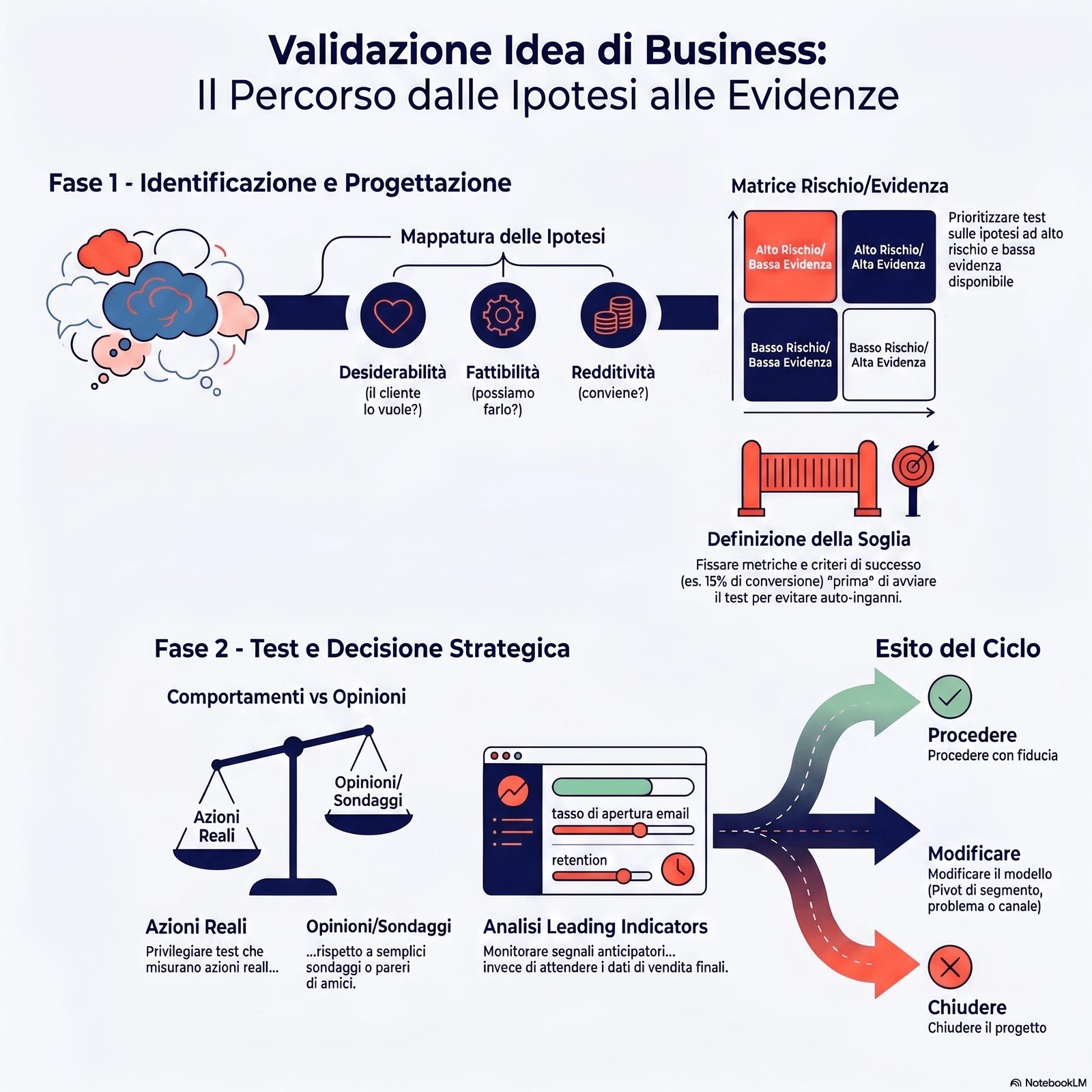
The word "validate" is used for very different things: from asking friends for their opinion to structured market research. The testing methodology described by Osterwalder and colleagues distinguishes desirability, feasibility and viability as three separate dimensions to validate [1]. Understanding the difference between an opinion and a proof is the first step to avoid wasting time on fake checks.
Does validating an idea mean looking for confirmation or looking for disproof? A validation that only looks for confirmation produces pleasant data and fragile decisions.
Validation is the process that turns the idea's assumptions into statements supported by evidence collected in the field. It is not an optional activity to complete once the product is ready: it is a sequence of tests to run before committing the main resources. The difference between market research, investigation and surveys matters: market research studies the competitive context and the size of the market; a survey collects opinions about what people say; validation checks what people do — or would do — when faced with a real offer.
The working line between "validating" and "surveying" lies in the quality of the evidence produced. A survey asks whether a customer would buy a hypothetical product; a validation test puts the customer in a position to take an action — click a link, leave contact details, pay a deposit — and measures actual behavior. Behaviors are worth more than stated intentions, because they are more costly to fake and more reliable as signals.
The working formula to keep in mind: a useful validation tests the idea's riskiest assumptions, not the most pleasant ones. Starting from the model's strengths produces confirmations; starting from the assumptions that, if wrong, would sink the entire idea produces decisions.
Identify the idea's riskiest assumptions
Every business idea contains dozens of assumptions: about the customer, the price, the channel, the costs. An analysis of 214 post-mortem accounts of new ventures shows that failure is concentrated on the commercial side — a missing or wrong business model in 35% of cases, weak business development in 28% — while product-related problems weigh much less (10% of the overall classification) [2]. Identifying the riskiest assumptions — the ones that, if wrong, bring down the whole model — is the place to start.
Which assumption should you test first when resources are limited? Often it is not the most obvious one, but the one the founder takes most for granted.
To choose where to start, it helps to build a matrix that crosses two dimensions: the risk of the assumption (how serious it is to be wrong) and the available evidence (how much is already known, and how solidly). Assumptions with high risk and little available evidence are the ones that call for priority testing.
Three categories of assumptions founders tend to take for granted:
- The customer is willing to pay. Interest expressed during an interview is not the same as willingness to pay in a real setting. The distance between "sounds like a good idea" and "here are my card details" is often underestimated.
- The channel is accessible at sustainable cost. A channel that works for an established business does not guarantee the same results for a new idea with no reputation. The cost of acquiring the first customer is systematically higher than estimated.
- Unit cost falls with scale. Optimism about production, delivery or support costs as you scale is common. Testing the cost at a small volume before assuming economies of scale gives a more reliable reading.
The risk × available evidence matrix does not need to be a formal document: a single sheet listing the idea's main assumptions, ranked by the potential impact of failure, is enough. The assumptions in the top-left corner (high risk, little evidence) are the ones to test first. Those in the bottom-right corner (low risk, plenty of evidence) can wait.
A useful link for framing assumptions within the model: the Business Model Canvas provides a structure for systematically listing the components of the idea, including the riskiest ones.
Build rapid, measurable validation tests
A useful validation test meets three constraints: it has an assumption stated in a testable way, a success metric defined before the test, and a threshold that says what "passed" and "failed" mean. Skipping any of the three produces ambiguous tests from which it is easy to extract the confirmation you wanted. Order matters: setting the threshold after seeing the data is a common and harmful practice.
How many tests is it reasonable to run before making a decision? A single test that fails is worth more than ten that confirm: choosing the right test is half the work.
The five-step process for building a reliable validation test:
-
State the assumption in a testable way. The assumption should be a sentence like "we believe [customer segment] needs [solution] for [problem] and will be willing to [specific behavior]." Vague assumptions produce vague tests.
-
Choose the metric. The metric must be an observable data point that leaves no room for interpretation: conversion rate, number of sign-ups, percentage of users who complete an action, number of advance payments. Not "customers' impressions" but "the number of customers who leave their contact details."
-
Set the success and failure threshold before the test. If 15% of the users who visit the page leave their contact details, the test passes; below 15%, the test fails. The threshold is set beforehand, not after the fact.
-
Run the test on the narrowest possible scope. Validation tests are not launch campaigns: they are run on small samples, over short timeframes, with minimal investment. Four types of rapid tests any business can use: customer interviews (10-15 people, open questions about the problem, not the product), a landing page with sign-up (measures interest before the product exists), a smoke test with pre-orders (measures willingness to pay), a manual or "concierge" prototype (the service is delivered by hand to simulate the product's promise) [1].
-
Decide on the data, not on your interpretation of the data. If the threshold was met, you proceed; if not, you revise the assumption or abandon that path. Building convincing narratives around negative data is one of the most common forms of self-deception in validation.
Choose indicators of the idea's viability, not just of sales
Sales come late: by the time revenue shows up, the idea has either already worked or not. You need leading indicators — weak signals that tell you whether the model's assumptions are holding before the market delivers its verdict. The distinction between outcome indicators and process indicators is central to stepping in on time.
Which metrics should you focus on in the first 12 weeks of a new project? Dashboards full of sales figures are premature; empty dashboards are worse.
The working distinction is between lagging indicators and leading indicators. Lagging indicators are the results: revenue, number of customers acquired, margin. They arrive when the decisions have already been made. Leading indicators are the early signals: they tell you whether the model is behaving as expected before the final results are available.
Three areas with concrete examples:
- Interest and demand. Email open rate, number of unsolicited information requests, number of people asking when the product will be available. These indicators show whether the problem really exists for the target segment.
- Conversion. The percentage of people who, after receiving a concrete offer, take a measured action (leave contact details, complete a pre-purchase, join a free trial). Conversion measures the distance between interest and willingness to commit.
- Retention. The percentage of customers who come back after the first use, frequency of use, number of unsolicited referrals. Retention measures whether the product solves the problem in a way that matters enough to justify a repeated choice.
For building a structured indicator system, see the guide to business KPIs.
Decide whether to proceed, change or abandon the idea
After the tests comes the most uncomfortable part: the decision. Three possible outcomes — proceed (the data confirms), change (the data calls for an adjustment), abandon (the data solidly disproves). Codifying in advance which outcome corresponds to which threshold keeps you from confusing courage with stubbornness.
How many adjustments are reasonable before continuous change becomes plain indecision? A course corrected three times is agile; a course corrected ten times is a course that never existed.
The working criterion is defining "kill criteria" in advance: the conditions that, if not met after a set number of tests, mean closing the idea down. Defining them before the test is essential because, once the project is underway, the emotional pressure on those who have already invested time and resources pushes them to read negative data as exceptions or as signals for adjustment.
When the data calls for a change, the most common types of adjustment are four:
- Segment adjustment. The problem exists, but the segment initially identified is not the one with the most urgent problem. You shift focus to a different segment.
- Problem adjustment. The segment is the right one, but the problem the idea solves is not the priority for that segment. You reformulate the problem assumption.
- Channel adjustment. The idea is solid but the channel used to reach customers does not work. You test an alternative channel.
- Revenue model adjustment. Customers want the product but not in the proposed payment form (e.g., subscription vs one-time purchase). You change the commercial structure.
The difference between a well-founded adjustment and stubbornness is measured with data: if the tests that follow the adjustment show improvements in the viability indicators, the adjustment was right; if the data keeps signaling problems even after multiple changes, the core assumption deserves a deeper review.
A strategic framing of adjustments is available in the guide to business strategy.
Common mistakes in validating a business idea
The most common mistakes in validation are not technical but a matter of posture: testing the most comfortable assumptions instead of the riskiest, asking customers whether they "would buy" instead of watching what they do, confusing compliments with commitments. Recognizing them is more useful than memorizing them, because they show up in different forms depending on the context. Dealing with them takes honesty more than method.
Which mistake is more costly: testing too little or testing the wrong thing? Both extremes lead to the same outcome — an idea that dies at its first serious contact with the market.
The six most common mistakes, each with a small practical correction:
-
Testing within your own circle. Friends and family tend to be too encouraging and do not represent the target segment. Correction: identify at least 10 people in the target segment whom you do not know personally and run the tests with them.
-
Interviewing with closed or hypothetical questions. "Would you buy this product for 49 euros?" is a question that produces intentions, not behaviors. Correction: ask the customer to describe the last time they had the problem, not to evaluate the proposed solution.
-
Confusing intention with behavior. "Yes, I'd be interested" is not worth as much as "here's my email address," which is not worth as much as "here's the payment." The hierarchy of commitment is the most reliable filter. Correction: always ask for an action, not an opinion.
-
Using vanity metrics. Page views, social media followers, likes on posts: these are data points that feel satisfying but do not measure the idea's viability. Correction: choose one behavioral metric for each test (e.g., visit-to-sign-up conversion rate).
-
Changing the success threshold after seeing the data. If the test produced a 6% conversion rate and the threshold set in advance was 12%, the result is a failed test — not an invitation to lower expectations. Correction: document the threshold before the test and do not change it after the fact.
-
Stopping at the first positive signal. A single positive test is not enough: it depends on the sample, the context, the timing. Correction: replicate the test on a different sample or in a different context before drawing final conclusions.
Limitations and conditions of applicability
The validation methods described in this article apply most solidly in contexts where customer behavior can be observed and measured — B2C models, B2B with short sales cycles, products and services with an identifiable point of purchase.
In some contexts classic validation has significant limits:
- Radical innovations. When the product is radically new, customers may lack the cognitive reference point to express consistent preferences. In these cases behavioral tests remain useful, but the conclusions should be read with more caution.
- Regulated markets. In highly regulated sectors (health, finance, energy) some forms of rapid testing may run into regulatory constraints. It is wise to check the sector's specific requirements before designing the tests.
- Products with long adoption cycles. When the customer takes 6-18 months to make a purchase decision, tests based on quick actions (landing pages, smoke tests) only measure initial interest, not staying power over time.
- Established businesses vs startups. The failure data [2] comes from post-mortem accounts of new ventures, mostly tech and non-Italian, written voluntarily by the founders themselves. Transferring it to traditional businesses is reasonable for the general principles, but the specific numbers (survival rates, test timeframes) need to be put in the context of the sector and the business model.
This is a practical guide with editorial purposes: it does not replace specialist advice for significant investment decisions.
FAQ
How long does a complete validation cycle take? A single validation test can last from one week (interviews with a small sample) to 4-6 weeks (a landing page with paid traffic on a controlled scope). A complete cycle that covers the main assumptions typically takes 2-4 months, depending on the complexity of the model and the availability of the target segment.
Do you need a product to validate an idea? No. The most useful validation tests are run before the product is developed. The manual prototype ("concierge test") and the landing page with pre-registration let you measure interest and willingness to pay without investing in product development.
How many people do you need to interview to get reliable data? The methodological literature suggests that 5-10 in-depth interviews within a homogeneous segment produce enough information saturation to identify recurring themes [1]. For behavioral tests (conversion, smoke tests) the minimum sample depends on the expected conversion rate: to detect differences of 5-10%, samples of at least 100-200 units are needed.
What happens if the tests produce contradictory results? Contradictory results are often a sign of poorly stated assumptions or of non-homogeneous segments in the sample. Before changing strategy, it is worth checking whether the sample was actually homogeneous and whether the assumption tested was stated specifically enough.
Does validation also apply to new product ideas in an established company? Yes. The same methods apply to launching new product lines, opening new geographic markets or introducing new service models in existing companies. The advantage, in these cases, is that the founder can use existing customers as the base for the initial tests.
Key takeaways
Validating a business idea means running a sequence of tests on the model's riskiest assumptions, not gathering approval for the product. The process starts by identifying the critical assumptions — the ones that, if wrong, would bring down the entire idea — and moves on to measurable tests that produce behavioral evidence, not opinions.
The working tools are accessible to businesses of any size: a risk-evidence matrix to choose where to start, a five-step checklist to build reliable tests, leading indicators to monitor the idea's viability in the first weeks. The hardest part is not technical, it is the willingness to read unpleasant data with the same attention as positive data.
Validation is not a guarantee: even well-tested ideas can fail because of timing, competition or the macroeconomic context. It is instead a tool for reducing the cost of the most predictable mistakes and for making investment decisions with more evidence at hand.
Conclusion
Validating a business idea is not a reassurance to seek before you start but a sequence of tests on the riskiest assumptions: it sets the criteria by which you will say whether the customer really exists, whether they are willing to pay, whether the channel reaches them sustainably. Building it takes honesty in choosing the assumptions, rigor in setting the thresholds and a willingness to read unpleasant data too.
The thread that ties these steps together is consistency with the business model and the strategy. When validation stays disconnected from the canvas or from quarterly priorities, it becomes a ritual exercise and the investment goes ahead on the initial beliefs anyway. To frame validation within the construction of the model, it is also worth reading the guide to the Business Model Canvas and, on the start-up side, how to start a company.
A business owner who truly validates their ideas stops confusing enthusiasm with market signals. They decide which projects to put energy into, know their own assumptions and know when to update them. It is a calmer working position with more solid results — accessible to organizations of any size, provided validation remains a tool before the start, not a justification after.
Sources and references
[1] Osterwalder, A., Pigneur, Y., Bernarda, G., Smith, A., "Testing Business Ideas — A Field Guide for Rapid Experimentation", Wiley, 2019.
[2] Cantamessa, M., Gatteschi, V., Perboli, G., Rosano, M., "Startups' Roads to Failure", Sustainability, vol. 10, no. 7, art. 2346, 2018. Available at: https://doi.org/10.3390/su10072346
[3] ISTAT, "Demografia d'impresa. Anni 2018-2023", Table 5 "Tassi di sopravvivenza delle imprese nate nel 2018, 2019, 2020, 2021 e 2022 negli anni 2019-2023 per macrosettore", Total row, 2025. Available at: https://www.istat.it/tavole-di-dati/demografia-dimpresa-anni-2018-2023/