

The answer is not obvious: two sentences describing the same fact can produce two opposite reactions, depending on whether one names a behavior and the other names a person.
Feedback to team members is the information that gives a person back what their work has produced, so they can keep or correct their behavior.
Whoever runs a small professional firm, manages a department in a small company or leads a business of a hundred people faces the same hesitation: the right words seem obvious until you actually need them, at the moment you are about to say them.
An Istat survey of Italian companies with at least 3 employees shows that the vast majority have fewer than 50 employees [1].
In organizations of this size it is plausible, as an operating hypothesis, that every conversation between the person who leads and the person who does the work carries more weight than elsewhere.
The following pages collect a repertoire of example wordings for the situations that come up most often: the late delivery, the mistake that comes back, the good work that goes by without comment, feedback between colleagues and feedback addressed to your own manager.
Words are not a neutral wrapping for feedback: the same observation, said as a judgment or as a verifiable fact, changes the outcome of the conversation — it is not the same thing said differently, it is a different thing.
Before getting into the repertoire, it is worth separating two things that are easily confused: the example wording and the structure to fill in.
The structure — described in the article on how to give feedback to team members — sets out the three steps of a feedback conversation: situation, behavior, impact.
The wording is the specific sentence that fills those steps in a concrete situation.
If you are looking for the method, you will find the structure in the other article; if you are looking for the words for a specific case, you will find the repertoire here.
The wordings collected here do not repeat those already published in the article on the structure of feedback: they cover different situations — late delivery, recurring mistake, recognition, peer feedback, upward feedback and judgment disguised as description.
Wording feedback for a late delivery: the same situation in two sentences
Do two sentences that point out the same delay really have the same effect on the team member who hears them?
A meta-analysis of more than 23,000 observations shows that more than a third of the feedback interventions examined worsened performance instead of improving it [2].
From this follows a working hypothesis, not a research finding: the way the sentence is built is not a stylistic detail.
A late delivery can be told as a trait of the person or as an event with a date.
In the first case the sentence tends to close immediately, because it leaves little room for a reply.
In the second case it opens a question: what caused it, and what changes next time.
The two wordings that follow tell the same delay in two different ways, applicable to a professional firm, a department or a small company.
With a late delivery the rule is visible to the naked eye: date and time are a verifiable fact, "not punctual" is a judgment, and only the first leaves something to discuss.
The Italian Treccani dictionary defines feedback, in technical language, as the process by which the effect resulting from the action of a system is reflected back on the system itself "to vary or appropriately correct its functioning" [3].
In a work team the sentence you say is part of that system, because it steers what the team member will do the next day.
The meta-analysis cited at the start dates from 1996 and aggregates 607 effect sizes (23,663 observations) on tasks and contexts that are very different from one another [2].
The authors note that the effectiveness of feedback decreases when attention shifts from the task to the person [2].
The situations in this repertoire are hypothetical, built to show the difference between the two forms.
| Judgment about the person | Description of the fact |
|---|---|
| "You're not punctual with deliveries." | "The draft financial statements arrived on Thursday at 5 p.m.; the client was expecting them on Wednesday at noon." |
| "You don't respect the department's deadlines." | "Batch 14 was tested on Monday; shipment was scheduled for Friday and the courier was moved to Tuesday." |
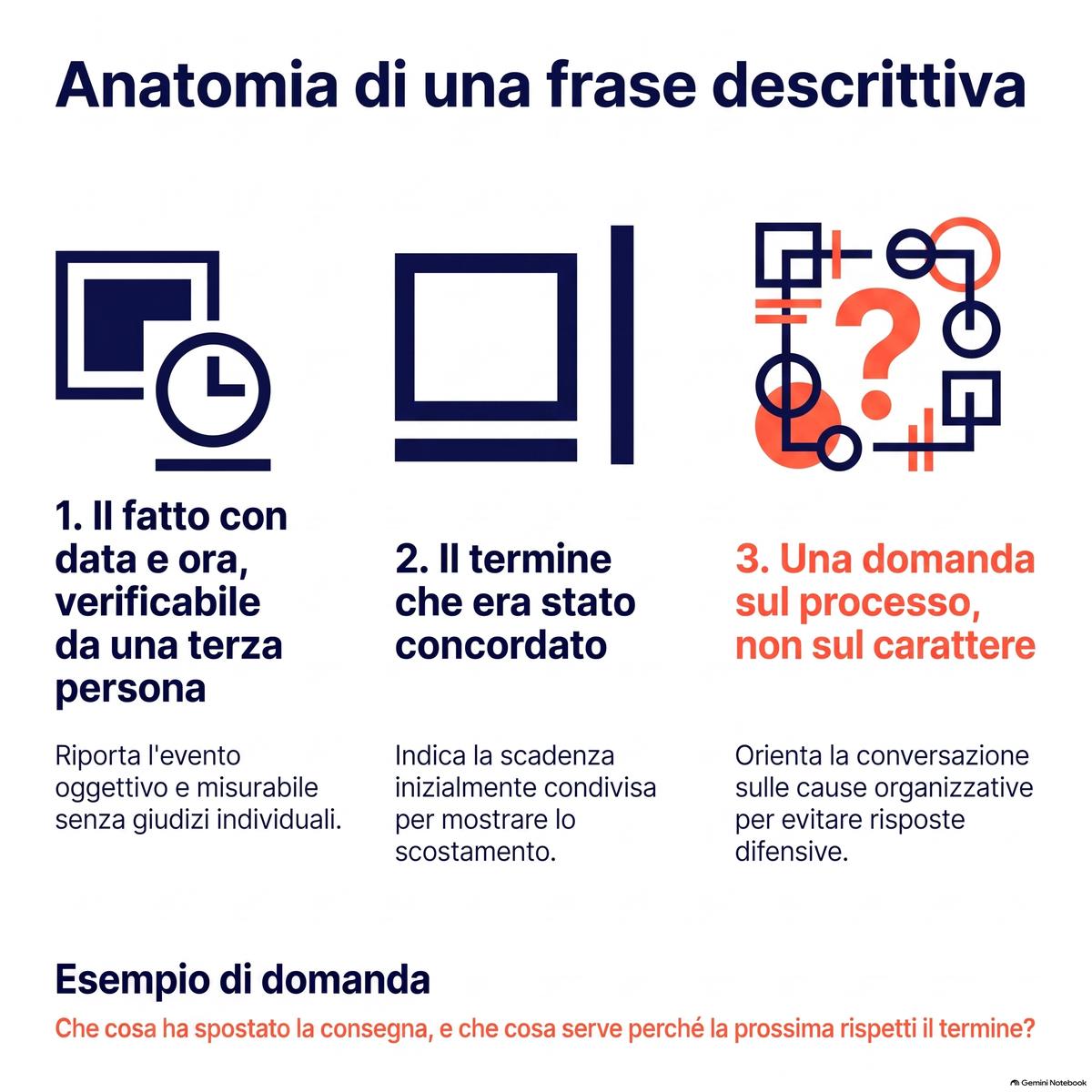
The descriptive sentence has a recognizable structure, in three elements:
- the fact with date and time, which a third person could verify;
- the deadline that had been agreed;
- a question about the process, not about character.
An example of a question about the process is: "What pushed the delivery back, and what is needed for the next one to meet the deadline?"
So the two sentences are unlikely to have the same effect: the first invites the team member to defend themselves, the second to explain.
When the same delay happens again, the situation changes nature and the words have to change with it.
Wording feedback for a mistake that keeps happening
Should a mistake that comes back for the third time be named as "carelessness" or as a fact that repeats?
The third occurrence of the same mistake changes the nature of the conversation compared with the first: it is no longer just the fact, it is also the pattern.
When a mistake repeats, the temptation is to name a trait of the person instead of the pattern.
The sentence "you're careless" closes the conversation in the same way at the first occurrence and at the third.
Naming the recurrence, instead, opens the question of what in the process allows the mistake to come back.
Consider the order desk of a small component manufacturer, where the same coding error shows up three times in five weeks.
The wordings change depending on the occurrence:
- first occurrence — "In today's order the fitting code has two digits swapped.";
- third occurrence — "This is the third time in five weeks that the fitting code has been typed with two digits swapped.";
- question about the process — "What in the check step lets the mistake get all the way to the customer?"
The first wording reports a fact, the second reports the fact and its repetition, the third shifts attention from the person to the check that did not stop the mistake.
The number of occurrences and the dates make the repetition verifiable: without them, the word "recurring" is already a judgment.
Naming the recurrence does not assign a cause, because the observation says that the mistake comes back, not why it comes back.
So a mistake that comes back for the third time should be named as a fact that repeats, with dates and number, and paired with a question about the process.
Work that went well is entitled to the same precision, and it risks getting fewer words than a correction.
Naming good work without reducing it to a polite compliment
Is a "well done, as usual" said in passing worth as much as positive feedback worded with care?
Generic recognition tends to be forgotten quickly; specific recognition offers a reference point to come back to (operating hypothesis).
Good work that goes by without being named is, as an operating hypothesis, one of the costliest absences in a company's everyday communication.
In a family business or a small manufacturing company, where the business owner moves between the desk and the shop floor, specific recognition can weigh as much as correction, because both tell the team member what gets noticed.
The wordings that follow distinguish generic recognition from recognition anchored to a precise fact.
In the Istat survey (a sample of about 280,000 Italian companies with 3 or more employees, reference year 2022) the population represented numbers 1,021,618 companies, of which 78.9% have 3-9 employees and 18.5% have 10-49 [1].
From this follows an operating hypothesis, not a data point: in organizations of this size much of the feedback comes from the business owner's own voice.
Think of a business owner who moves between the desk and the shop floor, and a team member with twenty years of seniority.
In that situation good work can go by without comment, while a mistake gets an immediate response.
Specific recognition names what was done and what it made possible.
| Generic recognition | Specific recognition |
|---|---|
| "Well done, great job." | "This morning's changeover took forty minutes instead of the planned ninety, and the department was back in production before the afternoon shift." |
| "The customer is happy, congratulations." | "The reply to the customer went out the same day with the quote already compared across three suppliers: it saved a second phone call." |
The difference lies in what the team member can reuse: the specific sentence points to which behavior to repeat, the generic one only says that the result was appreciated.
So a compliment said in passing is not worth as much as recognition that names the fact and its effect on the work.
When the authority of the role is missing, as between colleagues, the wording has to stand on its own.
Finding the words for feedback to a colleague at the same level
Does feedback to a peer call for the same words as feedback from the top down?
Between colleagues there is no role authority to support the conversation, as there is vertically: the wording has to do more of the work on its own.
The 2024 Excelsior survey reports communication, along with teamwork, among the soft skills increasingly sought by Italian companies [4].
Feedback to a colleague at the same level cannot lean on the role to be accepted.
It has to be built so that the other person receives it as useful information, not as an intrusion.
The summary published by the source states the finding in qualitative terms: problem solving, communication, teamwork and adaptability are "increasingly sought by companies," without a share attached to each skill [4].
Peer feedback puts exactly these skills to the test, because communication shows in the sentence you use to point out to a peer a problem that affects shared work.
Between peers the sentence rests on three elements: the fact, the effect on the shared work and a proposed agreement instead of an order.
| Judgment about the person | Peer wording |
|---|---|
| "You don't respect other people's work." | "The quotes file was changed last night in the price columns, without notice, and the salesperson sent an outdated version. It would help to flag changes in the chat before saving them." |
| "You're unfair to the team." | "Over the last two weeks the production data arrived after the Friday close and the supplier order went out on Monday. How can we agree on a delivery time that works for both of us?" |
The proposed agreement replaces the order because between peers there is no role that allows you to impose.
So feedback to a peer does not call for the same words as feedback from the top down: it states the effect on the shared work and proposes an agreement.
Upward, the constraint changes again, and with it the order of the words.
Finding the words to give feedback to your own manager
Can a team member give uncomfortable feedback to their own manager without seeming insubordinate?
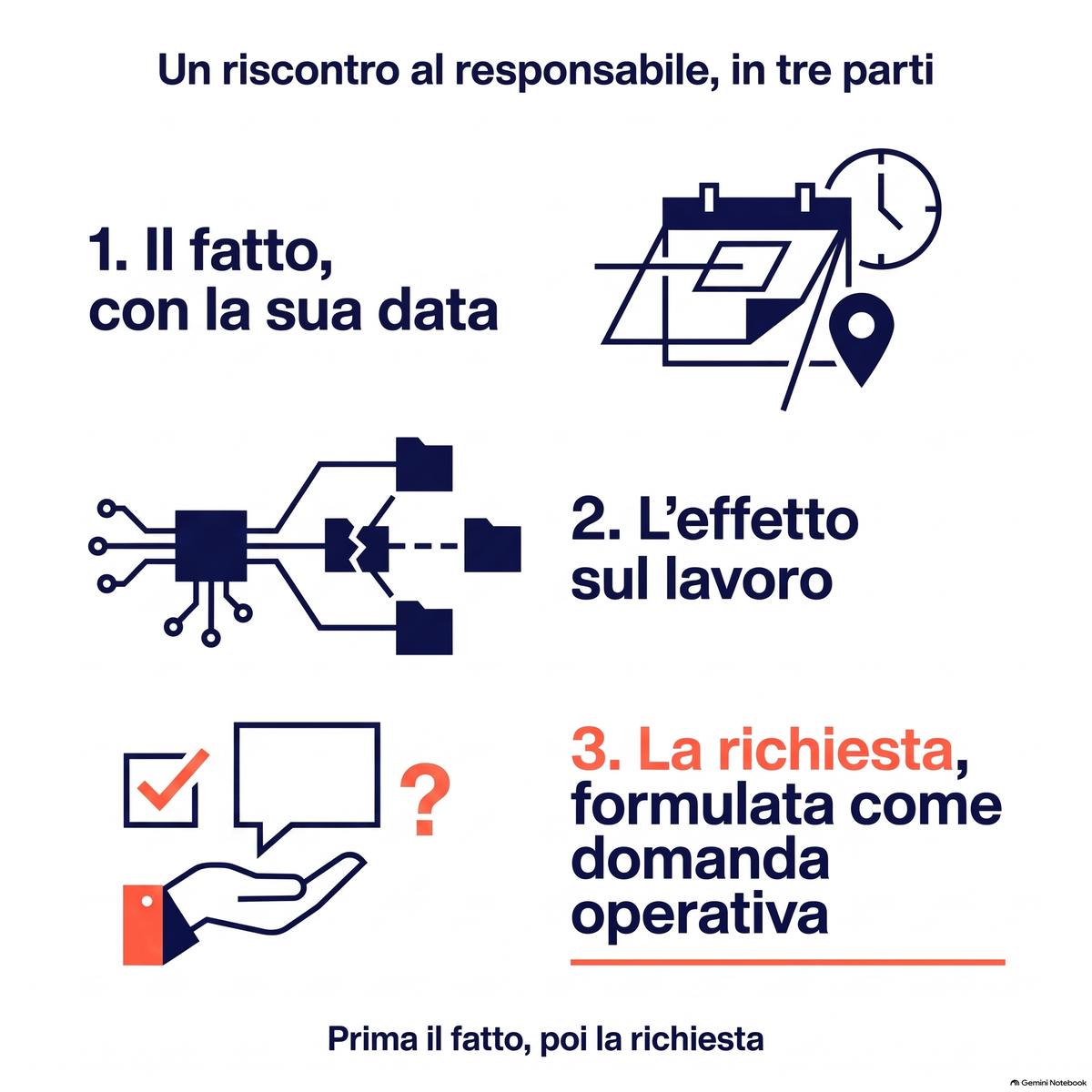
The difference often lies in where the sentence places things: first the fact, then the request, not the other way around.
Upward feedback follows the same descriptive logic seen so far, with one extra constraint: the request should be worded as an operational question, not as a reproach.
This kind of conversation fits naturally into structured review moments, such as those described in the article on employee performance evaluation, but it can also come up outside those moments.
Feedback to your manager is built in three parts: the fact with its date, the effect on the work and the request.
| Judgment about the manager | Fact, effect and request |
|---|---|
| "Priorities change all the time and we can't work like this." | "The priorities communicated on Monday for the Rossi job changed on Wednesday and again on Friday, and two orders were started and then put on hold. Which order of priorities should we consider valid until the end of the month?" |
| "You don't listen to the department." | "In Tuesday's meeting the proposal on shifts was closed before the department's two objections were heard. Could we set aside five minutes for objections before deciding?" |
In a family business the manager may be the business owner, and sometimes a relative: the descriptive form reduces the risk that the sentence is read as a personal attack.
The operational question leaves the manager a choice, while a reproach leaves them only a defense.
So a team member can give uncomfortable feedback to their own manager if the sentence describes and asks, instead of accusing.
What remains is to understand when a sentence that follows this form betrays it without the speaker noticing.
Recognizing wordings that look descriptive but remain disguised judgments
Is a sentence that starts with "I noticed that" necessarily a description?
Not necessarily: some wordings imitate the syntax of description but carry the same judgment as before, just in disguise.
Some wordings seem to follow the rule and do not.
"I noticed that you're often late with deliveries" contains an adverb of frequency that generalizes, not a single fact.
Recognizing these disguises keeps feedback perceived as technical from being experienced as a judgment, with the risk of opening a tension that then calls for the tools described in the article on conflict management at work.
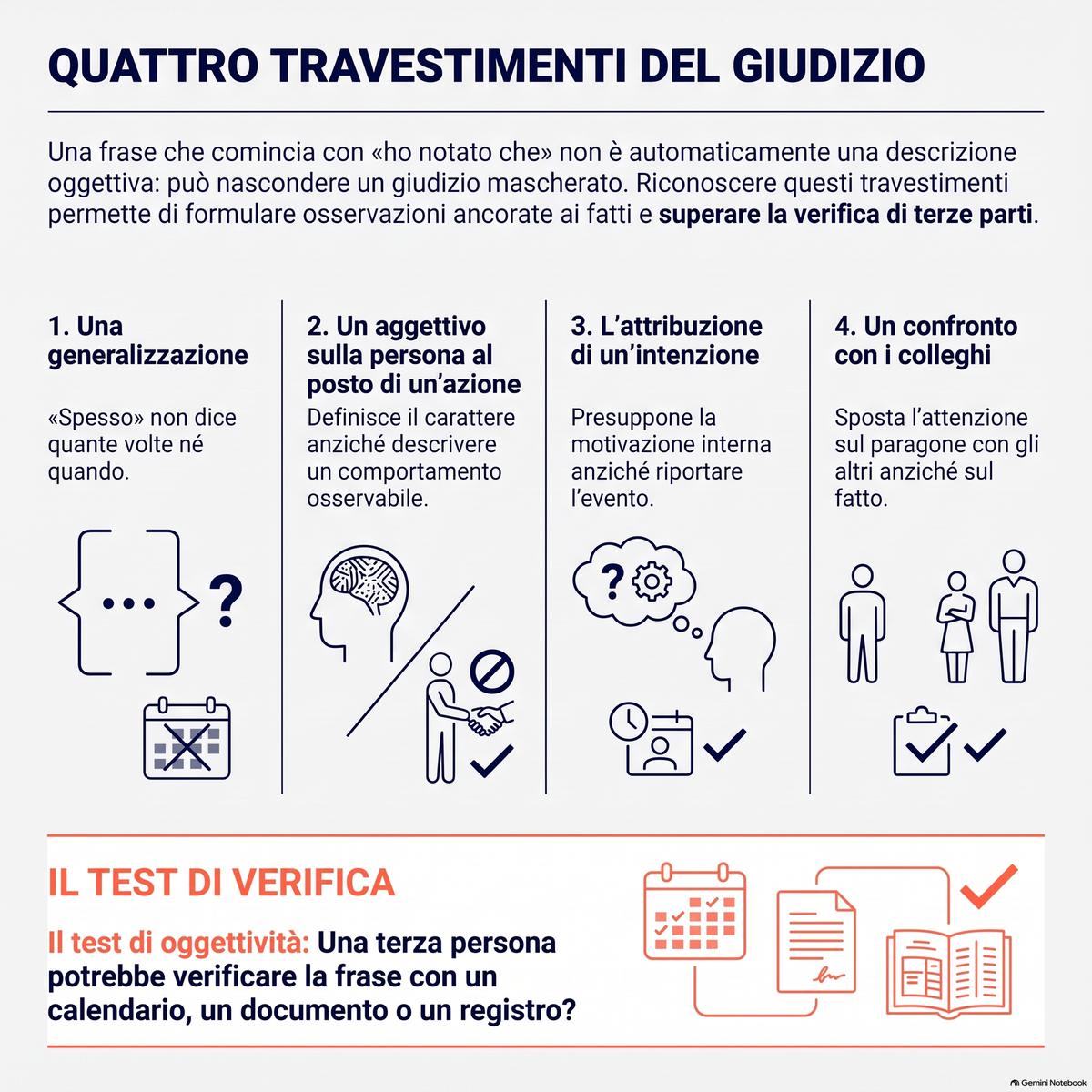
Four disguises serve as a reference, and each has a version that holds up to verification:
| Wording that imitates description | What it carries | Descriptive version |
|---|---|---|
| "I noticed that you're often late with deliveries." | a generalization: "often" does not say how many times or when | "I noticed that the last three deliveries arrived after the deadline: on September 4, 11 and 18." |
| "I noticed that you're not very cooperative with your colleagues." | an adjective about the person instead of an action | "I noticed that in Monday's meeting the request from our colleague in the warehouse got no reply." |
| "I noticed that urgent orders aren't given importance." | the attribution of an intention | "I noticed that the two orders marked as urgent went out after the ordinary ones." |
| "I noticed that the others manage to deliver on time." | a comparison with colleagues | "I noticed that the delivery arrived on Thursday, two days after the agreed deadline." |
A practical test helps tell them apart: could a third person who was not there verify the sentence with a calendar, a document or a log?
If verification is not possible, the sentence is a judgment preceded by the phrase "I noticed that."
So a sentence that starts with "I noticed that" is not a description just because it starts that way: it is one when it passes a third person's check.
Limits and conditions of applicability
The wordings in this repertoire are hypothetical examples to be adapted to the facts and vocabulary of each situation, not sentences to be read out as they are.
A sentence said without adaptation loses its anchor to the facts and becomes a generic template again.
The Kluger and DeNisi finding comes from a 1996 meta-analysis of feedback interventions in heterogeneous contexts, not of Italian companies [2].
The finding shows an association between shifting attention toward the person and lower effectiveness; it does not prove that a descriptive sentence produces a better result in itself.
The Istat data concern companies with 3 or more employees, which make up 22.5% of Italian companies, and do not cover the smallest businesses or self-employed professionals [1].
The summary of the 2024 Excelsior survey used here addresses soft skills in qualitative terms and does not make it possible to estimate how much communication weighs compared with other skills [4].
Descriptive wordings do not replace a disciplinary procedure, which follows its own formal rules, nor a conversation that has already turned into conflict, which calls for other tools.
Finally, description does not eliminate the emotional reaction of the listener: it reduces the material on which defensiveness kicks in, without determining the outcome of the conversation.
FAQ
What is the difference between describing a behavior and judging a person?
Describing means naming a fact that a third person could verify, with a date, a place or a measure; judging means attributing a stable trait, such as "unreliable."
Description leaves the team member room to respond; judgment shuts it down.
How do you give feedback to a colleague at the same level?
By describing the fact, stating the effect on the shared work and proposing an agreement instead of an order.
The role does not support the conversation, so the wording has to stand on its own.
How can you give feedback to your own manager without seeming insubordinate?
By placing the fact before the request and wording the request as an operational question.
If the topic is sensitive, it is better to ask first for a short slot to talk about it.
Can feedback sentences for team members be used as they are?
No: they are hypothetical examples and need to be filled with the real facts of the situation, with date, number and agreed deadline.
A generic sentence lifted from the repertoire without facts becomes a judgment again.
Operational summary
The repertoire starts from the hypothesis that the same situation produces two different conversations depending on the sentence that names it.
For the late delivery, the mistake that comes back and the good work, the descriptive wording names a fact with date and number and pairs it with a question about the process or with the effect on the work.
Between colleagues the sentence states the effect on the shared work and proposes an agreement, because the role does not support the conversation.
Toward the manager the fact comes before the request, and the request takes the form of an operational question.
A sentence that starts with "I noticed that" remains a judgment if a third person cannot verify it.
The method for leading the conversation remains the one described in the article on the structure of feedback, while these pages offer the words to fill it.
Conclusion
The words of feedback are not a stylistic detail: the same situation, told as a judgment or as an observable fact, produces two different conversations, not the same conversation said in two ways.
The repertoire collected here complements the structure described in the article on how to give feedback to team members, which remains the reference for leading the conversation from opening to close.
When the wordings stay descriptive, the tension that feedback can generate stops before it becomes a conflict to be mediated, like the ones covered in the article on conflict management at work.
A company where the words of feedback stay anchored to facts is a company where team members can tell a remark from a judgment about themselves, and respond to the first instead of defending themselves from the second.
Sources and references
[1] Istat, "Censimento permanente delle imprese 2023: primi risultati" (multipurpose survey, sample of about 280,000 Italian companies with 3 or more employees, reference year 2022), Istat, November 14, 2023. Available at: https://www.istat.it/comunicato-stampa/censimento-permanente-delle-imprese-2023-primi-risultati/
[2] Kluger, A. N., & DeNisi, A., "The Effects of Feedback Interventions on Performance: A Historical Review, a Meta-Analysis, and a Preliminary Feedback Intervention Theory", Psychological Bulletin, 119(2), 1996, pp. 254-284. Available at: https://doi.org/10.1037/0033-2909.119.2.254
[3] Istituto della Enciclopedia Italiana, "feedback", Vocabolario on line Treccani. Available at: https://www.treccani.it/vocabolario/feedback/
[4] Unioncamere — Ministero del Lavoro e delle Politiche Sociali, Sistema Informativo Excelsior, "Domanda di professioni e di formazione delle imprese italiane nel 2024", Unioncamere, 2024. Available at: https://excelsior.unioncamere.net/pubblicazioni/2024/domanda-di-professioni-e-di-formazione-delle-imprese-italiane-nel-2024