
It looks like a question of temperament, and it isn't: the answer turns on a single variable, how much it costs to go back.
When a decision stalls, what's missing isn't resolve: it's real alternatives, criteria stated in advance, and the name of the person with the mandate to close.
Decision making is the sequence that runs from recognizing a gap between how the work is going and how it should be going, all the way to the commitment of resources that narrows that gap.
For the choice to be reviewable, its reasons have to be written down along the way.
This holds for a professional with two team members, for a fifteen-person family business and for a hundred-person organization: the amount at stake changes, the sequence doesn't.
In 2021-2022, defending their competitive position was the top strategic goal for 88.3% of Italian companies with at least 10 employees [5]: a defensive goal points in a direction, but on its own it doesn't narrow the field of viable paths.
Deciding isn't picking the only path left: it's cutting away others that were genuinely viable, with criteria stated before the choice and a written record that lets you review it without starting over.
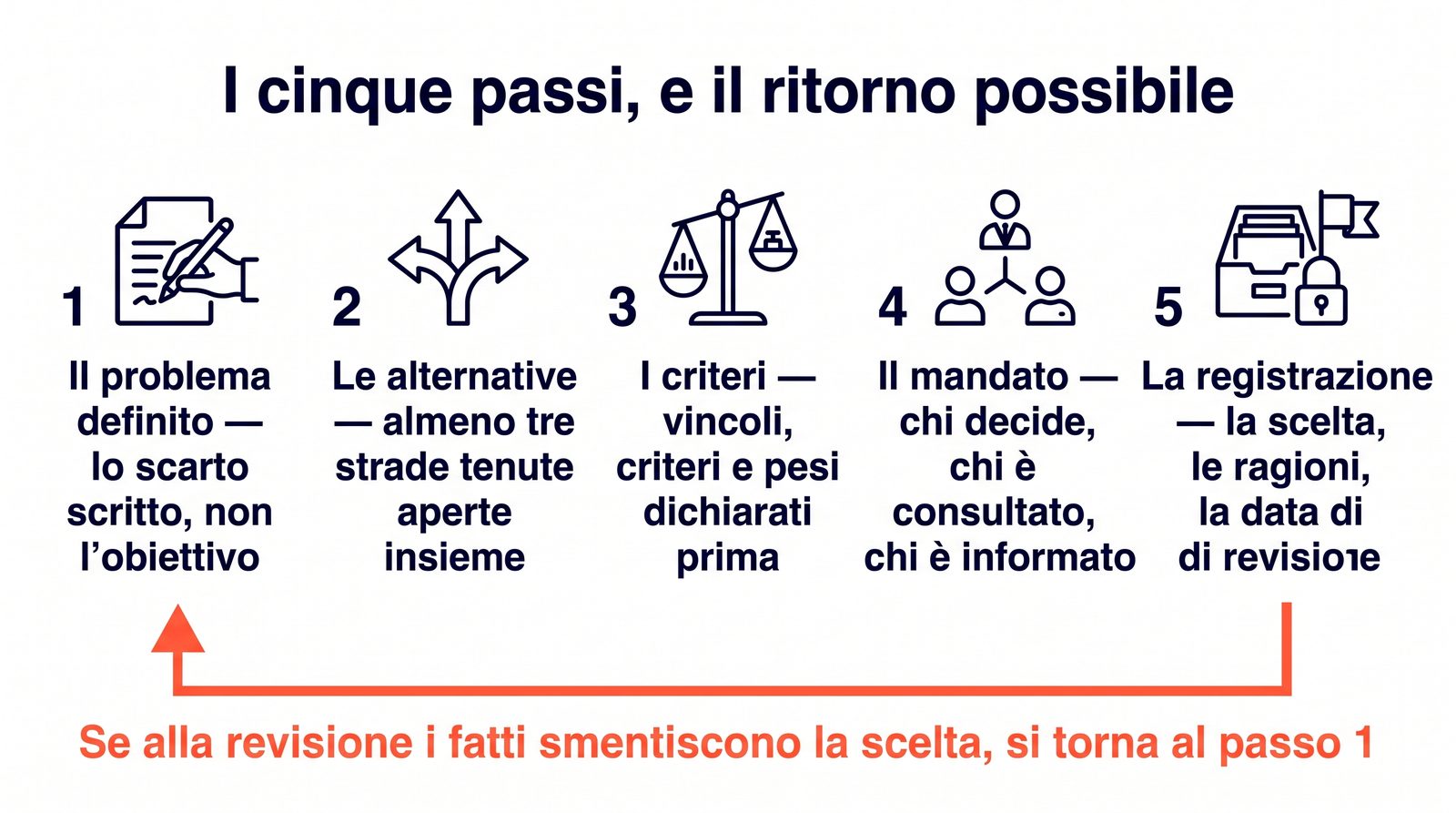
This article separates a decision from the things that resemble it, walks through the five steps — problem, alternatives, criteria, mandate, record — and closes with the most common mistakes.
What a decision is, and why they don't all weigh the same
Do two choices that commit the same amount of money take the same amount of time?
They don't, and the variable that separates them isn't the amount but how much it costs to go back.
The verb says it on its own: decide comes from the Latin decīdĕre, made of de- and caedĕre, "to cut," and properly means "to cut away" [1].
Deciding isn't adding a path, it's cutting off others that were open until that moment.
That gives the working definition this page rests on: a decision is a specific commitment to act — usually a commitment of resources — while the decision-making process is the set of actions that begins when something calls for a choice and ends when that commitment is made [2].
The distinction that matters isn't with opposites, but with the three things that take the place of a decision inside a company.
It isn't a preference, which stays in the head of whoever voices it and commits no resources.
It isn't an operating instruction, which says how to carry out something already decided and puts no alternatives in play.
It isn't an approval, which comes when the choice has already been made and serves to make it executable: in the study by Mintzberg and colleagues of 25 strategic decision processes observed in the field, authorization appears in 14 cases, as a separate step that follows selection [2].
With the definition in place, the first thing to look at is the door: some decisions can be walked back through, others can't, or not without losing almost everything you put in.
The economics literature on investment calls this property irreversibility: an expense is irreversible when the company can't disinvest, because the asset only serves that particular process and is worth a fraction of its cost on the secondhand market; the same goes for people, because bringing on new staff carries costs for hiring, training and separation [7].
The practical consequence holds outside corporate finance too: when an irreversible choice can be postponed, deciding right away uses up the option of waiting for information that would arrive anyway, and the cost of waiting has to be weighed against the value of that information [7].
So there's only one question to put in writing before opening the analysis: if this choice turned out to be wrong six months from now, what would still be recoverable?
| Reversible decision | Irreversible decision | |
|---|---|---|
| What's left if you're wrong | nearly everything, at a cost to readjust | little: the money is sunk |
| How much evidence you need first | what's already available in the documents | evidence gathered on purpose, over a stated period |
| Speed | high: decide and correct | low, as long as waiting has value |
| Typical examples | pricing, shifts, an organizational trial | dedicated equipment, new staff |
The five steps that follow are the same in both cases; what changes is how much evidence you demand at each one: a reversible decision is made to learn, an irreversible one to commit.
The starting point of the decision-making process: the problem, not the goal
Where does a decision start, if not from the goal to be reached?
From the gap that makes that goal unreachable with the work as it is today.
Deciding isn't picking the only path left: it's cutting away others that were genuinely viable, with criteria stated before the choice and a written record that lets you review it without starting over.
Field research places the starting point exactly there: the need for a decision is recognized as a difference between information about an actual situation and an expected standard — a past trend, a comparable company, a written rule [2].
Until that difference is written down, what circulates in the meeting is a goal.
And a goal, on its own, produces a single path: the one the person who stated it already had in mind.
In 2021-2022, defending their competitive position was the top strategic goal for 88.3% of Italian companies with at least 10 employees [5]: phrased that way — keep customers, don't lose ground — a goal points in a direction without narrowing the field, because any proposal fits inside it and comparing proposals turns into comparing people.
Step 1, then, is a short act that comes before any quote: write the gap down — what is happening, in which stretch of the work, since when, how often, with what measurable effect, and what lies outside the scope.
Writing the problem statement has rules of its own and is the rung before this one: here the only constraint is not to skip it, because a decision made on an unwritten problem can be debated but not checked.
When the gap is written down but its origin is still unknown, the intermediate step is the search for causes, covered in root cause analysis; the map of available methods is in the guide to business problem solving.
When, instead, the gap is written down and the causes are known, the question changes shape: no longer "what do we do," but "which paths do we choose among to narrow this gap, and at what cost."
It's a difference of a few words, and it changes how many alternatives make it into the room.
In a thirty-person family-run machine shop, "we need to buy a second milling machine" is an intervention dressed up as a decision.
"Over the last four months, 18 of 120 orders shipped after the confirmed date, and in 14 cases the bottleneck was the milling department" is a gap: at least three paths come out of that line, and the milling machine is one of them.
How real alternatives emerge in a decision-making process
How many alternatives actually reach the table?
Usually one, presented as the only option.
It isn't just an impression: in the study of 25 strategic decision processes, the hypothesis with the strongest support is that the organization designs a single, fully developed custom solution, and in the 14 cases that led to a purpose-built solution only one branch was followed all the way through [2].
The explanation the authors offer is economic, not psychological: designing a custom solution is expensive, and organizations don't pay for a second one; when the solution can be found ready-made on the market, the alternatives compared go back to being more than one [2].
The effect on outcomes has been measured: in Nutt's study of 356 decisions made in medium-sized and large organizations in the United States and Canada, multiple options were developed in fewer than 20% of cases, and where they were, the share of successful decisions rose from 56% to 70% [3].
There's also an effect on time, and it runs against common sense.
In Eisenhardt's study of eight firms, fast decisions are the ones that consider more alternatives in parallel, while slow ones consider few, one after another: one team spent nine months on a single option, and when it collapsed the decision slipped another five months because there was nothing to fall back on [4].
Three rules are enough to generate alternatives that are actually alternatives.
- The three-path threshold. No comparison opens with fewer than three options, and the third is always available by design: do nothing and keep measuring the gap for a stated period.
- Alternatives are kept open together, not in a queue. Two paths explored in parallel for three weeks cost less than two paths explored in sequence for six months.
- Every alternative comes with a data point gathered by whoever proposes it. A token alternative gives itself away because the person who put it in the table didn't spend half a day backing it up.
In the machine shop from the previous section, the three paths are the second milling machine, outsourcing the excess batches to a local supplier, and revising the sequence in which orders are released: they don't cost the same, they don't commit the same, and they aren't equally reversible, which is exactly why they need to sit side by side before you choose.
How to compare alternatives: criteria are stated first
When are the criteria for choosing written down?
Usually afterward, and that's the point where an honest comparison turns into a justification.
The field literature agrees, and is fairly blunt: the available studies don't find that the weights given to individual goals are set before the choice, and they find them determined implicitly, at the very moment of choosing [2].
There's more: the research describes a confirmation period before the decision is announced, during which the decision maker rationalizes to themselves the choice already made along with the goals that justify it, and setting the criteria ends up following the choice instead of preceding it [2].
In the same study, out of 83 evaluation-and-choice episodes, evaluation could be distinguished from choice in only 18 [2].
The remedy lies in three distinctions written on a sheet before you look at the alternatives.
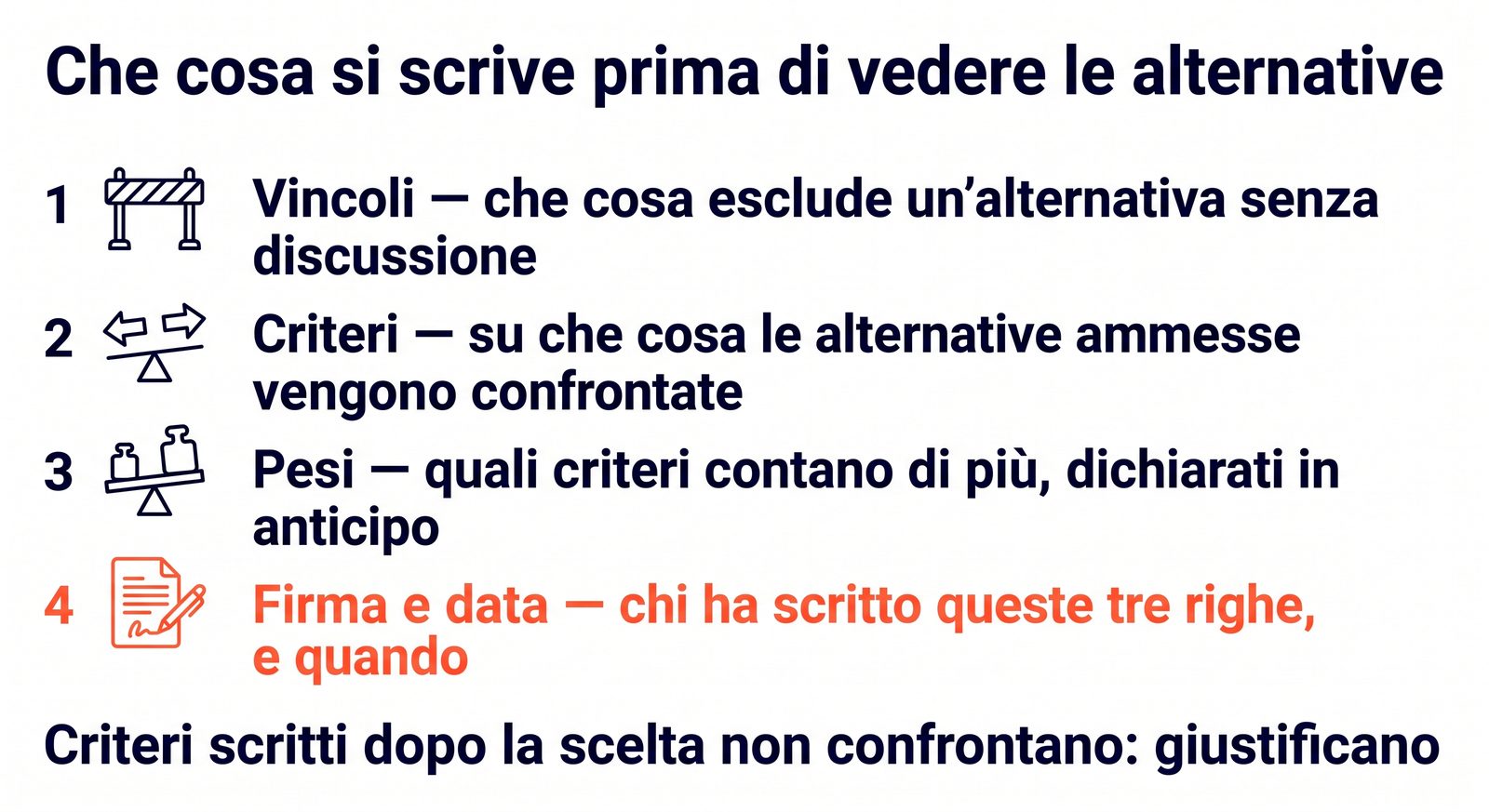
A constraint excludes: it's the condition that makes an alternative unworkable and can't be offset by anything — an outlay beyond the quarter's cash, a regulatory requirement, a delivery date that can't move.
A criterion compares: it applies to the alternatives that passed the constraints, and describes a dimension on which the remaining paths behave differently.
A weight ranks: it states which criteria matter most, and it has to be written before the alternatives have a name, because the moment a name appears the weight starts drifting on its own.
What makes it drift — the systematic distortions of judgment — is the subject of the page on cognitive biases to recognize in decisions: what matters here is that it's filed in advance.
Four or five criteria are enough, and each one has to be verifiable against a document or a number: expected effect on the gap, outlay over twelve months, internal workload, time before the effect shows, share recoverable if the choice turns out to be wrong.
The comparison itself is table work and has a dedicated tool that this page doesn't repeat: how to build the grid, assign scores and read the result is in the decision matrix.
What matters here is the rule that comes before it, and a thirty-second honesty test makes it verifiable: if the result came out different from what you expected, would the criteria stay the same?
If the answer is no, the sheet to redo isn't the table but the list of criteria, which needs rewriting to state what you're really looking for.
Who decides in a company, and with what mandate
Who closes when the comparison doesn't produce agreement?
In a business decision-making process it's the question asked last, and it determines whether the choice gets made or stays hanging.
The documented answer has a name: consensus with qualification.
In the eight firms of Eisenhardt's study, the teams that decided quickly used the same two-stage procedure — first you seek agreement by involving the whole team, and if agreement comes the choice is made; if it doesn't, the top executive decides, with the input already gathered from the whole team [4].
It's fast because it confronts disagreement instead of waiting for a deadline to resolve it, whereas full consensus set as a condition gives everyone a veto and decisions don't come out [4].
The opposite cliché falls too: the same study finds no relationship between centralization of power and speed [4].
Where ownership and management overlap, the question gets heavier, not lighter.
In Italy, according to the permanent business census, in 2022 management was in most cases entrusted to the business owner or a member of the owning family, and the use of an internal or external manager was concentrated in medium-sized and large companies [5].
In the roughly 3,200 companies with at least 20 employees surveyed by the Bank of Italy's Invind survey in 2019, directors from the owning family made up 47% in the South and 27% in the Center-North, and less separation between ownership and control goes hand in hand with less structured management practices [6].
In plain terms: the person who sees the problem and the person who signs are often the same, and the mandate stays unwritten because it seems obvious — as long as it's obvious it works, and it stops working the day the business owner is out on the floor and the decision waits for them to come back.
The remedy is one line for each family of recurring decisions, written once and reviewed once a year.
- Who decides — one person, named by role rather than by name.
- Who is consulted first — whoever brings a data point, not whoever brings an opinion.
- Who is informed afterward — whoever carries it out and whoever feels the downstream effect.
- The threshold — the amount above which the decision moves up a level.
In the thirty-person machine shop, the line reads like this: the order release sequence is decided by the production manager, after consulting the sales office; above a €15,000 commitment it goes up to the business owner.
A written mandate is the most concrete form of delegation, because it transfers the decision and not just the task: the boundary between the two is the subject of delegation in business.
Recording business decisions and reviewing them later
What's left of a decision three months after it was made?
The outcome remains, because you can see it; the reasons don't, and without them the review turns into a trial of intentions.
It's the risk from the previous step moved forward: if criteria are already reconstructed after the fact at the moment of choosing [2], all the more so when the result is right in front of you.
The remedy costs six lines, written at the moment the decision is made and not the next day.
- The date and the role that decided.
- The gap you started from, in the form written at step 1.
- The alternatives considered, including the discarded ones, each with a one-line reason for discarding it.
- The criteria and weights used for the comparison, in the form in which they were stated beforehand.
- The choice and the commitment it entails: money, people, time.
- The review date and the indicator it will be based on.
The most valuable line is the third, and it's the one skipped most often: an alternative discarded without a written reason comes back to the meeting every time the choice hits an obstacle.
The place where these six lines live isn't a new document: it's the minutes of the recurring meeting in which the decision was made, and the discipline that makes them usable is the same as for effective business meetings.
How far out the review sits depends on the door.
For a reversible decision the review comes soon, because correcting is cheap: four to eight weeks is a reasonable working interval, and it's an editorial rule of thumb, not a measured figure.
For an irreversible decision the review date has to be set before deciding, not after: at that point correcting is no longer among the available options, and the review serves to limit the damage or stop it from getting worse [7].
The review takes twenty minutes and three questions: has the gap narrowed as much as expected, has a new fact disproved one of the stated criteria, and knowing what you know today, would you make the same choice again?
Answering "no" to the third isn't disowning whoever decided: going back to an earlier step when a data point falls is part of the procedure [2].
The most common decision-making mistakes, and how to avoid them
Can a process be followed step by step and still produce decisions that get reversed?
It can, and it happens for six recurring reasons, recognizable from the shape of the meeting even before the outcome.
The goal in place of the gap. The meeting opens with a destination rather than a measured fact, and the field of viable paths stays as wide as the destination: the fix is to postpone by two days and reopen it with a line containing a number, a period and a scope.
The single alternative dressed up as a forced choice. A custom solution arrives fully developed and the others exist only as names in a table [2]: the fix is the three-path threshold, with the third reserved for not intervening and measuring, because where multiple options were developed the share of successful decisions rose from 56% to 70% [3].
Criteria written after the choice. The comparison sheet is filled in when the result is already known, and becomes the record of a justification [2]: the fix is a signature and a date on the three lines of constraints, criteria and weights, before the alternatives have a name.
The same speed for both doors. A reversible decision treated as irreversible stays on hold for months and costs the learning it would have produced; an irreversible one treated as reversible commits resources that don't come back.
The fix is the question about what's recoverable, asked in writing before the analysis; prolonged postponement of a reversible choice is a problem of its own, covered in putting off decisions.
The implicit mandate. Who closes stays unwritten and the decision waits for an outside event — a deadline, the departure of whoever was opposed [4]: the fix is the mandate line for each family of decisions, with the threshold above which it moves up a level.
The decision made and not recorded. The reasons evaporate, the discarded alternative comes back, and the same discussion repeats weeks later with different people: the fix is the six lines of the log, written at the moment of the choice.
The six mistakes share one trait: they save half an hour in the meeting where you decide, and cost much more in the meetings where you end up deciding the same thing again.
Limits and conditions of applicability
The three studies of the decision-making process cited here are North American and concern medium-sized and large organizations — 25 strategic processes reconstructed in the field [2], 356 decisions observed in the United States and Canada [3], eight firms in a high-velocity industry [4] — and they describe process mechanisms, not frequencies measured in Italian companies.
The irreversibility criterion comes from investment economics [7]: what transfers is the reasoning rule, not the calculation apparatus; the ISTAT and Bank of Italy data [5] [6] describe who sits where, and don't prove a causal link with the quality of decisions.
The machine-shop scenario and the figures in it are hypothetical, and the time intervals given for the review are editorial rules of thumb, not measured data.
When what's happening is an emergency — safety, a line stoppage, a blocked delivery — you contain first and decide afterward: in the study of 25 processes, formal diagnosis appears in 7 of 9 cases in the problem area and doesn't appear in the only crisis case observed [2].
FAQ
What is decision making?
It's the process that leads from a gap between how the work is going and how it should be going to a specific commitment of resources that narrows that gap.
It's distinct from a preference, an operating instruction and an approval, which come before or after without coinciding with the decision.
What are the stages of the business decision-making process?
Five: define the problem you're starting from, generate at least three viable alternatives, state constraints, criteria and weights before comparing them, establish who decides and with what mandate, record the choice with its reasons and set its review.
The sequence is the same for a thousand-euro decision and a hundred-thousand-euro one: what changes is how much evidence you demand at each step.
How do you make decisions when the available data isn't enough?
First establish whether the choice is reversible: if it is, decide with the data you have and set an early review, because correcting is cheap.
If it isn't, and postponing is possible, the cost of waiting has to be weighed against the value of the information that would arrive anyway [7].
What's the difference between a reversible and an irreversible decision?
Reversibility is measured by what stays recoverable if the choice turns out to be wrong: with a reversible decision you go back by paying a readjustment cost, with an irreversible one the money is sunk.
Equipment dedicated to a single process and bringing on new staff are partially irreversible [7].
Practical summary
A decision starts from a written gap, not from a stated goal: as long as the page holds a destination rather than a measured fact, the field of viable paths stays as wide as the destination.
The alternatives come out of the gap, and the practical rule is never to open a comparison with fewer than three paths, kept open together rather than one after another, with the third reserved for not intervening and measuring.
Before the alternatives have a name, you write three lines: the constraints that exclude, the criteria that compare, the weights that rank.
Then you state who closes — one person, named by role — who is consulted first, who is informed afterward, and above which threshold the decision moves up a level.
The choice is recorded in six lines in the minutes of the meeting where it was made, with the reason each alternative was discarded; the review comes early for reversible decisions and is set before committing resources for irreversible ones.
Conclusion
Deciding isn't picking the only path left: it's cutting away others that were genuinely viable, and the value of the process lies in the alternatives closed with a written reason, not in the one left standing.
Five steps hold the sequence together: the gap written down in place of the goal, at least three paths kept open together, constraints and criteria stated before the alternatives have a name, the mandate of whoever closes with the threshold above which it moves up a level, and six lines of log with the review date.
The calibration that runs through them comes down to one question: if the choice turned out to be wrong six months from now, what would still be recoverable?
The actual comparison between alternatives is table work and has a dedicated tool, the decision matrix.
What distorts judgment while you work through the five steps, and which countermeasures soften it, is described on the page about cognitive biases.
When the question steps back from "which path to take" to "why is this happening," the map of methods is in the guide to business problem solving; when the choice concerns the company's direction over the next few years, the plane it belongs to is strategic planning.
After a few months of decisions made this way, the meeting changes subject: you no longer argue over whether the choice was right, you check whether the gap has narrowed and whether a new fact has knocked out a criterion.
Decisions that get reversed become rare, because the reversible ones have already been corrected along the way and the irreversible ones had a review date set in advance.
The time once spent rehashing the same discussion with different people becomes available for the choices still to be made.
Sources and references
[1] Treccani, "decidere", Vocabolario on line, Istituto della Enciclopedia Italiana. Available at: https://www.treccani.it/vocabolario/decidere/
[2] Mintzberg, H., Raisinghani, D., Théorêt, A., "The Structure of 'Unstructured' Decision Processes", Administrative Science Quarterly, vol. 21, no. 2, 1976, pp. 246-275 (study of 25 strategic decision processes reconstructed in the field). Author's page: https://mintzberg.org/articles/structure-unstructured-decision-processes — full-text copy consulted at: http://www.sietmanagement.fr/wp-content/uploads/2016/04/Mintzberg1976.pdf
[3] Nutt, P. C., "Surprising but true: Half the decisions in organizations fail", Academy of Management Executive, vol. 13, no. 4, 1999, pp. 75-90, DOI 10.5465/AME.1999.2570556 (study of 356 decisions in medium-sized and large organizations in the United States and Canada). Publisher's page: https://journals.aom.org/doi/10.5465/AME.1999.2570556 — full-text copy consulted at: https://cebma.org/assets/Uploads/Nutt-1999-gecomprimeerd.pdf
[4] Eisenhardt, K. M., "Making Fast Strategic Decisions in High-Velocity Environments", Academy of Management Journal, vol. 32, no. 3, 1989, pp. 543-576, DOI 10.2307/256434 (inductive study of eight firms). Publisher's page: https://journals.aom.org/doi/abs/10.5465/256434 — full-text copy consulted at: https://assets.super.so/6b4b5d92-904a-4e7b-95bd-914dd1d1528f/files/d3e001de-5bf0-4c34-8230-9eec106a9339/Eisenhardt_1989_Making_fast_strategic_decisions_in_high-velocity_environments.pdf
[5] ISTAT, "Censimento permanente delle imprese 2023: primi risultati", press release, November 14, 2023, p. 4 and Table 2 (strategic goals for 2021-2022 for companies with at least 10 employees; managerial leadership by employee size class, reference year 2022). Available at: https://www.istat.it/comunicato-stampa/censimento-permanente-delle-imprese-2023-primi-risultati/ — PDF: https://www.istat.it/it/files/2023/11/REPORTCensimprese.pdf
[6] Baltrunaite, A., Formai, S., Linarello, A., Mocetti, S., "Proprietà, governance, management e performance delle imprese: evidenze dalle imprese italiane", Questioni di Economia e Finanza no. 678, Banca d'Italia, March 2022, § 4.2 and Figure 3 (Invind survey 2019, roughly 3,200 manufacturing and service companies with at least 20 employees). Available at: https://www.bancaditalia.it/pubblicazioni/qef/2022-0678/index.html — PDF: https://www.bancaditalia.it/pubblicazioni/qef/2022-0678/QEF_678_22.pdf
[7] Pindyck, R. S., "Irreversibility, Uncertainty, and Investment", NBER Working Paper no. 3307, National Bureau of Economic Research, March 1990, pp. 1-2 (later in Journal of Economic Literature, vol. 29, no. 3, 1991, pp. 1110-1148). Available at: https://www.nber.org/system/files/working_papers/w3307/w3307.pdf