
Strategic planning is the process that translates a long-term vision into measurable objectives, priority initiatives and review cadences. It is not the same as strategy (which defines positioning choices) or operational planning (which defines the week's activities). It should also be distinguished from the business plan, which is the financial forecasting document meant for discussions with banks and investors: strategic planning is the continuous process that produces and updates the company's objectives and priorities, regardless of the financial window.
ISTAT's permanent census of Italian businesses found that, in 2021-2022, defending their competitive position was the top strategic objective for 88.3% of Italian companies with at least 10 employees [2]. The next sections cover vision, OKRs, roadmaps, review cadences, and common mistakes.
Defining what a useful strategic plan should contain
The term "strategic plan" refers to very different documents: from an Excel sheet with three annual objectives to a fifty-page binder filed away in the executive office. More than length, what matters is the presence of three elements: vision, measurable objectives, review cadence.
Is a useful strategic plan a finished document or a mechanism that stays alive? A strategic plan locked in a drawer is already obsolete the day it is signed.
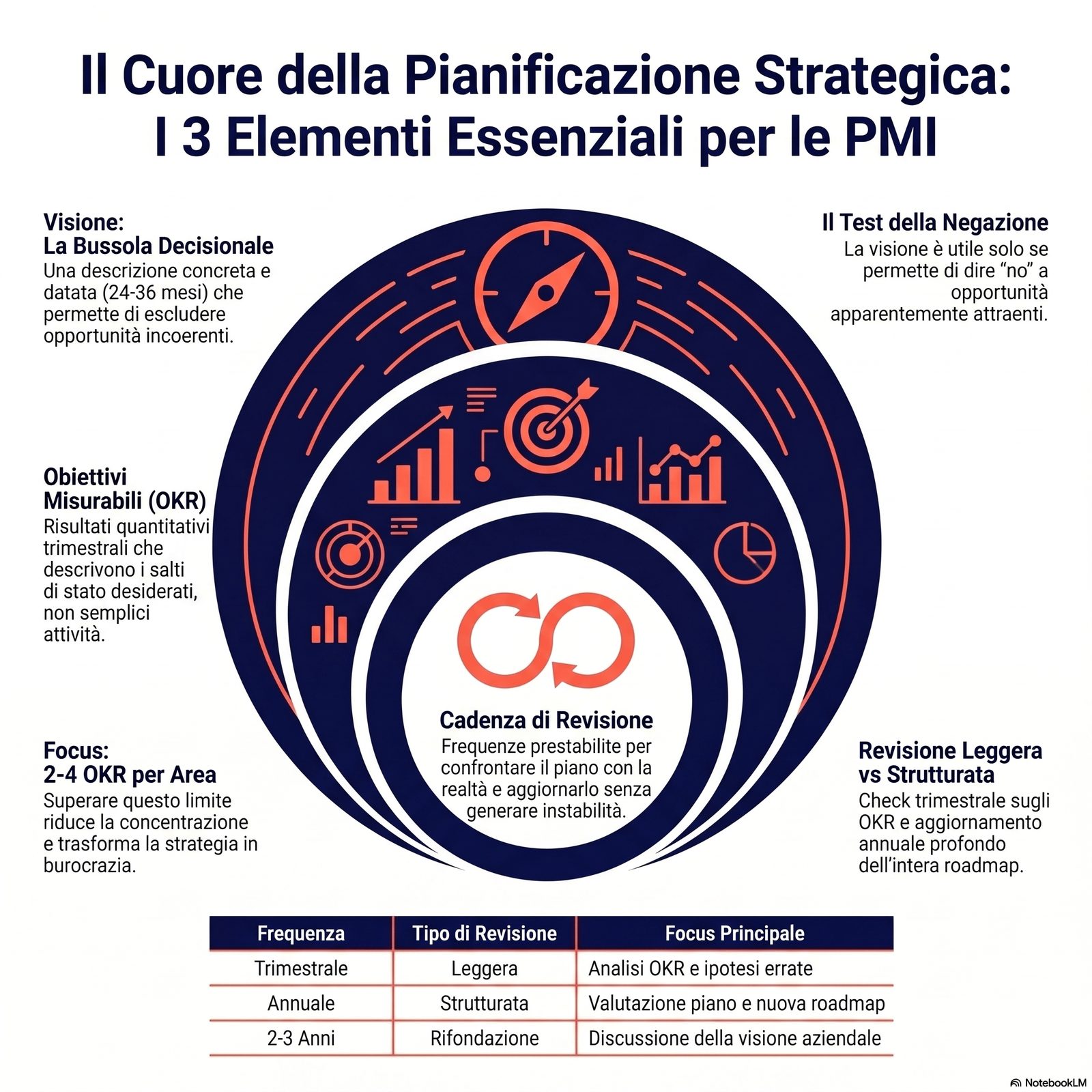
A useful strategic plan contains at least three minimum elements. The first is the vision: a concrete, dated description of the company's future state, specific enough to guide hiring, investment and exit decisions. The second element is measurable objectives: not generic intentions, but results with defined metrics and time horizons. The third element is the review cadence: how often the plan is compared with reality and updated.
Without a vision, every initiative seems consistent with the plan because there is no exclusion criterion. Without measurable objectives, the plan generates no useful signals about the company's direction. Without a review cadence, the plan crystallizes and does not react to changes in the market.
Before the three elements comes the diagnosis, which the plan takes for granted: the cheapest format for putting it on paper is a SWOT analysis built on verifiable facts.
The distinction from operational planning is central: strategic planning works on a 1-3 year horizon and defines the objectives that guide allocation choices. Operational planning works on a quarter/month/week horizon and defines activities, owners and deadlines. The first feeds the second; they are nested levels, not synonyms. For the level above — the positioning choices that give the plan its meaning — see the guide to business strategy.
Translating the company vision into concrete, dated choices
A useful vision is not an inspirational sentence hanging in the meeting room: it is a concrete description of the company's future state, specific enough to guide hiring, investment and exit decisions. Strategic planning begins when the vision is translated into three or four dated statements. OECD data on small Italian businesses point to a low rate of explicitly formulated visions in companies with fewer than 50 employees [3].
How detailed does a vision need to be to be useful for planning? A vague vision does not protect against wrong choices, because every choice seems consistent with everything.
The operational criterion for judging the quality of a vision is the negation test: a vision is useful when it lets you say no to an apparently attractive opportunity. A vision like "become the point of reference for our market" does not let you exclude anything. A vision like "by 2027, serve the top 200 professional firms in Northern Italy with a portfolio of three high-margin products" lets you assess whether each new proposal moves you closer to the goal or further from it.
The practical translation happens in three steps. The first is to describe the future state concretely: how many customers, in which markets, with which service model. The second is to put a date on the vision: a defined horizon (24, 36 months) turns the vision from an aspiration into a testable hypothesis. The third step is to derive three or four "field choices" — statements that define what the company does and does not do, consistent with that vision.
Some forms of vague vision come up often: "grow sustainably," "be a quality company," "become the industry leader." These statements have internal communication value, but they do not guide how time and resources are allocated. Putting them through the negation test helps make them operational [3].
Building OKRs consistent with the plan, not just with the month
OKRs (Objectives and Key Results) are a tool for translating the vision into measurable objectives over windows that are typically quarterly. The distinction from KPIs is central: KPIs measure current health, while OKRs describe the leaps you want to achieve.
How many OKRs is it reasonable to keep active at the same time? Having twenty OKRs means having no priority objectives, just a long list of good intentions.
The operational structure is simple: a single qualitative Objective — a sentence describing the desired state at the end of the quarter, phrased to be memorable and directional — paired with 3-5 quantitative Key Results that, if achieved, show that the Objective has been met. Key Results must be outcome indicators, not activity indicators: "customer renewal rate at 80%" is an outcome; "make 50 calls a month" is an activity disguised as a metric.
In a growing company, a reasonable number of active OKRs in a quarter is 2-4 per functional area. Going beyond that does not make the organization more ambitious: it reduces focus and turns every review into a bureaucratic exercise. The most common mistake is loading every meeting with new OKRs without closing those from the previous quarter.
The link to the strategic plan is essential: quarterly OKRs must derive from annual objectives, which in turn derive from the vision. When that thread breaks, OKRs become a list of operational emergencies, not a tool for translating strategy. For the operational management of the health indicators that sit alongside OKRs, see how to choose business KPIs.
Designing a roadmap that makes the sequence of initiatives visible
A strategic roadmap is not a Gantt chart or a list of projects: it is the visible map of priority initiatives over time, with dependencies and review windows. Its value is above all communicative — it lets different people see the same sequence. Without a roadmap, each department plans independently and overlaps only emerge once execution has started.
How many simultaneous initiatives can a company realistically pursue without spreading itself thin? A roadmap with every initiative active at the same time is not a roadmap, it is a list.
The operational structure that works best for a growing company organizes the roadmap across three time horizons. The first horizon covers the next 12 months and is the most detailed: initiatives are defined, have owners and deadlines, and are limited in number (3-5 per half-year). The second horizon covers months 13-24 and is indicative: it describes the expected areas of development, with explicit dependencies on the previous horizon. The third horizon covers months 25-36 and is visionary: it sets the direction without execution commitments, which helps guide current hiring and investment choices.
The dependency rule is essential: some initiatives are "enablers" — they create the conditions for others to start. A roadmap that does not show dependencies produces resource conflicts that only emerge during execution. Making them explicit while building the roadmap reduces coordination costs.
The roadmap is updated at the plan's review cadences, not every time a monthly priority changes. The distinction between a structured update and a tactical reaction is central to keeping the tool useful for communication. For the operational side that connects to the roadmap, also read the guide to business management.
Setting review cadences that avoid both stubbornness and instability
Planning that is never reviewed is a forecast, not a plan. Bank of Italy surveys of Italian firms show a correlation between companies' ability to react to demand shocks and the presence of structured review cadences [1]. The delicate point is frequency: reviewing every month creates instability, reviewing every three years creates stubbornness.
How often is it reasonable to review the strategic plan? A plan that is constantly revised is not agile; it is a plan that never existed.
The operational model includes three types of cadence, each with a distinct purpose. The light quarterly review (2-3 hours) focuses on OKRs: what worked, what did not, which hypotheses turned out to be wrong. It does not reopen the roadmap or the vision. The structured annual review (1-2 days) evaluates the plan as a whole: objectives achieved, new market hypotheses, an updated roadmap for the next 12 months. The two- or three-year reset reopens the vision itself when the context has changed significantly.
The most critical decision in every review is distinguishing between updating a hypothesis and defending it. Updating is right when data arrive that invalidate the original hypothesis (a market did not develop as expected, a competitor changed its positioning). Defending it is right when short-term pressure would push you to abandon a hypothesis that is still valid before it produces visible results. The criterion is not the mood of the moment, but the quality of the available data.
A sign of premature revision is when more than 50% of active OKRs are replaced every quarter for reasons unrelated to new data. A sign of excessive defense is when the plan does not change despite three consecutive reviews documenting data that do not match the starting hypotheses [1].
Involving the right people in the planning process
Strategic planning is often seen as the exclusive prerogative of top management. Planning built only at the top produces plans that few people apply, while planning that involves too many roles becomes scattered. There is a middle ground in which top management sets direction and constraints and functional managers contribute to objectives and initiatives.
Who should take part in building the strategic plan? When people have not contributed to the plan, they execute it as a task, not as a choice.
The operational matrix distinguishes three levels of involvement. The first level is decision: top management defines the vision, the major objectives and the resource constraints. This is not a collective matter. The second level is contribution: functional managers (production, sales, administration, operations) bring data from the field, identify feasible initiatives and flag dependencies. This is the level at which involvement produces concrete value. The third level is information: the rest of the organization receives the plan, communicated in an understandable way, with enough context to see how their own work fits into the shared direction.
The risk of too much involvement is a loss of sharpness in choices: when too many people take part in building the plan, difficult decisions are postponed or watered down. The risk of too little involvement is weak commitment to execution. The distinction between the three levels helps avoid both extremes.
In a company of 7-50 employees, the typical process has top management draft a proposed plan and submit it to functional managers for a structured round of discussion (not an endless negotiation), before consolidating and communicating it. For the link with the organizational structure that makes this process work, also see business organizational models.
Common mistakes in company strategic planning
The most common mistakes in strategic planning are not about method: they are about process and realism. They take different forms depending on company size, but some patterns recur. Recognizing them before starting a new planning cycle reduces the most expensive waste.
Which of these mistakes does the most damage: confusing planning with strategy, or skipping the review cadence? Both lead to the same outcome — a plan that exists on paper but does not guide the company.
The six most common mistakes, with the corresponding operational micro-fix:
-
Confusing strategy and planning. Strategy decides what to do and for whom; planning decides how to translate that into dated objectives. When you skip the field choices and go straight to activities, the plan has no underlying logic. Fix: first set at least three explicit field choices ("we do this, we don't do that"), then build the plan.
-
OKRs disconnected from the vision. If OKRs are chosen each quarter based on the urgencies of the moment without checking their consistency with the vision, planning becomes a system for managing emergencies, not for translating strategy. Fix: for each OKR, answer the question "how does it contribute to the vision for the next 24 months?"
-
A roadmap without explicit priorities. Putting every desired initiative into the roadmap without selecting them produces a document that does not guide allocation choices. Fix: for each horizon, define a maximum of 3-5 initiatives and state explicitly what does not make the cut.
-
No structured review. The plan is updated only when a crisis emerges, not on a predefined cadence. Fix: put at least one light quarterly review and one structured annual review in the yearly calendar, with a set agenda.
-
Involvement that is too narrow or too broad. The plan is built only by top management, or it is put to an undifferentiated group discussion. Fix: apply the decision/contribution/information matrix and stick to it even under time pressure.
-
Too many simultaneous objectives. A plan with fifteen priorities is a plan with no priorities. The organization's resources are spread thin and no objective gets enough attention. Fix: set no more than three strategic objectives per year, each with an identified owner.
Limits and conditions of applicability
The tools described in this article — a testable vision, OKRs, a three-horizon roadmap, review cadences — produce different results depending on the context.
In highly volatile markets (e.g., sectors with rapidly evolving technology, companies exposed to frequent regulatory changes), a structured three-year plan can quickly become inadequate. In these contexts, it helps to shorten the horizon of structured planning to 12 months and keep only a long-term direction for the vision, without rigid dated objectives beyond 18 months.
The surveys cited in this article cover different company size classes: the census data concern companies with at least 10 employees, while the degree of formalization described in the operational sections is calibrated for companies that are already structured. For smaller companies (under 15 employees), the suggested degree of formalization may be disproportionate: in these cases it is better to start with a single-horizon plan (12 months), with light quarterly reviews and a smaller number of objectives (2-3 per year).
There are not enough data to state that adopting structured planning directly causes better performance: the observed correlation could reflect a third variable (e.g., the quality of management). It is an operational hypothesis widely shared in the management literature, not a causal effect demonstrated unambiguously.
FAQ — Frequently asked questions
What is the difference between strategic planning and business strategy? Strategy defines positioning choices: what to do, for whom, with what advantage over competitors. Strategic planning translates those choices into dated objectives, priority initiatives and review cadences. Without strategy upstream, planning has no logic to guide choices; without planning, strategy remains a statement of intent.
How many OKRs is it reasonable to have in a growing company? A sustainable number is 2-4 active OKRs per quarter per functional area. Going beyond that reduces focus. The most common mistake is adding new OKRs without closing the previous ones.
How often should the strategic plan be reviewed? The three-cadence model (light quarterly review of OKRs, structured annual review of the plan, a two- to three-year reset of the vision) works for most companies. In very volatile markets, the annual cadence can be brought forward to every six months.
Does a strategic plan have to be a formal document? Not necessarily. The usefulness of the plan does not depend on its length or form: it depends on the presence of a vision, measurable objectives and a review cadence. A five-page plan updated with discipline is more useful than a fifty-page document filed away after it is written.
Who should be involved in building the plan in a small company? In a company with fewer than 20 employees, top management drafts the proposed plan and submits it to 2-3 key people for a structured discussion (not a negotiation). The rest of the organization receives the plan with enough context. The rule does not change: decision at the top, contribution from managers, information for everyone else.
Operational summary
Useful strategic planning is a cycle, not a document. It starts from the vision — a concrete, dated description of the company's future state — and translates it into quarterly OKRs through a roadmap that makes the sequence of priority initiatives visible. The cycle closes and renews itself with structured review cadences: light every quarter on OKRs, structured every year on the plan as a whole.
The four elements that separate living planning from a formal exercise are: a vision that lets you say no to inconsistent opportunities; OKRs derived from the vision, not from the month's urgencies; a roadmap with a limited number of priority initiatives and explicit dependencies; review cadences on the calendar, not reactive to crises.
Involving people follows a matrix: decision at the top, contribution from functional managers, information for the rest of the organization. The number of simultaneous objectives should be kept low — three annual strategic objectives, each with an identified owner, produce more results than fifteen undifferentiated objectives.
Sources and references
[1] Banca d'Italia, "Indagine sulle imprese industriali e dei servizi", Banca d'Italia. Available at: https://www.bancaditalia.it/pubblicazioni/indagine-imprese
[2] Istat, "Censimento permanente delle imprese 2023: primi risultati", Istituto Nazionale di Statistica, November 2023. Available at: https://www.istat.it/it/files/2023/11/REPORTCensimprese.pdf
[3] OECD, "SME and Entrepreneurship Outlook 2023 — Country Profile Italy", OECD, 2023. Available at: https://www.oecd.org/industry/smes/SME-Outlook-2023-Italy.pdf
Useful strategic planning is not a document to bind and file away, but the cycle that links the vision to the concrete choices of each quarter. A testable vision, measurable OKRs, a visible roadmap and consistent review cadences are the four elements that turn a plan into a mechanism that stays alive over time, instead of aging in a drawer.
The thread that ties these elements together is consistency between levels: the vision guides the OKRs, the OKRs guide the roadmap, and the roadmap is tested in periodic reviews. When that thread breaks, each level takes on a life of its own and the company goes back to running on inertia. For the level above, also read the guide to business strategy; for translating objectives into operating indicators, how to choose business KPIs.
A company that really plans stops choosing its monthly priorities on gut feeling. It knows what it is pushing forward and what it is postponing, it knows the hypotheses it is working on, and it has a cadence for updating them. It is a calmer, less reactive way of working — accessible to organizations of any size, as long as the plan remains a living tool.