

The question matters to the business owner who closes decisions in meetings, to the department manager who collects opinions from the shift, and to the independent professional who discusses a project with clients and team members.
Critical thinking is the habit of treating a claim as a hypothesis to check before building a decision on it.
Yet people who check the data at their desk often stay silent when the same data comes up in a meeting.
Critical thinking in a team is not a talent to look for in individuals: it is a working rule that makes it normal to ask "how do we know?" before deciding.
The path runs from the difference with common sense to practices you can attach to meetings already on the calendar, by way of a purchase decision reworked with real numbers and the mistakes that turn checking into opposition.
Telling common sense from critical thinking to decide on verified data
Without critical thinking, offices tend to decide on the latest piece of information, on the most authoritative voice in the room, or on "we've always done it this way."
Common sense accepts a claim because it sounds plausible; critical thinking checks it before using it.
The reference definition is the consensus statement that Peter Facione compiled for the American Philosophical Association with a panel of 46 experts [1].
In plain terms, it is purposeful, self-regulated judgment that reaches a conclusion together with the reasons that support it [1].
The panel identified six critical thinking skills [1]; here is how they translate into office situations:
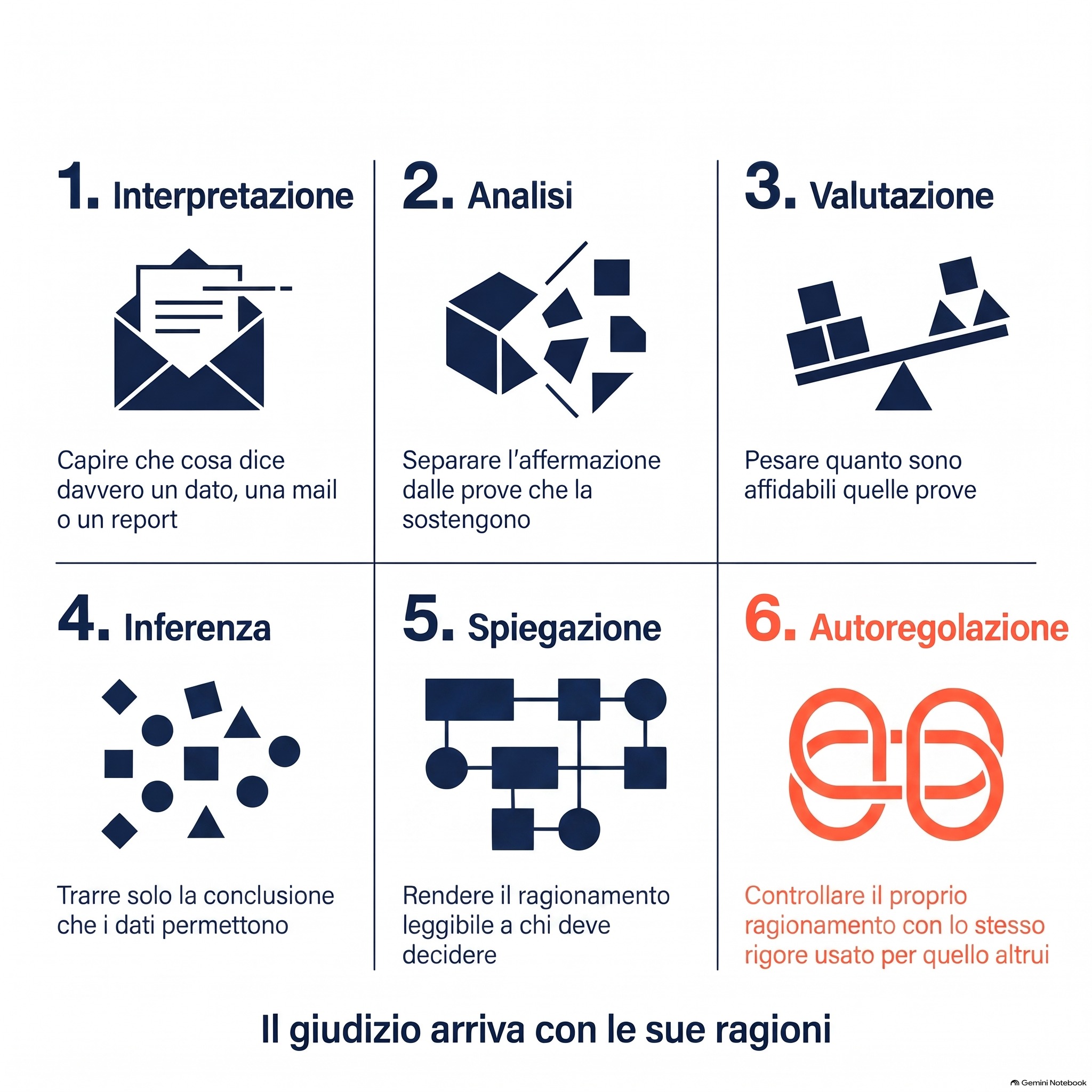
- interpretation: understanding what a figure, an email or a report really says;
- analysis: separating the claim from the evidence that supports it;
- evaluation: weighing how reliable that evidence is;
- inference: drawing only the conclusion the data allows;
- explanation: making the reasoning readable for whoever has to decide;
- self-regulation: checking your own reasoning with the same rigor you apply to other people's.
The term goes back to the Greek κρίνω, "to distinguish, to judge" [2].
In a department, the difference shows up in a sentence like "that customer always pays late": common sense takes it at face value and adjusts the payment terms, while critical thinking asks how many invoices, over what period and against which agreed terms.
Critical thinking does not mean criticizing the person speaking: what gets checked is the claim, not the person.
Nor is it the same as skepticism, which doubts on principle.
And it is not problem solving: problem solving looks for a solution, while critical thinking checks the premises that solution rests on.
Self-regulation is the hardest skill, because your own beliefs feel already verified.
That is where cognitive biases come in: systematic errors of judgment that push in the same direction.
In a meeting, instead of correcting one another, the same biases tend to add up.
Why critical thinking switches off in groups and which rule switches it back on
In a team, critical thinking depends not only on how well each person reasons, but on how normal it is to ask "how do we know?" in front of others.
Meetings bring forces into play that you don't meet at your desk.
Cass Sunstein and Reid Hastie, in their book Wiser (2015), describe how a group can amplify individual errors instead of correcting them [3].
Of the mechanisms they describe, two matter in meetings: the cascade, in which each person falls in line with whoever spoke first, and the preference for information the group already shares, at the expense of what only one person knows [3].
The cascade tends to weigh more when the first person to speak is the one with the most authority: you can call it the hierarchy effect.
Then there is time pressure: if the decision has to be closed by the end of the meeting, a checking question looks like a delay.
In a 20-employee company, at the Monday meeting the business owner, who splits time between the office and the shop floor, is the first to judge the new supplier, and the shift supervisor who saw the rejects in the last delivery says nothing.
Relying on individual talent alone is fragile: the OECD PIAAC 2022-2023 survey of adults aged 16 to 65 measures the ability to solve new problems, which is close to critical thinking even if it is not the same thing [4].
In Italy, 46% stop at level 1 or below, the two lowest steps on the scale, against 29% for the OECD average [4].
Italian companies ask for both skills: in the hiring of graduates planned for 2025, problem solving is required in 76.5% of cases and the ability to work in a team in 79.4% [5].
A workable lever, then, is to turn the checking question into a rule rather than asking individuals for more courage.
If "how do we know?" applies to every proposal in the chosen category, asking it does not signal distrust: the rule asks it, not the colleague.
With the rule in place, the following Monday the shift supervisor can answer a step that is on the agenda instead of challenging the business owner, and the reject data can enter the decision.
The rule is more likely to hold where an objection does not cost your reputation, that is, in a climate of psychological safety.
What remains is deciding when to ask it and who looks after it.
4 meeting practices that make critical thinking a department habit
Developing critical thinking with individual exercises trains the individual but leaves the meeting as it was: what becomes a department habit is what gets attached to a ritual that already exists.
In 2020, in Italian companies with at least 10 employees, 44.6% of employees attended training courses [6].
In 2020, 52.9% of Italian companies with at least 10 employees used forms of training other than courses (on-the-job training, conferences, self-study), about 10 points more than in 2015 [6].
The figure does not say which form pays off most, but it shows that learning on the job is a path companies already take.

1. Four questions before closing an item in a meeting:
- where does the data come from?
- what would have to be true for the proposal to be right?
- which alternative was discarded?
- what would change our mind?
They work within effective business meetings, with an agenda and a person accountable for the decision.
2. Rotating devil's advocate. The role passes to a different person at every meeting, so objecting does not become a label or stay delegated to a single colleague.
In the study by Nemeth and colleagues (2001), authentic dissent produced more and better solutions than any devil's advocate variant [7].
As a working hypothesis, a rotating role makes objections legitimate; the value, however, lies in objections that are genuinely held.
3. The person with the most authority speaks last. This is the countermeasure to the hierarchy effect.
The business owner first asks for the views of the shift supervisor and the purchasing office, then gives their own.
4. Decision review after 30 days. After a month, the decision is picked up again and the estimate made in the meeting is set next to the actual result.
The questions are: what did we expect, what happened, and what changes next time.
A meta-analysis, that is, a statistical synthesis of several studies, covering 46 samples (2,136 participants) estimates that debriefs, the reviews held at the end of an activity, improve performance by about 20-25% [8].
The authors point to facilitation and a structured format as possible reinforcing factors, and to alignment between the purpose of the review and the measure of the outcome as a confirmed factor [8].
How to start in a department that doesn't use the rule. Three choices:
- who looks after it: whoever runs the meeting;
- for which decisions: a single category, for example purchases above a threshold;
- where it is recorded: one line per question in the minutes.
You can extend it to other decisions once the first minutes have actually been filled in.
The review closes the loop of the decision-making process: what you don't look at again after a month does not become department learning.
A critical thinking example on a purchase: from price to real cost
When the four meeting questions are applied to a concrete proposal, the available numbers stay the same: what changes is which ones enter the decision.
Illustrative case, made-up figures: a 28-employee engineering company in a small industrial town buys 10,000 bushings a year in 12 deliveries from supplier A.
In the meeting, the purchasing office proposes: "Supplier B costs less, let's switch."
To the first question, "where does the data come from?", the answer is the price list: the price is real, but it is only one item.
The second goes beyond price, toward the total cost of ownership, which includes the other costs tied to the purchase [9].
The third, "which alternative was discarded?", reopens options the proposal didn't mention: staying with A, or splitting volumes between A and B.
B has already been a second supplier for 12 months on 6 small trial lots: the production manager has the data.
To compare the two suppliers, the rates observed on B are projected onto the full annual volume of 10,000 pieces in 12 deliveries.
The last column shows the question and the checking condition tied to each figure.
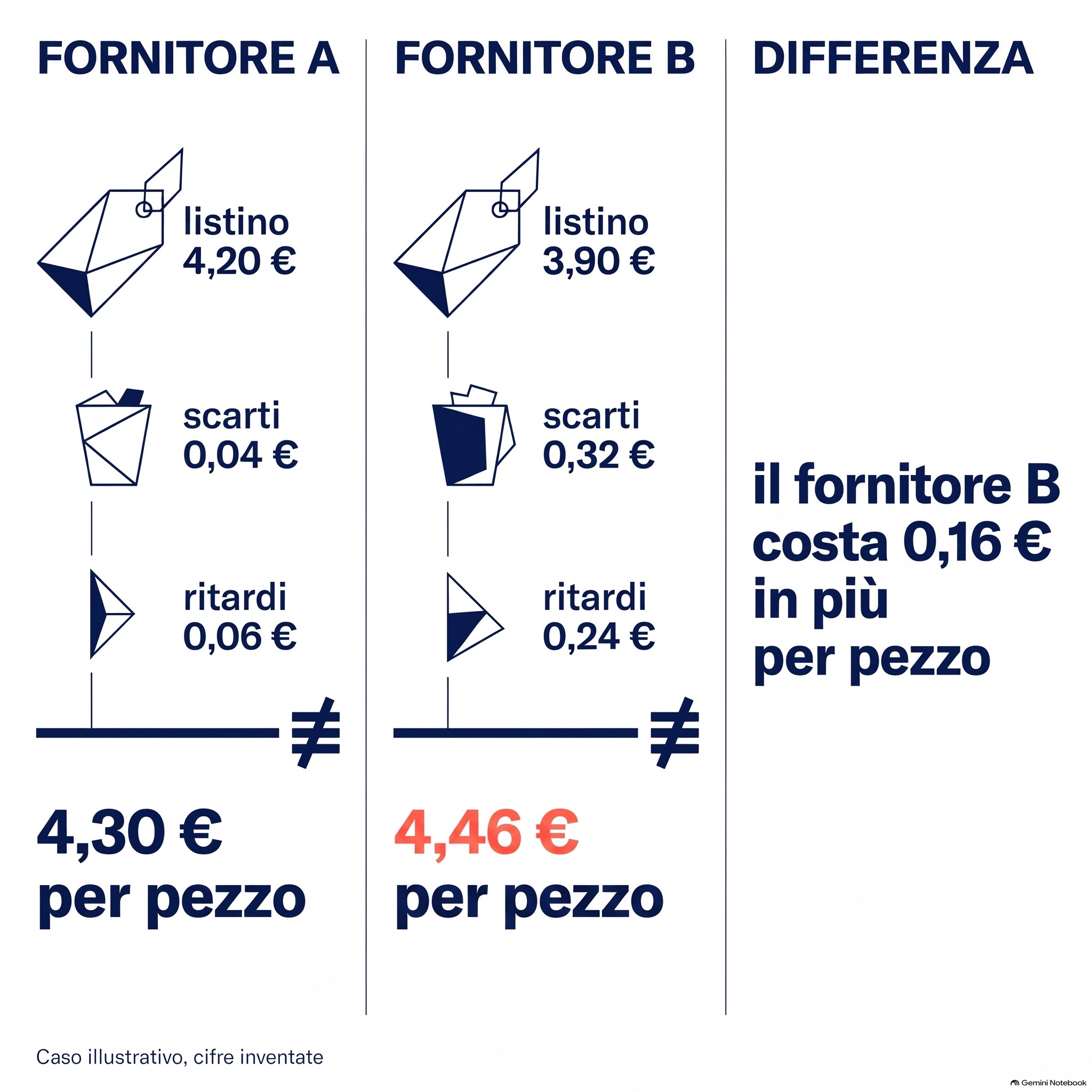
| Item (annual basis: 10,000 pieces, 12 deliveries) | Supplier A | Supplier B (projection) | Question and checking condition |
|---|---|---|---|
| Unit list price | €4.20 | €3.90 | Where does the data come from? The price list |
| Rejects at incoming inspection | 0.5% | 4% | What would have to be true? B's rejects no higher than A's |
| Reject cost per piece (€8 per reject, internal estimate) | €0.04 | €0.32 | Same question: B's reject cost no higher than A's |
| Late deliveries out of 12 | 1 | 4 (2 out of 6 lots) | What would have to be true? B's delays no more frequent than A's |
| Delay cost per piece | €0.06 | €0.24 | Same question: B's delay cost no higher than A's |
| Total cost per piece | €4.30 | €4.46 | What would change our mind? B's total cost no higher than A's |
Each delay stops the line, at an estimated cost of €600.
For B: 2 delays on the 6 lots received project to 4 delays over 12 deliveries; 4 times €600 is €2,400, or €0.24 on each of the 10,000 pieces.
For A: 1 delay times €600 is €0.06 per piece.
Before the check, the decision rests on savings of €0.30 per piece, or €3,000 a year.
After it, B costs €0.16 more per piece, or €1,600 more a year.
The decision does not become a rejection of B, but a verifiable condition on the next deliveries, to be reread at the 30-day review.
If B's rejects drop to 2%, their cost falls to €0.16 per piece (2% of €8).
With the same delays, B reaches €4.30 (3.90 + 0.16 + 0.24), the same cost as A.
If B's rejects have a recurring cause, the 5 whys technique helps trace where they originate.
The decisive step, though, comes before the table: reframing the question from "who costs less?" to "how much does a good piece, delivered on time, cost?", which is the work of business problem finding.
Mistakes to avoid so critical thinking helps decisions instead of blocking them
Critical thinking degenerates when the objection stops serving the decision and becomes a position to defend.
The first mistake is confusing systematic objection with rigor: someone who challenges every proposal, even in the face of data, is not checking, they are opposing.
The second is attacking the person instead of the claim, as in "this comes from the person who got the order wrong last year."
The meta-analysis by de Wit, Greer and Jehn (2012), covering 116 studies and 8,880 groups, finds a stable negative link between relationship conflict and group outcomes [10].
Disagreement about the substance of the work has less clear-cut effects, and less negative ones when it stays separate from personal friction [10].
The third is endless checking on reversible decisions, such as trying a new supplier on a single lot.
In cases like these, waiting for one more data point can cost more than getting it wrong and correcting at the next lot.
The fourth is the ritual without consequences: the four questions get recited, but the proposal goes through just as it arrived.
The fifth is leaving doubt to the department's resident contrarian alone, which is exactly what rotating the role is meant to prevent.
Raising an objection without hurting whoever made the proposal is a skill in itself, the same one you need to give feedback to team members.
Limits and conditions of applicability
The sources measure something other than the method: the OECD survey looks at solving new problems, Istat and Excelsior describe companies' training and skill demand in Italy, and the studies on dissent and debriefs do not by themselves prove that the four practices work in a department.
In roles that respond to requests in real time, such as customer service or reception, the decision does not wait for the meeting, and the rule has to be adapted to short moments, for example a check at the end of the shift.
In emergencies, checking can be suspended and caught up once the decision is made, during the review.
FAQ
How can you develop critical thinking in a team?
You develop it by attaching a few fixed questions to meetings already on the calendar, more than with exercises detached from work.
It helps to start with a single category of decisions and record the answers in the minutes.
What are the critical thinking skills?
The American Philosophical Association expert panel lists six, from interpreting data to self-regulation, described in the first section [1].
In meetings the last one matters most, because it is about checking your own beliefs with the same rigor you apply to other people's.
What is the difference between critical thinking and problem solving?
The two work at different moments of the same decision: critical thinking checks what is being taken as true, and problem solving then builds the answer.
In the illustrative purchase, the shift from "who costs less?" to "how much does a good piece cost?" belongs to the first phase.
Why does critical thinking matter for a business?
Because a decision made on price alone can cost more than it seems.
In the illustrative case, the apparent saving of €3,000 a year became an extra cost of €1,600 once rejects and delays were counted.
Operational summary
The path starts by telling common sense, which accepts, from checking, which asks for reasons.
Then you choose one category of decisions, set the four questions in the minutes and give a facilitator the job of looking after them.
The person with the most authority speaks last, and the devil's advocate changes at every meeting.
After a month, the estimate is compared with the actual result.
The illustrative purchase shows what enters the decision when the checking questions are applied.
Objections without evidence, attacks on the person and empty rituals are signs that the rule has stopped serving its purpose.
Conclusion
A team's critical thinking is not measured by who reasons best, but by how much it costs, in a meeting, to ask where a figure comes from.
When a rule calls for the question, it stops looking like distrust of whoever made the proposal and becomes a step in the decision, like the agenda.
That changes the numbers that go into choices: the list price stays, but next to it appear the rejects, the delays and the data that people on the floor used to keep to themselves.
Even before checking the answers, what counts is choosing the right question, and that is the territory of business problem finding, the next thing to read.
A department that uses the rule consistently tends to argue less about opinions and more about data, and to close meetings with decisions that can be reread a month later.
Whoever runs the meeting stops being the only guarantor and becomes the keeper of a method the department can carry on even when that person is not in the room.
In a team, useful doubt does not depend on individual courage: it depends on a rule that makes it normal.
Asking "how do we know?" before the decisions that matter changes the numbers that come into the meeting, not the people sitting at the table.
Sources and references
[1] Facione P. A., Critical Thinking: A Statement of Expert Consensus for Purposes of Educational Assessment and Instruction (The Delphi Report), American Philosophical Association, 1990. https://www.qcc.cuny.edu/socialSciences/ppecorino/CT-Expert-Report.pdf
[2] Istituto della Enciclopedia Italiana Treccani, Vocabolario, entry «critico¹». https://www.treccani.it/vocabolario/critico1/
[3] Harvard Law School, bibliography entry for C. R. Sunstein, R. Hastie, Wiser: Getting Beyond Groupthink to Make Groups Smarter, Harvard Business Review Press, 2015. https://hls.harvard.edu/bibliography/wiser-getting-beyond-groupthink-to-make-groups-smarter
[4] OECD, Indagine sulle competenze degli adulti 2023 – Nota Paese: Italia (PIAAC cycle 2), published by INAPP, 2024. https://www.inapp.gov.it/wp-content/uploads/Non-organizzati/PIAAC_IIc_Country-note_IT.pdf
[5] Unioncamere – Italian Ministry of Labour, Sistema Informativo Excelsior, Laureati e lavoro, 2025. https://excelsior.unioncamere.net/sites/default/files/pubblicazioni/2025/Laureati_e_lavoro.pdf
[6] Istat, «La formazione nelle imprese in Italia – Anno 2020», press release, 2022. https://www.istat.it/comunicato-stampa/la-formazione-nelle-imprese-in-italia-anno-2020/
[7] Nemeth C., Brown K., Rogers J., «Devil's advocate versus authentic dissent: stimulating quantity and quality», European Journal of Social Psychology, 31(6), 707-720, 2001. https://doi.org/10.1002/ejsp.58
[8] Tannenbaum S. I., Cerasoli C. P., «Do team and individual debriefs enhance performance? A meta-analysis», Human Factors, 2013. https://journals.sagepub.com/doi/10.1177/0018720812448394
[9] Ellram L. M., «Total cost of ownership: an analysis approach for purchasing», International Journal of Physical Distribution & Logistics Management, 25(8), 4-23, 1995. https://www.emerald.com/insight/content/doi/10.1108/09600039510099928/full/html
[10] de Wit F. R. C., Greer L. L., Jehn K. A., «The paradox of intragroup conflict: a meta-analysis», Journal of Applied Psychology, 97(2), 360-390, 2012. https://doi.org/10.1037/a0024844