
Effective adult learning, in a workplace setting, is the process through which a team member acquires new skills and brings them into their daily work, changing observable behaviors. It is not the amount of content delivered, but the translation of that content into practice.
The ISTAT survey on adult education records for Italy a participation rate in learning activities of 35.7% among people aged 25 to 64, almost 11 percentage points below the European average [1]. Among Italian companies the gap is a matter of size: in 2020, 66.1% of companies with 10-49 employees carried out training activities, compared with 95.5% of those with at least 250 employees [2]. The figure captures a mismatch between need and investment.
The next sections cover the definition, operating principles, methods that stick and common mistakes.
Understand how adults really learn at work
The term "training" is used to mean very different things: from a classroom lecture by an expert to protected practice alongside a more experienced colleague. ISTAT finds that in 2020 half of Italian companies used training activities other than courses — on-the-job training, shadowing and job rotation, conferences and seminars — an increase of 10 percentage points over 2015 [2]. The classic framework of andragogy [3] remains a useful reference, provided you read it from an operational angle.
Does a highly rated training day really produce learning, or entertainment? Participant satisfaction is not enough to measure a change in behavior.
Before going further, it is worth clarifying three distinctions that often cause confusion. School learning is centered on content, with a final assessment and a passive role for the learner. Adult learning is centered on the experience already accumulated, on relevance to real work and on the learner's choice to engage: carrying school methods over into workplace learning produces frustration and little transfer to the job.
Information is received (a seminar, a book, a video). Learning is built: it requires experience, reflection and application. Confusing the two is the most frequent cause of the belief that "we've already done training on that topic" when in fact behavior has not changed.
Learning is a discrete process, focused on a specific skill. Professional development is the long arc of a person's growth in their role and beyond. The two are intertwined, but they answer different questions.
Operational definition: effective adult learning is the process that turns content into observable behaviors in daily work. Three elements make it possible: relevance (the content responds to a real need of the job), protected application (there is room to practice without serious consequences), structured debrief (people reflect on the experience with guiding questions). The framework of andragogy [3] — developed from the 1970s onward — set out these principles systematically, describing how adults learn differently from children: through the experience they have already accumulated, solving concrete problems and having autonomy in choosing what to learn and why.
Recognize 5 operating principles of adult learning
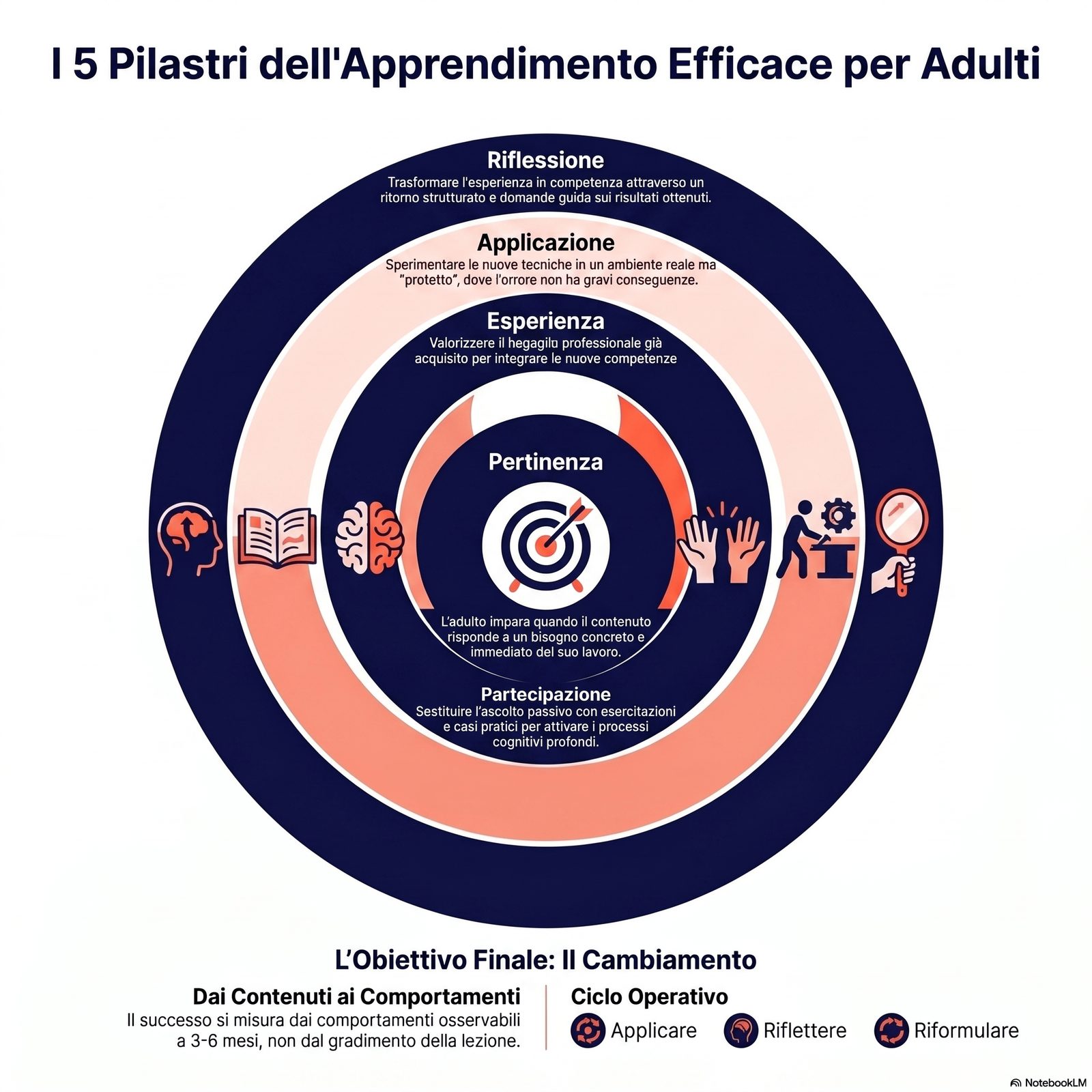
Adult learning that works rests on five recurring principles: relevance to real work (adults learn what they need, not what is interesting), building on experience already accumulated, active participation (not passive listening), protected application between one session and the next, and a structured debrief on the experience. Each principle supports part of the transfer to the job: skip one and the program weakens.
Which of these principles is most underestimated in company training programs? Protected application and the structured debrief are the two steps that get skipped first.
Principle 1: Relevance to real work. Adults invest energy in learning when the content responds to a concrete problem or need they already feel is relevant. A training program on "negotiation techniques" has a different impact on a salesperson facing a difficult negotiation than on one who has none on the calendar. Relevance is built before the program (by identifying the real need) and during it (by anchoring each concept to a concrete situation in the participant's work). Present: the trainer opens with "bring me an example of a negotiation you're working on right now." Absent: the trainer opens with "today we'll talk about the phases of negotiation according to model XY."
Principle 2: Building on experience already accumulated. Adults do not come to training as blank slates: they bring years of experience, established mental models, procedures already learned. Ignoring this experience and presenting content as brand new produces resistance. Acknowledging it — "you've probably already handled situations like this one, maybe with different methods" — builds trust and opens room to integrate the new with the existing. Present: you start from what participants already know and build from there. Absent: the model is presented as if participants had never dealt with the subject.
Principle 3: Active participation. Passive listening (lectures, videos, presentations) produces information, not learning. Active participation — discussion, exercises, simulation, case studies — triggers the cognitive processes that consolidate learning. Present: every 20-30 minutes there is a moment of active processing (a question, an exercise, a discussion in pairs). Absent: 4 hours of lecture-style presentation with 15 minutes of questions at the end.
Principle 4: Protected application between one session and the next. Adult learning needs a space between sessions in which people practice what they have learned — not in ideal conditions, but in real work, with the implicit support of the ongoing program. "Protected" means mistakes are expected and have no serious consequences: the team member knows they are experimenting, not that they are already supposed to be competent. Present: each session closes with a specific application task for the following 2-4 weeks. Absent: each session stands alone, with no link to practice in between.
Principle 5: Structured debrief on the experience. Experience alone does not produce learning: it is guided reflection on experience that turns it into competence. "How did it go?", "What worked?", "What would you do differently?" are questions that trigger the reflective process. Present: each session starts with a structured debrief on how the previous period's application went. Absent: you move straight to new content without returning to what was tried.
Build a training program that sticks: 4 methods that work
Four training methods show more consistent transfer to the job in Italian companies: structured shadowing of an experienced colleague (with explicit criteria), learning based on real company cases, distributed microlearning (short, recurring sessions) and an internal community of practice on specific topics. Combining two methods is often more effective than intensifying just one. The order matters: shadowing before cases, microlearning before the community.
In a company with 15 employees, does an internal community of practice make sense? Even with few participants, structured peer discussion beats a one-off seminar.
Method 1: Structured shadowing of an experienced colleague. Shadowing works when it has explicit criteria: the team member who is learning knows what to observe and has guiding questions, and the experienced colleague has been prepared to explain the reasons behind their choices, not just to do the work. Without structure, shadowing is osmosis — useful but slow. With structure, it is acceleration. Shadowing and job rotation are among the training activities other than courses that ISTAT finds in half of Italian companies [2], and the Excelsior information system reports that the most common strategy for closing the skills gap in Italian companies — in about one case out of two — is to look for people with skills similar to those required and, once they have joined, enroll them in targeted training [4]. To learn more about using this method in management training, read the guide to management training.
Method 2: Learning based on real company cases. A real case — a project already completed, a difficult situation already handled, a customer already lost or won — is the most relevant teaching material for an adult. Analyzing a real company case brings a double advantage: you learn from the specific situation and you build an "archive" of precedents that is useful for future decisions. The facilitator presents the case, guides the analysis with specific questions and helps extract the transferable principles.
Method 3: Distributed microlearning. Short sessions (15-30 minutes), recurring (weekly or every two weeks), focused on a single concept or behavior. Microlearning fits the schedule of a busy company: it does not require stopping work for a whole day. It works particularly well for cross-functional skills (communication, feedback, managing priorities), where frequent repetition matters more than the depth of a single intervention. The condition is that each session is linked to the previous one and that the participant comes back with an observation from real work.
Method 4: Internal community of practice. A group of 4-8 people working on similar skills meets periodically to discuss real cases, difficulties and solutions. In a small company, this might be the sales team discussing the month's toughest negotiations, or the team of coordinators comparing notes on how they run meetings. A community of practice works when there is a facilitator (internal or external) who structures the discussion and keeps it from turning into a complaint session. To learn more about onboarding as the first structured shadowing experience, read the guide to employee onboarding.
Design protected practice between one session and the next
Protected practice is where adult learning is won or lost: the space between one session and the next, in which the team member tries what they have learned knowing they can make mistakes without serious consequences. Without protected practice, every training session is an isolated event. Designing it requires three elements: a real but low-risk task, an observer (a manager or a peer) who can give feedback, and a structured moment to debrief on the experience.
How many training programs explicitly plan for practice between sessions? Most programs assume that "the work itself" is enough — an often optimistic assumption.
The operating cycle of protected practice has three moments:
Apply. The team member tries the behavior or technique they learned in a real work situation, chosen in advance with the trainer or the manager. The situation must be real (not simulated) but low-risk: not the most important negotiation of the year, but an ordinary one. The task is specific: "in the next team meeting, try going around the table before opening the discussion — notice what happens."
Reflect. After applying it, the team member spends 10-15 minutes answering three questions in writing: "what exactly did I do?", "what worked?", "what didn't work and why?". Writing forces a deeper processing of the experience than memory alone. The observer (a manager, a colleague, the trainer) who saw the application adds their own perspective.
Reframe. In the next session, the team member brings the experience and the reflection. With the facilitator, the behavior is reframed: "given your experience, what would you change next time? Which version of the behavior you learned best fits your context?". Reframing tailors the general principle to the team member's specific situation, increasing the likelihood of future application. To learn more about the broader context of corporate training, read the guide to corporate training.
Measure learning effectiveness beyond satisfaction
Measuring learning only with satisfaction questionnaires is too late and misleading: the end-of-class questionnaire tells you how much people liked the session, not how much of it reached their work. You need behavioral indicators at 3-6 months: observable changes in daily work, frequency of application, the quality of decisions in which the learned skill plays a part.
How many metrics is it reasonable to focus on to measure a learning program? Dashboards with fifteen indicators are a sign of not choosing, not of rigor.
The four-level measurement framework is useful as an operational guide. Level 1 (reaction) measures satisfaction: easy to collect, not very informative about learning. Level 2 (learning) measures whether participants have absorbed the content: useful for calibrating the method. Level 3 (behavior) measures whether the skills show up in work at 3-6 months: it is the most informative level about the quality of the program. Level 4 (results) measures the organizational impact: hard to attribute with certainty to training alone. This framework is presented as an operational guide, not as a formal system to implement in every detail.
Three examples of behavioral indicators at 3-6 months:
For communication and feedback skills. Before: the manager holds feedback conversations rarely and in general terms. After 3 months: they hold specific conversations within 48 hours of relevant events, name the observed behavior and ask for the other person's perspective. The indicator is checked with a short conversation with the manager's team members.
For priority management skills. Before: the team member does not flag when they are unable to meet a deadline. After 3 months: they flag conflicting priorities in advance and propose an alternative sequence. The indicator is observed in the frequency of proactive communication about deadlines.
For specific technical skills. Before: the team member asks for support on [problem category] 3-4 times a week. After 3 months: they handle most cases on their own and ask for support only on exceptions. The indicator is measured by tracking the frequency of support requests before and after the program.
Common mistakes in adult learning in the workplace
The most common mistakes in adult learning in companies are not about content but about process: confusing information with learning, compressing programs into intensive days with no protected practice, evaluating only on satisfaction, disconnecting content from real work, ignoring the experience participants have already accumulated. Recognizing them is more useful than memorizing them, because they show up in different forms depending on the size of the company. Addressing them takes honesty more than method.
Which of these mistakes is more costly: compressing the program or ignoring the participants' experience? Both extremes produce the same outcome — skills that never reach daily work.
The five most common mistakes, with a small correction:
Confusing information with learning. A training program is considered complete once participants have received the content. Behavior has not changed, but "we've done training on that topic." Correction: define up front the behavior you want to observe at 3-6 months, and use that as the success criterion — not the number of classroom hours.
An intensive program with no protected practice. Training is concentrated into 1-2 intensive days (or a training week), with no planned application or debrief. The effect is high stimulation during the training days and a quick return to old habits in the following weeks. Correction: spread the program over time, with shorter and more frequent sessions, and explicitly design protected practice between one session and the next.
Evaluating only on satisfaction. The program closes with a satisfaction questionnaire. If satisfaction is high, the program is considered a success. Correction: introduce at least one behavioral check at 3 months: 3 questions to people who can observe the team member in real work.
Disconnection from real work. The training content is abstract or refers to situations the team member has never experienced and probably never will. Correction: anchor every concept to a real situation in the company or in the team member's work. If you cannot find the anchor, the content is probably not relevant.
Not building on experience. The trainer presents the content as brand new, ignoring the experience participants have already accumulated. The result is resistance ("we already know this") or passivity ("this doesn't concern me"). Correction: start each session by exploring what participants already know and already do on the topic. New content is introduced as an addition, not a replacement.
Limits and conditions of applicability
The principles and methods described in this article apply with varying effectiveness depending on the type of skill and the organizational context. Very specific technical skills (a piece of software, a precise procedure) are learned well even with more traditional methods (direct instruction, manuals, guided practice). The principles of adult learning are particularly relevant for complex, cross-functional or highly relational skills.
The Knowles source [3] cited in this article is a theoretical framework developed in the North American context of the 1970s and 1980s. The reference is useful for understanding the logic of adult learning, but it should not be treated as a universal prescriptive guide: different national contexts, the organizational culture of smaller companies and the specific conditions of each organization require adaptation.
The ISTAT survey on training in companies [2] describes how widespread activities other than courses are, not how much transfer to the job they produce. The operational guidance in this section should be read as applied practice, not as a measured result of that survey.
The ISTAT survey on adult education [1] concerns participation in learning activities in Italy, not the effectiveness of specific learning methods. The mismatch between training needs and investment is documented, but the operational conclusions on adult learning require additional sources to be empirically supported.
FAQ
Does adult learning differ depending on the team member's age? Age has a partial effect: the principles of adult learning (relevance, experience, participation, application, reflection) apply to team members of all working ages. What changes with age is the amount of experience already accumulated (which deserves more recognition as it grows) and, in some cases, a preference for specific learning styles. The basic principles still apply.
How do you handle a team member who does not want to "go to training"? Resistance to training is almost invariably a sign of relevance that is not perceived: the team member does not see the link between what is being offered and their real work. Before reading resistance as a lack of interest, it is worth asking whether the program was presented in a way that lets the team member recognize their own need. A conversation about "which work situation would you like to feel better prepared for?" is often more useful than a summons to a course.
How much does a structured learning program cost? Costs vary enormously depending on the methods chosen. Structured shadowing and an internal community of practice cost very little (essentially internal time). Distributed microlearning can be run internally or with external support. The most expensive option is an external trainer for recurring sessions: in a company with 10-20 people, a 6-month program with monthly sessions costs between EUR 3,000 and 10,000, depending on the specialization required. The right comparison is not with the zero cost of "no training," but with the cost of the skills gap you want to close.
Operational summary
Effective adult learning at work is not measured by the amount of content delivered, but by the behaviors that change in daily work. The five principles that make it possible (relevance, building on experience, active participation, protected application, structured debrief) are applied through four main methods: structured shadowing, real cases, distributed microlearning and communities of practice. Protected practice between sessions — with the apply → reflect → reframe cycle — is the step most often skipped and the most decisive for transfer to the job. Effective measurement does not stop at satisfaction; it observes behaviors at 3-6 months.
Conclusion
Effective adult learning is not the sum of content delivered, but the process that turns that content into observable behaviors in daily work. Building it requires relevance to real work, building on experience already accumulated, active participation, protected application between sessions and a structured debrief. Without these elements, training becomes a pleasant interlude that leaves no trace.
The thread that ties these steps together is consistency between what is taught and what the environment allows people to practice. When that thread breaks, skills stay on the shelf and the company invests resources with no return in behavior. To place learning within the broader training framework, read the guide to corporate training and, on the development side, how to structure employee upskilling.
An organization that genuinely works on learning stops confusing "we've done training" with "we've learned." Team members apply what they have learned, work meetings show new skills, behavioral indicators move in the months after a program. It makes for a calmer way of working and more solid growth — within reach of organizations of any size, provided that the program stays connected to real work.
Sources and references
[1] ISTAT, "La formazione degli adulti — Anno 2022", Statistiche report, April 8, 2024. Available at: https://www.istat.it/it/files/2024/04/Formazione-adulti-Anno2022.pdf
[2] ISTAT, "Formazione nelle imprese — Anno 2020", Statistiche report, December 30, 2022. Available at: https://www.istat.it/it/files/2022/12/REPORT-formazione-imprese.pdf
[3] Knowles, M., "The Adult Learner — Andragogia, contesto e principi", classic academic reference. (cited as a theoretical framework)
[4] Unioncamere — Italian Ministry of Labor, Excelsior information system, "La domanda di professioni e di formazione delle imprese italiane nel 2024". Available at: https://excelsior.unioncamere.net/sites/default/files/pubblicazioni/2024/Domanda_professioni_formazione_imprese.pdf