
The question is the same for someone working alone with two team members, for someone leading a company of a dozen people and for someone coordinating a hundred.
Hours worked are not enough to answer it, because they tell you how much you work, not what has to go through a single person.
In organizational terms, too much work is the condition in which the tasks and decisions that must pass through a position consistently exceed what that position can handle within normal working hours.
Too much work is not a number of hours, it is a number of mandatory handoffs: as long as the organization stops when one person is missing, adding hours moves the problem and removing a handoff reduces it.
Five observable signs make it possible to tell the two conditions apart. For each one, this article shows what it signals at the organizational level and what the first concrete move is, before covering the mistakes that make the reading useless.
Tell a busy period apart from work overload
A peak ends; an organizational problem starts again the following Monday.
The Treccani Italian dictionary defines «sovraccarico» (overloaded) as something "excessively loaded, beyond the norm or beyond normal capacity to bear," and among its figurative uses it lists precisely being overloaded with work [1].
The useful core is the phrase "beyond the norm": overload exists relative to a reference point, and in a company that reference point is what a position absorbs under ordinary conditions.
In everyday language the same condition is described as "always rushing at work": it is a perception, not a reference point, which is why the phrase describes an exceptional week and an organization that has been stuck for three years in exactly the same way.
Three situations get confused with work overload, and each is corrected in a different way.
A seasonal peak has a start date and an end date — financial closings, campaigns, tax deadlines — and is managed by shifting work in time.
Fragmentation concerns the shape of the day, not the volume: the same work broken into twenty interruptions costs more than the same work in three blocks.
Other people's urgency concerns order, not quantity: when everything arrives marked as urgent, the criterion for priority management is the first thing to look at.
Too much work in a company, in the sense used here, is what remains once those three situations have been ruled out: a load that comes back every cycle, not tied to a season or to a wrong priority criterion.
Ruling them out takes observation, not discussion — and the five signs that follow are facts you count, not impressions you compare.
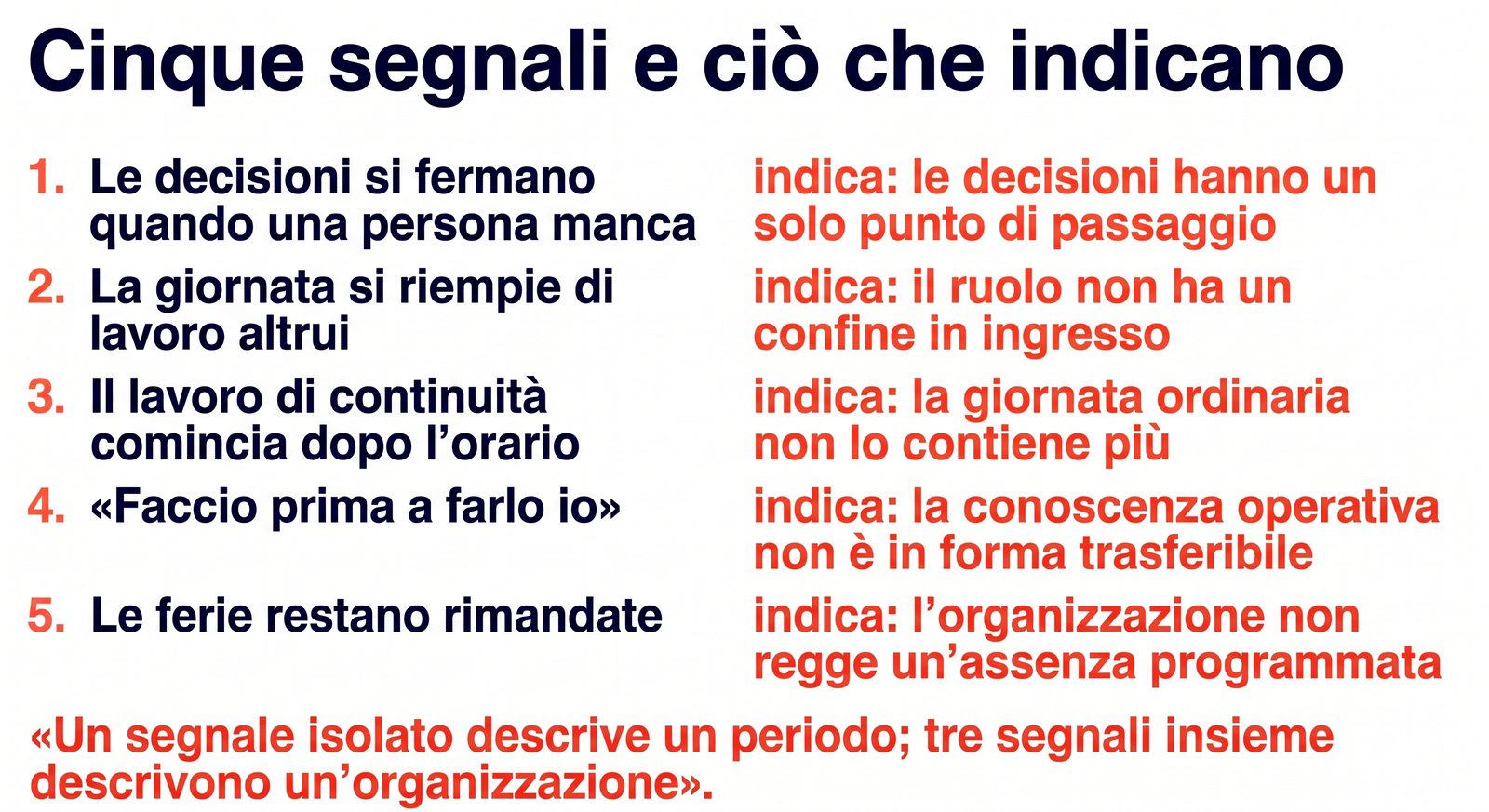
Read the sign of decisions that stall when one person is away
The quickest way to see how much an organization depends on one person is to look at it on the day that person is not there.
If on that day three matters sit waiting for an approval, the sign is not about the amount of work: it is about the number of decisions that have a single point of passage.
In Italy, that concentration is the norm, not the exception.
According to the first results of the Italian Permanent Census of Enterprises, in 2022 80.9% of companies with at least 3 employees were controlled by an individual or a family, and management of the company "is in most cases entrusted to the business owner or to a member of the owning family" [2].
Management entrusted to an internal or external manager concerns 1.4% of these individually or family-controlled companies and drops to 0.8% among those with 3 to 9 employees [2].
The figure describes ownership and management, not the quality of decisions: but it does say that concentrating decisions in a single position is the starting condition for most Italian companies, and that it is dismantled by choice, because through inertia it stays where it is.
First move.
For one week, write down every decision that crosses the leader's desk, in three columns: what is being decided, what happens if the decision is wrong, who else could have made it.
Reversible, low-value decisions go first: for two or three recurring types, write down who decides instead of the business owner and within what limit — on spending, discounts, delivery times.
The written limit is what distinguishes delegation from case-by-case permission, and it is the pivot of delegation that doesn't make you lose control.
The test comes on its own, at the first absence.
When the day fills up with other people's work and the real work slips to the evening
Two distinct signs often appear together, and it pays to read them together.
The first: the day fills up with tasks that started on someone else's desk — a request for clarification, a supplier to call back, an order to unblock.
The second: work that requires continuity — the complex quote, the production plan, the trial balance — starts when everyone else leaves.
Working evenings is not an individual anomaly.
According to Eurostat, in 2024 6.6% of employed people aged 20 to 64 in the European Union reported usually working 49 hours or more a week in their main job; among the self-employed the share rose to 27.5%, compared with 3.4% of employees [3].
The comparison does not explain the causes and does not concern Italy specifically, but it takes away the sense that this sign is a personal exception: long hours are the normal condition of those who lead.
As for the organizational meaning, the two signs together say that the role has no boundary on what comes in, and that continuous work has been pushed out of normal hours by the sum of the interruptions.
Among the context indicators in the preliminary assessment of work-related stress risk, the method of INAIL, Italy's national institute for occupational safety, lists "role within the organization" and "decision latitude and control" [4]: these are the two items that describe this sign in organizational terms rather than as a matter of character.
First move.
Two weeks of notes on a sheet: who asked, what, how many minutes.
The list by itself separates what really required that person from what landed there out of habit, and the latter is a matter of managing interruptions.
Then a single continuity task moves into a protected morning slot for four weeks, and you count how many times it gets skipped and because of what.
The number of skips is the measure of the missing boundary.
"It's quicker if I do it myself": the sign you pay for the second time
The phrase is reasonable the first time and becomes expensive from the second.
Explaining a task costs more than doing it, and the math works for a single episode: it doesn't work over a quarter, because the recurring task comes back and the explanation doesn't.
What it indicates at the organizational level: operational knowledge exists in a single head and not in a transferable form.
The Italian context makes the sign weigh more than it seems, because almost all self-employed workers in Italy work in companies with fewer than 10 employees (2023 data) [5]: the structure around the leader is small, and a second person able to do a task doesn't exist until someone builds it.
Among the job content indicators, the INAIL method refers to the "match between workers' skills and the professional requirements of the role" [4] — which is exactly what an unwritten explanation makes impossible to verify.
First move.
The next time the task has to be done, write it down while you do it: half a page with when it starts, the steps in order, and what you check before considering it done.
The next round is done by someone else with that sheet in front of them, and the person who wrote it notes only the points where the other person got stuck.
Those points are version two of the procedure, and the method for making them standard practice is the one for standard operating procedures.
The criterion for choosing where to start is frequency, not difficulty: a weekly task written down once pays for itself within a month.
Postponed vacations: the sign you read on the calendar
Of all the signs, this is the easiest to verify, because it is written in a document the company already has.
Italian law, for example, sets a clear benchmark: Legislative Decree 66/2003 grants "an annual period of paid leave of no less than four weeks," at least two of which must be taken during the year in which they accrue, consecutively if the worker requests it [6].
When those two weeks keep getting postponed year after year for the business owner, the production manager or the only person in administration, the calendar is saying that the organization cannot withstand a planned absence.
It is an organizational sign before it is a personal one, and the INAIL method places it in good company: sick leave, employee turnover, disciplinary actions and formal complaints are "sentinel events," that is, "warning bells for possible organizational dysfunctions and/or inconsistencies" [4]; how to read a sentinel event against a baseline is described in measuring workload.
First move.
Block two consecutive weeks on the calendar three months in advance, and write the list of what would stop during those two weeks.
That list is not a problem to solve right before you leave: it is the work order for the three months leading up to it, one line at a time.
The lines that remain without a solution show where the structure is thinnest, and as a rule they are the same ones that emerged from the first sign.
The most common mistakes in reading the signs of overload
Five recurring mistakes cancel out the reading before it leads to a decision.
- Reading the signs as judgments about people — the sign shows the point where work piles up, not the speed of the person there; the INAIL method also measures by homogeneous groups, not individuals [4].
- Counting hours instead of mandatory handoffs — working hours tell you how present someone is, not how many things cannot proceed without a signature; the fix is the list of decisions, not the list of tasks.
- Responding to the sign with more hours — the overloaded business owner who sets the alarm earlier moves the problem by two hours and leaves the number of handoffs untouched; the response that reduces the load is removing one.
- Waiting for a quiet period to reorganize — the quiet period is the window in which the sign is not visible, so it is also the one in which it is measured worst; it is better to observe during an ordinary cycle and act right after.
- Mistaking a seasonal peak for a structural problem — and vice versa: the two conditions call for opposite remedies, and applying the wrong one uses up the credibility you will need next time.
A sixth mistake contains the others: observing only once.
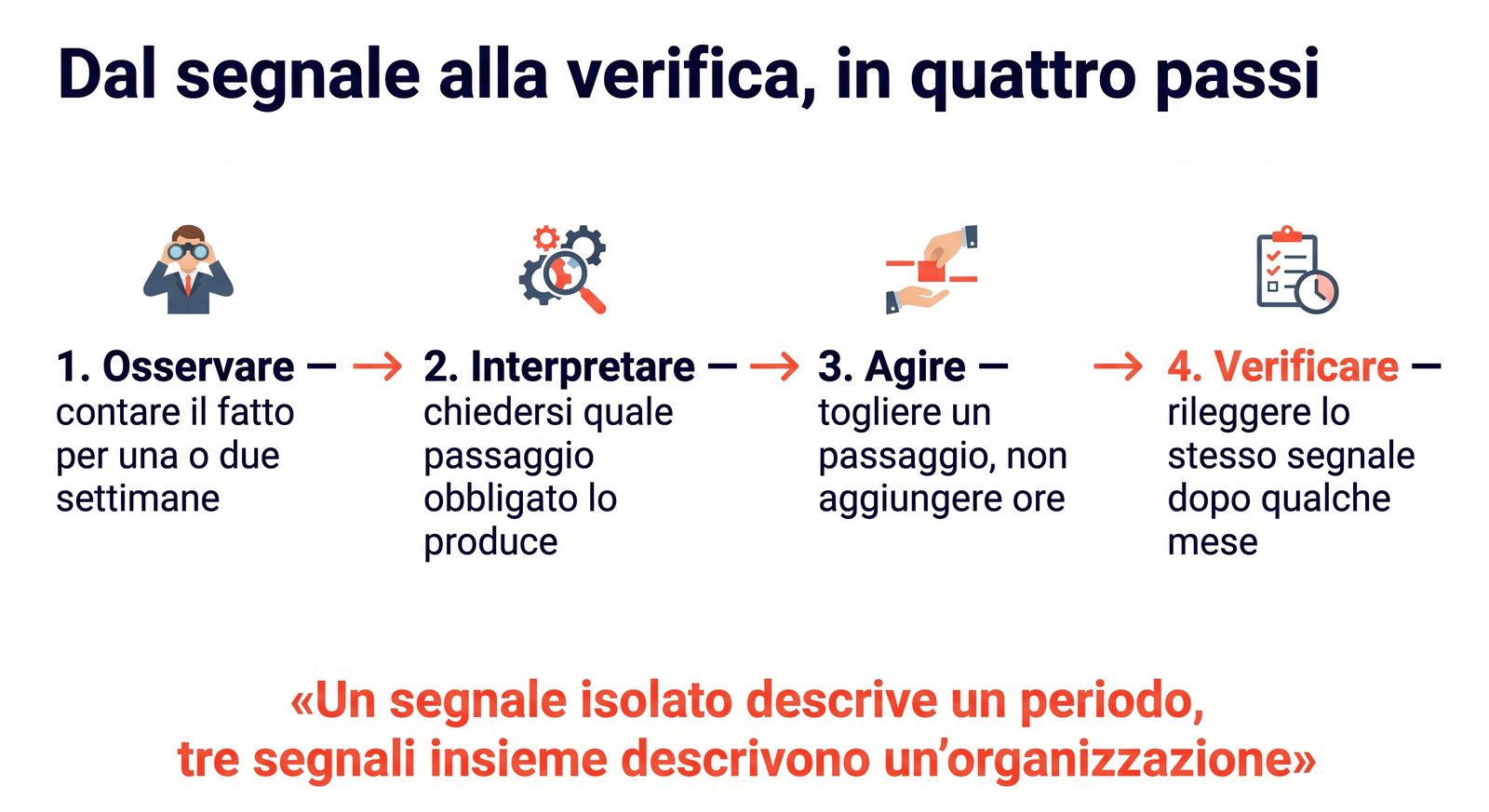
An isolated sign describes a period; three signs that come back together describe an organization, and the difference shows only when you look twice, a few months apart.
Limits and conditions of applicability
The five signs are observable clues, not a diagnosis: they show where to look and do not quantify the load, which requires a separate measurement.
The figures cited are sample-based: the Italian Permanent Census covers companies with at least 3 employees [2], and the Eurostat figure on long hours is European, not Italian [3], so they support a picture and do not prove a causal link.
Where responding to outside requests is the job and not an interference — customer service, emergency response — the second sign loses diagnostic value, and the first one still stands: how many of those requests must go through a single person anyway.
The method for assessing work-related stress risk is mentioned here for its vocabulary of indicators [4]: it remains a compliance requirement with its own roles, methods and responsibilities, which this article neither describes nor replaces.
When the picture goes beyond the organization — persistent sleep problems, difficulty concentrating that lasts over time, recurring physical symptoms — the right reading is that of a healthcare professional, and the signs described here offer no answer in that area.
FAQ
How can you tell whether too much work is temporary or structural?
A temporary load has a recognizable end date and coincides with a known event, such as a financial closing or a campaign.
A structural load comes back the same every cycle, regardless of the season.
The practical test is the week after the busy period ends: if the pace doesn't change, the busy period was not the cause.
How many signs does it take to call it an organizational problem?
An isolated sign describes a phase; three signs present together and recurring describe a way of operating.
The criterion is not the total but the repetition: the same sign observed twice a few months apart is worth more than three signs seen in one difficult week.
Which sign should you start with when several appear at once?
The first one, decisions that stall when one person is away, because it is the one that also blocks the others.
As long as every approval stays on a single desk, written procedures and protected time slots get reopened by the first urgent request.
What is the difference between too much work and poor time management?
Time management works on the order and placement of tasks within the day; overload concerns the quantity of things that must go through a position.
A time management method for business owners improves the yield of the available hours, but it does not reduce the number of mandatory handoffs: that can only be reduced by moving decisions and tasks to other people.
Operational summary
Telling a busy period apart from an organizational problem starts by ruling out three situations that resemble it: the seasonal peak, a fragmented day and urgency declared by others.
Once those are ruled out, five observable signs remain, and each points to a different mechanism.
Decisions that stall when one person is away point to mandatory handoffs that have not been distributed: the first move is to write down who decides instead of the business owner and within what limit.
Days filled with other people's work and continuous work slipping into the evening point to a role with no boundary on what comes in: the first move is to count requests for two weeks before moving anything.
"It's quicker if I do it myself" points to operational knowledge that cannot be transferred, and it is corrected by writing the procedure during the next execution.
Postponed vacations point to an organization that cannot withstand a planned absence: block two weeks three months in advance, and the list of what would stop becomes the work plan for the quarter.
Three mistakes remain to avoid: reading the signs as judgments about people, counting hours instead of handoffs, and responding to overload by adding hours.
Conclusion
Too much work is not a volume of hours, it is a number of mandatory handoffs: as long as the organization stops when one person is missing, every hour added pushes the problem forward and every handoff removed reduces it by a verifiable amount.
That is what the five signs are for, and they apply in a firm with two team members as much as in a company of a hundred: you count them, interpret them, turn them into a move and review them a few months later.
The next step depends on what the signs have shown.
If the load is real and needs to be quantified before it is moved, the path is measuring workload, which starts from an inventory assigned to a role, not to a person.
If instead what weighs is the shape of the day — many things open, few brought to completion — the useful reading is too many things to do.
To receive future in-depth articles, you can subscribe to the newsletter.
You feel the difference in a question that changes shape over time: no longer "is this a busy period?" but "which handoff goes this quarter, and who takes it?"
And it is a question that, once three or four handoffs are gone, gets answered even on the days when the leader is not in the office: that is the test that counts, and it doesn't require waiting for the year-end figures.
Sources and references
[1] Istituto della Enciclopedia Italiana, "sovraccàrico¹", Vocabolario on line Treccani. Available at: https://www.treccani.it/vocabolario/sovraccarico1/
[2] ISTAT, "Censimento permanente delle imprese 2023: primi risultati", release of November 14, 2023 (multipurpose survey of about 280,000 companies with 3 or more employees, November 2022 – March 2023; data reference year 2022). Available at: https://www.istat.it/it/files/2023/11/REPORTCensimprese.pdf
[3] Eurostat, "6.6% of employed people worked 49 hours or more weekly", Eurostat News, August 21, 2025 (Labour Force Survey 2025 data, referring to 2024, employed people aged 20-64, EU-27). Available at: https://ec.europa.eu/eurostat/web/products-eurostat-news/w/ddn-20250821-1
[4] Clerici, P. (Contarp), "Il percorso di valutazione del rischio stress lavoro correlato", series Conoscere il rischio — Fattore umano, INAIL, April 15, 2019. Available at: https://www.inail.it/content/dam/inail-hub-site/documenti/2015/10/Fattore_Umano_Percorso%20valutazione%20SLC_Apr%202019.pdf
[5] ISTAT, Annuario statistico italiano 2025, chapter 8 "Mercato del lavoro" (based on the Asia-Occupazione statistical register of employment in economic units, reference year 2023). Available at: https://www.istat.it/storage/ASI/2025/capitoli/C08.pdf
[6] Repubblica Italiana, decreto legislativo 8 aprile 2003, n. 66, art. 10 "Ferie annuali", current text. Available at: https://www.normattiva.it/uri-res/N2Ls?urn:nir:stato:decreto.legislativo:2003-04-08;66~art10