
The two sound like the same thing, and they produce two different meetings.
SWOT analysis is the four-quadrant grid — strengths, weaknesses, opportunities, threats — that organizes the facts about a company and its environment before a decision.
It works in a professional practice with two team members, in a fifteen-person family business and in a hundred-person organization: who brings the documents changes, how you fill the quadrants does not.
In Italy, professional management applies to 1.4% of companies with at least three employees controlled by an individual or a family: almost everywhere, the business owner or a family member makes the decisions (2022 data) [2].
The person filling in the matrix is almost always also the person who will have to decide.
A SWOT is only as good as the verifiable facts that fill it: it is not a snapshot of the company, it is the step that opens up the alternatives among which, the next day, someone will have to choose.
This article walks through the line that holds the quadrants together, the rule for filling them, a completed example and what to do with it afterward.
What a SWOT analysis really does, and what it gets confused with
What is a SWOT analysis really, and what is it mistaken for?
The acronym stands for strengths, weaknesses, opportunities, threats, and the technique is commonly attributed to A. Humphrey, who in the 1960s and 1970s worked on a research project on corporate planning at the Stanford Research Institute (now SRI International), an organization separate from Stanford University [5]. The most recent historical reconstruction shows, however, that this attribution is disputed: the research group was led by Robert F. Stewart, the acronym derives from an earlier one, and the four-quadrant matrix in the form widely used today came later [5].
The order is the part that usually gets lost: only after examining the four factors do you move on to identifying lines of action [1].
The matrix, then, is not the method: it is the container in which the method deposits what it has found.
Three nearby tools are the ones SWOT is most often mistaken for.
Market analysis gathers data the company does not have; SWOT organizes the data it already has, and when a quadrant stays empty it is because that data has to be sought elsewhere.
The business model canvas describes how the company creates and captures value: it answers "how does it work," not "where does it hold and where does it give way."
The decision matrix chooses among alternatives that have already been formulated, while SWOT is the step that brings those alternatives to the surface.
One case remains that changes the subject.
When there is not yet an operating company, only an idea, the internal quadrants have no documents to draw on: there the work is to validate the business idea, and SWOT comes later.
Separating what the company controls from what it is subject to in the SWOT matrix
How do you separate what the company controls from what the company is subject to?
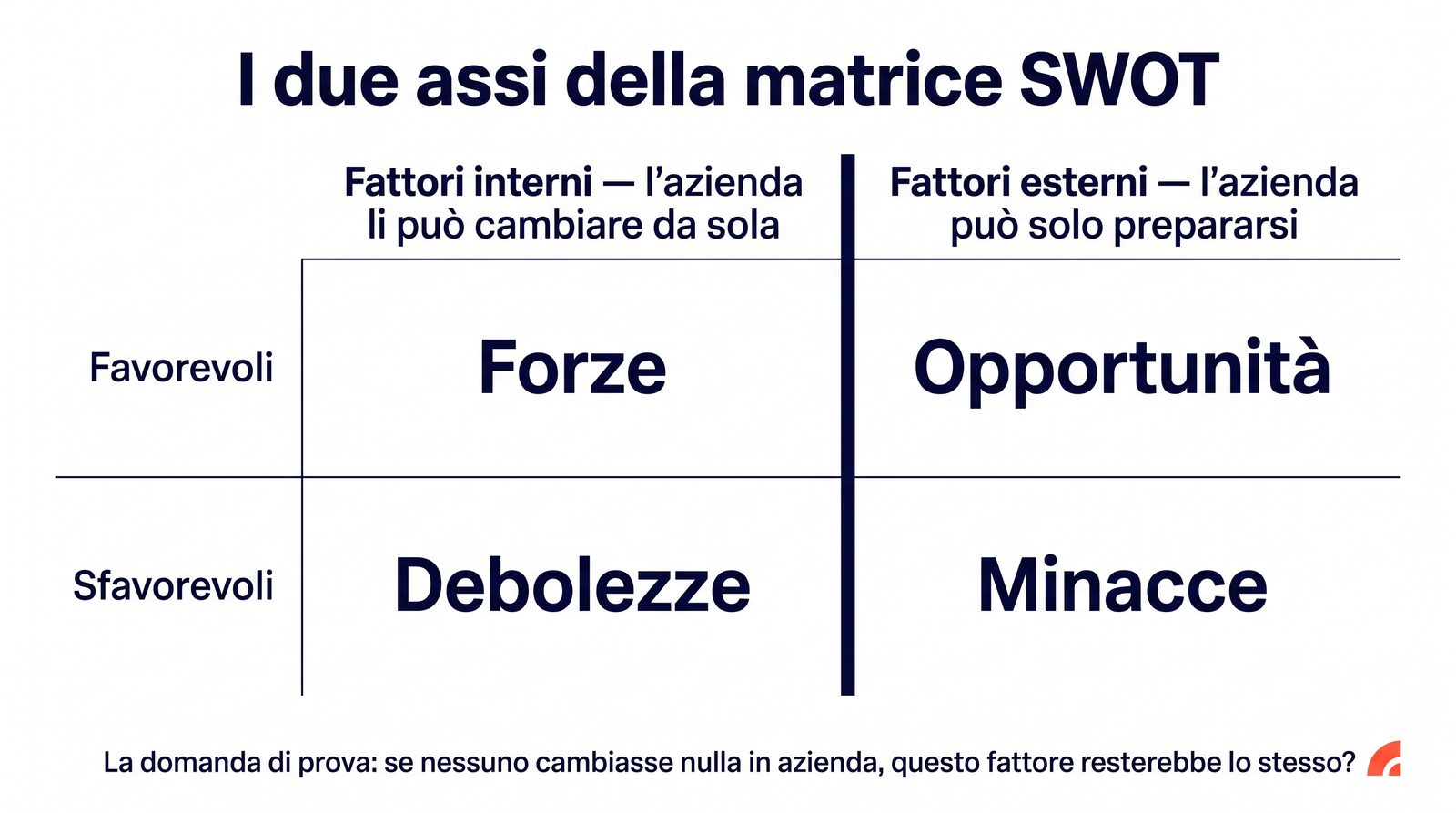
The matrix seems to be divided between good things and bad things.
It is divided by another line, and that line matters more: strengths and weaknesses sit inside the company, opportunities and threats sit outside.
Inside means the company can change it on its own; outside means it can only prepare.
The test lies in one question: if nobody changed anything in the company, would this factor stay the same?
If the answer is yes, the factor is external.
If it would change, it is internal — and then it is not something to put up with, it is something to correct.
The two halves produce different actions.
An internal factor becomes an intervention with an owner and a date.
An external factor becomes a positioning choice or a contingency plan, and nothing else.
Two borderline cases remain.
The first: the customer that accounts for 61% of revenue.
The dependence is internal — the company built it by deciding whom to sell to — while that customer's decision to cut orders is external.
A weakness and a threat coexist in the same row of the matrix, and they have to be written separately.
The second: people's skills.
They are internal even when finding those people in the local labor market is hard, because training the people already inside remains the company's decision.
Filling the four quadrants with verifiable facts, not opinions
How do you fill a quadrant with verifiable facts instead of opinions?
A SWOT is only as good as the verifiable facts that fill it: what cannot be verified is not a strength, it is an impression with a box around it. It is not a snapshot of the company, it is the step that opens up the alternatives among which someone will have to choose.
The filling rule fits in one line: an item goes into the quadrant if it carries a number, a period and the internal document it was read from.
"Good product quality" does not go in.
"Returns for nonconformity at 0.8% of parts delivered in 2025, nonconformity log" goes in, and it can be challenged — which is the point.
The documents to draw from already exist in almost every company.
Accounting and the order book for customer concentration, production reports for times, the complaints log for quality, the quotes log for response times, the skills matrix for who can do what.
The test that an item is a fact is mechanical: two people filling in the same quadrant from the same documents must arrive at the same line.
If they arrive at two different items, that was not a strength: it was an opinion people agreed on.
In a study published in Long Range Planning, the applications examined showed long lists — more than forty factors on average — generic descriptions and no attempt to set priorities [3].
Hence the stopping criterion: no more than four or five items per quadrant, ranked by weight, and whatever cannot be verified within the day stays out.
The two internal quadrants deserve the most effort, and there is a reason: between 2021 and 2022, defending their competitive position was the top strategic objective for 88.3% of Italian companies with at least ten employees [2].
Defending a position presupposes knowing what it is: that is what the two internal quadrants write down.
A completed SWOT analysis example in a family-owned machining company
What does a properly completed SWOT contain, on a concrete case?
The case that follows is hypothetical: the figures serve to show how an item is written, not to estimate a result.
A family-owned machining company with eighteen employees does contract work in a provincial area.
In February its main customer announces in writing a 30% drop in orders starting in the second quarter.
The question on the agenda is not "are we strong or weak": it is "what do we do over the next eighteen months."
| Internal factors (the company controls them) | External factors (the company is subject to them) | |
|---|---|---|
| Favorable | Strengths — average setup 42 minutes versus 65 in 2023 (production reports, 12 months) · returns for nonconformity at 0.8% of parts delivered in 2025 (nonconformity log) · 2 operators out of 8 can program the 5-axis machining center (skills matrix, March) | Opportunities — a local competitor closed in June and 4 of its customers have asked for a quote (contacts log) · among active customers, requests for batches under 50 pieces went from 3 to 11 a month (order book) |
| Unfavorable | Weaknesses — 61% of 2025 revenue comes from a single customer (accounting) · no quote goes out without the business owner's signature: 9 days' average wait (quotes log) · vacations and leave agreed verbally: 3 unplanned machine stoppages in 2025 | Threats — the main customer has announced −30% from the second quarter (notice of February 12) · 2 out of 4 suppliers of semi-finished parts went from 10 to 18 days for delivery (2025 delivery notes) |
Every row of the table can be read off a document the company already has in-house.
None carries an adjective: "good quality," "motivated staff," "difficult market" do not appear.
One item deserves a comment, because almost everywhere it ends up in the wrong quadrant.
The production manager will retire in twenty months.
It is not a threat: the date is known and the company can act.
It is a weakness, and it is written as what it is: nobody else knows how to set up the machining cycles.
From the matrix to the alternatives: what you do the next day
The next day: what do you do with the matrix?
A SWOT does not tell you what to do.
It tells you what you have to choose among, which is much more than a matrix pinned to a bulletin board produces.
You get to action by crossing the quadrants two at a time, with four blunt questions.
- Strengths × Opportunities — which strength lets you seize an opportunity that is already on the table?
- Strengths × Threats — which strength can withstand the impact of what is coming?
- Weaknesses × Opportunities — which weakness prevents you from seizing the opportunity, and can it be removed in time?
- Weaknesses × Threats — which combination must be avoided altogether, because the company cannot sustain it?
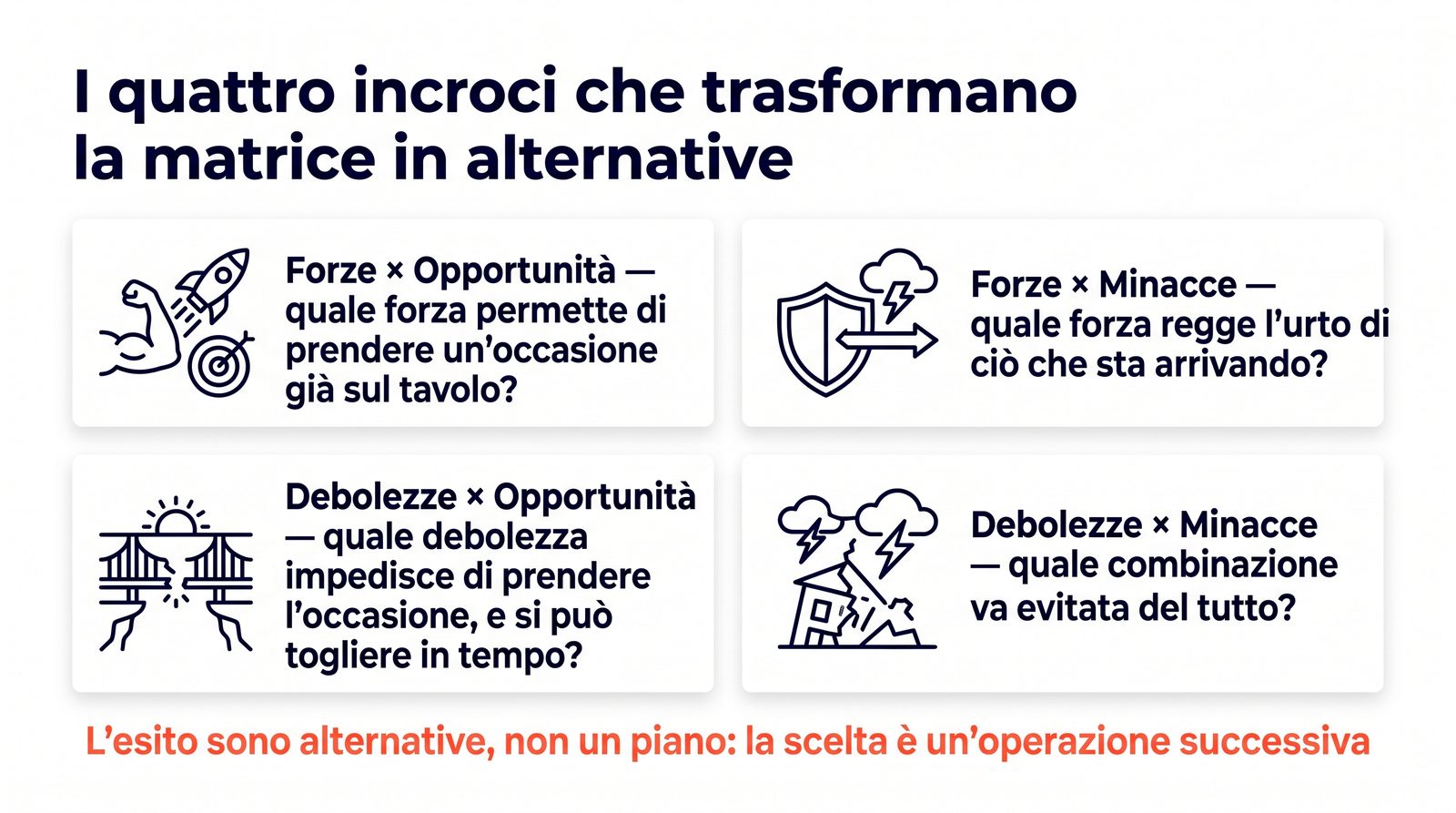
Crossing the quadrants is known as the TOWS matrix: it is the step in which SWOT stops being a list.
For the company in the previous section, the four questions produce three alternatives, not a plan.
Shift a share of revenue to the customers left free by the competitor that closed, after first eliminating the nine-day wait on quotes.
Go after the demand for small batches, where a 42-minute setup is worth more than any sales argument.
Move upmarket with 5-axis machining, where, however, two operators out of eight is a fragile number.
Three alternatives: this is the point at which SWOT finishes its job.
Choosing among alternatives is a different operation, with criteria and weights: the decision matrix does it, once the alternatives are there.
When instead the third crossing isolates a weakness to remove — the nine-day wait on quotes — that line is not yet a workable problem: it becomes one when you rewrite it as a problem statement, with the stretch of work, the period and the measure.
The order matters: whoever opens the choice grid before the diagnosis is weighing unverified options.
Four mistakes that leave the SWOT analysis pinned to the bulletin board
Which mistakes kill a SWOT by the end of the meeting?
Four mistakes keep recurring, and three of them can be recognized by looking at the matrix without knowing anything about the company.
The matrix with no decision on the agenda.
It is filled in "to take stock," and at the end of the meeting there is nothing to decide.
A SWOT with no open question in front of it produces no action: the question must be written at the top of the sheet before opening the quadrants.
Going around the table.
Items are collected in turn and transcribed as they come.
The result is a sum of impressions, and impressions cannot be challenged: whoever collects the items has to ask, for each one, which document supports it.
Evened-out quadrants.
Three strengths, three weaknesses, three opportunities, three threats, because the matrix "looks better."
Evening out is cosmetic: if there are six documented weaknesses and two opportunities, leveling the matrix erases the information.
Confusing internal and external.
It is the most expensive mistake, and in family businesses it takes a typical form: the long-standing team member who can do only one thing ends up among the threats, as if they were the weather.
As long as it stays there, nobody acts, because threats are not corrected, they are faced.
Moved among the weaknesses, it becomes a job-shadowing plan to schedule and a procedure to write.
The check to run on every unfavorable item is exactly that: if the company could intervene on its own, the line is in the wrong column.
Limits and conditions of applicability
The ISTAT data cited describe how Italian companies are managed and how many remain active over time — of those founded in 2019, 49.4% were still in business in 2024 [4] — and say nothing about the effect of a diagnosis: no link with the analysis method adopted can be drawn from those numbers.
The Long Range Planning study [3] examines applications from a specific context and period: the flaws it points out are a methodological risk, not a frequency measured in Italy.
The machining company case was built for this article: the figures show how an item is written, not how an industry is doing.
A matrix has an expiration date: the external quadrants age faster than the internal ones.
When the decision cannot wait, a full diagnosis is not feasible: you choose with what you have and say so.
FAQ
What is SWOT analysis in simple terms?
It is a four-quadrant grid that lines up, before a decision, the company's strengths and weaknesses and the opportunities and threats coming from outside.
It serves to review the factors: only afterward are lines of action identified [1].
How do you do a business SWOT analysis in practice?
Write the decision to be made at the top of the sheet, then fill each quadrant with items that carry a number, a period and the document they were read from.
The sources are the ones the company already has: accounting, orders, production reports, complaints, the skills matrix.
An item that cannot be verified does not go in.
What is the difference between a SWOT analysis and a SWOT matrix?
The SWOT matrix is the container, that is, the four-box layout.
The analysis is the work that fills it: gathering the facts, verifying them and ranking them by weight.
A matrix filled in without that work remains a layout full of adjectives.
How many items do you need in each quadrant?
Four or five per quadrant, ranked by weight, are enough.
The Long Range Planning study reports lists of more than forty factors on average, with no attempt to set priorities [3].
Practical summary
A diagnosis starts from a decision written at the top of the sheet: without an open question in front of them, the quadrants produce nothing.
The first line separates what the company can change on its own from what it can only prepare for, and it does not coincide with the line between good and bad.
Every item that goes in carries a number, a period and the internal document it was read from, and four or five items per quadrant are enough.
The test that an item is a fact and not an impression is that two people, starting from the same documents, write the same line.
A four-quadrant SWOT template with an evidence column next to each item keeps filling in and verification together.
Once the quadrants are filled, you cross them two at a time and what comes out is alternatives, not a plan.
The alternatives are chosen afterward, with criteria and weights, and that is a different job.
Conclusion
A SWOT is not a snapshot of a company: it is the step that opens up the alternatives, and it is only as good as the facts someone had the patience to go and read.
The four quadrants do not ask to be full, they ask to be true.
And the line that divides them does not separate good from bad: it separates what the company can change from what it can only prepare for.
The step before and the step after lie elsewhere.
The diagnosis is one moment within strategic planning, which gives it a regular cadence instead of leaving it to the year when things go badly.
The broader framework — objectives, consistency criteria, how to update them — is in the guide to business strategy.
After two or three diagnoses run this way, the material that reaches the meeting changes.
Instead of impressions, lines appear with a number, a period and a document next to them: the discussion shifts from who is right to what the record shows.
Decisions made on those lines can be reread a year later to understand where you went wrong.
Without those lines, the review has nothing to reread.
Sources and references
[1] Treccani, "SWOT, analisi", Dizionario di Economia e Finanza, Istituto della Enciclopedia Italiana, 2012. Available at: https://www.treccani.it/enciclopedia/analisi-swot_(Dizionario-di-Economia-e-Finanza)/
[2] ISTAT, "Censimento permanente delle imprese 2023: primi risultati", report, November 14, 2023 (reference year 2022; sample of about 280,000 companies, representative of 1,021,618 units with at least 3 employees). Available at: https://www.istat.it/comunicato-stampa/censimento-permanente-delle-imprese-2023-primi-risultati/ — PDF: https://www.istat.it/it/files/2023/11/REPORTCensimprese.pdf
[3] Westbrook, R., Hill, T., "SWOT Analysis: Time for a Product Recall", Long Range Planning, February 1, 1997. Record and abstract: https://ora.ox.ac.uk/objects/uuid:e44a6a9e-9537-4fb6-848c-2d20998a7ce6
[4] ISTAT, "Demografia d'impresa — Anni 2019-2024", statistical tables (Table 5, survival rates), ASIA statistical register, published July 13, 2026. Available at: https://www.istat.it/tavole-di-dati/demografia-dimpresa-anni-2019-2024/ — Tables: https://www.istat.it/wp-content/uploads/2026/07/TAVOLE-STATISTICHE.xlsx
[5] Puyt, R. W., Lie, F. B., & Wilderom, C. P. M., "The origins of SWOT analysis", Long Range Planning, 56(3), 2023 — https://doi.org/10.1016/j.lrp.2023.102304