

The answer is not clear-cut, and one figure calls for caution: in a 1996 meta-analysis of 607 effects and 23,663 observations, the feedback interventions examined improved performance on average, but more than a third of them made it worse [1].
The performance review is the conversation in which two people read a period of work together and draw from it the priorities for the next period.
Whoever works with a few team members, whoever leads a company where people see each other every day and whoever is accountable for several levels of responsibility all face the same scene: an hour set in the calendar, a person sitting across the table, a memory that mostly gives back the last few months.
The following pages follow that hour from before to after: what you bring into the room, how you state facts without judging the person, how you handle the moments that go off script, how you close so that the goals make it to the following month.
The performance review is not the moment when you evaluate: it is the moment when you show what has been prepared over twelve months. Without observed episodes, a prepared person and a check date, it remains a judgment that cannot be verified.
Building the material for the performance review during the year and stating it without judging
What stays in memory of a year of someone else's work, as the hour of the review approaches?
A business owner who moves between the desk and the shop floor observes a lot and writes down little: at the end of the year what remains are impressions, not datable episodes.
A review reconstructed from memory tends to weigh the last months more than the first ones and the most vivid episodes more than the most relevant: this is a working hypothesis, not a figure measured here.
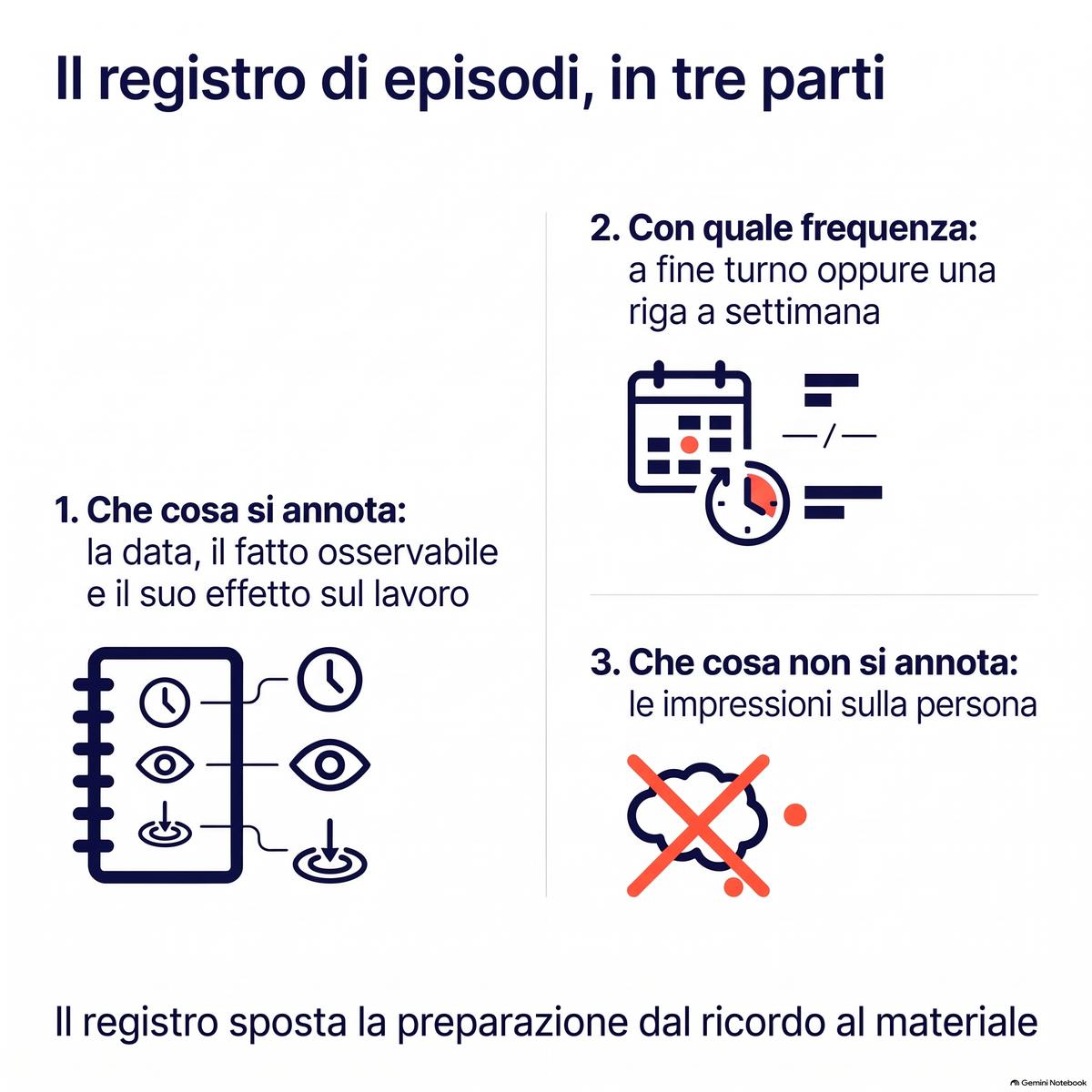
A log of observable episodes, written down when they happen, in two lines and with the date (fact, effect on the work), shifts preparation from memory to material.
In the room that material is read as the trend of a period and not as a sum of episodes, and it is stated in terms of the fact and the observed result, leaving out any judgment of character.
The method therefore has three parts: what you write down, how often, and what you do not write down (impressions of the person).
It is worth setting a boundary first.
Without a review, feedback on the work comes verbally and in no particular order, one episode at a time, to whoever happens to be nearby.
The performance review is something else: the summary reading of a period, done by two people sitting across from each other.
It does not coincide with day-to-day feedback, which feeds it, and it does not coincide with the evaluation system, which provides its criteria.
The performance review is not the moment when you evaluate: it is the moment when you show what has been prepared over twelve months. Without observed episodes, a prepared person and a check date, it remains a judgment that cannot be verified.
Each entry in the log records the date, the fact described as a third person would see it, and its effect on the work.
Two hypothetical entries show the minimum form:
- "October 14. The warehouse team member flagged an inventory discrepancy on shelving unit B before closing; effect: a shipment with the wrong quantity was avoided."
- "October 21. The work order for the batch was handed in without the tolerances field; effect: the inspection was repeated the following day."
The frequency follows the rhythm of the work: at the end of the shift for the business owner who goes from the shop floor to the desk, one line a week for the professional with two team members.
Successful episodes are written down too, while impressions of the person ("seems disengaged") stay out, because they cannot be verified.
In the 2023 permanent census of companies (Italian companies with 3 or more employees; experimental question referring to the last quarter of 2022), 17.1% of companies with activities that could potentially be done remotely cite the difficulty of monitoring and evaluating workers' results among the factors that prevented or limited remote work [2], but the figure does not measure how widespread reviews or evaluation systems are.
With more entries on file, the reading of team members' performance changes nature: episodes read in sequence show what repeats, what changes and what at some point no longer appears.
In the room the trend is stated in terms of the fact: the judgment/description pairs and the three-step structure are in the article on how to give feedback to team members.
The shared reconstruction of the period and recency and halo biases are covered in the article on employee performance evaluation, while the templates are in the tools "Performance review structure template" and "2x2 results/behaviors matrix template".
The opening question is answered by what the log has captured: without it, impressions remain; with it, datable episodes.
The material, however, belongs to only one of the two people sitting in the room: the other one still has to be prepared.
Preparing the team member too, so the hour of the review does not come as a surprise
If only one of the two people has prepared something, is the review a conversation or a hearing?
One-sided preparation turns the team member into the recipient of a judgment, even when the intention is different.
An invitation with three elements (date and length, an outline of the topics, two or three questions to bring) changes the nature of the meeting before it begins.
In small teams the temptation is to improvise, because people see each other every day; in companies with several levels the risk is that each manager prepares differently.
A shared outline makes the conversations comparable without making them identical.
How to prepare a performance review that does not turn into a hearing depends largely on what the invitation contains.
A hypothetical invitation, with the three elements, might look like this:
- date and length: Thursday, November 12, from 3 to 4 p.m., in the small meeting room;
- outline: how the work went over the past months, the priorities for the coming months, what is needed to achieve them;
- questions to bring: which piece of work from the year the person considers the most successful, what they would need for the next period.
The outline lists the topics and does not anticipate the verdicts, because an invitation that already contains the judgment turns the meeting into a notification.
The advance invitation is an editorial proposal, not a research finding.
That the annual review requires preparation from both sides is also pointed out in the article on employee performance evaluation.
With shared preparation the review remains a conversation, while with one-sided preparation it tends to become a hearing.
Even with a well-built invitation, however, the hour can go off script.
Handling what is not in the script: disputes, silences and memories that do not match
What do you do when the person does not recognize the episode, or stays silent?
In a family business, where the long-standing team member and the person conducting the review have known each other for years, a disputed fact also carries the history of the relationship.
When the person conducting the review is the same person who works alongside the team member every day, and who may have known them for years, a disagreement over an episode also touches the relationship: this is an editorial observation, not a measured figure.
Off-script reactions take three recurring forms: the disputed episode, silence, and comparison with colleagues.
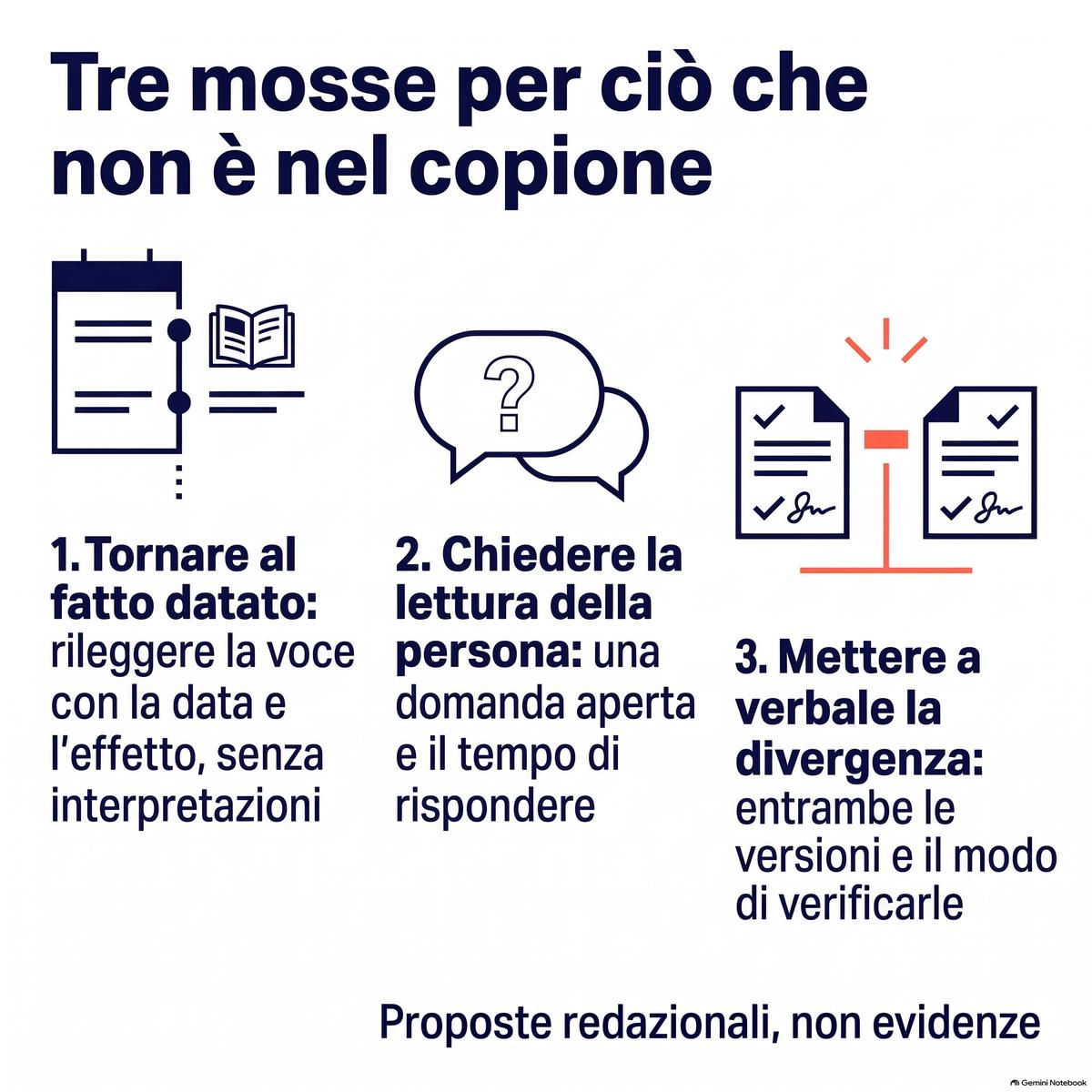
For each one there is a simple move: go back to the dated fact, ask for the person's reading, record the disagreement instead of winning it.
Consider a family business where the long-standing team member joined in the days of the business owner's father (hypothetical case).
The business owner rereads the October 21 entry on the incomplete work order, and the team member replies that it did not happen that way.
The three moves are editorial proposals, not evidence.
Going back to the dated fact helps with a dispute and with comparison with colleagues: you reread the entry with its date and effect, without interpretations.
Asking for the person's reading helps with silence, which is not the same as agreement: an open question is enough, followed by time to answer.
The team member's silence is not the same as the pause of the person conducting the review, described in the article on how to give feedback to team members.
Recording the disagreement helps when two memories remain different even after going back to the fact: the written summary includes both versions and the way to verify them.
The article on employee performance evaluation identifies disputes as a possible sign of criteria that were not clear upstream.
If the disagreement is already an open conflict, the topic leaves the review and finds its tools in the article on conflict management at work.
The opening question therefore has two answers: when the episode is not recognized, you go back to the dated fact; when there is silence, you ask for the person's reading.
With the conversation holding steady, what remains is to decide what you take away from the table.
Closing with goals that outlast the meeting and make it to the following month
Has a goal agreed in an hour and forgotten in a week really been agreed?
In the summary of 35 years of research on goal setting, an assigned goal is as effective as one set together, provided its rationale is explained; assigned curtly, without explanation, it leads to significantly lower performance [3].
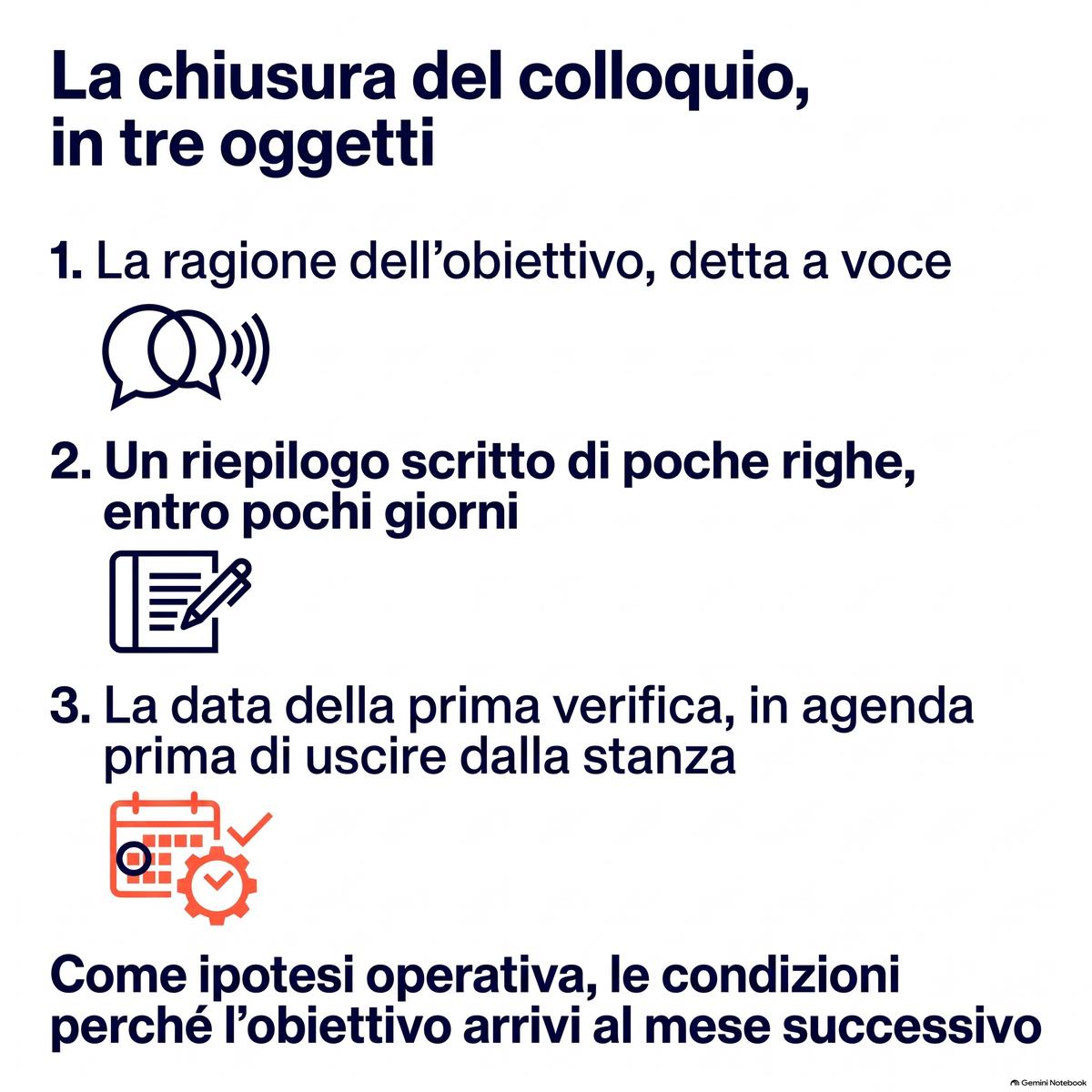
The close has three objects: the rationale for the goal, stated out loud and not left implied; a written summary of a few lines within a few days; the date of the first check, put in the calendar before leaving the room.
Goals accompanied by feedback on progress turn out to be more effective than goals alone [3].
The format of the goal (how many, with what resources) and the structure of the verifiable agreement are already described elsewhere: what matters here is that the goal from the annual review makes it to the following month.
Locke and Latham's summary concerns performance on work tasks and does not study performance reviews: the reading applied here is a working hypothesis [3].
Stating the rationale means connecting the goal to the department's work or to a client: "The goal is to complete the work orders on your own, because every incomplete work order currently requires a second inspection."
The written summary records the goal, the rationale and the date of the first check, and the person can correct it.
In development conversations with team members, the date of the first check, set in the following month, keeps the growth goal from remaining an intention: this is an editorial proposal, not a threshold drawn from the sources.
The format of the goal and the periodic check are described in the article on employee performance evaluation, while the verifiable commitment, with a deadline and a criterion, is in the article on how to give feedback to team members.
A goal forgotten in a week has not been fully agreed: a rationale stated out loud, a written summary and a date in the calendar are the conditions that, as a working hypothesis, carry it into the following month.
What remains to be seen is what, even before you enter the room, empties the hour.
Recognizing the mistakes that empty the review hour before you enter the room
Which mistake costs more: entering the room with no material, or with too much?
The two flaws have the same origin: preparation concentrated in the days before the meeting instead of spread over the months.
The mistakes that empty the hour, before you enter the room, are few and recognizable: material gathered in the days before the meeting instead of over the months, no selection (everything brought into the room, or almost nothing), a judgment written before having the episodes, a team member who discovers the topics only in the room.
The monologue review and the evaluation with no follow-up goals are already covered in the article on employee performance evaluation.
For ordinary feedback, which should flow throughout the year, the article on feedback to team members describes the basic structure.
When, instead, poor performance is already a pattern, the topic leaves the review and opens the one on managing unproductive team members.
Four checks, to do before entering the room, correspond to the four mistakes:
- the log contains entries spread over the months, and not only from the last few days;
- the episodes brought in are chosen with a criterion, for example the priorities for the next period;
- the judgment was written after rereading the episodes, and not before;
- the invitation with the outline has gone out and the person knows what will be discussed.
The answer to the opening question is that the cost seems to depend less on the amount of material than on the common origin of the two flaws: preparation concentrated in the last few days.
What remains is to state the boundaries within which what has been described applies.
Limits and conditions of applicability
The sources cited do not study performance reviews: Kluger and DeNisi (1996) concern feedback interventions in the laboratory and in the field [1], Locke and Latham (2002) performance on work tasks [3], and no causal link with the annual review is claimed.
The Istat figure concerns Italian companies with 3 or more employees, excluding the smallest ones and self-employed professionals without employees, and the 17.1% is a perceived obstacle to remote work, not a measure of evaluation practices [2].
The sources consulted do not include an Italian figure on how widespread performance reviews are.
The examples are hypothetical, and the log, the advance invitation, the three moves and the check date are editorial proposals, not evidence.
The literature on the participation of the person being evaluated has not been examined, and what is described here does not replace a disciplinary procedure or a conversation that has already become a conflict.
FAQ
What do you bring to a performance review?
A log of observable episodes, written down during the year with date, fact and effect on the work, and the outline of the topics already sent to the person.
How do you prepare an employee performance review?
By writing down episodes during the year, sending an invitation with date, outline and questions to bring, and reading in the room the trend of the period in terms of the fact and not of character.
What should you do if the team member does not recognize an episode?
You go back to the dated fact, without interpretations, and if the two memories remain different, the disagreement is recorded with both versions.
Operational summary
The performance review is prepared during the year, with a log of observable episodes that shifts preparation from memory to material.
The person arrives prepared if they receive the date, the outline and questions to bring, and in the room the trend of the period is read in terms of the fact and not of character.
The close sets the rationale for the goal, a written summary and the date of the first check.
Criteria, the four-stage structure and the cadence remain those described in the article on employee performance evaluation.
Conclusion
The performance review does not create the material it rests on: it gathers it.
The episodes observed during the year, the person who arrives knowing what will be discussed, the words chosen about the fact and not about character, the date of the first check: this is what separates an hour of synthesis from a judgment that cannot be verified.
For the criteria, the four-stage structure and the cadence of the system upstream, the article on employee performance evaluation describes the complete framework.
For the feedback that should flow throughout the year, the article on how to give feedback to team members describes the ordinary conversation.
A company where the performance review holds few surprises has team members who, before sitting down, already know how the year went, and an hour that serves to decide the next one instead of arguing about the last.
Sources and references
[1] Kluger, A. N., & DeNisi, A., "The effects of feedback interventions on performance: A historical review, a meta-analysis, and a preliminary feedback intervention theory", Psychological Bulletin, 119(2), 254-284, American Psychological Association, 1996. Available at: https://doi.org/10.1037/0033-2909.119.2.254
[2] Istat, "Censimento permanente delle imprese 2023: primi risultati" (second edition of the multipurpose survey; sample of about 280,000 Italian companies with 3 or more employees, representative of a universe of 1,021,618 units; survey conducted November 2022-March 2023; reference year of the data: 2022), Istat, November 14, 2023. Available at: https://www.istat.it/it/files/2023/11/REPORTCensimprese.pdf (press release: https://www.istat.it/comunicato-stampa/censimento-permanente-delle-imprese-2023-primi-risultati/)
[3] Locke, E. A., & Latham, G. P., "Building a practically useful theory of goal setting and task motivation: A 35-year odyssey", American Psychologist, 57(9), 705-717, American Psychological Association, 2002. Available at: https://doi.org/10.1037/0003-066X.57.9.705