
Distinguishing generational transition, management succession and sale: the three transitions compared
The three expressions are often used as synonyms, but they describe transitions that differ in what is transferred, timing and the people involved. Confusing them leads you to set up the wrong tools: a family pact does not handle a sale to a third party, and sell-side due diligence does not replace a management succession plan. A clear map of the three scenarios is the first practical step.
When is a transition truly "generational," and when is it really a disguised sale? The difference is not about age: it depends on who carries the company culture forward, not on who signs the deed.
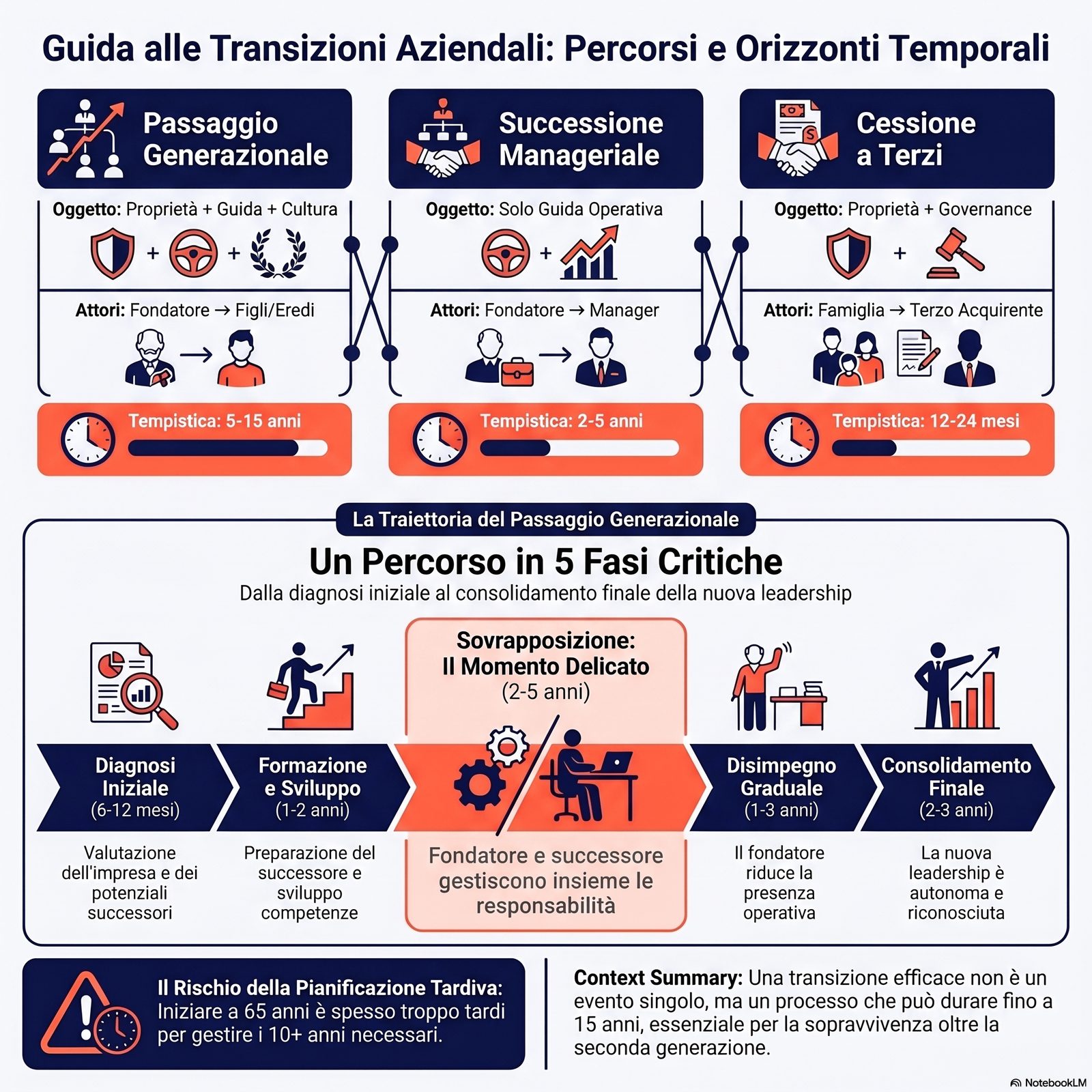
In practical terms, the three transitions differ on four dimensions: what is transferred, the people involved, the typical timeline, and the prevailing legal and tax instruments.
| Dimension | Generational transition | Management succession | Sale to a third party |
|---|---|---|---|
| What is transferred | Ownership + operational leadership + company culture | Operational leadership only (ownership stays in the family) | Ownership + often governance |
| People involved | Founder → children or heirs | Founder → internal or external manager | Family → third-party buyer (industrial or financial) |
| Typical timeline | 5-15-year trajectory | 2-5 years of working side by side | 12-24 months (preparation + due diligence) |
| Prevailing instruments | Family pact, holding company, family buy-out | Mandates, delegated powers, executive contracts | Vendor due diligence, share purchase agreement |
| Prevailing tax treatment | In Italy, exemption under art. 3 para. 4-ter of Legislative Decree 346/1990 (subject to conditions) | Ordinary taxes on the manager's income | Substitute tax or capital gains taxation for selling shareholders |
The three options are not mutually exclusive and can be combined. One documented trajectory sees the founder start a management succession while the generational transfer of ownership unfolds over a longer horizon; in some cases, the sequence ends with a partial or full sale to third parties when the next generation does not want to, or cannot, continue running the business. The most frequent mistake is confusing the three scenarios at the start and adopting tools designed for a scenario other than the one you are actually living.
ISTAT data on the structure of Italian companies show that companies controlled by an individual or a family make up 80.9% of all companies with at least 3 employees, a share that rises to 83.3% among micro-enterprises and falls to 41.6% among large companies [1], with a range that stretches from the micro-business to the industrial group with hundreds of employees. In the smallest segments (the independent professional selling the practice, the craftsman handing over the workshop), the transition often takes informal, loosely structured forms; in medium and larger companies, complexity grows, and with it the importance of formal tools.
For a specific look at business succession as a distinct process, also read business succession: what it is and how it differs from generational transition.
With the scope defined, it makes sense to look at the Italian data to gauge how urgent planning is.
Using the Italian numbers to understand when to start the transition
The common narrative tends to overestimate the resilience of the Italian family business. ISTAT data and the surveys of the AUB Observatory at Bocconi University paint a harsher picture: the transition is a high-mortality event, and the risk grows at the second and third generation. Knowing the magnitudes at stake helps you gauge how urgent planning is.
How likely is it that an Italian family business will go through the transition in an orderly way? The available data say it rarely happens, and rarely as a planned choice.
The AUB Observatory surveys of Italian family businesses with revenue above 20 million euros show that, up to 2019, completed generational transitions averaged 127 per year, rising to 181 per year in 2020-2022 [2]: the pandemic accelerated a turnover of leadership that had been moving slowly. These figures come from medium-to-large companies; the picture for micro and small businesses is less well documented statistically.
Two pieces of context complete the picture.
The age of those in charge. The AUB Observatory finds that in larger Italian family businesses, leaders over seventy are still one in four, and that their growth nearly stopped only from 2020 onward [2]. The phenomenon is partly natural (companies with a longer history tend to have older founders) and partly a symptom of how rarely generational transitions are started in time.
Leadership concentrated in the family. In 70% of larger Italian family businesses, leadership is entirely in the hands of the controlling family [2], and among Italian companies controlled by an individual or a family, an internal or external manager is brought in in 1.4% of cases [1]. In many cases, succession planning exists only as the founder's intention, without being translated into operational documents and timelines.
Reading the three figures together gives a practical picture: the risk of disruption in the transition to the second generation is structurally high, the average age of founders squeezes the time available to plan, and the share of companies without a formal plan is high. One immediate consequence: if you start planning at 65, in many cases you are starting late compared with the typical horizons of a well-run transition (5-15 years). Knowing these magnitudes guarantees nothing, but it changes the relative priority planning takes on the founder's agenda.
The numbers suggest starting early. Starting early means entering an operational trajectory made of distinct phases, not a single act.
Planning the 5 phases of the transition: from diagnosis to post-transition
The academic literature converges on a process made of phases that precede and follow the formal moment of transfer. It is not an event but a multi-year trajectory: diagnosis, successor preparation, overlap, transfer, consolidation. Skipping even a single phase exposes the company to significant operational discontinuity.
How many years does a well-run transition take on average? The conventional answer talks about months; empirical research talks about double-digit years.
The 5 phases of the transition, each with a verifiable output and a typical time horizon.
Phase 1 — Diagnosis (output: assessment of the current state, 6-12 months). You assess the starting situation in a structured way: the state of governance, the quality of formalized processes, the financial position, the map of critical skills, the profile of potential successors, and any latent family tensions. The diagnosis must be honest: the most frequent mistake is denying visible problems (a successor who is not ready, missing governance, a skill concentrated in one person) to avoid difficult conversations. A diagnostic checklist typically covers five areas: family, ownership, governance, operational processes, finance.
Phase 2 — Successor preparation (output: personalized development plan, 2-5 years). The successor or successors follow a path that combines experience outside the family business (work in other companies in the same or adjacent industries, structured management training), internal experience in operational roles (not symbolic positions), and support from internal and/or external mentors. The review of the literature on family succession describes exactly these ingredients — outside work experience, exposure to the company's tacit knowledge, observation and imitation — as the factors that strengthen the successor's self-efficacy [3]. Italian data show how rare they are: fewer than two in ten members of the new generation had significant outside work experience before joining the company [2].
Phase 3 — Overlap (output: gradual transfer of responsibilities, 2-5 years). Founder and successor work together, with responsibilities transferred progressively. The overlap phase is the most delicate: too short, and the successor inherits the company without internal and external legitimacy; too long, and the successor cannot actually lead while the organization perceives confused leadership. The literature describes this as the phase in which two leaders coexist and family and business role norms overlap, producing contradictory behavior and emotional ambivalence [3]: that is why its length must be decided and communicated, not left to inertia.
Phase 4 — Transfer (output: formal deed, months). The moment of the legal and tax act (deed of gift, family pact, contribution to a holding company, sale of shares). It is the most visible moment, but also the shortest and the least decisive for the overall outcome: if the previous phases were handled well, the transfer records a change that has already happened in practice. If they were skipped, the formal deed does not solve the problems that have built up.
Phase 5 — Consolidation (output: stabilization of the new setup, 2-3 years). The successor takes over actual leadership, and the founder leaves day-to-day management — gradually or cleanly. New decision-making habits settle in, the successor's internal and external legitimacy is consolidated, and any adjustments that emerged during the overlap are handled. Consolidation is when the effects of the choices made in earlier phases become measurable: post-transition performance in line with or above the industry average is the sign that the trajectory was well managed.
Adding up the durations of the five phases, the overall horizon typically exceeds a decade: 8-15 years from the start of the diagnosis to consolidation. Compared with the share of leaders over seventy still running Italian family businesses [2], this simple calculation explains many rushed transitions: when planning starts at 65-70, the time available for phases 1-3 is already squeezed. Once the trajectory has started, the first tool to set up is family governance.
Building family governance: pacts, councils and rules of engagement
Family pact, family council, family charter, holding company: the tools exist, but only a minority of Italian family businesses adopt them. Governance is not a formal frill: in businesses that formalize it, intergenerational conflicts are less frequent and operational continuity is stronger.
Does a company with five employees really need a family council? The threshold is not about size: it kicks in when more than one decision-maker is involved.
The governance of a family business in transition works on three levels, which should not be confused.
Family governance (rules among family members, including those not working in the business). Typical tools: a family charter (a document that sets out principles and rules for the relationship between family and business), a family council (a body that meets periodically to discuss matters affecting family and business), and a family pact (in Italy, the legal instrument provided for by art. 768-bis of the Civil Code to transfer the business in advance with the heirs' consent). It becomes significant as soon as the family has several branches involved, regardless of company size.
Corporate governance (rules among shareholders, set out in the articles of association and shareholder agreements). Typical tools: clauses in the articles of association on the transfer of shares, clauses on the appointment of corporate bodies, shareholder agreements among family shareholders, and the holding company (a company that owns the shares of the operating company, separating ownership from management). The holding company is a documented tool for separating the ownership of shares (held by family members, including those not working in the business) from operational leadership (held by whoever runs the company).
Operational governance (rules for how the company works). Typical tools: organizational chart, job descriptions, operating procedures, delegation systems, recurring decision-making meetings. This is the governance that determines who decides what in daily operations and which, in many family businesses, is informal and concentrated on the founder. To go deeper, read business organizational models and business management: principles and tools.
AUB Observatory data show how concentrated leadership remains: collegial leadership, the most common model, applies to 32.7% of larger Italian family businesses, and in 70% of cases leadership is entirely in the family's hands [2]. In smaller companies, formalizing the three levels of governance is even rarer, and its absence comes at a price as soon as there is more than one decision-maker.
The threshold beyond which formalizing governance pays off is not about size: it kicks in when more than one decision-maker is involved and when family relationships start to influence business decisions. A company with five employees but two siblings as partners, each with a family of their own, needs structured family governance at least as much as a company with fifty employees and a single owner.
A minimum workable setup for a family business includes: a 3-5-page family charter setting out principles (who can work in the company and under what conditions, who can hold shares, how directors are appointed); a family council that meets 2-4 times a year; clear clauses in the articles of association on the transfer of shares; and possibly a family pact if you want to transfer ownership in advance. The disproportion between the cost of these tools (weeks of work, modest notary and legal fees) and the risk they prevent (conflicts that paralyze the company, family disputes lasting years) is documented. Once governance is defined, the most delicate choice remains the successor.
Selecting and developing the successor: criteria, paths and weak signals
Choosing the successor is not the same as choosing the firstborn or whoever is immediately available. The approach adopted here rests on three elements: explicit evaluation criteria, work experience gained outside the family business, and a gradual increase in responsibilities. The review cited [3] describes the criteria predecessors use to choose — mostly ethical ones, integrity and commitment to the business — and how hands-on experience contributes to the successor's self-efficacy, but it does not compare successful and failed transitions. The same applies to the independent professional preparing a partner to take over.
Can you select a successor with the same criteria you would use to select an outside executive? The two selections overlap, but one variable weighs much more in a family transition.
The explicit criteria for evaluating a successor work on three interconnected dimensions.
1. Skills. The technical, managerial and interpersonal skills needed to lead the company in its future context (not just the current one). The assessment must be honest: does the successor have the necessary skills? If so, do they show them in the company or only in informal conversations? If not, can they acquire them in the time available? A lack of skills can be made up with structured training; a lack of motivation cannot.
2. Motivation. The genuine will to take on the responsibility of leadership. It must be distinguished from availability — many children of business owners are available because of family pressure, but not motivated. The telling signal is not what they say but how they behave: those who are motivated invest more energy than required, take initiative and look for learning opportunities. Those who are merely available wait for the role to be handed to them. The review on family succession links the predecessor's active support — resources made available, room to make mistakes, communicated expectations, real delegation — to the strengthening of the successor's self-concept [3].
3. Perceived legitimacy. Recognition by internal stakeholders (long-standing team members, non-family managers) and external ones (key customers, critical suppliers, banks) of the successor's ability to lead the company. Legitimacy cannot be decreed: it is built over time through outside experience (having worked successfully in other companies in the same or adjacent industries), demonstrable internal results (responsibilities progressively taken on and carried through), and professional recognition (structured management training, roles in industry associations). This is the variable that weighs most in a family transition compared with selecting an outside executive: an executive arrives with the legitimacy the role confers; a family successor arrives with the legitimacy the organization grants them.
The preparation path, derived from the patterns documented in the literature [3] and in the AUB Observatory surveys [2], combines three components.
Experience outside the family business. 3-5 years of work in other companies in the same or adjacent industries, in roles with progressively greater responsibility. The purpose is twofold: to build hands-on skills that the family business could not teach in the same way (because the person teaching is the founder), and to build professional legitimacy independent of the family name.
Structured management training. Master's degrees, executive programs, specialized courses. They work both as a way to acquire technical skills and as a signal of external legitimacy. The choice of program must match the company's future challenges, not the habits of the past.
On the criteria for choosing and structuring a management training path, also read management training: how to design an effective program.
Internal support from a mentor. A mentor — from inside or outside the family — who supports the successor in strategic decisions, gives regular feedback and mediates the inevitable tensions with the founder. The supporting role of the predecessor and of mentors is one of the levers the literature most consistently links to a successful transition [3].
On the specific topic of transferring responsibilities while working side by side, also read effective delegation in a team: how to transfer responsibility without losing control. Once the successor has been selected, the most underestimated risk remains: the tacit knowledge the founder has not yet passed on.
Formalizing tacit knowledge and processes before the transition
The most underestimated risk in a generational transition is neither tax nor legal: it is the loss of the operational knowledge accumulated in the founder's head. Customer relationships, implicit pricing criteria, unwritten agreements with long-standing suppliers. Turning this tacit capital into readable procedures is one of the most underused levers of the transition.
How much of the company's value lies in information that has never been documented? The answer surprises even founders who consider themselves organized.
In many family businesses, a significant share of the company's value lies in undocumented tacit knowledge: the criteria the founder uses to set the price for a long-standing customer, the informal terms agreed with a strategic supplier back in the 1990s, the signals that show when an order is truly reliable, the judgment on the creditworthiness of customers acquired decades ago. This knowledge is not recorded anywhere, yet it is exercised every day.
Three areas systematically concentrate the most critical tacit knowledge.
Relationships with long-standing customers and suppliers. The history of the relationship, the terms agreed (even just verbally), personal sensitivities, reliability criteria developed over time, the weak signals the founder reads automatically. Losing this information in the transition has measurable effects: customers who feel "unrecognized" by their new contact, pricing errors, suppliers who seize the opportunity to renegotiate.
Implicit decision criteria. How to decide whether to accept an exceptional order, how to evaluate a discount request, how to tell projects that deserve the business owner's personal attention from those that can be delegated. These criteria are often never put into words; the founder applies them automatically. They are also the criteria most exposed in the transition, because in most Italian companies management remains with the business owner or a family member: among those controlled by an individual or a family, an internal or external manager is brought in in 1.4% of cases [1].
Unwritten operational processes. The work sequences that run "because we've always done it this way," without ever having been mapped. They include production procedures, sales practices, ways of handling crises, and unwritten rules for hiring and onboarding staff.
The organizational lever that demonstrably reduces the risk of losing tacit knowledge is the progressive formalization of critical processes and criteria. Three practical steps.
1. Mapping critical processes. Identify the 5-10 processes that generate most of the value (sales, production, decision-making) and map them as they are today, with the people who carry them out — not in a meeting room. For the operational details, read how to map business processes.
2. Documenting implicit decision criteria. Make explicit the criteria the founder uses automatically, through structured conversations guided by an internal or external facilitator. Putting into words "why we decided that way that time" builds a body of criteria the successor can replicate. On the broader topic of building a readable operating system for the company, business systemization: what it means and when you need it develops the perspective.
3. Defining job descriptions and responsibilities. Every role — including the founder's — has responsibilities that must be made explicit before the transition. The founder's job description is often the most revealing document in the process: writing down what they actually do, in detail, sheds light on the areas where knowledge is concentrated and needs to be transferred. To build it, the job description: what it is and how to write it offers a practical template.
Formalization is not a bureaucratic exercise: it is the condition that makes the transition reversible. Without it, the successor inherits a company without its operations manual, and the first 18-24 months become a high-risk learning period. Once operational knowledge has been addressed, what remains is finding your way through the tax and inheritance framework.
Navigating the tax and inheritance framework: the Italian case
Inheritance and gift taxes, exemptions for the transfer of businesses and controlling stakes (in Italy, art. 3 paragraph 4-ter of Legislative Decree 346/1990), the family pact: the Italian framework offers specific instruments, but favorable treatment requires precise conditions. Knowing the rules before you sign keeps you from discovering constraints when your room for maneuver has already shrunk.
Is the tax exemption for transferring a business really available to every family business? The benefit exists, but it only applies when conditions are met that many people discover too late.
The Italian legal framework for generational transition covers three main areas, of which this guide provides an orientation summary; rules differ from country to country, and readers outside Italy should check their own national framework. It must be said from the outset: this section does not replace specialist advice from an accountant or a lawyer experienced in corporate and inheritance law, which is essential for any actual decision. The rates, thresholds and conditions described are subject to legislative change and must be checked at the time of the decision.
1. Inheritance and gift taxes. In Italy, Legislative Decree 346/1990 governs taxes on gratuitous transfers (on death or by gift). Ordinary rates vary by degree of kinship: typically 4% for spouses and direct relatives (with a significant tax-free allowance), 6% for siblings (with a lower allowance), 6% for other relatives up to the fourth degree, and 8% for non-relatives. The allowances must be checked case by case. The tax applies to the value of the assets transferred, including shareholdings and businesses.
2. Exemption under art. 3 paragraph 4-ter of Legislative Decree 346/1990 (exemption for the transfer of a business). It is the main incentive for generational transition in Italy. It provides an exemption from inheritance and gift tax for the transfer of businesses, business units or shareholdings in corporations that confer control, provided that: (a) the transfer is made to the spouse or descendants; (b) the beneficiaries continue to run the business or retain control for at least 5 years from the date of transfer; (c) for shareholdings in corporations, a stake conferring control (over 50% of voting rights) is transferred. Breaching the five-year requirement means losing the benefit and paying the ordinary tax with penalties and interest. The Italian Supreme Court has ruled on this condition repeatedly, and it must be checked with a professional before the deed.
3. Family pact (art. 768-bis and following of the Italian Civil Code). A legal instrument introduced in 2006 to allow the transfer of the business or shareholdings to one or more descendants during the founder's lifetime, with the consent of the spouse and of all potential forced heirs. The family pact stabilizes the transfer (the forced heirs waive in advance the right to challenge it in a future succession) and is compatible with the art. 3 para. 4-ter exemption when its conditions are met. It requires a notarial deed and the unanimous consent of the forced heirs.
4. Holding company. A corporate tool, not a tax tool in the strict sense, but with significant tax implications. By contributing the shares of the operating company to a holding company, the founder (or family members) hold the company indirectly through the holding. The structure makes it possible to separate share ownership from operational leadership, to manage any dividend distributions among family branches in a structured way, and to make future transitions easier. It must be assessed case by case: the benefits are offset by management costs and additional compliance requirements.
5. Family buy-out and extraordinary transactions. When only one successor wants to take over leadership and the other forced heirs prefer to cash out their share, the successor can finance an acquisition (possibly with bank leverage), often structured as the purchase of the remaining shares through a dedicated holding company. These are complex transactions that require dedicated financial, tax and legal analysis.
The operating principle that runs through the whole tax framework is: check the conditions for the benefit before the deed, not after. Many companies discover they do not meet the five-year requirement only after it has been breached, when losing the benefit is unavoidable. Tax planning for the transition requires a time horizon: choices made today bind you for the following 5 years.
Having built the full picture (phases, governance, successor, knowledge, taxation), what remains is to recognize the error patterns documented across sources.
Recognizing the most frequent mistakes in family business succession
The academic literature and data observed on tens of thousands of Italian companies converge on a handful of recurring patterns that precede failed transitions. Recognizing them in time guarantees nothing, but it noticeably reduces the likelihood of negative outcomes.
Which mistake most often precedes a failed generational transition? It is not technical or tax-related; it is a relational mistake that founders systematically underestimate.
Eight error patterns recur in a documented way in AUB Observatory data [2] and in the literature on family succession [3].
1. Postponing planning. The founder sees the transition as a future problem and postpones diagnosis and planning. When planning starts, the time available is already squeezed, and the trajectory has to compress phases that would require years. Fix: start the diagnosis no later than age 55-60, regardless of how ready the successor appears.
2. Confusing family roles with business roles. The founder treats the successor as a child at work and as an employee at home, mixing the two dimensions. Business decisions are affected by family dynamics, and family tensions are affected by business dynamics. Fix: make the rules of engagement explicit in a family charter, and separate the decision-making tables (family council for family matters, corporate bodies for business matters).
3. No selection criteria. The successor is chosen as the firstborn or by availability, not through an explicit assessment of skills, motivation and legitimacy. Fix: apply the criteria described in the section "Selecting and developing the successor" even when the choice seems obvious.
4. De facto obstruction by the outgoing founder. On paper, the founder has handed over leadership; in practice, they keep making the important decisions, contradicting or bypassing the successor. The organization perceives the confusion and turns to the founder for the decisions that matter. Fix: set an explicit timetable for transferring responsibilities, with defined dates and scope; the founder gradually reduces their physical presence in the company during consolidation.
5. No governance. There is no family charter, no family council, the articles of association are the standard ones without adjustments, and there are no shareholder agreements. When a conflict arises, there is no mechanism to handle it. Fix: formalize family and corporate governance before the transition, not after.
6. Knowledge not formalized. Critical processes, decision criteria and relationships with long-standing customers and suppliers have never been documented. The successor inherits a company without its operations manual. Fix: map critical processes, document decision criteria and write explicit job descriptions — before the transition.
7. Underestimating tax planning. Constraints (the five-year requirement, control requirements) are discovered after the deed, when the position is already fixed. Losing the benefit brings unexpected costs. Fix: involve a specialized accountant and lawyer from the diagnosis phase, not at the time of the deed.
8. No external legitimacy for the successor. The successor takes the lead without a path to build legitimacy with customers, suppliers, banks and non-family internal managers. Critical stakeholders extend only conditional trust, and the transition creates operational friction. Fix: build legitimacy through outside experience (3-5 years in other companies), demonstrable internal results, structured training, and presence with key customers during the overlap phase.
These patterns share a common root: treating the transition as a one-off legal and tax event rather than as a multi-year trajectory that is organizational, relational and cultural in nature. Taxation matters, but it is not the dimension that determines the outcome; governance and the quality of the successor matter more. Knowing the patterns does not guarantee you will avoid them, but it makes the risk manageable rather than invisible.
Limitations and conditions of applicability
The practical guidance in this article refers to the Italian legal framework in force at the time of publication. The tax regime (inheritance and gift taxes, the art. 3 para. 4-ter exemption, the family pact) and case-law interpretations are subject to change: for actual decisions, advice from an accountant and a lawyer specialized in corporate and inheritance law is essential. The tools described (holding company, family buy-out, family pact) require a specific assessment of each situation.
The statistical data cited (ISTAT [1], AUB Observatory [2]) refer to specific samples and periods: the Italian permanent census covers companies with at least 3 employees as of 2022, while the AUB Observatory monitors only family businesses with revenue above 20 million euros. The picture for micro and small businesses is therefore less well documented statistically. The associations observed (for example, between the quality of successor preparation and post-transition performance) should not be read as deterministic cause-and-effect relationships.
The indicative timelines (8-15 years for the full path, 2-5 years for the overlap) are not measured thresholds: they come from adding up the typical durations of the phases described, observed in moderately structured companies. The five-year requirement of the tax exemption, by contrast, is a legal term. Smaller businesses can compress some phases (for an independent professional, the overlap can shrink to 1-2 years); larger and more complex companies may require longer horizons.
The review of the literature on family succession [3] is based on international studies with heterogeneous methods and contexts: applying it to the Italian context requires caution. The findings remain informative, but they do not replace case-by-case assessments.
The focus of this article is organizational and relational. The legal and tax aspects are covered for orientation only and are not exhaustive: for specific insights into business succession from a tax and legal point of view, refer to specialist sources updated to the legal framework in force.
FAQ
1. When should you start planning a generational transition? Adding up the typical durations of the five phases places the start of the diagnosis at least 8-15 years before the formal transfer, ideally when the founder is 55-60. Planning that starts after 65 significantly compresses the successor preparation and overlap phases — and this is precisely the age bracket where a significant share of Italian family business leaders is concentrated today [2].
2. What is the difference between a family pact and a gift? In Italy, the family pact (art. 768-bis of the Civil Code) is a notarial deed that requires the unanimous consent of the forced heirs (spouse and all potential heirs) and stabilizes the transfer, avoiding challenges in a future succession. A simple gift does not require this consent, but it can be challenged through a clawback action by forced heirs whose share has been infringed when the donor dies. Both are compatible with the art. 3 para. 4-ter exemption when its conditions are met.
3. Is it possible to carry out a business succession without an heir in the family? Yes. When there is no available or suitable family successor, the options are management succession (operational leadership passes to an internal or external manager while ownership stays in the family) or a sale to third parties (full or partial sale to an industrial or financial buyer). The three options — generational transition, management succession, sale — can also be combined in a single path.
4. How much does the tax dimension weigh compared with the organizational one in the success of the transition? The tax dimension is important but not decisive. None of the sources cited on this page compares the weight of preparation with that of tax savings on the outcome after five years: the approach adopted here is that the quality of successor preparation, family governance and the formalization of operational knowledge make up the substance of the transition, while taxation is the part you must not get wrong. Taxes must be handled well, but they do not replace organizational substance.
5. Does a micro-business or an independent professional need all these tools? The tools should be scaled to size. A micro-business or an independent professional handing the business over to a partner or a colleague can simplify governance and agreements, but the five phases (diagnosis, successor preparation, overlap, transfer, consolidation) remain valid in principle, even if compressed into shorter timeframes. Formalizing operational knowledge is just as important: in a professional practice, transferring the client relationship is often the critical dimension.
6. How should you prepare key non-family team members during the transition?
Key non-family team members are often the most underestimated continuity factor in a generational transition, because attention almost always focuses on the relationship between founder and successor.
A long-serving manager who has known customers, suppliers and processes for many years holds a significant part of the company's operational knowledge, and keeping them on board during the transition reduces the risk of disruption in less structured transitions.
Two levers recur in the cases documented as the most solid: explicitly involving the key team member in the overlap phase, with responsibilities that expand progressively instead of staying unchanged until the day of the transfer, and a form of recognition — not necessarily only financial — that signals their importance in the new setup.
The opposite risk — treating non-family team members as spectators of the transition — increases the likelihood that the most capable people will leave the company precisely when their experience would be most needed.
7. How long does a complete generational transition take on average, and how should its phases be paced?
A complete generational transition, from the initial diagnosis to the consolidation of the new setup, typically requires a double-digit multi-year horizon: adding up the durations of the five phases gives a window of 8-15 years.
The phases follow in sequence: a diagnosis of the current state (6-12 months), successor preparation through outside experience and structured training (2-5 years), an overlap in which founder and successor share leadership with responsibilities transferred progressively (2-5 years), the formal act of transfer (a matter of months), and finally the consolidation of the new setup (2-3 years).
The acceleration of transitions recorded in 2020-2022 [2] shows how often the transition is triggered by an external event rather than a planned choice: companies without a formal plan tend to compress these phases into much shorter timeframes.
Respecting the sequence, rather than speeding it up, is the recommendation this article closes with: a principle of operational prudence, not a result measured on how well the company holds up after the transition.
Key takeaways
Family business succession is a multi-year trajectory, not a one-off legal act. The three transitions — generational transition, management succession, sale to third parties — must be distinguished from the start to avoid adopting tools designed for a different scenario. Italian data show that each year the transition affects a small share of companies and that family business leaders are, on average, older [1][2]: the time available to plan well is tighter than the common narrative suggests. The trajectory unfolds in five phases — diagnosis (6-12 months), successor preparation (2-5 years), overlap (2-5 years), transfer (months), consolidation (2-3 years) — which should be started at least 8-15 years in advance. Governance should be formalized on three levels (family, corporate, operational) before the transition, not after: the threshold for doing so is not about size but kicks in when more than one decision-maker is involved. Selecting the successor requires explicit criteria (skills, motivation, perceived legitimacy), a preparation path that combines outside experience, structured training and mentoring, and time to build legitimacy with internal and external stakeholders. Formalizing tacit knowledge — relationships with customers and suppliers, implicit decision criteria, unwritten processes — is the most underused lever and the most important for a solid post-transition. The Italian tax framework offers specific instruments (the art. 3 para. 4-ter exemption, the family pact, the holding company) but with precise conditions to check before the deed: losing the benefit by breaching the five-year requirement is a documented risk. The recurring mistakes — postponement, confusion of roles, no criteria, obstruction by the outgoing founder, no governance, knowledge not formalized, underestimated taxation, no external legitimacy — share the root of treating the transition as a one-off event instead of an organizational and relational trajectory.
Conclusion
Family business succession is not settled by a notarial deed: it is a multi-year trajectory that tests governance, processes and relationships. The data show that leadership turnover remains slow and concentrated among older leaders [2], but companies that plan early, formalize operational knowledge and set clear rules of engagement reach the next generation on a more solid footing.
The common thread is practical: make readable what today lives in the founder's head, spread decision-making across more people, and support the successor with adequate time. For more on operating procedures, see the guide to business procedures; for the overall management framework, see business management.
A family business that goes through the transition with a method does more than outlive its founder: it hands a replicable way of working to the next generation and contributes to the strength of an economy — the Italian one — in which eight companies out of ten are controlled by an individual or a family [1].
Sources and references
[1] ISTAT, "Censimento permanente delle imprese 2023 — primi risultati", Istituto Nazionale di Statistica, November 2023. Available at: https://www.istat.it/it/files/2023/11/REPORTCensimprese.pdf
[2] Quarato F., Salvato C., "Sintesi dei risultati della XVI edizione dell'Osservatorio AUB", Cattedra AIDAF-EY di Strategia delle Aziende Familiari, Università Bocconi, February 3, 2025. Available at: https://aidaf-ey.unibocconi.eu/sites/default/files/media/attach/Sintesi%20Osservatorio%20AUB%20XVI%20edizione_Final.pdf
[3] Li W., Wang Y., Cao L., "Identities of the incumbent and the successor in the family business succession: Review and prospects", Frontiers in Psychology, 14, 2023. Available at: https://doi.org/10.3389/fpsyg.2023.1062829