
Running a business means making decisions, coordinating people and activities, and trying to steer results in the desired direction. When control over the system is low, however, it becomes hard to predict what will happen, to plan, and to intervene consistently. Management can then turn into a string of emergencies, where a lot of energy goes into checking, correcting and fixing whatever is not going as planned.
Loss of control can show up in different ways: what happens becomes less predictable, the need to step in and correct grows, and it becomes harder to achieve the desired results consistently.
But what does control of a company really depend on? And how can you exercise control without turning control itself into a problem?
The problem: low control of the system
Losing control over a system is a problem because it means you can no longer influence what happens inside it enough.
A system is made up of people who have to carry out activities and meet responsibilities: a company is a system, and so are a family or a relationship.
When control over the system declines, it becomes harder to steer behaviors and results in the desired direction. Activities may stop being carried out as planned, responsibilities may be neglected, and disagreements, tensions and conflicts may appear.
A decline in how well the system works can therefore be a sign of a progressive loss of control.
When an empire begins to decay, for example, the deterioration can be read as a progressive loss of the ability to govern territories, people and resources. The same principle, on a different scale, can apply to a company, a family or a relationship: when the ability to steer the system decreases, the likelihood that it drifts away from how it is supposed to work increases.
But how can you tell whether a system is actually losing control?
And how widespread is this problem?
Scientific research makes it possible to observe the phenomenon through a few objective indicators and to understand whether the feeling of having little control matches a real condition.
What science says about the ability to control a system
What are the objective signs of a loss of control?
What does the ability to control a system depend on?
To answer these questions, you can turn to the findings of several studies that have examined the ability to control a system and how it changes over time.
Control theory, for example, offers a way to observe loss of control through what happens in the system.
Lord and Kernan (1989)*1, applying Control Theory to work settings, describe control as a process in which goals are compared with the feedback coming from the system and any discrepancies are managed.
From this perspective, a first sign of loss of control is an increase in deviations from the expected result: what happens drifts away from what was planned or desired.
This may come with greater variability in results, more errors and less predictability: under the same conditions, results, timelines or behaviors become less predictable, and the relationship between an action and the result it produces becomes less stable. Getting the same result may therefore require more and more corrections, exceptions, interventions and adjustments.
Loss of control, however, is not necessarily visible from the start.
Kontogiannis and Malakis (2012)*2, in their systemic model of loss of control in human and organizational processes, show how some deviations can be compensated for by the interventions of the people who work in the system.
The system can keep producing the expected result even while its variability is increasing, because someone steps in to correct, adapt or compensate for what is happening. Loss of control becomes evident when these compensations are no longer enough and an unexpected result appears.
So what does the ability to control a system depend on?
A first element is the ability to know it.
Conant and Ashby (1970)*3, through the Good Regulator Theorem, state that a good regulator of a system must have a model of that system. In simple terms, to control a system effectively you need an adequate representation of how it works. If the available information is scarce or inaccurate, your mental model of the system can progressively diverge from reality.
You can keep making decisions, but they are made on the basis of an incomplete or wrong representation.
Losing autonomy in control can therefore stem from scarce or inaccurate information.
Knowing how the system works, however, is not enough: you also need to know what is happening in the system at that moment.
Francis and Wonham (1976)*4, through the Internal Model Principle, show that robust regulation requires the control system to incorporate an appropriate model of the dynamics of the relevant signals.
Feedback on the regulated variable allows the control system to compare itself with what is actually happening.
In simple terms, these principles point to two conditions that matter for control: Model, that is, a representation of how the system works, and Feedback, that is, information about what is happening in the system. If either condition is missing, the ability to regulate is reduced.
On top of this there is another limit: the amount of variety the control system is able to distinguish and handle.
Ashby (1956)*5, through the Law of Requisite Variety, formalizes the principle that regulating capacity must be sufficient relative to the variety of disturbances the regulator has to compensate for.
To simplify, the more variety and complexity there is in the system, the greater the controller's ability to detect and handle that variety must be.
This is especially relevant for a company. A company with 10 people, 3 products, few customers, standardized processes and few surprises has a different variety from a company with 100 people, 20 products, 500 customers, 10 departments, 30 concurrent projects, a shifting market and many exceptions. The second system generates much more variety. If management's ability to stay informed and regulate the system remains suited to the first, the greater complexity of the second can exceed what the management system is able to handle effectively.
A similar principle also emerges in the study of how larger systems are governed.
Lee and Zhang (2017)*6 studied legibility, that is, how well a state is able to know its population and its activities. The authors argue that state capacity also depends on the breadth and depth of the information it holds about citizens and their activities, and they test this relationship empirically using data on national censuses and on tax contributions to public goods.
The research concerns state capacity, not companies directly, but it points to the same principle: the ability to govern a system also depends on being able to make its states, and what happens in it, visible and knowable.
In companies, this problem is also addressed by Galbraith's Organizational Information Processing Theory (1974)*7. Galbraith starts from the idea that as task uncertainty increases, so does the amount of information the organization has to process. This creates an organizational design problem: information processing capacity must be adequate to the uncertainty and complexity the organization faces.
The problem, then, is not only how big the company is, but how much information has to be processed to govern it compared with the organization's ability to process it.
From this perspective, the ability to control a system depends on the fit between the system's complexity, the information available, and the ability to process and use that information to act on deviations.
Overall, the research shows that the ability to control a system is tied to having an adequate model, receiving information about its state, and handling the variety and complexity that characterize it. Loss of control can therefore appear when these conditions are not sufficient for what the system requires.
It can also stay hidden for a while, because people manage to compensate for deviations with constant interventions.
When these compensations are no longer enough, the deviations become visible and the functioning of the system suffers.
Understanding these signals therefore lets you recognize loss of control before you see its most obvious consequences. At this point you need to understand what effects loss of control produces on the system, in order to quantify the problem and its negative consequences.
The effects of a low level of control over the system
A low level of control over the system produces effects.
When you cannot influence what happens, loss of control does not only affect your ability to get a given result: it also progressively changes the way the system is managed and experienced.
Some consequences directly affect your ability to get what you want, others concern the effort needed to do it, and others again the way you deal with the problems that keep coming up.
- Weak ability to influence: you may want something to happen but be unable to make it happen. The difficulty can concern people, such as team members and customers, but also the system's indicators. Influence, in this sense, is synonymous with control: despite the effort you put in, you cannot get the expected result.
- More stress and a greater sense of fatigue: you lose the energy boost that comes from doing something and seeing an effect consistent with what you did. If the expected result does not follow the action, frustration grows and the effort feels greater.
- More compromises and chronic problems: when you can no longer influence the system, you have to accept compromises all the time. Instead of being changed, problems then tend to persist and pile up.
So if the problem is a progressive loss of the ability to influence the system, you need to clarify what goal you want to reach in order to solve it. And this is exactly where you need to distinguish between an ideal condition that seems desirable but is almost always wrong, and the correct one that will lead to solving the problem.
Having control or doing control: a fundamental distinction
To tackle a problem, you first need to clarify what the desired situation should be, that is, the ideal condition toward which to steer the solution. Setting this reference point lets you define more precisely what you want to achieve.
What looks desirable, however, does not always match the ideal condition. Some conditions, precisely because they are common and seem positive, can lead you to act in the wrong direction.
In the case of losing control of a system, the goal that would seem intuitive actually leads to a wrong solution that does not solve the problem.
The wrong condition for regaining control of the system is: Having total control of the company.
Having total control of the company is impossible, and also harmful. Pursuing total control puts you in the position of chasing something that cannot be achieved, and it gradually leads to rigidity. This way you risk getting the exact opposite of the result you wanted.
When the empire becomes too big for the ability to manage it, you move to coercive control, that is, to the exercise of coercive authority: you demand that things go as decided.
The correct ideal condition for taking control of the system is instead: Having influence over the company.
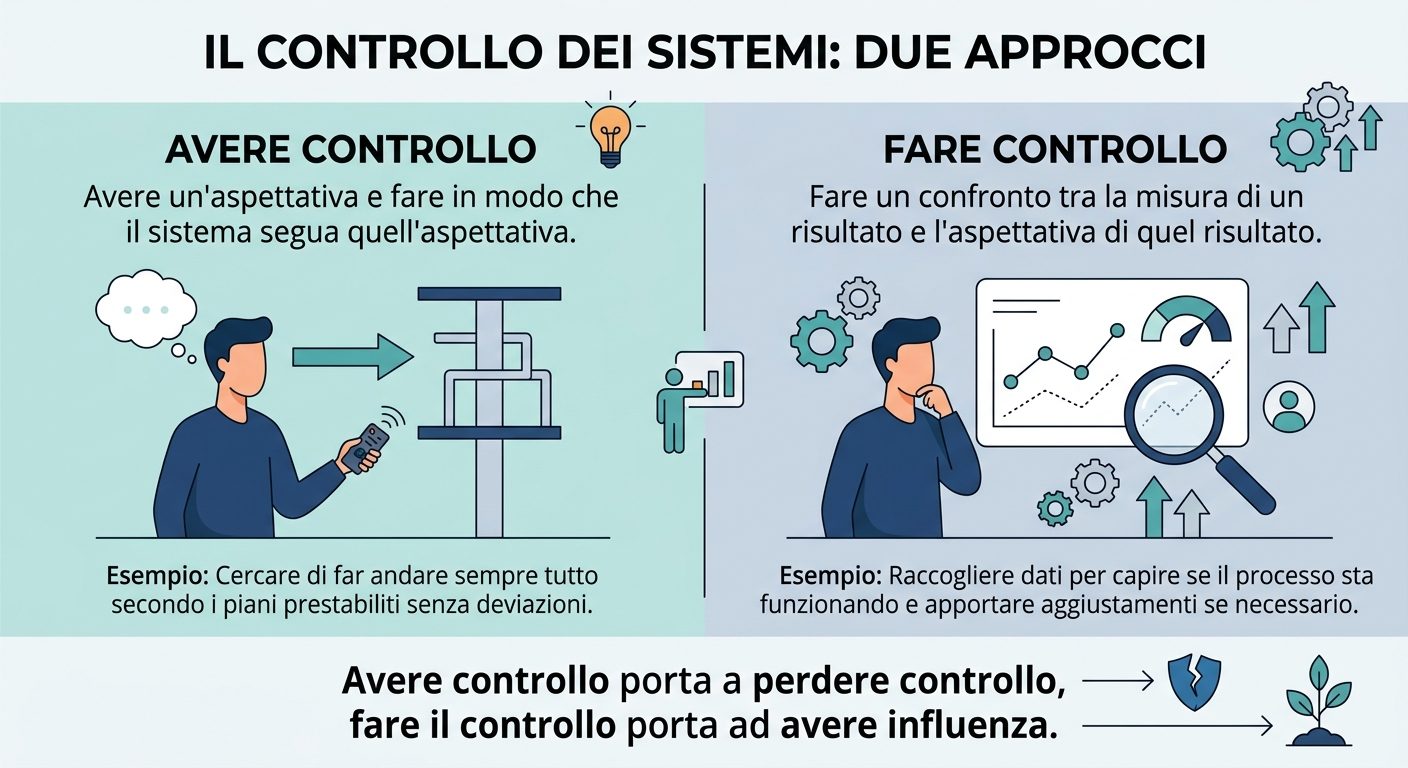
To understand how it is possible to have influence, you need to distinguish between having control and doing control, because they are two completely different things, and the distinction brings a fundamental clarification.
HAVING CONTROL means influencing, that is, "flowing into": entering, according to your own expectations, into the results of something or someone. In this sense, exercising control means having an expectation and making the system follow that expectation. This, however, leads to chronic tension.
The word "control" comes from the Old French contre-role, which can be translated as "counter-roll" or "double register".
DOING CONTROL means instead comparing the measurement of a result with the expectation for that result.
The difference between having and doing control thus lets you understand which of the two actually leads to more influence.
Having control leads to losing control; doing control leads to having influence.
This is the goal to set in order to solve the problem of low control over a system.
Lack of information, then, is the first condition that drives a system out of control.
Doing control means gathering information and comparing it with an expectation.
Having information and data lets you influence, "enter into" the system.
Influence, in this sense, carries no positive or negative judgment in itself; having control, on the other hand, has a negative value when it coincides with demanding that the system conform to your expectations.
The development of a system is progressive: over time the variables increase and, as a result, so does the need for information. The further you go, the more there is to measure, and if measurement does not increase, the possibility of doing control decreases, and with it the possibility of influencing the system.
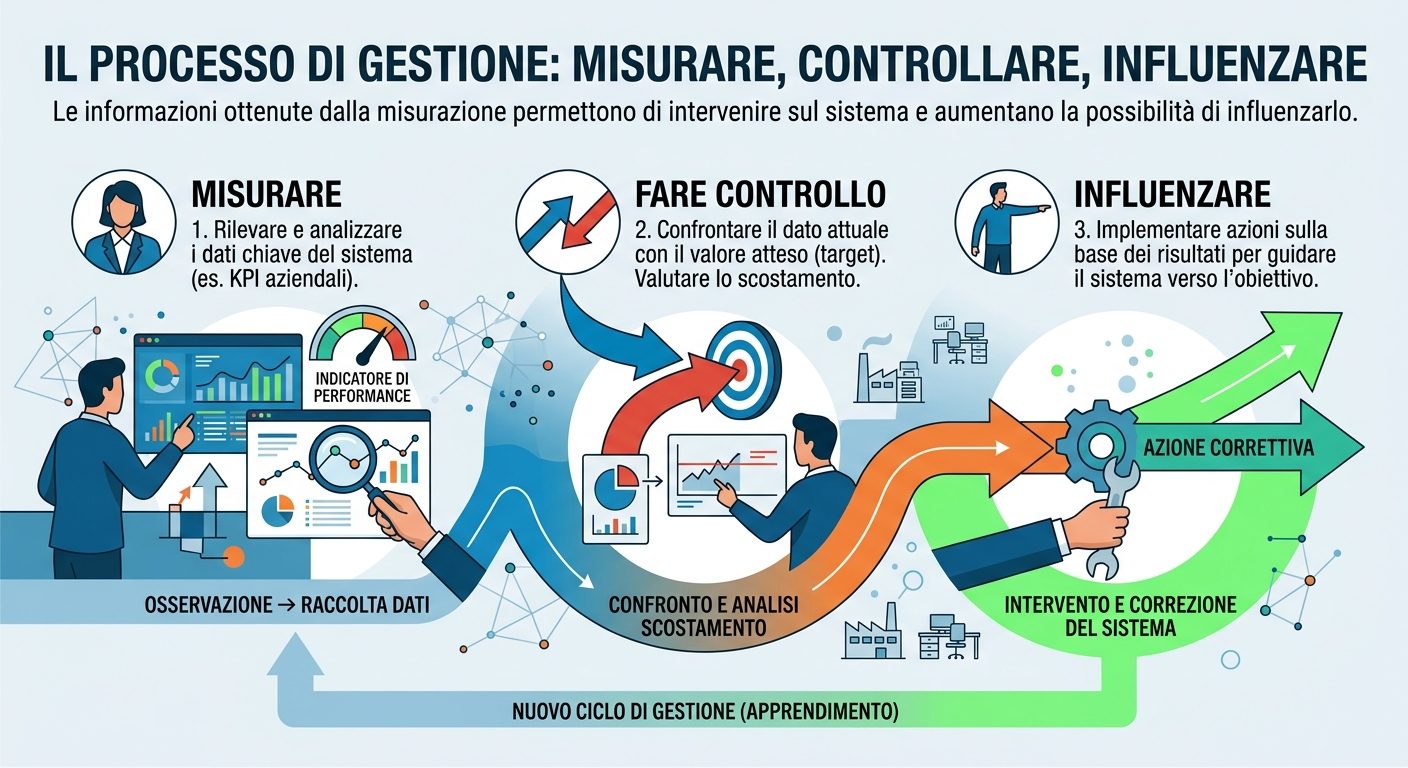
Measuring, that is, collecting the information needed to make this comparison and do control, is therefore the act that increases your ability to influence your systems.
If you are looking for control, you do not get it simply by demanding to have it; through measurement, instead, your ability to exert influence grows.
In this sense:
- measuring is the origin
- controlling is the means
- influencing is the effect
This distinction also helps you understand how the relationship between measurement and influence works in practice. The point is not to increase the amount of control exercised over the system, but to increase the ability to do control through information.
What causes and sustains the loss of control of a system
To understand why you lose control of a system and why the situation tends to repeat itself, you need to look at what is done to deal with the problem and, even before that, at the ideas that guide those actions.
Difficulties in keeping a system under control do not depend only on what happens, but also on how what happens is interpreted and on the solutions that are put into practice as a result. When the starting idea does not allow you to identify the real cause of the problem, the actions taken can only work on the effects, without changing what keeps generating them.
That is why, to regain and maintain control, you need to understand which beliefs guide your actions, and to distinguish those that point in the wrong direction from the conditions that let you act on the actual causes of the problem.
WRONG IDEA: the power to influence is proportional to the control you have.
According to this idea, the more authoritarian you are, the more influence you have. But that is not how it works.
CORRECT IDEA: the power to influence is proportional to the control you do.
Measurement lets you detect what happens and, through this information, do control, which in turn increases your ability to influence the system.
How much you can influence your systems therefore depends on how much they are measured.
Measurement serves to increase influence. That is why, when you feel you are losing influence over something, the first thing to do is to increase measurement, not to try to have more control. This applies to every area, from personal to professional life: it is true for body weight, for spending, for relationships and for the company.
If the loss of control is interpreted differently, though, you will tend to act on what seems to be the cause without acting on the mechanism that sustains the problem. That is why it is useful to distinguish the false causes (considered the most common) from the real causes of lack of control.
The false causes of lack of control
When a system lacks control, some mistaken beliefs can lead you to look for the cause of the problem in factors that seem to prevent you from exerting enough influence on the system. Among the most common are:
- Low authority: you think you are not in control because you are not authoritative enough and, as a result, you try to increase your authority. In reality, this is a consequence and not a cause of the problem: it stems from the fact that you are not measuring enough.
- Insufficient exercise of power: you think you are weak and that you therefore need to increase coercive power.
In both cases, the attempt is to regain influence by increasing the control exercised over the system. But if the problem is insufficient information, this intervention does not act on the cause.
The real cause of lack of control
The real cause is the reason the problem exists and persists.
In the case of losing control over a system, the first real cause to address is:
- Insufficient measurement
There are further real causes of this problem, but this is the very first one, the fundamental one to start from to steer the solution.
If lack of information leads to a decrease in the ability to influence the system, the first intervention to solve the situation must therefore make up for this shortfall through a concrete, well-defined action.
Practical tips for regaining control of a system
Once the causes behind the loss of control have been identified, you need to act on the gaps that allow the problem to appear and persist. The practical tips therefore concern the actions needed to fill these gaps and regain stable control of the system.
For the real cause identified, the corresponding implementation action that resolves the gap and the problem is:
When you feel you are losing the power to positively influence a system, start measuring it more.
Nothing else is needed but to increase measurement. As soon as you start measuring, your ability to influence already changes.
The absence of information in fact causes a drop in autonomy and leads to wrong decisions. Little information creates insecurity, fear and indecision, conditions that reduce autonomy. The more information you have, on the other hand, the greater the clarity.
Control, understood as imposing your own expectations, tends to shut off the flow of information; measurement, instead, increases the information available, makes it codifiable and unlocks the ability to act.
Without measurement and data gathering you freeze up and will no longer have influence over the system. Those who control shut themselves into the confirmation of their own expectations; those who measure stay open to collecting all the information, including what does not match their expectations.
So when results are not coming, measurement must increase: you need to define where, how and when to gather information and make measurement an established habit.
The choice of what to measure must start from the effects: from the areas where you feel you have little influence, that you want to change but cannot, and where stress and chronic problems are most concentrated. You start from these areas because they are the ones where you have the least influence.
Doing control means having an expectation, measuring and collecting all the available information and, based on what is found, acting to change the system.
In conclusion, losing control of a system means progressively losing the ability to influence what happens inside it. When deviations, errors and unpredictability increase, it becomes harder to get the expected results, and the effort needed to step in and fix what is not working grows.
The problem is not solved by trying to exercise more authority or to have greater control over the system. The fundamental cause to start from is insufficient measurement: without up-to-date information on what is happening, it becomes hard to understand where to intervene and to check the effects of your actions.
To regain control, you therefore need to increase your ability to do control, that is, to measure what you want to influence, compare what you find with your expectations, and use the information collected to act on the system.
Measuring lets you know what is happening; doing control lets you steer your actions and, as a result, increases your ability to influence the system.
Sources and references
*1 Lord, R. G., & Kernan, M. C. (1989). Application of Control Theory to Work Settings. In Research in Organizational Behavior, Vol. 11, pp. 493–514. Elsevier.
*2 Kontogiannis, T., & Malakis, S. (2012). Recursive modeling of loss of control in human and organizational processes: A systemic model for accident analysis. Accident Analysis & Prevention, 48, 303–316.
*3 Conant, R. C., & Ashby, W. R. (1970). Every good regulator of a system must be a model of that system. International Journal of Systems Science, 1(2), 89–97.
*4 Francis, B. A., & Wonham, W. M. (1976). The Internal Model Principle of Control Theory. Automatica, 12(5), 457–465.
*5 Ashby, W. R. (1956). An Introduction to Cybernetics. Chapman & Hall.
*6 Lee, M. M., & Zhang, N. (2017). Legibility and the Informational Foundations of State Capacity. The Journal of Politics, 79(1), 118–132.
*7 Galbraith, J. R. (1974). Organization Design: An Information Processing View. Interfaces, 4(3), 28–36.