
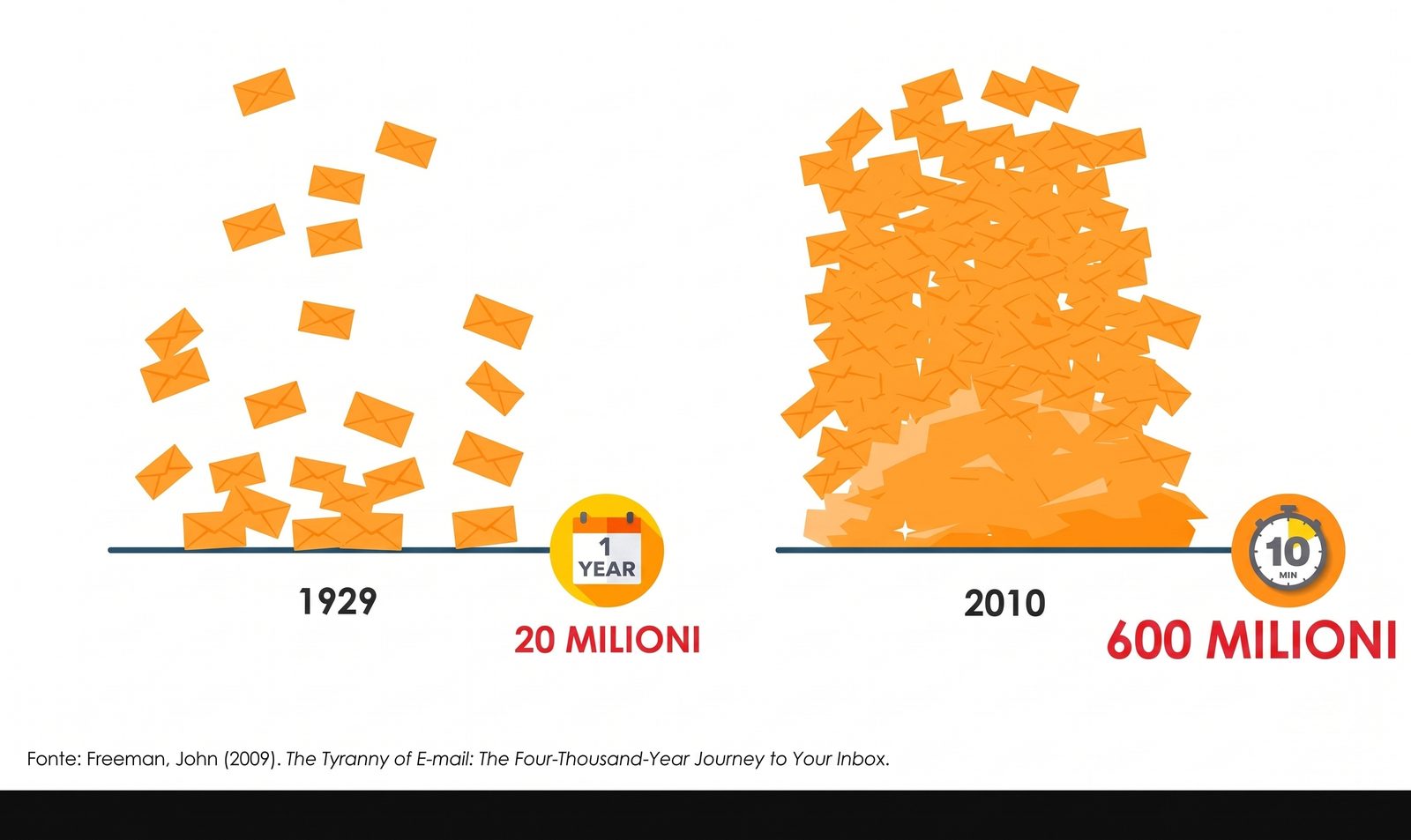
Every day, in organizations, a substantial part of the work goes through email, chat and other communication tools. The number of messages exchanged has grown rapidly over time: from 1929 to 2010, it went from about 20 million messages exchanged in a year to 600 million in just 10 minutes.
Such a significant increase can be read as the result of a greater need to communicate and coordinate activities. But not all messages are necessary and, when communications grow beyond a certain point, they can become a problem to be managed in their own right.
The time spent reading, writing and answering messages adds to the constant interruptions and context switches, making it harder to stay focused on the work at hand. Misunderstandings, conflicts and discontent can also increase, especially when it becomes difficult to handle all communications properly.
The problem: too many unnecessary or inappropriate messages
WhatsApp, email, Teams, internal communications and messages in general are now part of everyday communication. The problem, however, isn't having a high number of messages in absolute terms: after all, what would the number be beyond which messages become "too many"?
The problem is rather the presence of unnecessary or inappropriate messages.
To understand how present the problem is in your own organization, simply look at how many messages were received and sent over the course of a week and then check how many of them could have been avoided and should not have been sent.
A communication that should not have been made, in fact, doesn't produce only the message itself. It can generate further communications and other effects within the system, feeding the problem.
To understand how much this phenomenon affects work, you therefore need to look at how the flow of messages in organizations has changed and what consequences it has on productivity. Starting from these elements, you can analyze the problem of inappropriate and unnecessary messages and identify how to intervene to reduce its effects.
What science says about the number of messages, their usefulness and communication overload
The presence of unnecessary and inappropriate messages in a system is a phenomenon that needs to be quantified in order to understand that it is a real, widespread problem, with effects not only on the quality of work but also on the quality of life of workers, at every level of the hierarchy.
To investigate the problem, it is useful to put two questions to the research:
What is the trend in the number of messages handled in a company?
How many unnecessary or inappropriate messages do people receive?
The number of messages exchanged at work has increased substantially over time.
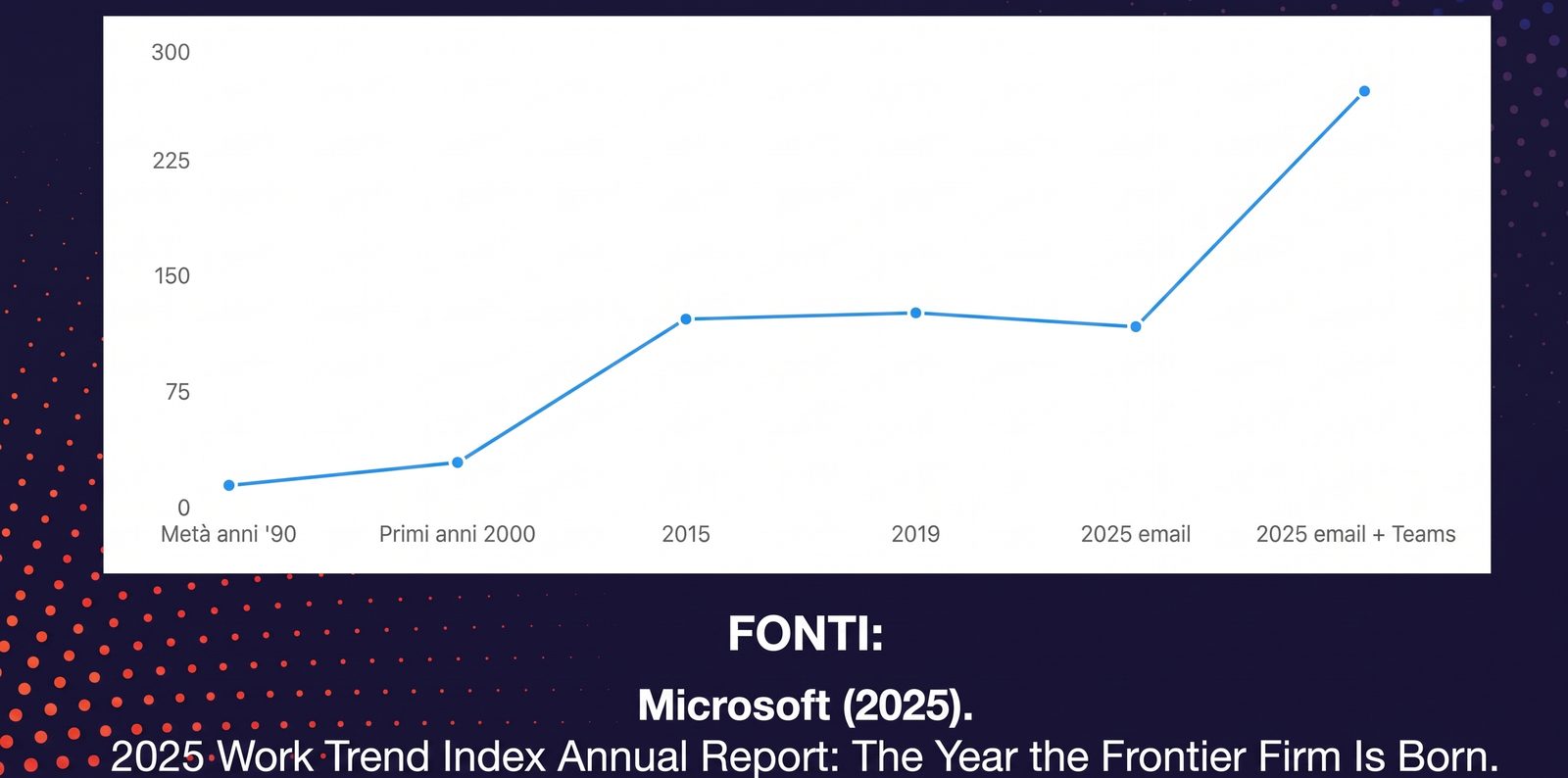
In the mid-1990s an average user received about 15 emails a day, a figure reported by Jackson, Dawson and Wilson (2003)*1 based on earlier research. In the early 2000s, a study of managers found that most received up to 30 emails a day, while Burton and Nesbit (2007)*2 found, in a sample of Australian and Hong Kong managers, an average of 26.9 emails received per day. The same authors also observed that the greater the experience with email, the greater the number of messages received, outlining a possible upward spiral: more emails sent generate more replies and, as a result, more messages.
With the spread of workplace chat, the volume of communications has increased even further.
Microsoft data show that, between February 2020 and February 2021, Teams users sent 45% more chats per week, while over the same period 40.6 billion more emails were delivered than in the previous year*3. The increase was not limited to the early phase of the pandemic: in 2022 Teams users were still sending 32% more chats than in March 2020*3.
These data therefore show that chat didn't simply replace email, but added a further flow of communication.
The most recent data make the scale of the phenomenon even clearer. In 2025, the analysis of Microsoft 365 productivity signals found an average of 117 emails and 153 Teams messages received every day by a worker, with a 6% increase in messages per person compared with the previous year*3. That makes about 270 emails and Teams messages a day, without counting other forms of communication.
The increase in the number of messages also comes with more frequent interruptions. Microsoft finds that Microsoft 365 users are interrupted on average every two minutes, for a total of about 275 interruptions a day, by meetings, emails or chat notifications *3. This figure indicates the total number of interruptions considered by the research and leads to a further, very interesting question:
What percentage of the messages you receive didn't need to be received?
The quantitative increase highlighted so far concerns not only the number of messages, but also their relevance and the way they are used.
Burgess, Jackson and Edwards (2005)*4 studied so-called email defects, that is, ways of using email that make communication ineffective. In one of the organizations analyzed, 16% of the emails received were messages in which the recipient had been copied unnecessarily, while 13% were considered irrelevant or not correctly addressed. The research also found that 56% of employees felt that email was used too often in place of more appropriate means of communication. The 16% and the 13%, however, can't be added together to conclude that 29% of emails were unnecessary, because the two categories may overlap, but the figure still shows that a significant share of the messages received has problems of relevance or addressing.
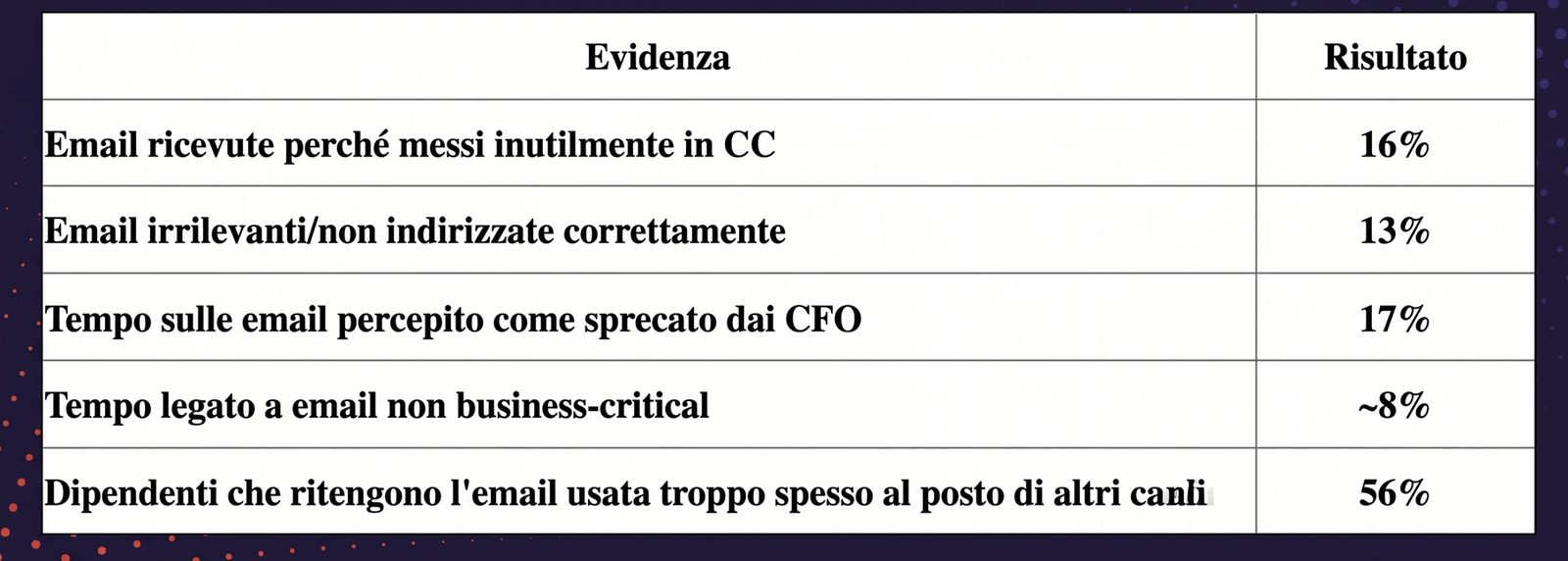
Another survey makes it possible to look at the problem from the point of view of time spent. In the survey conducted by Robert Half (2016)*5 of more than 2,200 US CFOs, 17% of the time devoted to work email was considered wasted. Among the main causes were spam, copying people who weren't concerned, overly long messages and communications that could have been handled through another channel. The figure doesn't mean that 17% of emails were unnecessary, but that 17% of the time spent managing email was nonetheless perceived as wasted.
More recent research also shows that the problem depends not only on the number of messages, but also on the work needed to establish which ones are actually relevant.
Kern, Ohly, Ďuranová and Friedrichs (2024)*6 distinguished emails directly tied to tasks (task-related) from those tied to communication (communication-related). In two studies, one of which involved 444 workers, the number of communication-related emails received turned out to be particularly important in determining perceived email load. According to the authors, these communications more often contain information that isn't immediately relevant to the priority task, but they still have to be opened and processed to find out whether they contain something important. The same study therefore highlights a cost even for messages that end up being unnecessary: to establish that a message isn't needed, you still have to give it your attention.
Finally, message overload can affect well-being at work.
Kern and colleagues (2024)*6 found a significant association between email overload and perceived stress. The scale used to measure overload also includes the difficulty tied to the time spent deleting unimportant messages. The increase in the number of communications therefore means not only a greater amount of information to receive, but also more time needed to select, evaluate and manage it.
Overall, the literature considered shows two connected phenomena: over time the messages exchanged in workplaces have increased significantly and, along with their number, so has the amount of communication perceived as irrelevant, unnecessary or handled through inappropriate channels. The result is a greater communication load, which can translate into wasted time, more frequent interruptions and more stress.
It is therefore necessary to see unnecessary and inappropriate messages as a problem that affects the whole system, with effects that go beyond the use of time.
The effects of unnecessary and inappropriate messages in a system
The presence of unnecessary and inappropriate messages in a system can produce several negative effects: some are immediately obvious, while others are less apparent but more deeply rooted, and make the problem much deeper and more critical than you might imagine.
To quantify the negative consequences of unnecessary and inappropriate communication, you need to consider the following effects:
- Poorly invested time
Time is spent reading, understanding and handling communications that should not have been produced or received. - More misunderstandings (a worse climate)
In an environment where people communicate less, there can be fewer occasions for conflict. Conversely, unnecessary or inappropriate communication can become fertile ground for discontent, power struggles, conflicts and misunderstandings. So it isn't only the number of messages that matters, but also their appropriateness. - Fewer interactions
Remote communication can replace some in-person interactions and, as a result, reduce the opportunities for direct interaction. There are activities that can't be handled effectively through messages, but require interaction. This is the case, for example, with conflict management, because a written message can easily be interpreted in different ways. - Rising functional illiteracy (the ability to understand)
When you constantly write in an inappropriate way, you gradually risk speaking and thinking the same way. Losing the functions that belong to the structure of communication can translate into a loss of the cognitive functions tied to thinking and understanding.
A growing amount of written material can lead you to pay less and less attention to what is actually written, with a resulting loss of functions tied to writing, communication and thinking. When communication happens mostly through written messages of ever poorer quality, you therefore risk unlearning how to write, read and understand.
It is now clear that unnecessary and inappropriate messages in a system are a problem with significant consequences for a company's productivity, and one that needs to be solved by finding stable, lasting solutions.
The priority goal: recognizing inappropriate messages
When you want to solve a problem, you first need to identify the ideal condition to be reached. You need to be careful, though, about what you want to achieve: a goal can be logical and bring some benefits without being the ideal situation to aim for.
In the case of messages, the wrong ideal condition, however correct it may seem, is reducing the number of messages.
Reducing the number of messages, however, can lead to cutting not only the unnecessary ones, but also the useful ones. Or it can lead to delegating the work of handling messages, simply shifting the problem while unnecessary communications keep circulating in the system (along with their negative effects).
A concrete example of this situation is asking your team members to stop copying you on emails, and then finding yourself no longer receiving information you actually need: cutting these communications isn't ideal, it doesn't work.
The goal, then, can't be to reduce the number of messages in general, but to intervene selectively on those that should not be sent or received.
The correct ideal condition is therefore to eliminate inappropriate messages.
To do that, the first thing you need is to be able to tell useful messages from unnecessary ones, and appropriate messages from inappropriate ones.
There is a precise categorization of inappropriate messages and, specifically, there are 3 fundamental types of inappropriateness:
- Inappropriate in absolute terms – it shouldn't have been received by anyone: it shouldn't have been written or sent.
- Inappropriate for the role – it shouldn't have been received by that role: the message may be legitimate, but it wasn't meant for the person who received it.
- Inappropriate in timing – the message should have been received by that role, but not at that moment.
Recognizing an inappropriate message lets you correct your own behavior, avoiding both generating an unnecessary communication and adding another one in reply.
But if it's possible to recognize an inappropriate message, why is everyday work full of unnecessary communications?
To answer this question, you need to look into the beliefs and causes behind the mechanism that creates inappropriate communication in an organization.
How inappropriate messages are generated
Problems rest on wrong beliefs. These aren't illogical or counterintuitive beliefs, or beliefs without benefits. On the contrary, they are beliefs that can seem correct and work in certain circumstances, but that don't allow the problem to be solved in a stable way.
In the case of unnecessary and inappropriate messages in a system, the idea that prevents a lasting, deep solution to the problem is particularly popular.
Wrong idea: asking is legitimate, answering is a courtesy.
This belief leads to the habit of being courteous no matter what and always answering the messages you receive. In this way, however, unnecessary and inappropriate messages are fed even further.
You don't need to stop answering communications, but you do need to pay attention to the type of reply you are going to generate.
When you receive an email, in fact, you can distinguish between answering the message (that is, the communication) and answering the content of the message (that is, the request contained in the communication). You can answer the communication even when the request isn't your responsibility; it isn't always necessary, however, to address the request itself.
The unnecessary message, in fact, isn't only the one that arrives, but can also become the one sent in reply, like a self-regenerating mechanism: one inappropriate communication produces another in a cascade, and the habit of unnecessary messages spreads through the system, normalizing the problem.
Distinguishing between a reply to the message and a reply that inappropriately takes up the content of the message is very important.
If, for example, a customer writes to someone who isn't the contact person they should have addressed, it is right to answer the communication but without going into the content of the request: the best way to handle this communication is to give the directions needed to point them to the right contact person.
Giving directions that make it possible to turn the inappropriate message into a legitimate message means acting on the process that keeps unproductive habits alive.
Acting out of courtesy could increase the problem or create new ones, as indeed often happens in every system.
Correct idea: answering illegitimate messages feeds them.
You should therefore answer only legitimate messages.
But what is a legitimate message?
A legitimate message is a message that is appropriate with respect to context, content, form and timing. Context concerns respect for the role: the message must be addressed to the right role. The content must be appropriate to the request, the form must be consistent with the message, and the timing must be appropriate.
The distinction between the message and the content of the request therefore becomes fundamental: you need to answer the request when it is legitimate, without necessarily answering the content of the question when the answer would contribute to increasing unnecessary messages.
The problem, then, doesn't depend only on the number of messages received, but on the way the system reacts to each communication.
If inappropriate messages are also handled and fed, the system ends up maintaining and spreading the habit of generating new ones. This is the mechanism you need to act on, before looking for solutions that merely manage the volume of communications.
The most common false solutions for reducing the number of messages
When there are too many messages to handle, people look for solutions that make managing communications more sustainable. However, not all of them act on the causes that create and maintain this situation. Some can temporarily reduce its effects without solving it at the source, leaving untouched the mechanism that keeps producing unnecessary and inappropriate messages.
Faced with the problem of too many messages, the following solutions are common:
- Setting aside blocks of time for messages and email
This solution, however, doesn't take into account the distinction between legitimate and illegitimate messages. Moreover, a time block should group together homogeneous functions, while messages cut across different roles. - Delegating replies to messages
First of all, this solution doesn't act on inappropriate messages. Moreover, it merely shifts the problem. Messages can't be delegated: they are part of your duties. You need to ask yourself whether a given communication is correct, instead of simply passing the responsibility to someone else and leaving inappropriate communications circulating in the system.
These are two extremely superficial solutions, because they act on how messages are handled without tackling the problem at its source.
To solve the problem, you instead need to understand the real causes that create and maintain it.
The real causes of unnecessary and inappropriate messages
The real causes are the reasons why the problem exists and persists.
The solution is built by implementing the causes in a preparatory sequence. You don't necessarily have to start from the biggest cause, but from the main one, that is, the one that comes first in order of priority.
The main causes of too many unnecessary and inappropriate messages are:
- Not knowing how to tell legitimate messages from illegitimate ones
The message KQIs are missing, that is, the quality parameters that make it possible to establish whether a message is legitimate. Without these parameters, it becomes difficult to assess whether a communication is appropriate or not. - Not having a filter on message quality (before sending)
Before sending a message, you should be able to ask yourself: in terms of quality, is this message appropriate or not? What's missing is a tool that makes it possible to assess the quality of a message before it is sent.
The fact that today messages aren't limited and can be sent in potentially infinite numbers leads people to pay less attention to their quality.
If there are no tools and checks to make sure a message's quality is respected, it will be easier to feed inappropriate communication into the system.
To solve the problem of having too many unnecessary messages in a system, you need to act on the real causes of the problem with practical actions that act directly on the gaps that generate it.
Practical tips for eliminating inappropriate messages
To eliminate inappropriate messages, it is useful to act both on the criteria used to classify them and on the way they are written and sent.
1. Define in writing how to tell an illegitimate message from a legitimate one
The first step is to clarify what makes a message necessary and appropriate and what, instead, makes it inappropriate. So it isn't simply a matter of deciding how many messages to send, but of defining which messages should be sent, to whom and at what moment.
2. Use a checklist to verify the quality of a message before sending it
A checklist makes it possible to turn these criteria into a concrete check. It can be used both to analyze messages already received and to check those you are about to send.
First of all, you can look at the messages you received and ask yourself:
Did this message need to reach me, and right now?
When the answer is no, it is useful to identify who it should have been sent to or when it would have been more appropriate to send it. This way you can recognize messages that are addressed to the wrong person or sent at a moment when they weren't needed.
The same check can be applied before sending a message. A few questions help check the main aspects:
- is it right for me to write it, or should someone else write it?
- is the information correct, clear and sufficient to understand what is being asked?
- am I using a message as the appropriate tool, or would a call or a meeting be more effective?
- is this the right moment to send it?
The checklist therefore lets you verify not only what is written, but also who should write it, to whom it should be sent, when and with which tool.
One question can sum up the whole check:
Did this message need to be sent, to this person, now?
Applying this check consistently makes it possible to identify the messages that shouldn't have been sent and to act on the way internal communications are generated.
Writing better means speaking better and thinking better.
In conclusion, messages keep increasing, while part of the communications has problems of quality, relevance or appropriateness. That's why, faced with a high number of communications, the first response shouldn't be to find more time to read them, answer them or delegate them, but to check which messages are really necessary.
The goal isn't to reduce messages in general, but to eliminate those that shouldn't have been sent. Distinguishing between Legitimate Messages and Illegitimate Messages lets you understand which communications are really necessary and which, instead, can be avoided. The Quality Verification Checklist helps make this distinction systematic.
Keeping the number of messages to a minimum therefore means acting on their source: eliminating inappropriate messages before they are sent, instead of dealing with the consequences they produce.
Sources and references
*1 Jackson, T. W., Dawson, R., & Wilson, D. (2003). Reducing the effect of email interruptions on employees. International Journal of Information Management, 23(1), 55–65.
*2 Nesbit, P. L., & Burton, S. (2007). Technology in the Hands of Managers: Email Use by Australian and Hong Kong Managers. Contemporary Management Research, 3(3), 197–212.
*3 Microsoft. (2021; 2022; 2025). Work Trend Index / Microsoft 365 productivity signals. Data on the evolution of the use of Microsoft Teams, email and interruptions during the workday.
*4 Burgess, A., Jackson, T. W., & Edwards, J. (2005). Email training significantly reduces email defects. International Journal of Information Management, 25(1), 71–83.
*5 Robert Half. (2016). Work Email Is A Waste, 17 Percent Of The Time, Execs Say. Survey of more than 2,200 US CFOs.
*6 Kern, M., Ohly, S., Ďuranová, L., & Friedrichs, J. (2024). Drowning in emails: investigating email classes and work stressors as antecedents of high email load and implications for well-being. Frontiers in Psychology, 15, 1439070.