
The free-time trend
Human free time is eroding the way the polar glaciers are eroding.
On average, we have less free time than our grandparents had. On average, our grandchildren will have less free time than we do.
This is largely due to the increase in surprises.
In the 2010s, people experienced more stressful events on average (known in technical terms as stressors*) than in the 1990s. Specifically, about one extra week per year of days with at least one surprise, with a much sharper increase among middle-aged adults (*1).
*The term stressors refers to all the external and internal stimuli, events or conditions that disrupt a person's psychophysical balance (homeostasis) and trigger a stress response
The overall picture points to a more stressful daily life in the first decade of the 21st century than in the 1990s.
The OECD (Organisation for Economic Co-operation and Development) defines time poverty as the condition of those who have less than 60% of the median worker's time available for leisure and for restorative personal care.
The study analyzes ten countries (*2) and finds that the incidence of time poverty among full-time workers rose from the 2000s to the 2010s: from 1.4% to 1.8% for men and from 1.3% to 1.8% for women. In 2015, 43% of workers in OECD countries said they were dissatisfied with the amount of time they devoted to work, and the main cause of dissatisfaction was working too much.
The OECD also shows that between the 1970s and the 2010s the leisure time of a full-time worker fell by an average of 1.5 hours per week, across the 14 countries for which data exist. The decline began after the 1980s and accelerated in the following decades.
And yet, again according to the OECD, average annual working hours per employed person have not increased: they have been falling over the long term, although since the 1990s the decline has slowed and in some countries reversed (*3). So why does an ever-growing number of workers have less and less time?
The problem, in reality, is not the quantity of time but the quality of time.
Our time is not all the same: it can be divided into 'good' and 'bad.'
'Good' time is time that can be planned, that is stable, in which you can stay focused on an activity long enough to create value and avoid mistakes. Good time is time we control.
You plan your day: two meetings in the morning and a slot for making calls, then lunch with your partner, and in the afternoon you set aside 3 hours to move an important project forward. Two hours at the gym in the late afternoon and a quiet family dinner in the evening.
This will be good time if nothing erodes it, suddenly changes your commitments or creates distractions during your activities. It will be good time if every activity is carried out in a highly productive, focused and reliable way.
'Bad' time is time that cannot be planned, that is fragmented, full of distractions and disruptions that prevent you from staying focused on an activity long enough to create value. Bad time is unpredictable time, in which surprises are more likely to happen.
Good time is inversely proportional to bad time: if the first grows, the second shrinks, and vice versa. There is no alternative: everything we do is done either in good time or in bad time.
Over the past few decades, good working time has kept shrinking. People are less and less able to plan their days, and find it harder to do so, and this leads to longer lead times, the constant feeling of not having enough time to do everything and the ongoing frustration of feeling that something is being neglected.
Surprises on the rise, good time on the decline, a perception of free time that keeps getting lower.
The increase in surprises is a phenomenon that perhaps deserves more attention than it has received and that has more serious consequences than people think.
What causes a surprise
Surprises mostly show up as interruptions or distractions.
A surprise can be an event that interrupts us while we are doing something, or that distracts us from what we are focused on.
You have just arrived at the beach and discover you forgot your swimsuit. This interrupts your vacation because you have to go and buy one.
You are on a phone call and the neighbor's dog starts barking insistently. This distracts you from the call and breaks your concentration, so much so that you ask the other person to repeat what they just said.
Interruptions and distractions are what make us lose control of our time and, as a result, erode our productive potential.
An interruption, like a distraction, can be caused by:
- a tool (a cell phone, a computer, a car, etc.)
- a person (a team member, a customer, your child, etc.)
- a natural event (a thunderstorm, an earthquake, etc.).
Since there is very little we can do about natural events, the only way to reduce surprises is to focus on tools and people.
Both the tools we use and the people around us are increasingly frequent sources of distractions and interruptions.
Tools create a surprise when they suddenly break down or when they call for our attention to remind us to use them.
Both dynamics are on the rise.
Tools are breaking down and wearing out faster and faster.
Between 2004 and 2012, in Germany, the share of large household appliances replaced within five years because of a technical defect more than doubled, rising from 3.5% to 8.3% (*4).
This figure has fueled a decades-long debate about planned obsolescence: the strategy whereby a product is supposedly designed to have a deliberately limited useful life, so as to encourage its replacement and, therefore, new purchases.
The tactics attributed to this strategy are well known: making broken components harder to find, creating incompatibilities with new software or technologies on the market, making repair inconvenient — in other words, making scrapping the product easier and cheaper.
Research on the subject, however, tells a more nuanced story: the reasons for replacement are many and intertwined, and weak points deliberately built in by manufacturers have not been proven. What can be observed is rather a change of criterion: durability has become a design variable, and products are designed to last as long as needed, not as long as would be technically possible.
On top of this, many large companies compete in the booming low-cost market, making products (furniture, clothing, cell phones, tech devices, etc.) of ever lower quality and shorter life which, once broken, are cheaper to replace than to repair.
All of this leads tools and equipment to break down more often or become obsolete more quickly, generating more surprises.
Technology tools are increasingly designed to grab our attention.
Large multinationals in technology and advertising have realized that 'time' as a currency is worth far more than 'money' as a currency. So they have adapted their business model, getting customers to pay them no longer with money but with data and information, provided mostly unknowingly, by spending time on their devices or platforms.
You get nothing for free from a multinational: when they make you believe it is free, you are paying for it with your time. Today attention is considered one of the most valuable resources of all, and that is why so many players compete for it, designing tools that are ever more distracting and interruptive.
The researcher Leslie Perlow spent nine months studying the work habits of a group of software engineers and came to call time famine the feeling of having too much to do and not enough time to do it (*5).
What is interesting is where this feeling came from: not from the number of hours the engineers had available, but from the difficulty of completing their work because of constant interruptions.
Gloria Mark's research on the use of digital devices (*6) reveals a striking detail. The time spent in front of a screen before shifting attention elsewhere gets shorter with each measurement: in 2004, direct observation of fourteen workers measured 2 minutes and 52 seconds of continuous computer use before an interruption or a switch of activity; in 2012, the average duration of a window on the screen, across thirteen participants, was 75 seconds; in 2016, tracking the computer activity of forty knowledge workers over two weeks measured an average of 47 seconds, with a median of 40.
Shifting attention more often means getting distracted more and fragmenting time further (this is known as work fragmentation)(*7).
Tools designed to take over our time, interrupt us and distract us to remind us to use them are becoming more and more widespread. All that's missing is screwdrivers designed to vibrate and ring every half hour to remind us to use them!
On top of tools, there are people.
People cause distractions and interruptions for other people directly (they need help because they lack independence or autonomy) or indirectly (they make a mistake, forget something, overlook something that someone else has to make up for).
Both are on the rise.
Team members are less and less autonomous and independent.
A study conducted in Europe in 2014 shows that work autonomy had declined compared with 1995 (*8).
Another study, from 2025, shows a genuine 'collapse' of autonomy over the course of a career. In this study of more than 400,000 longitudinal individual observations from Australia, Germany and the United Kingdom, autonomy was found to grow in the early part of a career, peak around age 40, and then decline steadily over the following 20–30 years of working life (*9).
Less autonomy and less independence mean asking others for support more often, becoming the source of more and more surprises.
People are less and less reliable.
Reliability is an increasingly rare and sought-after trait in suppliers and team members. Society is becoming more and more unreliable, and this is happening for several reasons.
First of all, because of a general increase in tolerance for unreliability.
Modern society is built on competitiveness, spreading an orientation increasingly focused on achieving the best result, and less and less on how that result was achieved. How much comes before how. The goal before the execution. Quantity before quality. The end before the means.
In a society like this, it is normal to expect a growing tolerance for unreliable behavior, since it is not essential to achieving a result: effectiveness does not necessarily require reliability. A salesperson can be the best in their company in terms of sales revenue and be completely unreliable.
Adding to the unreliability is the growing pressure of roles and responsibilities piling up on the same person.
So-called work intensification is the tendency to increase the demands, responsibilities and roles placed on a single person.
Sociological literature has for decades described the overload that arises when different roles and expectations pile up on the same person (*10), and European data on working conditions show that since 1995 work pressure has increased in most EU countries (*8): the result is time that is more fragmented and more unpredictable.
More roles and tasks in the same day mean less focus, less concentration, less clarity in what we are doing — in other words, bad time. And in bad time we gradually become less and less reliable.
A study published in Organization Science describes as excessive busyness the condition in which people must constantly juggle many activities and deadlines, feel they have little control over their time and, as a result, experience time as accelerated and marked by fatigue, helplessness and lower productivity (*11).
By trying to do too much, people become unreliable, and unreliability leads them to cause more mix-ups for others — in other words, more surprises.
If we want a concrete solution to the slow decline in the quality of our time, we must look for it precisely in eliminating surprises.
The train is late.
Excuse me, my phone is buzzing.
The guest arrived an hour early.
He was supposed to deliver the work 3 days ago, but I still haven't heard from him!
Another mistake in filling out the forms …
Didn't she say she would take care of it?
Surprises consume our time. They take over our days. They fill our calendars with bad time. And even if they are small and seemingly insignificant, that does not change the damage they do: turning good time into bad time.
One of the greatest frustrations of our time is linked to the awareness of not being in control of our own time and, as a result, to the perception that our systems are unstable and unpredictable.
This frustration comes from many small surprises endured, which over time have turned into many compromises. So many that they have created a tangled, complex knot of contradictions, tacit agreements, acts of submission and counterproductive habits. Small surprises that, taken one by one, seem insignificant, but taken all together seem unsolvable.
A frustration that, unfortunately, suggests that the only way out of this mess is to get used to living with it.
In reality this condition can be changed, one step at a time, solving one problem at a time, eliminating one surprise at a time.
The misunderstanding about surprises
Is a surprise always a problem? Generally, yes.
A surprise is a polarized* event, for better or for worse. So there are negative surprises and positive surprises — for example, an unexpected visit from a loved one you have not seen in a long time, or discovering that an unknown relative has left you a sizable inheritance. That said, when we talk about a surprise, we usually mean an event that is negative and that we would gladly have done without.
*Neutral events tend not to be considered, even though they are surprises.
In other words, when someone says 'something unexpected came up,' they rarely mean something good; otherwise they feel the need to add the adjective 'pleasant' to specify that it is a particular kind of surprise.
A surprise is, therefore, an unwanted, unplanned event that interrupts or alters an ongoing or scheduled activity. An event that either completely interrupts what you are doing or delays it, complicates it, changes how it is carried out.
A person is late.
The dishwasher breaks down.
A supplier misses the delivery date.
A team member forgets to run a check.
All these situations are examples of surprises: events that cause mix-ups.
The most common definition of 'unforeseen', however, hides an insidious misunderstanding.
For most people, the term 'unforeseen' is confused with the term 'unforeseeable', meaning 'something that could not have been seen in advance.'
This definition leads people to believe that surprises are part of life, that nothing can be done about them, that they must be accepted as the normal randomness of the universe.
In this way, a surprise turns from a problem into a problem with no solution.
This definition, currently widespread and deep-rooted, invites a passive approach of total submission to surprises. Surprises happen; they always have, they do and they always will. Get over it.
As proof of this, the surprise is the most widespread and effective excuse to justify anything. It is effective precisely because there is practically nothing you can say in reply.
Sorry I'm late, something unexpected came up.
Yes, it's true, I forgot, but one of those unexpected things happened to me …
If that unexpected thing hadn't happened, I would have finished on time.
What do you say in response to these statements? Nothing: playing the surprise card is like playing the joker in a card game — you're always safe!
As long as unforeseen means this, there is no chance of taking control of your time or of having even the slightest influence on these unwanted events.
If we analyze the original meaning of 'unforeseen,' however, we discover an important difference.
The Italian word for 'unforeseen,' imprevisto, derives from the Latin praevidere, formed from prae- ('before,' 'ahead') and videre ('to see'). Literally it means: 'what has not been seen beforehand.'
Between 'what could not have been foreseen' and 'what was not seen' there is a substantial difference. The first definition allows no option for action and prompts no questions. The second, on the other hand, assumes that a solution exists and opens up the option that the surprise could be seen and prevented in the future.
A small grammatical difference that makes a big practical difference.
Unforeseen and unforeseeable are two different things. Unforeseen does not mean unforeseeable.
Getting a flat tire is a surprise. Was it also unforeseeable?
A customer who calls after business hours because they have a problem is a surprise. Was it also unforeseeable?
A team member who forgets a key step in a procedure, with the problem landing on you, is a surprise. Was it also unforeseeable?
The answer to these questions is neither yes nor no, but 'it depends.'
It depends on whether it was actually possible to foresee that event. It depends on whether a more methodical, precise and attentive person would have been able to foresee it. In short, it depends on the behavior of the person who suffered that event.
Getting a flat tire 15 days after replacing it is unforeseeable. Getting one after driving 60,000 km without a checkup is still a surprise, but an entirely foreseeable one.
A good share of the unwanted events that happen to us are caused not by incompetence, but by ineptitude, sloth* and superficiality.
*The Italian word used here, accidia, derives from the ancient Greek akedia (ἀκηδία), formed from a- (privative prefix, "without") and kedos ("care," "concern"). It literally means 'lack of care.'
Did you know the road you were driving on well when you got the flat? Did you check that the road surface was in good condition? Were you paying attention to your driving or were you distracted? Had you taken good enough care of the condition of your tires?
Depending on the answers to these questions, and on how honest you want to be with yourself, you can consider this surprise unforeseeable or foreseeable, bad luck or an opportunity to improve.
A customer who calls you after business hours with a problem for the first time is unforeseeable. A customer who calls you after business hours with a problem for the second time could have been foreseeable.
The nature of a surprise is objective: a surprise is generally a surprise for everyone, not just for some. A delay, a breakdown, a viper on a mountain trail are surprises for everyone, because they are unwanted events. What is subjective is predictability: a tire specialist is more likely to be able to predict the surprise of a flat tire, just as an experienced mountain guide is more likely to predict the presence of a viper on a specific trail.
The predictability of an event has to do with knowing that the event will happen and, roughly, when it will happen.
Saying 'sooner or later the tire will go flat' is not a prediction.
Saying 'in 3 months, if I keep going like this, the tire is very likely to go flat,' or 'as soon as I drive on a bumpy road the tire is very likely to go flat' — those are predictions.
Besides predictability, another characteristic of surprises must also be taken into account: preventability. If predicting means knowing when the event will happen again, preventing it means stopping it from happening again.
By crossing predictability and preventability in a matrix, every surprise can be placed in one of 4 quadrants (see Figure 1).
Figure 1:
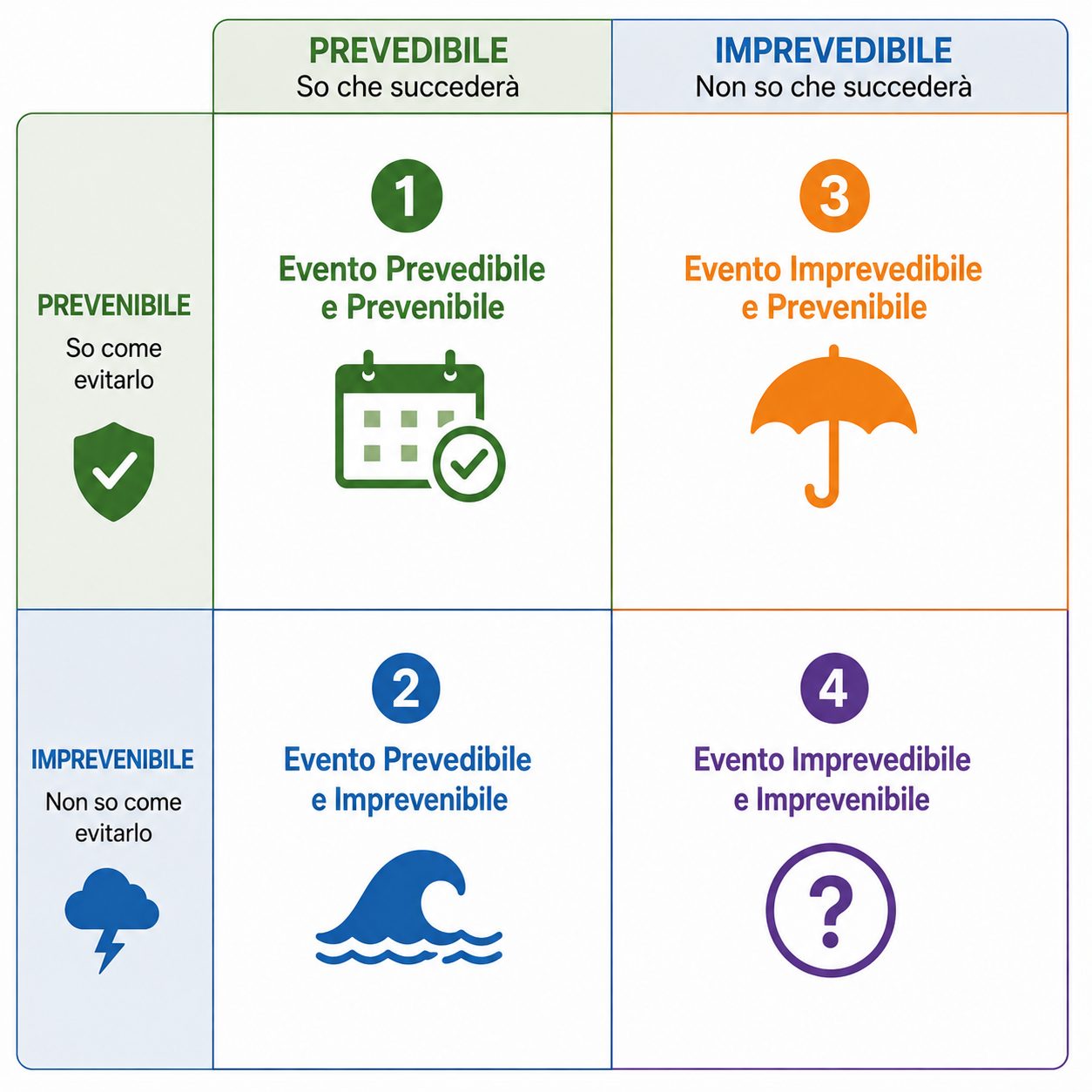
Quadrant I: Predictable and Preventable (I know when it will happen and I know how to avoid it).
These events depend entirely on whoever suffers them; they are caused by gaps that can be filled. One example is an execution error in a procedure: it can be predictable and also preventable.
Quadrant II: Predictable and Unpreventable (I know when it will happen but I don't know how to avoid it).
This is a predictable calamity: we know when it will happen but there is no way we can stop it from happening. These events must be taken into account so we can adjust to them with flexibility and adaptability. One example is a forecast thunderstorm: I can predict it, but I cannot in any way prevent it from happening, so the only solution is to protect myself as much as possible*.
*On this point, there is a well-known saying in the mountains: 'There is no such thing as bad weather, only bad clothing.'
Quadrant III: Unpredictable and Preventable (I don't know when it will happen but I know how to avoid it).
This is an event that may or may not happen, at an unknown time, but that can still be prevented. These events, like those in quadrant I, depend on gaps in whoever suffers them, so it is possible to eliminate them or reduce the risk of them happening. One example is a burglary at home: there is no way to know when or whether it will happen, but we can take precautions to prevent it or at least reduce the likelihood that it happens.
Quadrant IV: Unpredictable and Unpreventable (I don't know when it will happen and I don't know how to avoid it). This is an event that realistically could be neither predicted nor avoided, and can only be managed when it happens. These events are very rare, because they are genuine anomalies in the system that nobody could have predicted in any way. One example is an earthquake: it is not possible to determine when an earthquake* will occur, nor to stop it from happening; the only solution is to be ready.
*Earthquakes are stochastic events, predictable statistically and probabilistically, but not precisely.
These are all surprises, but they have different characteristics and therefore require different approaches to reduce or eliminate them.
Preventable surprises (whether predictable or unpredictable) must be eliminated or reduced to a minimum.
Unpreventable surprises (whether predictable or unpredictable) must be contained and their effects limited.
If a team member repeatedly makes a careless mistake, by the second time they make it, it must already be considered a preventable surprise. A surprise that can be eliminated by filling a gap in the team member or, in the most drastic case, by replacing the team member.
If we are often distracted by our cell phone, we cannot change the phone's functions and purpose; we can only adapt our behavior to the phone, using it less and setting ourselves limits.
In both cases, the difference is not the surprise that happens, but the approach we take toward it.
We will have fewer and fewer surprises in life if we know how to use every surprise to grow and mature. We will have more and more of them if we do otherwise.
Treating every surprise as unpredictable and unpreventable is a distortion of reality, a lie, a powerful self-deception that gets us used to inertia.
This is how surprises turn into chronic problems.
A chronic problem is a surprise that happens two or more times. Chronic problems are the result of failing to respond correctly to surprises.
The first concrete action we can take to regain control of our time (and increase our 'good time') is precisely to influence our surprises and keep them from turning into chronic problems.
Surprises are there to show us a shortcoming, something we need to improve in ourselves, in a procedure, in an inadequate rule.
Whenever a surprise hits us, we should always consider the hypothesis that the event does not depend on chance, but on a specific shortcoming of ours.
Whether it is undisciplined customers, distracted team members or spiteful neighbors, we should always assume we can eliminate that surprise from our lives.
And surprise after surprise, that hypothesis will start to seem like a constant, then become the only possibility, the one solid certainty available.
This habit trains our mind in a highly productive and powerful mindset. A mindset that leads us to always see ourselves as the cause, the protagonists, the controllers and active influencers of every event that happens to us in life.
The opposite mindset is to endure events as passive victims, to limit ourselves to judging and complaining about what happens to us. To gradually see life as a great wheel of (mis)fortune over which we have not the slightest influence.
It all starts with how you respond to a surprise.
During the night a violent hailstorm hits and destroys the crops of two farmers.
The first farmer complains about what happened and tries to rely on insurance* and government funding to be compensated for the damage.
*Note that insurance is not a way of preventing surprises, but a form of protection against their effects.
The second farmer, before taking any stopgap action, asks himself whether every farmer in the world would have found himself in the same situation after a hailstorm. Then he starts asking himself what the difference is between him and a more careful and experienced farmer. He starts researching how to predict and prevent a hailstorm in the future, and what shortcomings left him unprepared for this event.
A few years later, these two farmers will not just have different businesses; they will be completely different people. What is the substantial difference between the two farmers? Their interpretation of the surprise: for the first farmer it is an event about which nothing can be done (except asking for help with the damage); for the second it is an event that points to a gap to be filled.
When a surprise hits us, we can endure it and suffer its effects, or we can ask ourselves: 'Did it happen because of a shortcoming of mine?' 'Can I prevent it in the future?' 'Is it up to me whether the same thing happens again?' 'Can I prevent it in some way?'.
When the answer to these questions is yes, we are facing a surprise we can prevent and, if not eliminate outright, at least contain its effects. More importantly, we are facing the chance to fill a gap of ours or a gap in our system. We are facing a significant opportunity to evolve.
Every surprise not only can but must be eliminated, reduced or contained, whether predictable or unpredictable.
A team member arrives 15 minutes late to a meeting.
This is in fact a surprise, in the sense of an unwanted event that we would rather not see repeated. We can ignore it and pretend nothing happened, or we can ask ourselves some questions about it.
Was it preventable? In other words: if we had acted differently, could we have avoided this delay?
It depends on the team member's track record with lateness, on how the meeting was set up to run, and on how precisely the person in charge of the meeting communicated the meeting rules.
Who is involved? The surprise involves at least two people: the one who arrived late and the one who suffered the delay. This means the surprise arose from at least two gaps: one in the person who arrived late and one in the person who suffered it.
Which gap matters most? Which one is the priority, to be considered first?
The answer is simple, but not so easy to apply: the gap that matters most is always your own.
If you are the team member who arrived late, you must look for your own gap that caused the delay, not that of the person who called the meeting.
If you waited 15 minutes for someone, you must look for your own gap that caused the delay, not that of your team member.
This is for a simple reason: you cannot and never will be able, in any way, to change other people's behavior as you wish, as you can with your own.
When assessing causes, it makes no sense to consider someone over whom we do not have full power.
The most useful questions to ask yourself are: 'Is there a gap, a shortcoming of mine, that caused this surprise? Was there something missing in me — and probably still missing today — that could cause the same kind of unwanted event again in the future?'
Other people will often share part of the responsibility, but who you focus on will make all the difference in eliminating your surprises. Putting other people's gaps before your own can never reduce surprises or help your system evolve.
A productive company, a healthy relationship, an effective team all have one thing in common: their members look at their own gaps first and only then at those of others.
Doing the opposite leads to a growing climate of accusations, criticism, complaints and hypocrisy. Above all, it makes surprises spread like weeds in a garden.
It is identifying your own gaps, and acting on them with precision and determination, that will make any surprise stop happening or, at least, happen far less often.
This is how you take back your time: by eliminating, one by one, the surprises that interrupt it, fragment it and steal it from you by distracting you.
Failing to follow this methodical process leads to normalizing surprises and complaining and criticizing more and more. It leads you to be less and less at cause, to see more and more of other people's gaps and fewer and fewer of your own.
This is the antidote to the great frustration we talked about earlier: using every single surprise to fill gaps. One at a time, until one day we realize we have practically no surprises left.
The negative effects of chronic problems
Unforeseen is different from Unforeseeable, but many surprises accumulated over time lead to unpredictability.
A job full of surprises becomes unpredictable, a company where surprises are frequent becomes unpredictable, a week packed with surprises becomes unpredictable, a team member loaded with surprises becomes unpredictable.
Nobody is comfortable in an unpredictable environment. Our mind reacts by immediately tensing up when it senses unpredictability, because it associates it with confusion and danger.
Besides this far-from-negligible effect, a surprise that becomes a chronic problem can have many other negative consequences.
A small oversight can have negligible direct effects or cause a genuine catastrophe and cost dozens of people their lives (*12).
Then there are effects that are less evident in the short term, but much more invasive.
Effects on well-being: our mind picks up chronic problems the way our ear picks up annoying static on the radio. This increases the feeling of stress, and is one of the factors that promote chronic low-grade inflammation: an asymptomatic immune response that, over time, wears down tissues and promotes the development of chronic degenerative diseases such as type 2 diabetes, cardiovascular disease, obesity and cognitive decline (*13).
Chronic problems weaken our nervous system.
Effects on relationships: chronic problems reduce closeness and the motivation to cooperate in a couple or a group. A chronic problem that persists in a relationship is a reminder of imperfection, a reminder of the fragility of a relationship that has not managed to get rid of even a small problem. And the mind will tirelessly reinforce this corrosive insinuation: 'If you couldn't handle these little things, how will you face the bigger ones?'
Chronic problems weaken relationships.
Effects on discipline: chronic problems are picked up by our mind, which, unable to manage them, looks for a way to hide or justify them. This constant work takes energy and consequently weakens self-regulation, reducing the discipline and willpower available. Resources that, when they are lacking, we cannot use where they are needed.
Chronic problems weaken our will.
Effects on the psyche: chronic problems slowly shape a mentality that normalizes them, lowers the thresholds for detecting problems and builds an increasingly pessimistic view of the world, of relationships and of the systems we are part of.
Chronic problems weaken our mindset.
Effects on identity: The most serious and far-reaching effect of keeping chronic problems around is probably the slow, relentless demolition of our sense of self-efficacy. After seeing the same (small) problems come back again and again, who wouldn't doubt their own effectiveness as a human being?
Much as in a relationship, the mind will reinforce this disempowering statement in us too: 'If you couldn't handle these little things, you'll never be able to face the big ones!'.
Chronic problems weaken our identity.
Keeping chronic problems around, pretending nothing is wrong or waiting for time to sort things out, is an extremely risky choice that can lead to genuine self-destruction — of a business, a relationship and even an individual.
Detecting and eliminating surprises
We are addicted to surprises. So addicted that we struggle to see and recognize them.
What makes a surprise hardest to recognize is that we have completely normalized surprises. Events we should not consider normal start being seen as normal. Frequent becomes a synonym for acceptable. Acceptable becomes a synonym for normal.
A new team member is particularly grumpy and touchy. Over time people start paying more and more attention to how they speak to him, avoiding offending or contradicting him as much as possible, until this behavior becomes normal.
Over time, either we influence our surprises or our surprises will influence us.
However common it may be, however frequent it may become, an unpleasant event should never change its nature (and should therefore always remain unpleasant if it is).
To counter the normalization of surprises, a good antidote is to recognize and record surprises methodically. As long as you pay attention to surprises, you are telling your brain: 'this is not normal, it must not happen again'.
To get better at recognizing surprises, two practices help.
The first is to get into the habit of writing them down in real time in a planner or a digital note-taking tool.
As soon as you run into a surprise, that surprise must be noted, written down somewhere.
Stopping for a few seconds to note the surprises we run into is an essential practice for identifying them and not getting used to them. Writing down a surprise reminds our brain that we do not want to compromise with that surprise.
Conversely, by repeatedly failing to note a surprise right after experiencing it, we reinforce the idea that the surprise can become acceptable and normal.
The second practice concerns what to observe to detect surprises more easily: tune your radar to something more evident than the surprise itself, namely its direct consequences.
A surprise can have 3 different consequences:
- Interrupted activities
A surprise can interrupt an ongoing activity (leaving it half done, taking longer to finish it, or ending up with a worse result because of distractions).
Your phone battery dies and abruptly cuts off the call you are on.
A manager contacts a team member, tells him he has changed his mind and asks him to stop the current plan.
A colleague walks into the office and asks you a favor, breaking your concentration. - An extra activity added
A surprise can create extra activities (something has to be done to contain unpleasant consequences: patching up a problem, calling a meeting, sending a message, launching a corrective action).
The husband forgets to pick up the laundry from the dry cleaner, and the wife has to do it before the dry cleaner closes.
At the last minute, the boss asks a team member to stand in for him at a meeting with a client.
The package delivered to your home is the wrong one and now has to be sent back. - Unused time
A surprise can create a gap in time (finding yourself with nothing to do because an activity was skipped or postponed).
You had a dentist appointment at 3:00 p.m., but the receptionist tells you the dentist is running 30 minutes late.
The customer does not send you the documents you requested, and this prevents you from moving forward with the file.
You had planned to clean the garage with a friend since it is a two-person job, but at the last minute he texts you that he can't come.
At first it is easier to focus on these consequences to identify that a surprise exists, because they are easier to detect.
If detecting surprises is the first step, eliminating them is the second: let's see how it is done.
How to deal with surprises
There are only two kinds of reactions to a surprise: those that feed it and those that eliminate it.
Those that feed it, or at any rate do not eliminate it, are ineffective responses. They are usually impulsive reactions that act only on the effects of the surprise but do not eliminate it, dealing with the single episode without preventing it from happening again.
Effective reactions — the ones that eliminate the surprise — are corrective: responses that correct the gaps that caused it. Only in this way can you eliminate or reduce the likelihood of the surprise happening again.
So every surprise that happens to us must be linked to a specific gap of ours, to something we lack and that, if we do not put it in place, will turn the surprise into a chronic problem.
A gap can be organizational, or one of resources, skills or knowledge. A shortcoming of ours, of one of our team members or of our whole system. A small gap or a big gap. Either way, a shortcoming we can fill, which eliminates the surprise or reduces its effects.
Whatever our current situation, we can endure surprises all our lives, or we can always, always, always use a surprise to rid ourselves of a gap and evolve.
How do we know we have handled a surprise correctly? We can tell from 2 different signals, which also define the 4 corrective solutions to a surprise:
Signal #1: the event no longer happens, happens less often or no longer happens in the same way.
If a surprise can be eliminated, it means it is preventable — that is, it was caused by a specific gap that can be acted on.
The corrective solution in this case is to identify the gap that caused the surprise and fill it.
The gaps that cause a preventable surprise are mainly two:
- Carelessness
The surprise is caused by a lack of care in how we work, low precision, superficiality.
The solution is to increase our reliability, the quality of how we do things in general, our general execution habits. - Incompetence
The surprise is caused by insufficient skills and abilities.
The solution is to acquire or improve one or more skills.
Signal #2: the event no longer has the same effects on us or triggers the same reactions in us.
If a surprise is not preventable, the only solution is to work on ourselves or on our system, so that it has less effect on us. Either we can change events to improve them, or we change ourselves to adapt to events.
The corrective solution, in this case, is to weaken the impact of the surprise, increase our protection or change our views about the surprise.
The gaps that cause an unpreventable surprise are mainly two:
- Improvidence
The surprise is caused by underestimating a risk or a threat.
The solution is to launch a 'sunk-cost' prevention project, such as building an equipped bunker in case of an earthquake. - Impulsiveness
The surprise is caused by a dysfunctional emotional reaction to a particular event.
The solution is to change the judgment associated with the event: accept, reinterpret and reweigh what happened so that it no longer has the same meaning for us.
Either we change reality or we adapt to reality.
Carelessness, incompetence, improvidence and impulsiveness: it is because of these 4 gaps that we run into what is called a 'surprise.'
If you think about it, surprises cannot happen to a person who is reliable, competent, provident and emotionally stable. Something unpredictable or something unpreventable may happen to them, but not something they have not seen beforehand. A person with these qualities is simply immune to surprises, because they are always prepared, attentive, intelligent and rational.
That is why each of us should work precisely on these 4 gaps. This is the hidden gift behind every surprise: the opportunity to improve our reliability (how much we take care of things and people), our skills (how good we are at doing things), our foresight (how well we can anticipate risks and threats) and our emotional stability (giving events the right weight).
From this perspective, every surprise becomes a valuable course of training and growth for ourselves and for our systems.
All our systems (our company, our department, our family) can become highly productive, profitable and very useful, provided they are free of chronic problems.
What causes the most stress in a company, as in a marriage, is not isolated problems (however big they may be), but chronic problems — the ones that keep coming back (however small they may be).
Studies on daily stress indicate that the accumulation of small recurring hassles predicts psychological distress better than major individual life events, and that what leaves its mark is repeated wear rather than the intensity of the single episode (*14).
The longitudinal research of John Gottman and Robert Levenson has shown that what predicts the end of a relationship is not a single big problem, but recurring patterns of negative interaction in everyday arguments (*15). In Gottman's reading, a substantial part of couples' conflicts is never resolved: these are the so-called perpetual problems, which at best people learn to live with.
And something similar applies in the business context: research on work stress looks at conditions that persist over time — high demands combined with little decision latitude, gradual wear — more than at intense, isolated episodes (*16).
Chronic problems, besides slowly wearing us down, keep our mind busy, limiting our ability to notice other problems, the use of our creative potential and any possible growth activity.
Conclusion
To sum up:
- We are increasingly losing control of our time, replacing good time with bad time
- The increase in surprises is the main cause of this negative trend
- A surprise shows up as distractions or interruptions, caused by tools, people or natural events
- Most surprises can be eliminated or scaled down, regardless of whether they are unpredictable (we don't know when they happen) or unpreventable (we can't avoid them)
- An unmanaged surprise becomes a chronic problem, and chronic problems have the power to wear down relationships, systems and identities
- Every surprise arises from a gap of carelessness, incompetence, improvidence or impulsiveness
- Writing down the surprises that happen to us, linking each one to our gap and filling it is the process that steadily reduces the surprises in our lives and lets us regain control of our good time.
Sources and references
(*1) Almeida, D. M., Charles, S. T., Mogle, J., Drewelies, J., Aldwin, C. M., Spiro, A. III, & Gerstorf, D. (2020). Charting Adult Development through (Historically Changing) Daily Stress Processes. American Psychologist, 75(4), 511–524. https://dx.doi.org/10.1037/amp0000597
This research is particularly interesting because it compares two cohorts from the same large American longitudinal project, the National Study of Daily Experiences (NSDE).
Participants were interviewed every evening for 8 consecutive days, and the study recorded whether at least one stressor had occurred during the day: arguments, avoided tensions, problems at work, problems at home, stressful events involving people close to them, or other stressful events.
Overall, adults in the 2010s reported stressors on 2% more days than in the 1990s: the authors write that this amounts to an extra week of stressors over the course of a year. Among middle-aged adults (45–64), the increase was much larger: the share of days with stressors grew by 19%. The study does not convert this percentage into a number of days per year.
Moreover, it was not only exposure that increased. The study also finds changes in emotional reactivity to stressors and in their perceived consequences: middle-aged adults in the 2010s showed a particularly unfavorable picture compared with their counterparts in the 1990s.
(*2) OECD (2021), OECD Employment Outlook 2021: Navigating the COVID-19 Crisis and Recovery, Chapter 5: “Working time and its regulation in OECD countries: How much do we work and how?”, OECD Publishing, Paris. https://www.oecd.org/content/dam/oecd/en/publications/reports/2021/07/oecd-employment-outlook-2021_e81ed73a/5a700c4b-en.pdf
In the chapter, time poverty is defined as the condition of full-time workers aged 15-64 whose share of time devoted to personal care and leisure is less than 60% of the median worker's. The incidence rises from 1.4% (men, 2000s) to 1.8% in the 2010s, and from 1.3% to 1.8% for women, on average across the ten countries for which data exist. On satisfaction, the chapter reports that 43% of workers in OECD countries were dissatisfied with the amount of time they devoted to work in 2015, with working too much as the dominant cause of dissatisfaction. Finally, time spent on leisure fell by 1.5 hours per week for a full-time worker between the 1970s and the 2010s, on average across the 14 OECD countries for which data are available.
(*3) Evans, J. M., Lippoldt, D. C. & Marianna, P. (2001), “Trends in Working Hours in OECD Countries”, OECD Labour Market and Social Policy Occasional Papers n. 45, OECD Publishing, Paris. https://www.oecd.org/content/dam/oecd/en/publications/reports/2001/03/trends-in-working-hours-in-oecd-countries_g17a14e3/674061356827.pdf
The paper cites Maddison's (1995) reconstruction, according to which average annual working hours in advanced OECD countries fell from about 3,000 in 1870 to between 1,500 and 2,000 in 1990. The authors add, however, that in more recent years the decline in average annual hours worked per employed person slowed in almost all OECD countries, and occasionally reversed: during the 1990s hours rose in Hungary, Sweden and the United States, while the decline continued, at a slower pace, in France, Germany, Italy, the Netherlands and Norway.
(*4) Prakash, S., Dehoust, G., Gsell, M., Schleicher, T. & Stamminger, R. (2016), Einfluss der Nutzungsdauer von Produkten auf ihre Umweltwirkung: Schaffung einer Informationsgrundlage und Entwicklung von Strategien gegen „Obsoleszenz", Öko-Institut e.V. for the Umweltbundesamt (German Environment Agency), Texte 11/2016. https://www.umweltbundesamt.de/publikationen/einfluss-der-nutzungsdauer-von-produkten-auf-ihre-1
Between 2004 and 2012, the share of large household appliances replaced within five years because of a technical defect rose from 3.5% to 8.3% of all replacement purchases: more than doubling, despite technological innovations.
The study points out, however, that the reasons for replacing an appliance are many — material, functional, economic and psychological — and that in the course of the research it was not possible to identify focal points, not even with regard to weak points deliberately built in by manufacturers. Verifying or refuting the charge of planned obsolescence, the authors write, was not the aim of the study.
(*5) Perlow, L. A. (1999). “The Time Famine: Toward a Sociology of Work Time.” Administrative Science Quarterly, 44(1), 57–81.
The study is ethnographic and was conducted by a single researcher, who followed a software group at a high-tech company through an entire product development cycle, nine months, from funding to launch.
(*6) Mark, G. (2023). Attention Span: A Groundbreaking Way to Restore Balance, Happiness and Productivity. Hanover Square Press.
Mark, G. (2015). Multitasking in the Digital Age. Synthesis Lectures on Human-Centered Informatics
The figures cited come from a series of successive observational studies by Mark's group, not from the same sample followed over time, and each is reported here from the paper that published it, not from the account given in the 2023 book:
González, V. M., & Mark, G. (2004). “Constant, Constant, Multi-tasking Craziness: Managing Multiple Working Spheres.” Proceedings of CHI 2004, pp. 113-120, doi 10.1145/985692.985707 — fourteen workers observed through shadowing in a single company, three days of formal observation each; average time per PC-use event 2 minutes and 52 seconds (sd 51 seconds).
Mark, G., Voida, S., & Cardello, A. (2012). “A Pace Not Dictated by Electrons: An Empirical Study of Work Without Email.” Proceedings of CHI 2012, pp. 555-564, doi 10.1145/2207676.2207754 — thirteen participants; average duration of a window on the screen in the baseline condition 75.5 seconds.
Mark, G., Iqbal, S., Czerwinski, M., Johns, P., & Sano, A. (2016). “Neurotics Can't Focus: An in situ Study of Online Multitasking in the Workplace.” Proceedings of CHI 2016, pp. 1739-1744, doi 10.1145/2858036.2858202 — forty knowledge workers tracked for two work weeks; mean 47.0 seconds (sd 21.4), median 40.2 seconds.
The figure of "150 seconds in 2004" that circulates in popular summaries does not appear in the 2004 paper: the published value for continuous PC use is 2 minutes and 52 seconds, and that is the one reported here.
(*7) Mark, G., González, V. M., & Harris, J. (2005). “No Task Left Behind? Examining the Nature of Fragmented Work.” Proceedings of CHI 2005, ACM. https://ics.uci.edu/~gmark/CHI2005.pdf
The authors directly observed 24 information workers in their real work environment, rather than relying simply on questionnaires. They define fragmentation through two key dimensions: the length of time spent on an activity and the frequency of interruptions. The most interesting finding is this: 57% of the working spheres observed were interrupted.
Mark, G., Gudith, D., & Klocke, U. (2008). “The Cost of Interrupted Work: More Speed and Stress.”
Mark, G., Voida, S., & Cardello, A. (2012). “A Pace Not Dictated by Electrons: An Empirical Study of Work Without Email.
(*8) Lopes, H., Lagoa, S. & Calapez, T. (2014), “Work autonomy, work pressure, and job satisfaction: An analysis of European Union countries”, The Economic and Labour Relations Review, 25(2), 306–326. https://www.cambridge.org/core/journals/the-economic-and-labour-relations-review/article/abs/work-autonomy-work-pressure-and-job-satisfaction-an-analysis-of-european-union-countries/634344D889028F1AFB56F585929B08D4
Based on microdata from the European Working Conditions Survey (1995, 2000, 2005, 2010), the authors show that, on average, work autonomy has decreased and work pressure has increased in most European Union countries since 1995.
(*9) Mujcic, R. & Oswald, A. J. (2025), “The growth and collapse of autonomy at work”, Proceedings of the National Academy of Sciences (PNAS), 122(27), e2504419122. https://www.pnas.org/doi/10.1073/pnas.2504419122
(*10) Goode, W. J. (1960). “A Theory of Role Strain.” American Sociological Review, 25(4), 483–496
Goode starts from the idea that a person has several role relationships at the same time and that time, energy and resources are limited. The result is role strain: the difficulty of meeting all the expectations associated with one's roles at the same time.
Kahn, R. L., Wolfe, D. M., Quinn, R. P., Snoek, J. D., & Rosenthal, R. A. (1964). Organizational Stress: Studies in Role Conflict and Ambiguity. New York: Wiley
Sieber, S. D. (1974). “Toward a Theory of Role Accumulation.” American Sociological Review, 39(4), 567–578
Marks, S. R. (1977). “Multiple Roles and Role Strain: Some Notes on Human Energy, Time and Commitment.” American Sociological Review, 42(6), 921–936.
Verbrugge, L. M. (1983). “Multiple Roles and Physical Health of Women and Men.” Journal of Health and Social Behavior, 24(1), 16–30.
These works define the mechanism of role overload and its effects; they do not measure a historical trend in the number of roles held by the average person. For the increase in work pressure, see (*8).
(*11) Lupu, I., & Rokka, J. (2022). “Feeling in Control”: Optimal Busyness and the Temporality of Organizational Controls. Organization Science, 33(4), 1396–1422. https://pubsonline.informs.org/doi/10.1287/orsc.2021.1486
(*12) There are many sources for examples of small oversights that led to disasters; here are the best known:
Charles Perrow – Normal Accidents
James Reason – A Life in Error: From Little Slips to Big Disasters
Diane Vaughan – The Challenger Launch Decision
(*13) Furman D., Campisi J., Verdin E., et al. (2019). “Chronic inflammation in the etiology of disease across the life span”. Nature Medicine, 25(12), 1822–1832. https://www.nature.com/articles/s41591-019-0675-0
Bastard J-P., Maachi M., Lagathu C., et al. (2006). “Recent advances in the relationship between obesity, inflammation, and insulin resistance”.
Rohm T.V., Meier D.T., Olefsky J.M., Donath M.Y. (2022). “Inflammation in obesity, diabetes, and related disorders”.
Palmer, T. M., & Salt, I. P. (2021). “Nutrient regulation of inflammatory signalling in obesity and vascular disease.”
Alfaddagh, A., Martin, S. S., Leucker, T. M., Michos, E. D., Blaha, M. J., Lowenstein, C. J., Jones, S. R., & Toth, P. P. (2020). “Inflammation and cardiovascular disease: From mechanisms to therapeutics.”(This research highlights that chronic inflammatory activation can lead to progressive tissue damage).
Anita, N. Z., Zebarth, J., Chan, B., Wu, C. Y., Syed, T., Shahrul, D., Nguyen, M. M., Pakosh, M., Herrmann, N., Lanctôt, K. L., & Swardfager, W. (2022). “Inflammatory markers in type 2 diabetes with vs. without cognitive impairment; a systematic review and meta-analysis.”
(*14) McEwen, B. S. (1998). “Protective and damaging effects of stress mediators.” New England Journal of Medicine, 338(3), 171–179.
McEwen, B. S. (2000). “Allostasis and allostatic load: Implications for neuropsychopharmacology.” Neuropsychopharmacology, 22(2), 108–124.
Kanner, A. D., Coyne, J. C., Schaefer, C., & Lazarus, R. S. (1981). “Comparison of two modes of stress measurement: Daily hassles and uplifts versus major life events.” Journal of Behavioral Medicine, 4(1), 1–39.
Kanner and colleagues find that the Hassles Scale — small everyday annoyances — predicts psychological symptoms better than scores on major life events. McEwen describes the mechanism of allostatic load, the progressive wear produced by repeated activation of stress responses. Neither work measures the effect on organizational systems or on relationships.
(*15) Gottman, J. M. (1994). “What Predicts Divorce? The Relationship Between Marital Processes and Marital Outcomes.” Hillsdale, NJ: Erlbaum.
Gottman, J. M., & Levenson, R. W. (1992). “Marital processes predictive of later dissolution: Behavior, physiology, and health.” Journal of Personality and Social Psychology, 63(2), 221–233.
The two works document the 'cascade model' of marital dissolution: it is recurring patterns of negative interaction, not the single event, that predict separation. The figure of 69% of 'perpetual' problems, widely attributed to Gottman, does not appear in these works: the Gottman Institute reports it without citing a study, and it could not be verified against a primary source. For this reason it is not cited in the text.
(*16) Karasek, R. A. (1979). “Job demands, job decision latitude, and mental strain: Implications for job redesign.” Administrative Science Quarterly, 24(2), 285–308.
Maslach, C., & Jackson, S. E. (1981). “The measurement of experienced burnout.” Journal of Occupational Behavior, 2(2), 99–113.
Karasek analyzes national data from the United States and Sweden and shows that it is the combination of high demands and little decision latitude — a condition that lasts over time, not an episode — that is associated with mental strain and dissatisfaction. Maslach and Jackson provide the instrument for measuring burnout, a typical outcome of prolonged wear.