
How often do you remember something you need to do at the worst possible moment?
You suddenly realize that something that needed doing has slipped through the cracks…
What we forget most often are not big events or important deadlines, which instead stay firmly fixed in the mind.
It is more common to overlook small commitments: think of even simple tasks, things considered unimportant that you forget to do, like a document to send, calling someone back, sending a message, or booking a doctor's appointment after a problem, even a passing one.
Our mind is constantly subjected to thoughts that keep demanding a memory effort to avoid forgetting and falling short.
And yet, despite the intention to keep the commitments made to ourselves and to others, we often fail to remember, or remember when it is too late, or at a moment when it is not yet possible to do the thing that suddenly comes to mind.
The most immediate and relevant problem would seem to be the failure itself: not having done what needed to be done.
But the real problem concerns something less visible and far more damaging to the functioning and productivity of every individual or system (companies included): the effort the mind is forced to make in order not to forget comes, in fact, at a very steep cost in the long run.
How the problems of mental overload show up
How can you tell if you have a mental overload problem that leads to forgetting?
A few common expressions help you recognize yourself in everyday situations that reveal this problem.
"It just came to mind and now I have to do it right away"
You suddenly remember that something was left unfinished.
Unfortunately, the moment that thought comes to mind is not ideal, because you are doing something else and cannot devote yourself to that action.
So you end up putting it off (in the same "I'll remember to do it later" mode), or you interrupt what you were already doing, making the current situation worse and taking time away from the people who are with you.
"I feel like I have too many things on my mind"
Lots of thoughts circulate in the mind, along with the awareness that you have to keep remembering so as not to fail, so as not to forget to do things: it is a condition that creates confusion and disorder, and the mind experiences a sense of disorientation that slows down your reasoning and your reactions to what is happening in the present.
"Let me check my messages"
You live in a constant state of alert, continually checking whether you have received messages, because you have the feeling that there is always someone or something that could remind you of something to do at any moment.
"And now what do I tell them?"
When you forget to do something and the damage is done, you face the unpleasant situation of having to justify yourself and explain why you forgot.
On top of that, having given your word and not kept the commitment has a very negative consequence on your relationship with yourself and with others: you feel unreliable, because you were unable to keep a promise, and as a result others will also lose trust in you.
The situations listed here are just a few very common ones that help you gauge the situation and realize how easy it is to fall into the problem of mental overload and its negative consequences: from forgetting, to stress, to loss of trust.
So forgetting does not just cause mistakes: it increases stress, creates avoidable emergencies and forces you to spend precious mental energy trying to remember everything.
It is a very significant problem, studied from several angles by many researchers around the world, precisely because of its effects on the individual and on their productivity.
What the science says
The study by Maximilian Haas, Sarah Zuber, Matthias Kliegel and Nicola Ballhausen at the Department of Psychology of the University of Geneva, Switzerland, titled "Prospective memory errors in everyday life: does instruction matter?" and published in the journal Memory in 2020, states that:
- between 50% and 80% of everyday forgetting concerns future actions
The systematic review conducted by several researchers from German and US universities, titled "Aftereffects and Deactivation of Completed Prospective Memory Intentions: A Systematic Review" and published in Psychological Bulletin in 2020, shows that:
- intentions do not switch off on their own: even after the action has been completed, they keep being recalled by memory and interfering with subsequent tasks
The research by Maximilian Haas and Corinna S. Martarelli, in collaboration with the Swiss university institute UniDistance Suisse, titled "From delay to forgetting: how boredom and procrastination disrupt prospective memory" and published in the journal Humanities and Social Sciences Communications in 2026, shows that:
- everyday life is increasingly full of activities to manage, and procrastination and lack of interest increase the risk of completely forgetting planned activities
Looking across several studies, the distinction between what we remember and what we forget more easily becomes clear.
We remember more easily:
- Emotionally significant events
- Situations that worry us a lot
- Unusual or out-of-the-ordinary experiences
- Information that is repeated frequently
- Established habits
- Things linked to many mental associations
We forget more easily:
- Small operational commitments
- Activities to be done in the future
- Actions without a date
- Things we are told while we are focused on something else
- Activities interrupted by constant distractions
- Commitments we have not turned into a concrete action
In short, we tend to remember only what has an emotional hook or is linked to automatic habits, while we tend to forget what requires a future action, what has no emotional impact, and what has not been given a precise place in time on a calendar or in a list.
It is precisely the unfinished activities that occupy the mind the most and push it to consume so much energy that it takes resources away from its main function: reasoning about and analyzing the present in order to read the situation and react accordingly.
In practice, the more the mind remembers, the less it thinks.
The limit of "seven plus or minus two" items held in mind at the same time goes back to Miller (1956), who, however, presented it as a rough estimate and a rhetorical device, not as a measured capacity limit. Later research revised it downward: Cowan (2001), reviewing a wide range of experimental data, places the central limit at around four items. The exact number is therefore debated; what is not debated is that the limit exists and is low.
Once this limit is reached, the mind starts using shortcuts and strategies to avoid exhaustion: it chooses not to remember, usually the tasks that take more effort and that you really do not like.
What are the effects of the problem
It is fair to ask, then: what effects does the problem of an overloaded mind that forgets commitments produce?
There are 4 most evident effects:
1- project timelines and costs are higher: whatever is kept in mind and not written down in accessible documents will have to be retrieved from memory (your own or other people's). To reconstruct the necessary information, you are forced to invest more resources (energy and time), raising costs and creating bottlenecks in the process, since other people will have to be interrupted to help reconstruct the missing information. These delays and interruptions have a big impact on production flows, and they are very often invisible costs, which therefore nobody works to reduce.
2- lower performance in execution: if the mind is drained by the energy spent on having to remember, the quality of execution will be lower.
3- cognitive fatigue: the chronic tiredness felt by most workers comes precisely from having too many things to keep in mind, which stress you and drain your energy. At work there is very often a feeling of having too much to do, or that tasks keep multiplying: chronic fatigue makes you perceive more difficulties than there actually are.
4- unreliability in your roles: remembering something unfinished at the wrong moment, especially while you are in another role, makes you perform worse in that role. If, while you are at the office, you realize you have forgotten something personal, your attention will shift and the quality of what you do in your current role will suffer (and vice versa if you are with your family and a work-related thought reaches your mind).
Quantifying these effects of mental overload makes the negative consequences of letting the problem persist even more evident.
The most common mistakes in solving the problem
An overloaded mind that leads to forgetting is, therefore, a significant problem.
Faced with this awareness, you can decide to tolerate the problem and consider it part of everyday life, or take action to correct it.
The second choice is certainly more constructive, but it does not always lead to the hoped-for results: not all the solutions people come up with produce a real and lasting improvement.
Among the most common solutions adopted to solve the problem of forgetting are:
1- trying to keep things in mind (mental reminders): you underestimate the mechanism of keeping things in mind, assuming it is a "small" thing to remember and that it will be easy to remember… so there is no point writing it down; in fact, writing it down is more work!
In this case, you consider only the immediate advantage of not wasting time and energy writing down something you can remember.
The long-term disadvantage is not considered: however small, that thing will contribute to lowering your overall energy level.
Behind this solution there is also the belief that the effort of memorizing trains your memory and intelligence: it is a very costly and scattered form of training, because it leads to constant repetition that creates interruptions, which in turn break your workflow.
2- writing notes everywhere: you always write everything down, but on various devices or surfaces… on your phone, among notes, email drafts and chats with yourself, on whiteboards, planners, calendars.
Writing things down, but in a scattered and fragmented way, is not a good solution either: the information exists but is hard to retrieve, so you put yourself through the effort of having to remember where you wrote it.
3- constantly checking everything: you do not trust your organizational system, so you are busy with constant checking, which leads to permanent alert, a stressful state that is dangerous for the quality of execution.
4- working in emergency mode: a solution favored by those who have given up on their own disorganization (having already tried to keep everything in mind or write everything down, without success) and have noticed that urgent things are remembered more easily.
In practice, you choose to live in urgency because urgency, with its high emotional impact, lets you remember everything: working with reminders, last-minute requests and deadlines becomes your field of work.
The consequence is extremely high stress and a lifestyle that cannot be sustained for long.
Many solutions seem effective because they produce an immediate change.
However, in the case of the problem at hand, these four alternatives do not change what causes it to appear, and for this reason they cannot be a definitive answer.
Tackling a critical issue means going beyond what is visible and reconstructing the path that generated it. Focusing exclusively on the consequences often leads to temporary results, bound to fade over time.
To build a lasting solution, you need a method that lets you understand how the process involved works, identify the elements that are not producing the result, and pinpoint the exact point where to intervene.
No problem arises by chance. Every unwanted situation is linked to a specific condition that, if not recognized, will keep producing the same effects.
This article proposes an operational path for the problem of forgetting, aimed at identifying and correcting the cause that generates it. It is a logic that applies not only to this specific case, but to most of the difficulties that arise within companies.
Prodability Academy developed the course "Un Problema a Settimana" (One Problem a Week) to spread a specific problem-solving method: a weekly 50-minute online session devoted to analyzing and managing the most common problems in the world of work.
Besides providing practical, immediately usable guidance, the course helps build a very valuable professional habit: looking at problems methodically and turning them into opportunities for improvement.
The starting point is always the same: understanding at which stage of the process the origin of the problem to be solved lies.
Where to look for the cause of the problem: analyzing the process involved
Reaching a truly conclusive solution takes much more than finding a remedy: it takes a method capable of guiding every stage of the path.
The temptation to jump straight into action to solve a problem is strong, but without a correct understanding of its nature you risk intervening at the wrong point or with ineffective tools.
That is why the problem analysis phase plays a central role. It is the moment when you gather the elements needed to understand what is happening and to build a solution that solves the problem at its origin.
Knowing how to analyze a problem is a strategic skill that applies to very different contexts. Once learned, it lets you deal more effectively with both organizational challenges and those that arise in everyday life.
The investigation to explore the problem starts from a specific point: identifying at which step of the process the element that gave rise to the problem, its cause, is located.
The stages of the process where the real cause of forgetting generated by an overloaded mind can lie are:
1- Creating Personal Organization Tools (e.g., Lists)
2- Using Personal Organization Tools (e.g., Input Management, Reset)
3- Correcting Personal Organization Tools
In this article, the stage of the process isolated and analyzed is the one concerning the creation of a system of Personal Organization Tools and its use.
Identifying the real cause of the problem
When information reaches us that is useful and requires an action we need to remember, what can lead to forgetting it?
Why do we forget something that should be done?
We forget what to do because there is no method for collecting and completing the actions to be carried out.
A method lets you place the information you need to remember in specific tools and ensures that these tools are reliable and will remind you what to do at the right time.
Not having a method, by contrast, puts you in two situations:
- wasting time figuring out what to do
- often forgetting something because you have no tool to remind you what to do at the right time
A method relies on tools that are precise and reliable, with rules that also prescribe how to use them.
So, if the real cause is a gap, what fills it are 2 operational solutions to apply, concerning the creation and use of to-do lists, the tool that lets you acquire the method in question.
The operational solutions
The proposed solutions develop an execution method and therefore work on how to make and use a to-do list.
To create a method for managing information through a filing system, you need to apply 2 solutions in the form of habits to put in place.
Solution 1
Habit: every time you identify an activity to be done, without yet knowing when it will be done, write it in the to-do list.
This first habit introduces the tool through which you can free your mind from overload and solve the problem of forgetting: the to-do list.
A to-do list is a list of actions to be done that must contain all the useful information that will let you act immediately when you are in the execution phase.
To create a to-do list your mind can rely on, you need to follow these rules, which prescribe how the activity should be written in the list:
1- immediate entry: the list must always be accessible, so the device on which it is kept must be easy to reach. This way the mind will trust the process more easily and, without hesitation, will let go of the thought because it trusts the tool.
2- consistency of actions: the actions in the list must have something in common; they should never be of a different nature. The mind needs consistency in order to rely on the list and to see it as the single place that collects the information it lets go of. You therefore need to create lists based on logical criteria: by space, by role, by time period (a to-do list as a salesperson or as a mother, a to-do list for the garage, a Christmas to-do list).
3- order of completion: the activities entered in the list must follow an order of priority, so that when you check it you don't waste time deciding where to start you need to adopt filing parameters that speed up the choice.
4- well-defined actions: make clear what to do, so as to prevent interpretations that cause confusion when you use the list.
The information entered must also be detailed in a precise way, specifying:
- the ROLE you are in when you carry out that action
- the PRODUCT the action must produce at the end
- the DURATION of the activity (even a rough estimate)
As for the duration of each action, note that the actions that can be kept in a to-do list are those that can be completed in a maximum of 3 or 4 hours (or in any case in a single block of time). If the time needed is longer, then you are no longer dealing with an action but with a project, that is, a set of actions (the place for project information is not the to-do list but the brief, so the activity must be moved off the list).
Here is a simple difference between a poorly written action and a well-written one:
hire new warehouse worker
vs
role: production manager product: brief for hiring a new warehouse worker duration: 1h
Clearly, in the first case the action is very generic and it will take longer to get started. In the second case, the details already provided when writing it help you know exactly what to do: produce a brief in one hour during the part of the day when you are acting as production manager.
Once you have defined which details to specify when writing an action in the to-do list, you then need to learn how to use this tool, which lets you unload from your mind a lot of information that would otherwise keep draining your energy.
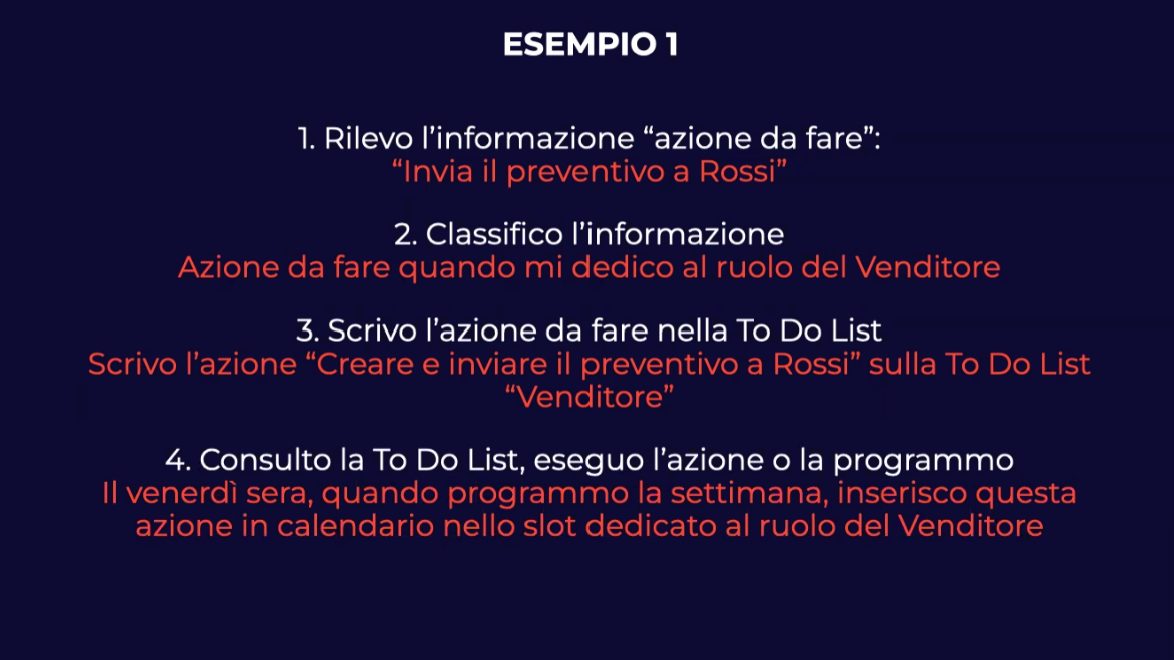
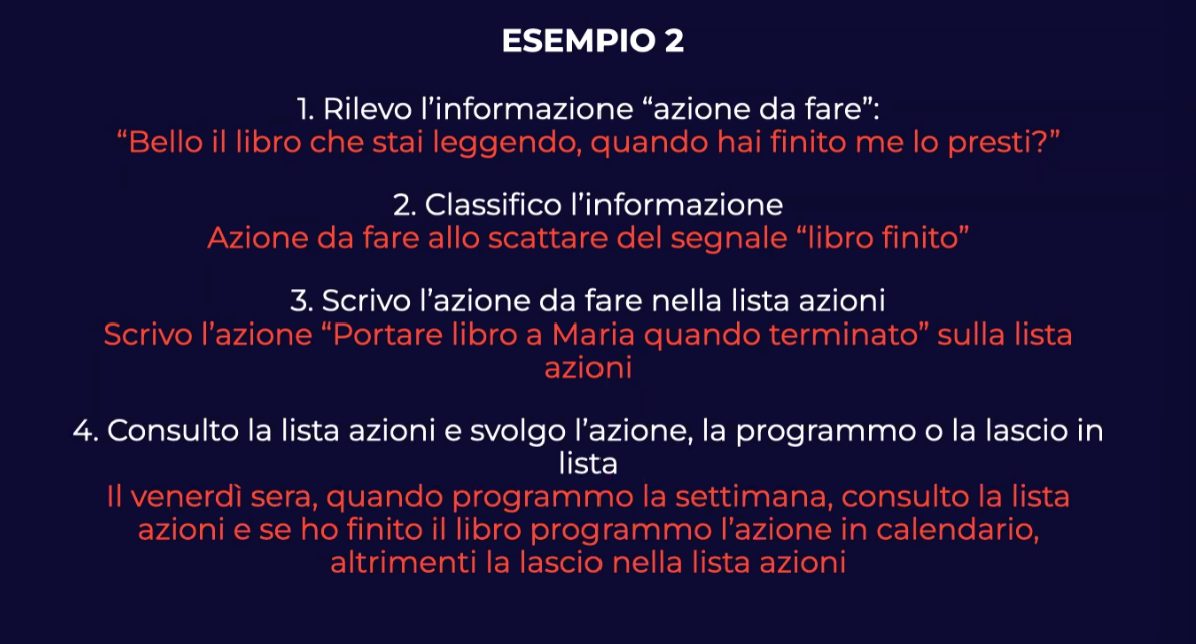
The procedure to follow when you receive information you need to remember is:
- detect the "action to do" information
- classify the information
- write the action to do in the to-do list
- check the to-do list, carry out the action or reschedule it
The following images show a few practical examples.
Solution 2
Habit: review your to-do lists once a week
To make the list a tool your mind can trust, you need to review it periodically.
The list is dynamic, never static: during the review, delete the activities that have been moved to the calendar and therefore scheduled, and add the new activities to be scheduled.
The calendar is the place that marks the end of the to-do list process: once an action has been scheduled, there is no longer any reason for it to be on the list.
The only exception is for activities that were put on the calendar but need to be rescheduled: they go back from the calendar to the to-do list until it is clear when they will be done, with precise dates and times on the calendar.
The weekly review procedure is as follows:
- check which actions are still on the list
- ask yourself whether to keep them on the list or delete them
- ask yourself whether they can be scheduled
- then put them on the calendar and remove them from the list
Another rule for refining the tool is to keep all lists on a single device, always accessible and tidy, with the details specified and the reset cleanup carried out punctually every week.
Following these rules lets the mind trust the tool and stop holding on to unfinished information, reducing the effort of remembering and increasing the energy available for thinking.
This tool can thus solve the long-term problems seen so far, with very simple and repeatable actions: using to-do lists correctly lets you increase your personal reliability, reduce mental fatigue and work with greater peace of mind.
Two simple but effective practices that can improve the situation right away and prevent consequences that harm the organizational health of the business.
Any problem can be solved in a lasting way when it is tackled with a method that combines careful analysis with concrete application of the solutions identified.
Sources and references
Haas, M., Zuber, S., Kliegel, M., & Ballhausen, N. (2020). "Prospective memory errors in everyday life: does instruction matter?". Memory, 28(2), 196-203. https://doi.org/10.1080/09658211.2019.1707227
Möschl, M., Fischer, R., Bugg, J. M., Scullin, M. K., Goschke, T., & Walser, M. (2020). "Aftereffects and deactivation of completed prospective memory intentions: A systematic review". Psychological Bulletin, 146(3), 245-278. https://doi.org/10.1037/bul0000221
Haas, M., & Martarelli, C. S. (2026). "From delay to forgetting: how boredom and procrastination disrupt prospective memory". Humanities and Social Sciences Communications.
Miller, G. A. (1956). "The magical number seven, plus or minus two: Some limits on our capacity for processing information". Psychological Review, 63(2), 81-97. https://doi.org/10.1037/h0043158
Cowan, N. (2001). "The magical number 4 in short-term memory: A reconsideration of mental storage capacity". Behavioral and Brain Sciences, 24(1), 87-114. https://doi.org/10.1017/S0140525X01003922