
Negative feedback to a team member is a corrective response given to a person about a specific behavior, with the aim of changing it.
The answer to the question is not clear-cut: putting it off reduces tension in the short term, but research on the reluctance to communicate unwelcome news, known as the MUM effect, indicates that people who have to deliver negative information tend to hesitate more than those who have to deliver positive information [3].
Whoever works alone with a few team members, whoever is accountable for a department, whoever leads a more structured company shares the same hesitation in front of the same sentence to be said.
In Italy, among companies with at least 3 employees, almost eight out of ten have fewer than 10 [2]: in a context like this, the person who should say that sentence is often the same person who hired the team member, sits next to them every day, or has a long-standing relationship with them.
The following pages address the conversation at the moment it is being put off, before it becomes an open conflict.
Negative feedback that is put off does not stay the same over time: it builds up, changes shape, and when it finally arrives it is no longer the correction of a behavior but a challenge to a sum of results that can no longer be verified.
The term "negative feedback", on its own, is ambiguous.
In the technical and scientific language the term comes from, "negative feedback" refers to the response of a system that dampens the effect of its own action — a usage that the Italian Treccani dictionary describes starting from electronics and that extends to other scientific fields [1].
In management language, "negative feedback" instead refers to the conversation in which you point out to a person a behavior that needs correcting.
The two meanings share the word but not the field: the first concerns systems, the second concerns conversations between people.
Recognizing the cost of negative feedback that is put off
Does putting off negative feedback make it lighter or heavier when it arrives?
Studies on the reluctance to communicate unwelcome news indicate that people who have to report negative information tend to hesitate more than those who report positive information: the delay is not neutral, it is a pattern described in the literature [3].
Negative feedback that is put off does not stand still over time.
It builds up together with other similar episodes, changes shape, and when it arrives — often at the annual review — it is no longer the correction of a precise behavior, but the sum of results whose details have been forgotten.
This mechanism explains why a postponed conversation is harder than the same conversation held right away, even when the content is the same.
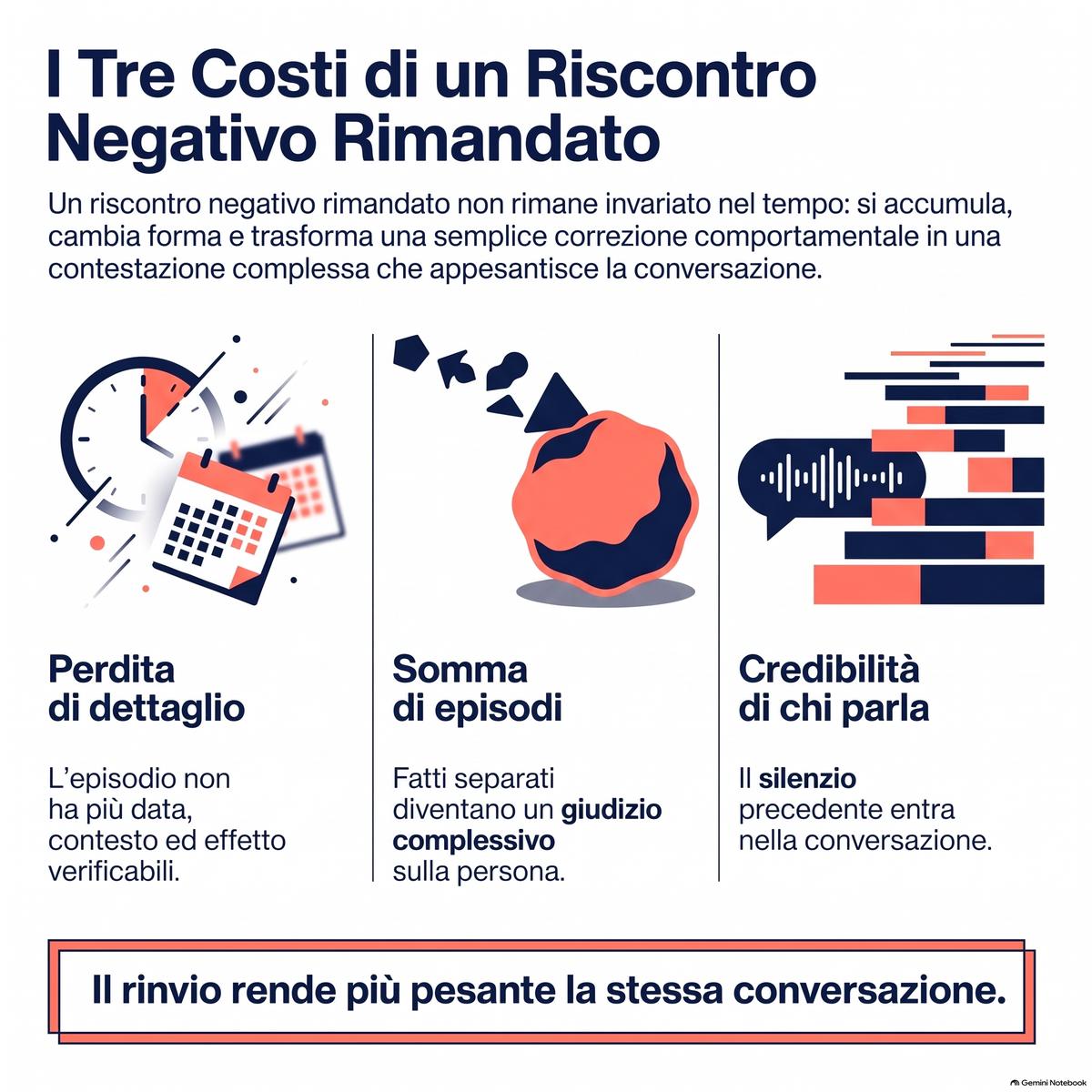
The cost of the delay shows up in three places.
The first is the loss of detail: after a few weeks the episode no longer has a verifiable date, context and effect, and all that remains is the impression that something is not working.
The second is the sum: episodes that, taken one by one, could be addressed merge into an overall judgment of the person.
The third is the credibility of the person speaking: if the episode mattered, the team member may wonder why it was not mentioned earlier, and the conversation shifts from the behavior to the silence of the person who should have spoken.
This leads to the idea that holds up the whole article: negative feedback that is put off does not stay the same over time, it builds up and changes nature, from the correction of a behavior to a challenge to results.
A practical habit is to note down right away, in one line, three elements: the date, the observed behavior (what was seen or heard, not a judgment) and the effect it had on the work.
The answer to the opening question, then, is that the delay makes the same conversation heavier, even when the content stays identical.
What remains is to establish how to begin, because the first words decide which conversation you end up in.
Opening the conversation without putting the other person on the defensive
Do the first words of an uncomfortable conversation matter as much as the rest, or are they just a formality?
It is reasonable to assume that a vague opening leaves the team member guessing how serious things are, and getting defensive out of excess caution before the content even arrives.
An opening that names the topic in one sentence reduces the room for the worst assumption.
"I'd like to talk about Monday's delivery" signals the subject without signaling the judgment.
Opening without naming the subject, on the other hand, leaves the team member to build a scenario on their own, often harsher than the real one.
When the feedback has already been put off, the opening has one more job: acknowledging the delay without turning it into an excuse.
A three-part opening covers all the needs: the subject, the acknowledgment of the delay, the stated purpose of the conversation.
An example of the order, not a script to repeat: "I'd like to talk about the delivery from two weeks ago; I should have brought it up sooner, and I'd rather do it now so we can work out together how to proceed."
The full structure of the ordinary conversation, the one that has not been put off, is described in the method for how to give feedback to team members.
The answer to the opening question, then, is that the first words are not a formality: they set the subject and the tone on which the other person will build their response.
Once the subject is set, what remains is to clarify what you are really talking about: a behavior or a result.
Telling a behavior to correct apart from a result to challenge
Does "The project went badly" correct a behavior or challenge a result?
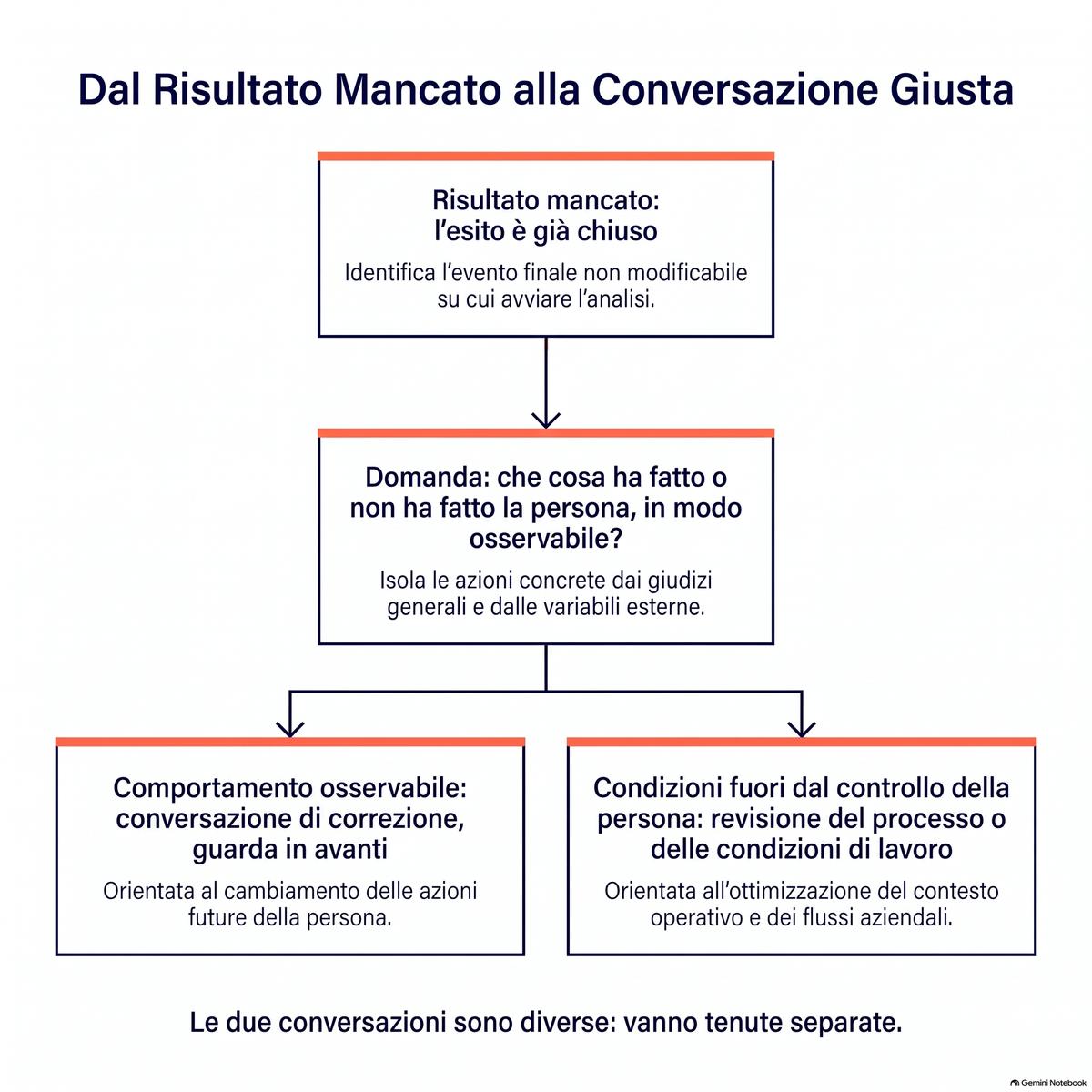
The two call for different conversations: the first seeks a future change, the second measures an outcome that is already closed — mixing them up produces a conversation that leads to neither.
A missed result can have a precise behavioral cause, or it can depend on conditions the team member did not control.
Challenging the result without having isolated the specific behavior leaves the team member with no indication of what to change next time.
When the behavior to correct is not an isolated episode but a recurring pattern of poor performance, the topic widens to what is described in the article on how to manage unproductive team members.
Consider the hypothetical case of a quote delivered to a client three days late.
The delay is the result, and its cause can be a behavior, such as starting the final checks right before the deadline, or a condition, such as the client's data arriving late.
Two questions are enough to separate the two cases: what did the person do or not do, in an observable way, and how much of what happened depended on them.
If a behavior emerges, the conversation corrects it and looks ahead; if external conditions prevail, it is about the process, and the team member has nothing to correct.
The feedback literature also points out that the effect of feedback on performance depends on where the recipient's attention is directed, on the task or on the self [4].
It is reasonable to assume that a behavior named in observable terms keeps attention on the task, while a judgment of the result as a whole shifts it to the person: this is a working hypothesis, not a figure measured on Italian companies.
The answer to the opening question, then, is conditional: "the project went badly" challenges a result, and corrects a behavior only once a specific one has been isolated.
Once the behavior is isolated, the variable that decides how manageable the conversation stays is when you have it.
Choosing the moment before the feedback becomes material for the annual review
Does negative feedback held back for months arrive more credible or less credible at the time of the formal evaluation?
An isolated episode, recounted months later together with other similar ones, loses the details that made it manageable and becomes a list of accumulated complaints.
In a small company or a professional practice, where the business owner and the team member share the same space almost every day, it is plausible that physical proximity makes it easier to put things off, not easier to face them (a working observation, not a measured figure).
What prevails is the idea that "we'll talk about it calmly" at a moment that often never comes.
Setting a short time frame — a few days, not the next performance review — reduces the number of episodes that pile up before they are named.
The context is the most widespread one in the Italian business landscape: in the 2023 permanent census of companies (reference year 2022), Italian companies with 3-9 employees number about 805,000, 78.9% of those with at least 3 employees, and those with 10-49 employees about 189,000, 18.5% of that total [2].
Consider the hypothetical case of a family manufacturing company with fifteen employees, where the business owner walks through the shop floor every morning and one team member has been with the company for ten years.
A machining error repeated for two weeks is noticed, but every occasion seems like the wrong one: the greeting on the shop floor is too informal, the Monday meeting has other people present.
A practical rule avoids this scenario: within a few days, schedule a short meeting in a private place, separate from the daily contact on the shop floor or in the office.
The answer to the opening question, then, is that feedback held back for months arrives less credible, because it has lost its details and taken on the look of an accumulated list.
Once the moment is set, what remains is to decide what you take away from the table.
Closing the conversation with a verifiable agreement, not a good intention
Has a conversation that ends with "let's try to do better" produced a commitment, or just a shared good feeling?
Without a verifiable reference point, the same conversation is likely to come back identical within a few weeks.
Closing a conversation about negative feedback needs a checkpoint, not a generic intention.
Stating what will be observed and when reduces ambiguity for both sides.
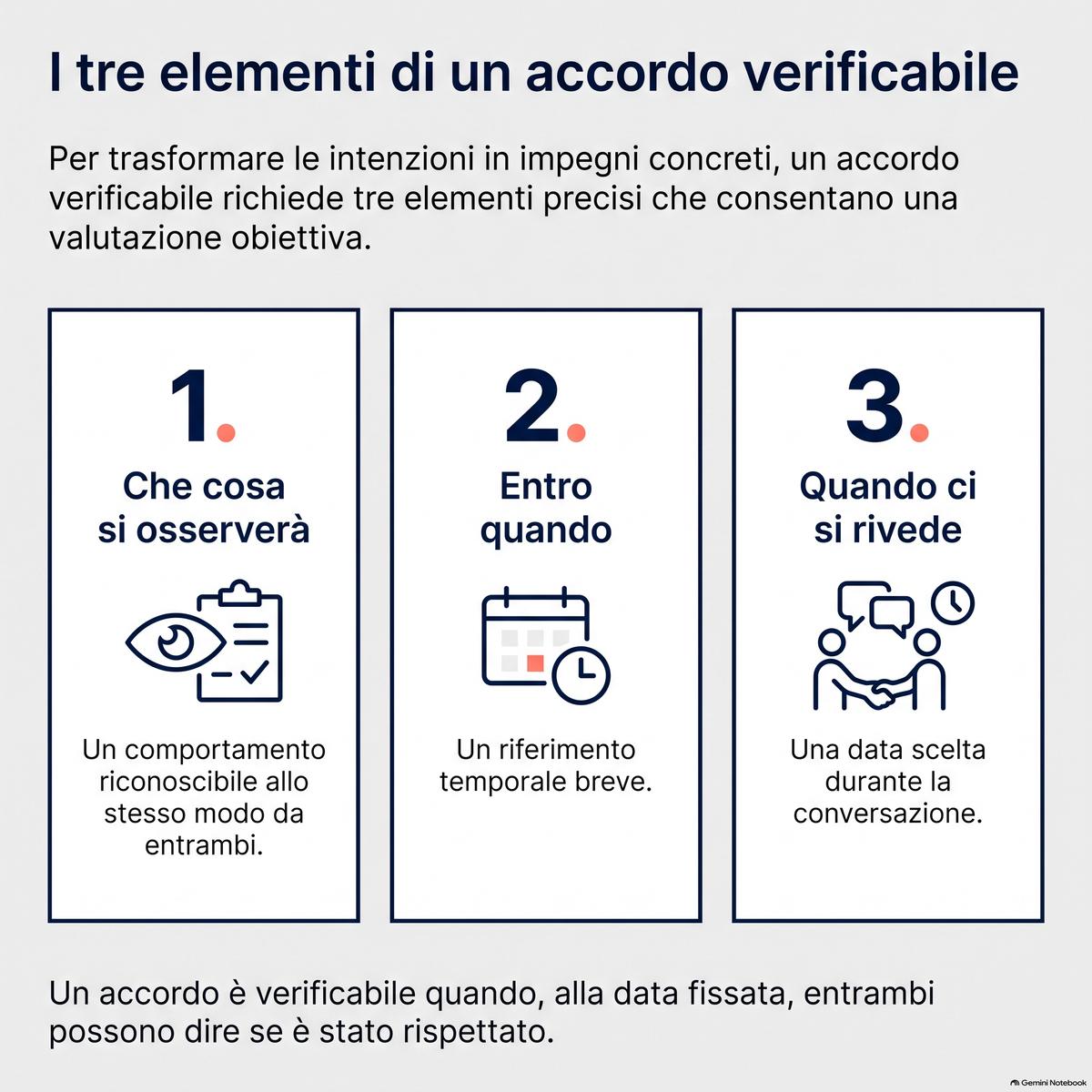
A verifiable agreement contains three elements: what will be observed, by when, and when you will meet again to check.
What will be observed is a behavior described in terms that two people can recognize in the same way, not a quality like "more attention".
In the case of the late quote, for example, the agreement can state that the final checks start the day before the deadline and that you will talk about it again after the first two quotes.
It helps to ask the team member to restate the agreement in their own words: the restatement shows whether the subject was understood in the same way and leaves room for any obstacles that have not come up yet.
The answer to the opening question, then, is that "let's try to do better" produces a shared good feeling, not a commitment: the commitment arises when it is clear what is observed and when.
A well-worded agreement does not cover every situation, however, because not every delay remains a feedback case.
Recognizing when the postponed conversation has already become a conflict
Up to what point does a postponed feedback conversation remain feedback, and when does it become conflict?
The boundary is not how long it has been put off, but the appearance of specific signals: mutual avoidance, hints dropped in meetings, escalation of decisions that used to be handled independently.
When these signals appear, the conversation described in this article is no longer enough on its own.
At that point the situation calls for the tools described in the article on conflict management at work, starting with recognizing the early signals.
In mutual avoidance, the team member and the manager stop seeking each other out, and contact shrinks to what is strictly necessary.
In hints dropped in meetings, the topic is brought up indirectly in front of other people, without being named in full.
In the escalation of decisions that used to be handled independently, even an ordinary choice becomes the subject of a request for confirmation or of a dispute.
The answer to the opening question, then, is that postponed feedback remains feedback as long as the signals concern only the delay of the person who has to speak, and becomes conflict when the tension is present on both sides.
Having clarified where the conversation stops applying, what remains is to state the limits of the whole line of reasoning.
Limits and conditions of applicability
The guidance in this article consists of good communication practices, not a method validated on samples of Italian companies.
The research cited [3][4] belongs to social and organizational psychology and was not conducted on Italian companies: its transferability to a small company or a professional practice is a hypothesis.
The Istat figure [2] concerns Italian companies with 3 or more employees, and does not cover professionals without employees or even smaller organizations, which are nonetheless part of the intended readership.
The guidance does not apply when the behavior in question amounts to a breach with disciplinary or contractual consequences.
In that case a separate path is needed, within the constraints set by the applicable labor law and employment agreements, to be defined with an employment law advisor.
Nor does it apply when the conversation concerns the team member's personal difficulties outside of work, for which the appropriate setting is not feedback on performance.
Frequently asked questions
How do you give negative feedback to an employee when you have waited too long?
You start by acknowledging the delay in a single sentence and naming the subject of the conversation.
Then you separate the behavior to correct from the result that is already closed, and agree on a checkpoint.
The delay cannot be erased, but stating it keeps the earlier silence from becoming the real topic of the meeting.
How much time can pass before giving negative feedback to an employee?
The sources consulted do not indicate a threshold in days beyond which feedback loses effectiveness: the figure is not available.
As a working guideline, it is better to schedule the conversation within a few days of the episode, without waiting for the performance review.
The criterion is to keep the episode from adding up with others and losing its details.
When does postponed negative feedback to an employee become a conflict?
The boundary is not how long it has been put off, but the appearance of signals that involve both sides: mutual avoidance, hints dropped in meetings, escalation of ordinary decisions.
When these signals are present, the feedback conversation alone is not enough.
You need the tools for conflict management, covered in the dedicated article.
Operational summary
Negative feedback that is put off does not stay the same over time: it loses its details, adds up with other episodes and ends up being a judgment of the person instead of the correction of a behavior.
This is why the timing of the conversation is the first variable to manage, and it is best to set it within a few days of the episode.
The opening names the subject and acknowledges the delay, the core separates the behavior to correct from the result to challenge, and the close sets a verifiable agreement with three elements: what will be observed, by when, and when you will meet again.
When mutual avoidance, hints dropped in meetings or escalation of ordinary decisions appear, the conversation is no longer enough and you need to move on to conflict management.
Conclusion
Negative feedback that is put off does not get easier with time: it builds up, loses the details that made it manageable, and when it arrives it risks measuring a sum of episodes instead of correcting a precise behavior.
The difference between correcting a behavior and challenging a result remains the point to start from again when the conversation seems harder than expected.
For ordinary feedback, the kind that has not been put off, the article on how to give feedback to team members describes the basic structure of the conversation.
When, instead, the signals of delay have already turned into visible tension, the article on conflict management at work explains how to step in.
A company where uncomfortable feedback is given when it is needed, and not when it can no longer be put off, is a company where difficult conversations stay small instead of becoming events.
Sources and references
[1] Treccani, "Feedback", Vocabolario Treccani on line, Istituto della Enciclopedia Italiana. Available at: https://www.treccani.it/vocabolario/feedback/
[2] Istat, "Censimento permanente delle imprese 2023: primi risultati" (multipurpose survey, sample of about 280,000 Italian companies with 3 or more employees, reference year 2022), Istat, November 14, 2023. Available at: https://www.istat.it/comunicato-stampa/censimento-permanente-delle-imprese-2023-primi-risultati/
[3] Rosen, S., & Tesser, A., "On Reluctance to Communicate Undesirable Information: The MUM Effect", Sociometry, 33(3), 1970, pp. 253-263. Available at: https://doi.org/10.2307/2786156
[4] Kluger, A. N., & DeNisi, A., "The effects of feedback interventions on performance: A historical review, a meta-analysis, and a preliminary feedback intervention theory", Psychological Bulletin, 119(2), 1996, pp. 254-284. Available at: https://doi.org/10.1037/0033-2909.119.2.254