
Creating a procedure takes time, skills and discussion. Yet, once it has been introduced, there is no guarantee it will actually be used. At first it may seem that everything works: people consult the instructions, follow the steps and adopt the agreed method. Then, gradually, something changes. The procedure is followed only in part, some steps get skipped and, in some cases, people go back to working the way they did before.
Why does this happen? The most immediate explanation is a lack of discipline, attention or willingness to follow the rules. But what if the problem didn't depend only on people? What if the very way a procedure is conceived contained something that makes it hard to use in day-to-day work?
A procedure can look correct, complete and well documented without becoming part of the way work gets done. This is exactly where an often overlooked aspect lies: there is a fundamental difference between creating a procedure and making sure it is actually used.
Understanding what this difference depends on means moving past the idea that, to get a procedure followed, it is enough to write it down and ask people to follow it.
The problem: procedures that go unused
Many companies have written procedures, created to show how activities should be carried out, that are not used consistently. The business owner put them in place, yet they are not always followed by team members, customers, suppliers or even the business owner.
The procedures exist, but in practice they are applied only partially, imprecisely or inconsistently.
So the problem is not necessarily the absence of procedures, but the difficulty of making sure they are actually used and put to work.
To understand how to tackle this difficulty, you first need to clarify what is meant by a procedure and what role it should play within the company.
What a procedure is
Everyone knows the word procedure, but it is not always used precisely. In this context, a procedure means any written document in the company that describes how to carry out an activity.
A procedure is an operational asset: it can be a procedure in the strict sense, a manual, a checklist or a production flow. In essence, it is a document that contains the operating instructions needed to carry out a task, specifying how to do something.
This is the core of the problem under analysis: somewhere it is written down how certain activities should be carried out, but people keep doing them without using those instructions or without following them precisely.
To understand how widespread this problem is, it helps to look at what research shows about the presence of procedures in organizations and their actual use.
What science says about how widespread procedures are and how they are used
How widespread are procedures in companies today?
On average, how closely are written procedures followed?
Organizational formalization, process standardization and business systemization are the reference areas to consider when looking into how widespread procedures are in organizations.
To answer the first question, it helps to consider two indicators of organizational formalization: how widespread structured management practices are, and how widespread certified quality management systems are.
Bloom and colleagues (2019)*1 analyzed the management practices adopted by companies, looking at 16 aspects related to performance monitoring, target setting and incentives. The results show how widespread these practices are and how much they vary from one organization to another. In particular, 18.3% of companies adopted at least 75% of the practices analyzed, 54.4% adopted between 50% and less than 75%, and 27.3% adopted less than 50%.
A second indicator is the spread of quality management system certifications. Data from the ISO Survey, which collects information on valid certificates for international standards, show the growth of ISO 9001 certifications worldwide*2. This trend points to a wider adoption of certified quality management systems.
To obtain ISO 9001 certification, organizations must define, manage and control the processes needed for their quality management system and maintain the documented information required by the standard*3. This requirement encourages the formalization of activities through documents such as procedures, work instructions, process flow diagrams and checklists.
The two lines of research therefore offer complementary insights into organizational formalization. On one side, studies on management practices describe the adoption of structured methods for managing business activities; on the other, ISO Survey data document the spread of certified quality management systems, which require adequate process documentation.
To answer the second question, you need to distinguish between the formal existence of a procedure and whether it is actually followed.
A systematic review of 96 studies on hand hygiene in hospital care, conducted by Erasmus and colleagues (2010)*4, found a median compliance with the guidelines of 40%. The figure varied by professional group: compliance was 32% among physicians and 48% among nurses. In addition, the guidelines were followed in 21% of cases before contact with the patient and in 47% after contact. The 40% is the median of the compliance levels found in the studies reviewed, not the overall percentage of all observed opportunities.
A study by Brown and colleagues (2021)*5 highlighted an even sharper gap between documented compliance with a procedure and its actual application. The researchers examined the surgical safety checklist, comparing the completed documentation with direct observation of the activities. While the documents showed 100% compliance, direct observation found that the checklist was carried out correctly and in full in only 3.5% of cases. Following organizational and training interventions, compliance with the procedure rose to 63%.
The study shows that checking that a procedure has been recorded as completed is not the same as checking that it was actually carried out.
A similar result emerges from the study by Giles and colleagues (2017)*6 on the use of surgical checklists in Australia. The researchers compared what the documentation showed with what was actually done during surgery. The documentation showed 86% completion, while direct observation found 27% completion.
The gap shows how formal completion can paint a very different picture from the real-world application of procedures.
The study by Sendlhofer and colleagues (2015)*7, on the implementation of a surgical safety checklist, also distinguishes between using a procedure and completing it in full. Across three successive audits, the checklists were used in 95.3%, 91.9% and 89.9% of cases respectively. Considering only the checklists that were used, however, the rate of full completion was 81.7% in the first audit, 60.6% in the second and 53.2% in the third. In the last audit, then, almost 90% of the checklists were used, but just over half of those used had been completed in full.
Taken together, these studies show that the formal existence of a procedure, its use and full compliance with it are three distinct things.
A procedure can have been introduced and be properly documented without being applied in all its parts.
Having a written procedure, therefore, does not guarantee that it will be used correctly in everyday practice.
When this gap between documented procedures and the work actually done repeats itself over time, the problem has consequences that affect not only how work is carried out, but also the organization's knowledge, autonomy and ability to improve.
The effects of not following procedures
When procedures are not used or not followed precisely, the consequences show up in several areas of the organization.
- Errors from distraction and forgetfulness increase
Activities carried out without referring to the written instructions increase the risk of making mistakes during execution: it is easier to get distracted or forget steps when you rely on your own mind and memory to carry out a task.
Errors caused by distraction or forgetfulness mostly concern cases where people have the knowledge and skills needed to carry out an activity, but do not apply them correctly.
Distraction and forgetfulness also have a further negative effect: they often fail to trigger reactions that change behavior. The mistake is acknowledged, people apologize and move on, without addressing the conditions that made it possible. As a result, the same mistake can happen again because no improvement is identified and put into practice.
- Dependence on team members increases
When know-how is not translated into written procedures, knowledge improves only in the head of the person doing the work. The organization cannot preserve it and make it available to others. The result is a zeroing effect: when an employee leaves the company, part of the knowledge acquired is lost (along with the person who leaves) and the work has to start again from scratch.
- Improving becomes difficult
Without written procedures, there is no documented representation of the process to work on. Activities are carried out from memory, based on individual knowledge, without an explicit reference that makes it possible to observe the process, evaluate it and improve how it works. Improvement thus becomes much harder, if not impossible.
Given these consequences, it is clear that failing to follow procedures is a problem with concrete effects on the whole system, and that it needs to be addressed right away.
Before choosing how to act, however, you need to clarify which condition you really want to reach: the possibility of finding an effective solution depends precisely on how the goal is defined.
Defining the goal to solve the problem of procedures that aren't followed
Before acting to solve the problem, you need to understand what the ideal condition to reach is. If the goal is defined wrongly, the solution is likely to be wrong too.
When faced with a problem, the mind tends to suggest a condition that seems desirable but can keep you stuck in the problem itself.
When procedures exist but are not followed, what condition should you aim for?
The most immediate and common answer is not necessarily the right one for reaching a solution that fixes the lack of use of procedures in a definitive and lasting way.
That's why it helps to distinguish between a wrong and a right ideal condition, in order to define the right goal to aim for to solve the problem.
Wrong ideal condition: everyone follows procedures blindly.
This condition cannot realistically be reached, because it would require people to constantly switch off their own thinking, giving up autonomy, initiative and their own uniqueness.
An organization in which people simply carry out instructions without thinking can work only under certain conditions, for example when most decisions are concentrated at the top and those doing the work are given very little autonomy. But in smaller companies (though not small ones), team members need to be able to think, assess situations and contribute to how the organization runs. The issue, moreover, does not depend only on company size, but also on how the company is managed.
If the goal cannot be blind execution, you need to identify an ideal condition that allows procedures to be used without giving up the ability to think and act independently.
Right ideal condition: everyone actively improves the procedures.
This is the goal to pursue to solve the problem.
The way to make procedures work and get them used is not to impose them on team members, but to give them the job of improving them.
Giving people the job of improving procedures completely changes their relationship with them: it is no longer about passively carrying out instructions prepared by others, but about using procedures as work tools that they can act on to get better results.
To understand why this change is so important, you need to examine the beliefs that lead people to see procedures as tools to impose and comply with, rather than tools to use and improve.
The mechanism that leads to procedures going unused
The problem is likely rooted in wrong beliefs that lead to equally wrong solutions, which, instead of solving the problem, keep it going over time and normalize it.
To understand the mechanism that leads to procedures going unused, it helps to look into the beliefs at the root of the problem, the false solutions these beliefs lead to in the attempt to solve it and, finally, the causes that really generate it.
The first step in analyzing how the problem is created is to start from a fundamental question: what is a procedure for?
The answer most people give may contain the very wrong idea that prevents the problem from being solved.
Asked what procedures are for, many people might answer that they are useless! It is an answer that, when it refers to procedures set up and used in a certain way, is even consistent: if a procedure produces no concrete improvement and is only imposed or filled in as a formality, its operational value effectively drops to zero.
Even turning to an expert professional may not be enough to solve the problem, if the advice received rests on a wrong belief.
One of the most common recommendations, in fact, is that "procedures must be written to be foolproof".
But if a procedure is designed to be used by someone who isn't supposed to think, it will end up suited only to people who aren't supposed to think. If the person using it is not a fool, they may not want to follow it precisely because it was designed for someone who isn't supposed to think. If, on the other hand, the person using it is not able to think independently, they may still not apply it.
The result is paradoxical: procedures risk going unused both by those who want to think for themselves and by those who are supposed to just follow instructions.
When they are overly detailed and spell out every single step, procedures can also prevent people from using their own powers of observation and judgment. Those who follow them are not asked to think, while those who want to reason and find solutions may reject a tool that forces them to carry out instructions without being able to change anything.
So the problem is not only the level of detail in procedures, but also the way they are conceived and introduced into the organization. This shows up in a second common belief: the idea that procedures should be prepared exclusively by those higher up in the hierarchy.
A second wrong belief is that procedures should be set from the top.
In reality, the reasoning is the opposite: procedures should be set by the people who carry out the activities, because they are the ones who will actually have to use them. Whoever does an activity knows its operational features and can spot the opportunities for improvement that come up during the work.
Creating and improving procedures should therefore be part of everyone's responsibilities, rather than a task reserved exclusively for the upper levels of the organization.
These beliefs, too, stem from an underlying idea about the purpose of procedures. To fully understand the problem, you therefore need to examine what you are trying to achieve by applying them.
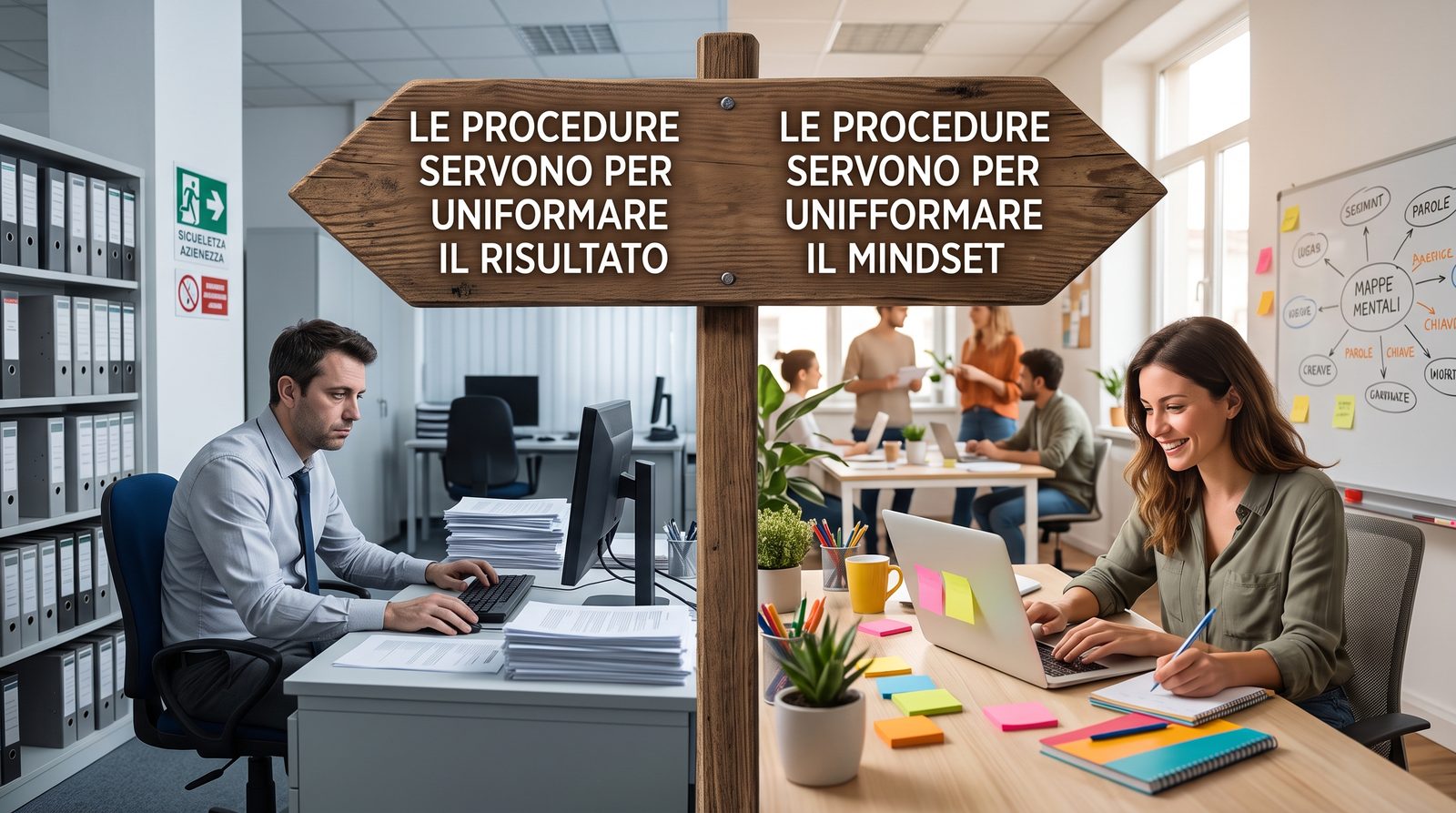
Wrong idea: procedures are for making results uniform
A common belief is that procedures exist to make sure everyone reaches the same result.
It is a logic typical of mass production processes, like those associated with IKEA and McDonald's: the process determines the result and, the less people are asked to use their own minds, the more the aim is to get uniform results.
This approach seeks total control over execution, with the aim of always getting the same result. Yet nobody wants to be treated as a number, the same as everyone else and forced to always behave in the same way.
Moreover, demanding that the result always be identical is artificial and ignores the laws of physics and biology, which make a perfectly identical reproduction of every condition and every outcome impossible.
Uniformity can be useful, but it should concern the way activities are approached and carried out, not the elimination of differences between people and of the results that can come from their individual abilities.
You therefore need to distinguish uniformity of results from uniformity in the way of thinking and working: it is the latter that the role of procedures should focus on.
Right idea: procedures are for making the mindset uniform
Procedures should not serve to make results uniform, but the mindset, that is, the way of thinking and approaching work.
The goal is for people to share a common way of carrying out activities, while keeping the ability to express their own individuality and their specific talent.
The way of working should be guided by shared principles, but the result can express each person's distinctive abilities. Uniformity should therefore concern the mindset and the approach to activities, not necessarily the outcomes produced.
Changing the idea underlying your beliefs is the first step toward solving the problem. It is step number one.
The key question remains: what are procedures for?
To answer it, you need to understand why an activity may not be carried out correctly. Not all difficulties in execution have the same cause: it is therefore useful to look more closely at human fallibility and identify the causes that can prevent people from carrying out activities correctly.
This analysis makes it possible to distinguish what a person cannot do, what they don't yet know how to do, and what they could do but don't.
Distinguishing these situations makes it possible to understand what role procedures should play.
Causes of human fallibility
In their essay on human fallibility, Samuel Gorovitz and Alasdair MacIntyre*8 distinguish three fundamental causes of human fallibility:
- Impossibility. The available resources are insufficient, or the goal to be reached exceeds human capabilities.
- Ignorance. The activity would be possible, but the knowledge and skills needed to carry it out correctly are not yet there.
- Ineptitude. The necessary knowledge and skills are there, but they are not used.
It is important to distinguish cases in which an activity is not carried out correctly because the necessary knowledge and skills are missing from those in which people already have the ability to carry it out but do not use it. This distinction makes it possible to understand what role procedures should play: addressing ineptitude, not replacing missing knowledge and skills.
Procedures, then, serve to reduce, if not eliminate, ineptitude. They should not make results uniform, but lighten the cognitive load while carrying out an activity, making it possible to do it better and to improve it.
A written procedure can play this role because it offers an external reference while the activity is being carried out. This way, you don't have to rely solely on memory to remember all the steps, and it becomes possible to compare what you are doing with the instructions set out in the procedure.
When an activity is carried out by relying on a written procedure, it can become possible to take a meta-position: observing your own work while you do it, as if you were observing that of a team member. From this perspective, problems and opportunities for improvement can become more evident.
If during execution all your attention is absorbed by the task, there is less mental space left to observe how you are doing it. A procedure makes it possible to lighten this cognitive load, freeing up mental resources for observation and improvement.
This develops a form of metacognition: the ability to observe your own way of working while carrying out an activity, recognizing what works and what can be improved.
The goal, therefore, is to create your own procedures and put them to concrete use. Not just reading or following them, but using them while carrying out activities to identify and introduce improvements.
This process does not end when the product or the procedure seems perfect, because definitive perfection cannot be reached: there are always further opportunities for improvement. Work on procedures should be seen as an ongoing process.
If the role of procedures is also to support execution and free up mental resources for improvement, it becomes clearer why some of the usual reactions to their lack of use do not solve the problem. It is therefore useful to examine the most common false solutions adopted to solve it.
The most common false solutions for getting procedures followed
When people realize that procedures are not being followed, they tend to look for solutions that, instead of tackling the problem at the root, act in the wrong direction or only on the surface.
The first reaction may be to take a course on procedures. However, if the training rests on the wrong assumption that procedures should make results uniform, it risks reinforcing the very belief that keeps the problem going.
The most common false solutions include:
- Increasing controls (imposition). When procedures are not followed, people try to get more compliance through more frequent checks and stricter enforcement. This way, however, they act on the obligation to carry out procedures rather than on their actual use and improvement.
- Stopping using procedures. When people realize that procedures are not being followed despite their efforts, they may end up giving up on them. Little by little, non-compliance becomes normal and procedures lose their operational function.
These reactions show two different ways of not tackling the problem at the root: on one side, people try to enforce compliance with procedures; on the other, they give up on using them. To act effectively, you need instead to identify the real causes that generate and sustain the problem, and act on them.
The real causes of procedures going unused
To solve the problem, you need to identify the reasons why it exists and persists.
The real causes of a problem are gaps, that is, shortcomings that create critical issues and keep them going.
Two of the first causes to consider in order to understand why procedures go unused in a company concern how their usefulness is communicated and the habit of improving them.
- The usefulness of a procedure is not communicated.
People have been given the wrong information about the purpose of procedures. The idea may come across that following them means becoming a number, being replaceable and giving up your individuality and talent.
If procedures are presented as tools that force everyone to carry out activities in the same way, leaving no room for individual thinking, it is understandable that they are seen as a limit rather than a resource.
It is therefore necessary to communicate their real usefulness: reducing ineptitude, lightening the cognitive load while carrying out activities and freeing up mental resources for observation and improvement. - There is no habit of improving procedures.
People need to be used to improving procedures, not just following them. The message to get across is not simply to comply with what has been written, but to work on procedures to make them progressively more effective.
For this reason, it is not enough to introduce a checkpoint to verify whether procedures have been followed. You need to create a time dedicated to developing them, in which people can discuss how to improve them.
The two causes identified call for matching interventions: communicating the usefulness of procedures to everyone, to overcome the belief that they are tools of imposition, and introducing an organizational habit dedicated to improving them, so that people learn to use them actively in their work.
Practical tips for having procedures that get followed
Practical actions need to address the two causes identified: the failure to communicate the usefulness of procedures and the lack of a habit of improving them. The first action serves to clarify why procedures are useful; the second to make their improvement part of everyday work.
- Write down and communicate to all team members what a procedure is for.
You need to explain clearly what procedures are for: reducing ineptitude and forgetfulness, lightening the cognitive load, encouraging people to observe their own work and improving both the process and the way the work is done.
Procedures should be presented as tools that protect and enhance people's abilities, not as instructions that take away their ability to think and act independently. - Set up regular meetings to improve procedures.
One option is to hold a monthly meeting dedicated to improving procedures. The goal should not be to check whether they have been followed, but to figure out how to make them more effective.
Having a regular appointment dedicated to improvement helps build a habit: while carrying out their activities, people are encouraged to observe their own work and identify possible improvements to propose.
This way, improving procedures becomes an integral part of the work. It encourages a shared mindset, in which everyone is actively involved in developing processes, rather than just carrying out instructions prepared by others.
The two practical actions introduced here therefore turn into concrete behavior the principle on which the whole line of reasoning rests: procedures gain value when people understand their usefulness and are involved in improving them.
In conclusion, procedures do not become useful simply because they are written, introduced or imposed. Their value depends on the ability to turn them into work tools that help carry out activities better, reduce forgetfulness and ineptitude, and free up mental resources for improvement.
The goal, then, is not to have team members who follow procedures blindly, but people who understand their usefulness and help develop them. Procedures should make the way of thinking and approaching work uniform, not the results, leaving room for everyone's talent and individuality.
That's why improving procedures must become an integral part of everyday work: this is how they stop being mere documents to comply with and become tools for concretely improving processes and your own way of working.
Sources and references
*1 Bloom, N., Brynjolfsson, E., Foster, L., Jarmin, R., Patnaik, M., Saporta-Eksten, I., & Van Reenen, J. (2019). What Drives Differences in Management Practices? American Economic Review, 109(5), 1648–1683.
*2 International Organization for Standardization (ISO). (s.d.). The ISO Survey.
*3 International Organization for Standardization (ISO). (2015). The process approach in ISO 9001:2015. ISO/TC 176/SC 2/N1289.
*4 Erasmus, V., Daha, T. J., Brug, H., Richardus, J. H., Behrendt, M. D., Vos, M. C., & van Beeck, E. F. (2010). Systematic Review of Studies on Compliance with Hand Hygiene Guidelines in Hospital Care. Infection Control & Hospital Epidemiology, 31(3), 283–294.
*5 Brown, B., et al. (2021). Surgical safety checklist audits may be misleading! BMJ Open Quality, 10, e001593.
*6 Giles, K., et al. (2017). Use of surgical safety checklists in Australian operating theatres: an observational study. ANZ Journal of Surgery.
*7 Sendlhofer, G., et al. (2015). Implementation of a Surgical Safety Checklist: Interventions to Optimize the Process and Hints to Increase Compliance. PLOS ONE, 10(2), e0116926.
*8 Gorovitz, S., & MacIntyre, A. (1975). Toward a Theory of Medical Fallibility. In The Journal of Medicine and Philosophy, 1(1), 51–71.