
Responsibilities grow, commitments grow and, over time, so does the risk of neglecting something important. It can happen at work, when a strategic activity keeps getting postponed, but also in your personal life, when a role or a responsibility ends up on the sidelines because you didn't find the time to take care of it.
The problem isn't always a lack of time. Often the time available gets allocated without first considering what needs to find room in the day. The result is a constant chase after urgent matters, with important activities stuck on the to-do list and roles that get attention only when the situation demands it.
To keep this from happening, you need to change the way your time is organized: but for time management to work as a method, it has to start from a fundamental awareness about something that is often ignored.
The problem: neglecting important roles and activities
Having many roles and many responsibilities makes it easier to neglect what matters.
The company may be running well while your family gets neglected; or all your attention may go into the company while your rest, your body or your well-being get neglected. Some of your roles within the company may also end up neglected.
The same can happen when it's your team members who neglect a role.
When roles get neglected, a problem arises.
You live with a constant sense of emergency and crisis: sooner or later, what gets neglected can become impossible to ignore.
So you live with the constant feeling of not having done everything you should have done, and with an ongoing sense of inadequacy. This condition can be called non-fulfillment.
Non-fulfillment means failing to carry out, or carrying out incompletely, an obligation, a duty or a commitment you have taken on: it means not doing what you should have done.
But how can you know what you really should have done?
Every time you take on a role, you automatically take on certain obligations as well. When you become the CEO of a company, for example, or a parent, you take on obligations tied to that role, whether you know them or not.
Since you hold many roles in life, it becomes more likely that you lose sight of some of the things to do, and so it becomes easier to fall short.
Non-fulfillment can show up both as a personal feeling of not doing what you should be doing, and concretely, as a failure to carry out what the role requires.
Holding many roles, then, doesn't just increase the number of activities to carry out: it also increases the chance of losing sight of what each role requires.
To understand how significant this phenomenon is and how different roles shape the perception of non-fulfillment, it helps to look at what science says.
What science says about roles and the perception of non-fulfillment
To understand the problem of non-fulfillment, it helps to analyze, by cross-referencing scientific research and studies, how many roles a person holds on average, how involved and aware they are of each role's functions, and how well they manage to give each role the time it needs.
So it's worth asking two questions:
how widespread is non-fulfillment?
how much do people feel they are wasting time?
A first element to consider in answering is the number of roles each individual currently holds.
In 1986, the roles a person held ranged on average from 1 to 5: a study of 500 employed women, with data collected in 1981, identified 1 to 5 roles among worker, partner, parent, volunteer and student (Pietromonaco, Manis and Frohardt-Lane, 1986)*1.
More recent research, published in 2026, let participants freely identify their own roles and found an average of 6.28 roles in a typical workday, across 202 workers. This value falls between the 4.03 and 8.17 roles reported by previous research (Paryono et al., 2026)*2.
What emerges, then, is greater attention in contemporary research to role set density, that is, the number of roles a person holds across the different areas of their life*3.
A particularly relevant aspect of the study, however, concerns not only how many roles people hold, but also how close together or overlapping these roles are in time.
The authors introduce the concept of role occurrence proximity, which indicates the extent to which several roles are performed within the same time span or at closely spaced moments*2.
According to the authors, contemporary ways of working and technology also make it more likely that the boundaries between roles overlap: a person may, for example, switch quickly from one role to another or perform more than one in the same time interval.
The finding suggests, then, that the problem is not simply the number of roles to fill, but also the need to cover different functions in quick succession.
More roles mean more functions to keep in mind and, when these follow one another or overlap quickly, it can become harder to recognize which role needs attention at that moment.
You can see, then, how as roles increase and overlap in time, it can become easier to neglect some functions, get absorbed by emergencies and fall short.
In other words, more roles also means more functions to cover and more chances that some of them get neglected.
Engagement in your own role also shows how hard it can be to stay consistently involved.
According to the State of the Global Workplace 2026, based on data collected in 2025 in more than 140 countries and territories, only 20% of workers worldwide are engaged, while 16% are classified as actively disengaged (Gallup, 2026)*6.
Among managers, engagement fell from 27% in 2024 to 22% in 2025.
The figure doesn't measure non-fulfillment directly, but it shows that engagement in your own work can't be taken for granted.
Another element of great interest in defining the current situation concerns the ability to estimate time correctly.
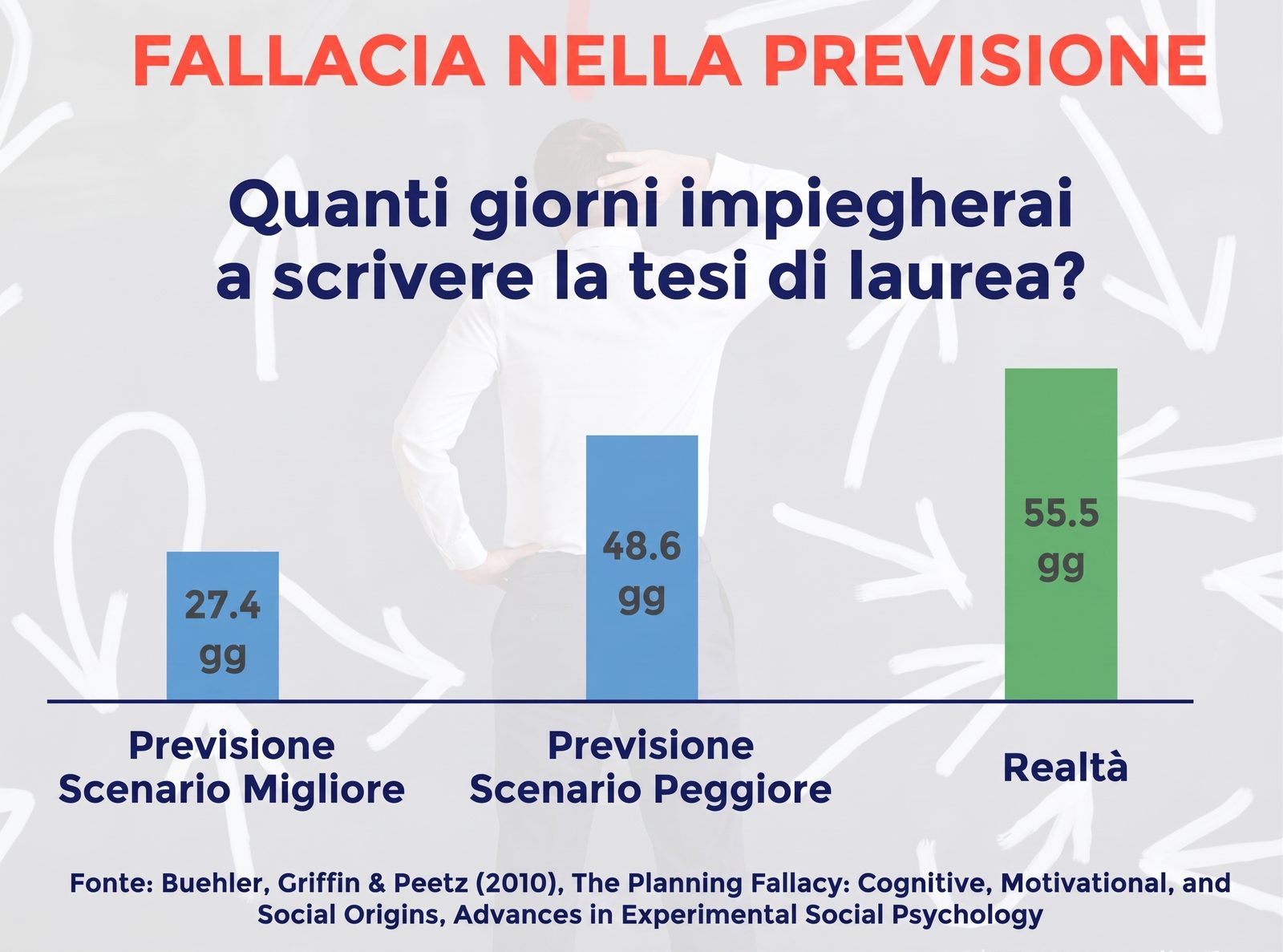
Research on the planning fallacy points to the tendency to predict that you will finish a task sooner than you actually will (Buehler, Griffin and Peetz, 2010)*4.
In the studies the authors cite on writing a thesis, students estimated they would complete it in about 30 days, while it actually took them about 55; even when asked to imagine the worst-case scenario, their prediction remained below the time actually needed.
The phenomenon doesn't only affect students: a study of 759 procedures performed by nine orthopedic surgeons found a 17.3% underestimation of total operating room time (Katt et al., 2021)*5.
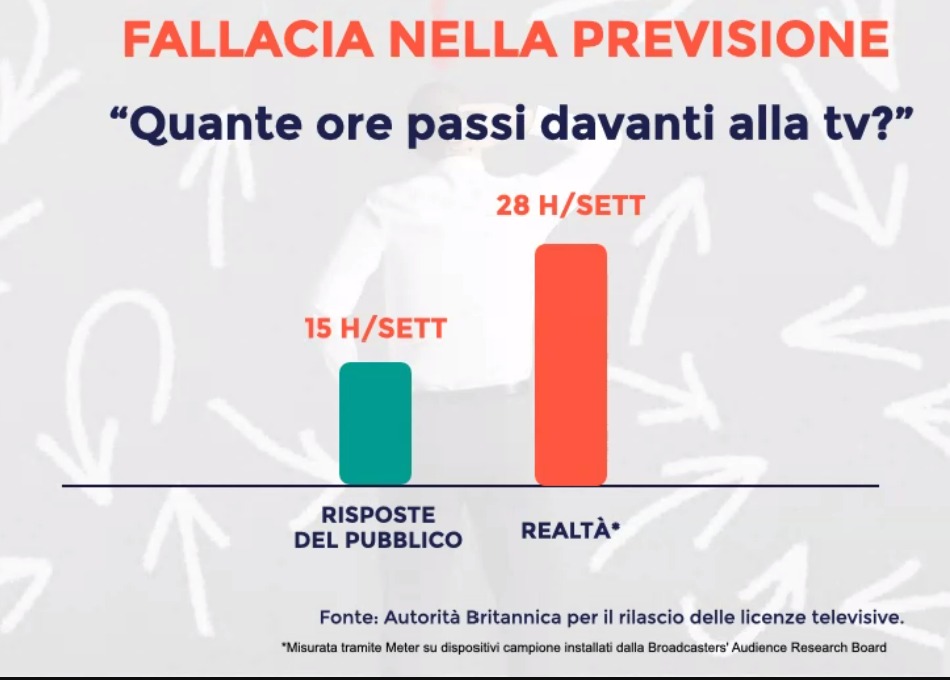
Research shows, then, that people can have an imprecise perception both of the number of roles they need to cover and of the time needed to carry them out.
Overall, this research helps clarify an important point: people don't always realize that they aren't giving a role the time and attention it needs, and at the same time they may underestimate the time required by the activities they have to carry out.
When this difficulty repeats, the risk is that non-fulfillment isn't recognized in time and its consequences only surface later.
It is therefore necessary to understand what effects non-fulfillment of your roles and their functions produces, in order to size the problem through the harmful consequences it brings.
The effects of non-fulfillment
Non-fulfillment has several consequences, which can affect both the person and their relationships with others.
- Greater risk of emergencies: the more roles you hold, the easier it is for each role to generate an emergency that adds to the emergencies of the other roles. It may involve a child, a supplier, a customer, a department or any other area. When you fall short, sooner or later the emergency blows up, like a pressure cooker, and at that point it can no longer be neglected. The problem is that, by attending to the emergency of one role, you risk neglecting the other roles as a result.
- Loss of self-confidence: non-fulfillment also leaves marks inside. You are aware that you're not doing what you should be doing, and you start justifying the missed behavior or the gap. Part of you weakens because it perceives an inconsistency between what you should do and what you actually do. This inconsistency causes a loss of self-confidence.
- More stress and a greater sense of fatigue: you never reach the full satisfaction that comes from having completed what you had to do. It is increasingly common to have so many things to do that you can't even fit them all into a to-do list. The difficulty, then, is no longer just completing the to-do list, but managing to know everything you should be doing.
- Lower reliability: other people notice non-fulfillment. Just as your self-confidence drops, the trust others place in you can also drop when they notice that certain commitments, duties or functions aren't being carried out.
What it really means to fulfill your roles
To get out of non-fulfillment, you need to identify the ideal condition to aim for. Once non-fulfillment is eliminated, what is the goal to reach? What does it really mean to fulfill your roles?
It's important to pay attention to what you consider the ideal condition, because if you pick the wrong goal, the solution will also head in the wrong direction.
Wrong condition: "always finishing everything on the list"
One possible ideal condition might be always managing to complete everything you have to do, that is, getting through your to-do list.
That would certainly be a good situation, but it isn't the ideal condition for eliminating non-fulfillment.
To-do lists, in fact, are built by the person themselves and are therefore filtered by what that person knows about the functions of their role. A list contains what you know and know you have to do. But if you don't know all the functions of a role, you can never be sure you've included everything you should be doing.
Non-fulfillment, then, isn't solved by managing to do everything on the list you built yourself. Non-fulfillment is about not doing something that was your duty. The key point is precisely duty, that is, what you are obliged to do in relation to the functions of that role.
Correct condition: "fulfilling all your functions"
The correct condition is fulfilling all your functions, that is, doing everything you should do to fulfill the role.
This means giving each role the right amount of time and carrying out the right activities for it.
It is first of all a question of knowledge: what are the functions of the roles you hold? If you don't know them, how can you put on the calendar what needs to be done?
You need, then, to know the functions of each role you hold, whether it's parent, partner, CEO or any other.
The key point is knowing the functions of all the roles you hold. These are professional roles, personal roles and also meta-roles, that is, roles that concern you as a person beyond your other roles. You can also fall short toward yourself, your body and your well-being.
Once you've identified the goal to aim for and defined what it really means to fulfill your roles, you need to understand the mechanism that makes the problem appear: what does non-fulfillment depend on, and why do important roles and activities get neglected?
To answer, you need to look into the ideas underlying the problem and the related causes, both the assumed ones and the real ones, that create it and keep it going over time.
The mechanism that leads you to neglect your roles
What is the mechanism that makes the problem appear and persist?
First of all, you need to consider what you believe lies behind the problem.
You keep neglecting important roles and activities because you act on an idea that leads you to apply a certain solution. But if the belief behind the action is wrong, the actions taken to solve the problem won't lead to a lasting solution.
It becomes essential, then, to recognize the wrong and right ideas and causes in order to find stable, lasting solutions.
Wrong idea: "first you think about the things to do, then you measure the time spent on a role"
According to this logic, you first think about what needs to be done, that is, the activities on the list, and only afterward decide how much time to give those activities and, as a result, that role.
Reasoning this way, you can start neglecting the role itself. If, for example, there seem to be no activities to carry out for that role, you end up skipping the time to give it as well, because you think there's nothing to do.
This way, the role gets neglected automatically.
Right idea: "first you think about the time to give a role, then about the things you can do in that role"
If, instead, you set aside space on the calendar for every role in advance, regardless of the things to do, there is always time reserved for each role.
This lets you give time to a role even when you haven't yet identified specific activities to carry out, progressively eliminating non-fulfillment and the reliance on emergencies, and creating the space you need to take care of that role.
Why does the problem exist, or keep existing? To understand it, you have to ask what generates non-fulfillment, analyzing the causes at the root of the problem.
Identifying a cause isn't enough, though: you need to identify the real cause, the one that actually creates non-fulfillment. Often, instead, logic suggests a shallower cause, popular and widespread as it may be, that doesn't let you tackle the problem at its root.
Knowing the most common false causes therefore helps you find the right path to solve the problem and tell it apart from the path that doesn't let you act on the real cause.
The false causes of non-fulfillment
People usually believe that important roles and activities get neglected because time blocking isn't set up for those activities.
Not using this time management technique is therefore seen as one of the most common causes of non-fulfillment.
TIME BLOCKING is a time management technique that consists of dividing the calendar into blocks of time and assigning a specific category of activity to each block.
Using the time blocking technique on its own, however, isn't enough to solve the problem. Time blocking doesn't eliminate non-fulfillment because it lets you create time blocks on the calendar, but those blocks then get filled with the activities on the to-do list.
The risk is filling your schedule with commitments like this:
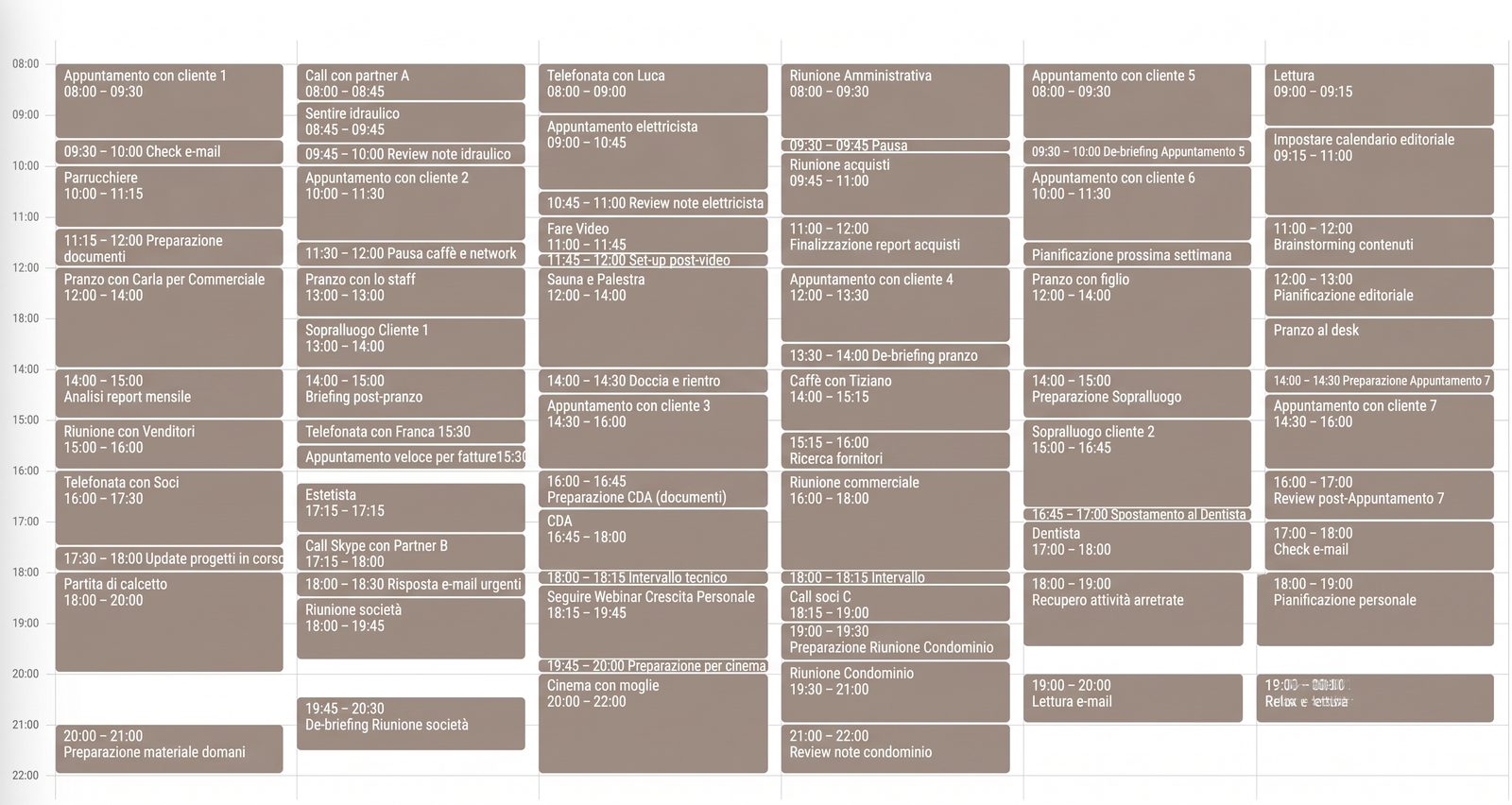
As we've seen, what goes on the list is filtered by what you know about your functions, so it doesn't necessarily match all the functions of the role.
You need, then, to identify the true cause behind the problem: what really generates non-fulfillment and leads you to neglect roles and activities?
The real causes of non-fulfillment
The reasons the problem exists and persists over time are actually the following:
- We aren't aware of all our functions and all our roles
If you don't know the functions of your roles and of the different roles you hold, you can't know everything that should be done to fulfill them. - We don't have a system that guides/binds us to fulfill them
There is no system that commits you to giving the necessary time to your different roles and their functions.
In practice, the ingredients and the recipe for fulfilling your roles are missing.
These are very practical causes, followed by equally practical solutions.
Practical tips to avoid neglecting important roles and activities
Every cause of a problem corresponds to the gap that made it appear. Once you've identified the real cause of non-fulfillment, to solve the problem and stop neglecting your roles you need to act by filling the gap hidden behind the problem with practical, definitive actions.
1. Draw up a "role map" and budget time for each role
You need to identify all your roles (personal, professional and meta-roles) and, for each one, clarify what that role produces, what it is for and whom it serves.
Then, for each role, you need to assign an amount of time to devote to it every week, regardless of the to-do list.
This way you won't fall short if fixed hours on the calendar are devoted to those roles. Even without knowing in advance what to do, during those hours you devote yourself to the role and find the time you need to take care of it, avoiding neglecting it.
The principle, then, is to budget time before knowing which activities will need to be done.
Time comes first: first you decide how much time to devote, then you identify the activities to carry out.
The calendar tends, in fact, to fill up with what you know how to do, not necessarily with what is useful to do. If, for example, you know how to sell, you tend to fill your calendar with activities tied to that role.
So you tend to give more time to your professional role than to your personal one, because in the former it's easier to know what to do.
2. Use a role planner, not time blocking
A role planner is a weekly or monthly calendar divided into blocks of time that are homogeneous in terms of roles.
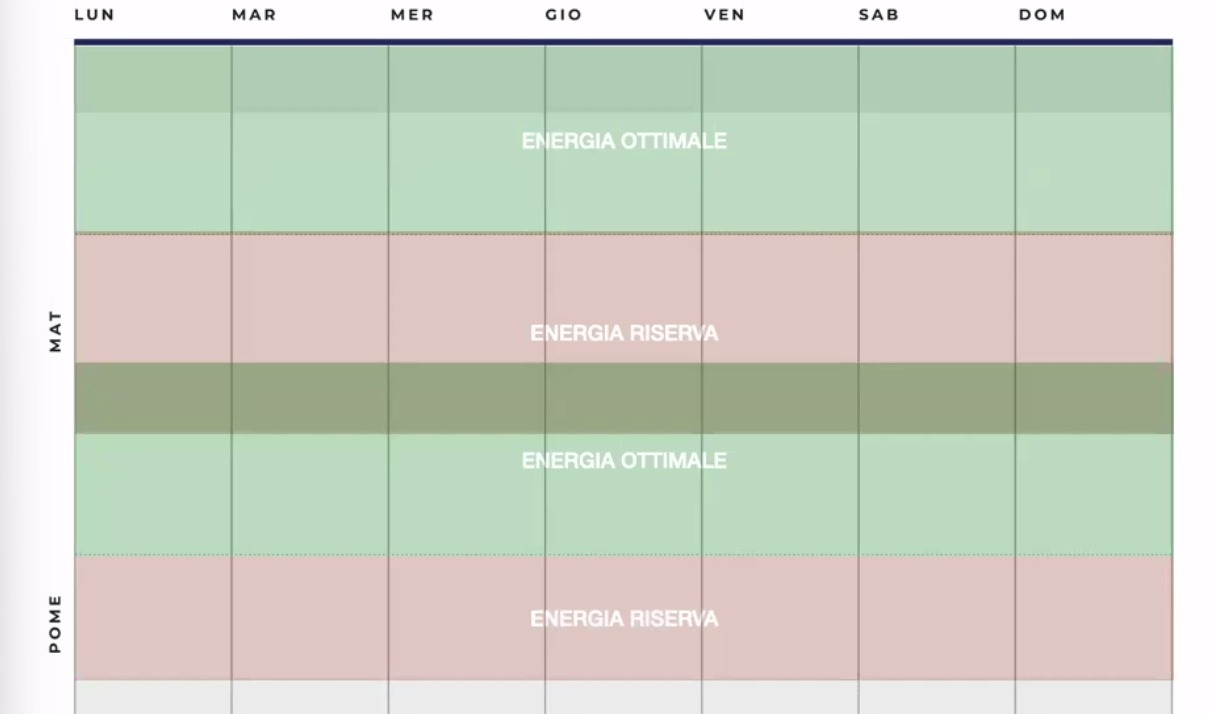
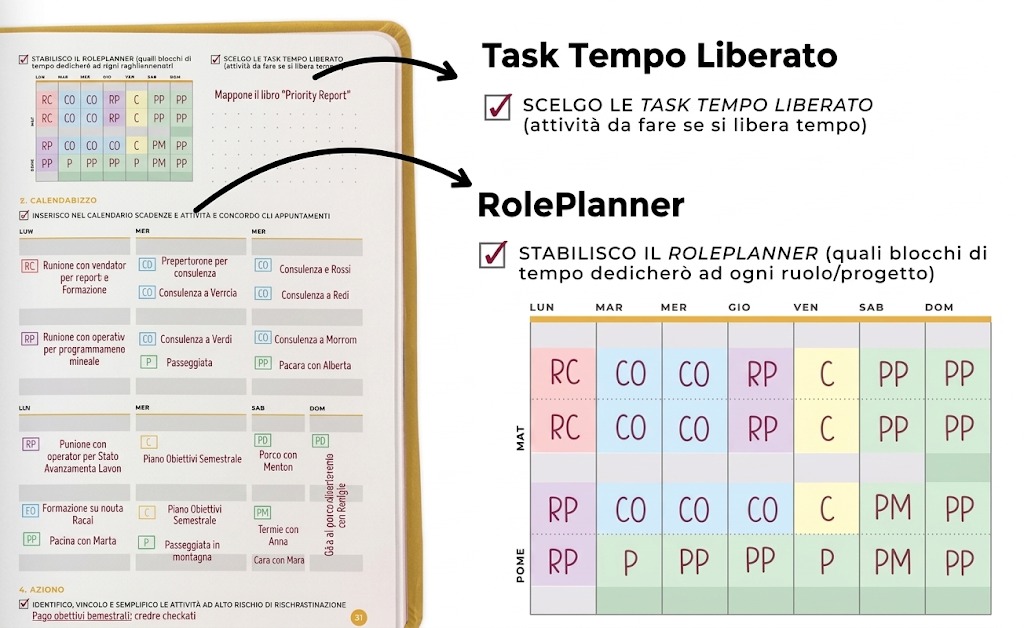
*Images taken from AgendaPro
The question, then, is not: "What needs to be done for this role?"
The question becomes: "There are two hours for that role: what should I do in those two hours?"
Time blocks for each role need to be set on the calendar, defining the time to be devoted to each role: personal, professional and meta-role.
Time blocks should last at least two hours, ideally four, because you need to be able to choose and carry out homogeneous activities to improve the quality of the time devoted to the role.
Knowing the functions of the role and protecting the time blocks devoted to each role lets you stop neglecting your roles and stop falling short.
The benefits of block-based time management
Without planning your time in advance, every moment requires a new decision: what to do, where to start and which activity to treat as the priority.
This constant decision-making creates cognitive friction and can encourage procrastination and wasted time.
With time management in blocks, instead, many decisions are made in advance: time is already tied to activities, and it becomes easier to start what has been scheduled.
The method also gives you a more realistic perception of the time available.
An empty calendar can give the impression that you still have plenty of time, while commitments and activities to carry out are often greater than you perceive. Placing activities into time blocks makes the real limit of the available hours visible.
This helps you choose priorities, protect commitments you've already made and, when necessary, say no to new activities.
When an activity has a specific slot on the calendar, it also becomes more concrete. It's no longer just thinking "I have to do it," but deciding "I've decided I'll do it at this time."
Time blocking thus turns time from an abstract intention into a concrete operational space, increasing accountability for what has been decided and the likelihood that the activity actually gets done.
Block planning also helps reduce the feeling of operational chaos.
A fragmented or unstructured calendar can heighten the sense of backlog, uncertainty and loss of control. Organizing commitments in advance instead creates a more orderly structure, reducing the load of constantly having to decide what to do.
The calendar, then, doesn't only organize time; it also organizes attention.
Finally, time blocking makes visible some organizational problems that might otherwise stay hidden.
When time is actually assigned to activities, too many meetings, incompatible duties, confused priorities or missing delegation can surface. The calendar becomes a kind of X-ray of the organization: it shows how time is used and makes the areas that need intervention more evident.
Overall, these effects can translate into less tendency to procrastinate, greater focus on what you're doing and a more concrete perception of the time available. Planning also lets you protect your different roles and responsibilities, reducing the feeling of constantly neglecting something important. By making the limit of time explicit and allocating it in advance, it also becomes less likely that commitments are left without any real space to be carried out.
In conclusion, non-fulfillment doesn't simply come from having too many things to do, but from the risk of neglecting important functions and roles without realizing it.
To avoid it, the first step is knowing the functions of all the roles you hold, because you can't devote time to something you don't know you have to do.
The second is deciding how much time to devote to each role before you even define the activities to carry out.
This way, the calendar isn't filled only with what you know how to do or with the activities on your to-do list, but actually protects every role. Only after allocating the time can you decide which activities to carry out within it.
Time management thus becomes a system for fulfilling your roles, reducing the risk of neglecting them and of turning what gets postponed into an emergency.
Sources and references
*1 Pietromonaco, P. R., Manis, J., & Frohardt-Lane, K. (1986). Psychological Consequences of Multiple Social Roles. Psychology of Women Quarterly, 10(4), 373–382.
*2 Paryono, H. Y., van de Brake, H. J., de Bloom, J., & de Vries, T. A. (2026). The Duality of Multiple Roles: Examining The Moderating Effects of Role Occurrence Proximity. Occupational Health Science, 10, 5.
*3 Kulik, L., & Liberman, G. (2013). Work–Family Conflict, Resources, and Role Set Density: Assessing Their Effects on Distress Among Working Mothers. Journal of Career Development, 40(5), 445–465.
*4 Buehler, R., Griffin, D., & Peetz, J. (2010). The Planning Fallacy. Advances in Experimental Social Psychology, 43, 1–62.
*5 Katt, B. M., et al. (2021). The Planning Fallacy in the Orthopedic Operating Room. Journal of the American Academy of Orthopaedic Surgeons.
*6 Gallup (2026). State of the Global Workplace: 2026 Report. Data collected in 2025 across more than 140 countries and territories.