

Moving from one task to the next without a break, squeezing one commitment in after another, facing every activity with timelines that seem to shrink day by day. For many people, living in a rush has become normal. Yet behind this pace there is not always an excessive amount of work.
So where does the feeling of never having enough time come from, even when commitments are limited? Which organizational habits feed a frantic work pace? And which strategies let you handle your activities more calmly while keeping the same productivity?
Before looking for answers, it is worth asking a simpler question: when you look around, do you meet more calm people, moving at the right pace, or people who are always in a hurry?
The problem: always being in a hurry
The first step in tackling this problem is recognizing it: noticing that you are in a hurry and understanding that this condition is a problem, not an inevitable part of your days.
Why is it important to avoid rushing? And, before that, what does "hurry" really mean?
Hurry shows up in two ways, which correspond to two different kinds of lateness:
- in relation to an appointment: when you fear arriving late to a meeting or a commitment set for a specific time;
- in relation to a deadline: when you fear you won't manage to complete a task by the agreed date.
In both cases, hurry is a distortion of time: a situation the mind creates when it does not accept the pace it is in.
Hurry comes with a recurring thought: "I wish I had done it earlier, but I didn't". From this thought comes the attempt to bend your own rhythms, to the point of breaking them in an unnatural way, just to meet expectations (your own and other people's).
Hurry is, then, a distortion that could be summed up like this: "I want to, but I can't, so I speed up".
This distortion, moreover, does not stay confined to a single moment. If the morning starts in a hurry, the evening ends in a hurry too, because activities are chained together from the start of the day. The pace is set in the first 30-40 minutes after waking up and carries over into all the hours that follow.
If hurry is a distortion generated by the mind, it remains to be seen how widespread it is and what harm it can do. On both counts, scientific research offers significant data.
What science says about hurry in modern society
To grasp the scale of the problem, it helps to look at scientific research starting from two questions:
- How widespread is hurry in modern society?
- What are the main harms of hurry?
A first answer comes from the research by Southerton and Tomlinson (2005)*1. The authors analyzed data from a British survey and a number of household interviews to understand the feeling of being constantly pressed for time, the so-called time squeeze.
The most significant finding concerns how widespread the phenomenon is: 75% of respondents said they felt, at least to some extent, under time pressure (somewhat pressed for time).
The data come from two British surveys, carried out in 1985 and 1992, and show that three people out of four felt, at least in part, that they had little time available. The research shows that time pressure is not only an individual problem, but a widely shared social experience.
More recent data point in the same direction. A European survey carried out by Eurofound (2022)*2 during the pandemic found that:
– 49% of workers frequently work at high speed;
– 48% frequently work to tight deadlines.
In other words, about one person in two routinely does their job at high speed or with reduced timelines.
To these data we can add an indirect indicator, taken from Gallup's State of the Global Workplace report (2026)*3, which collects 2025 data on workers around the world. Participants were asked whether, the previous day, they had felt stress for a large part of the day: 40% said yes. The figure gives an important indication of the level of pressure experienced every day at work.
The studies cited so far are based on what people say they feel. The study by Levine and Norenzayan (1999)*4 is particularly interesting because it takes a different approach: it tries to measure objectively the speed of everyday life, going beyond simply asking people whether they feel rushed.
The researchers compared 31 countries using three observable indicators:
| Indicator | How it was measured |
|---|---|
| Walking speed | Time needed to walk 18.3 meters (60 feet) |
| Work speed | Time taken by a postal clerk to complete a simple transaction |
| Clock accuracy | Deviation of public clocks from the exact time |
For walking, about 70 adults were observed per city; for the postal service, at least 8 clerks; and for clocks, 15 readings were taken in banks. The three indicators were then combined into an overall index, called the Pace of Life Index.
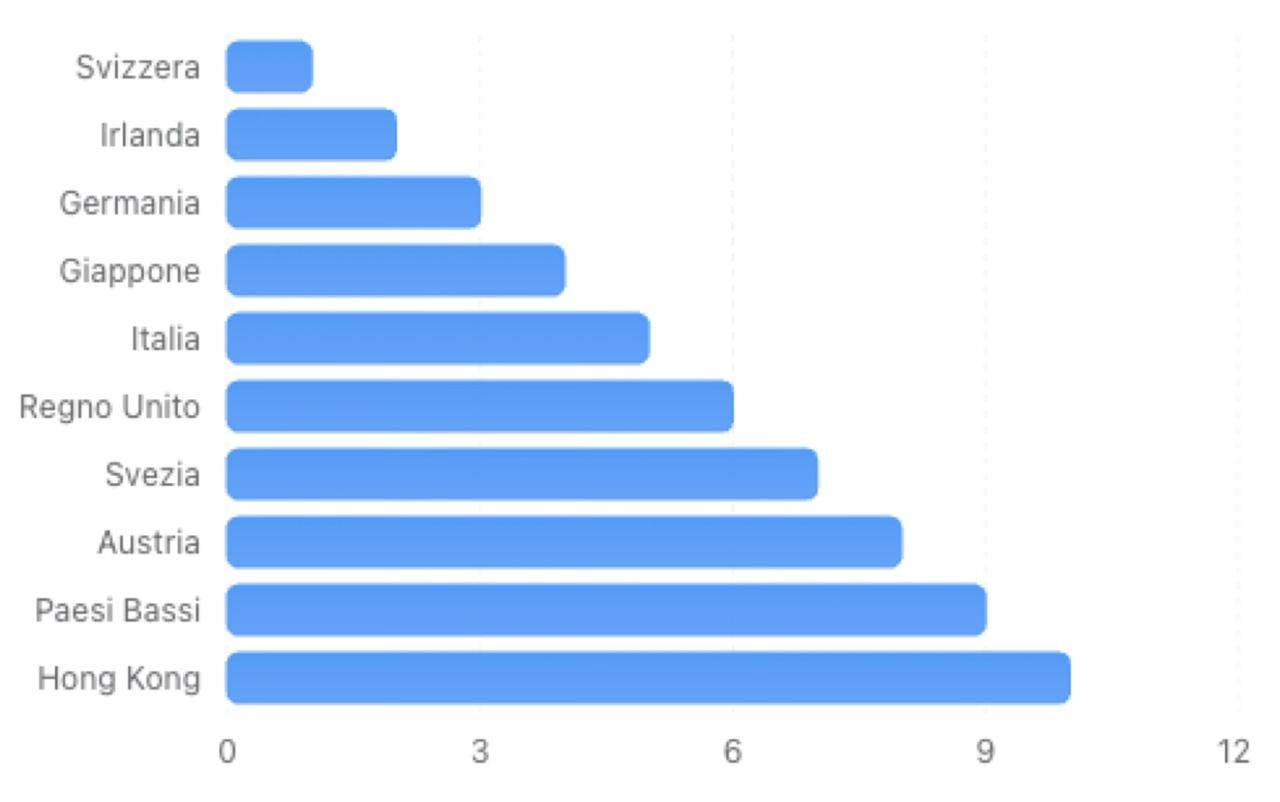
The results showed faster paces on average in the most economically productive countries, in Western Europe and in Japan. In particular, a very strong correlation emerged between pace of life and GDP per capita (r = 0.74): richer countries tend to have faster paces.
In the overall ranking, Italy comes 5th. Here are some of the values recorded:
| Country | Overall rank | 18.3 m walk | Postal transaction |
|---|---|---|---|
| Switzerland | 1st | 11.80 s | 16.91 s |
| Ireland | 2nd | 11.13 s | 17.49 s |
| Germany | 3rd | 12.01 s | 13.46 s |
| Japan | 4th | 12.11 s | 18.61 s |
| Italy | 5th | 12.75 s | 23.00 s |
| United States | 16th | 12.03 s | 36.99 s |
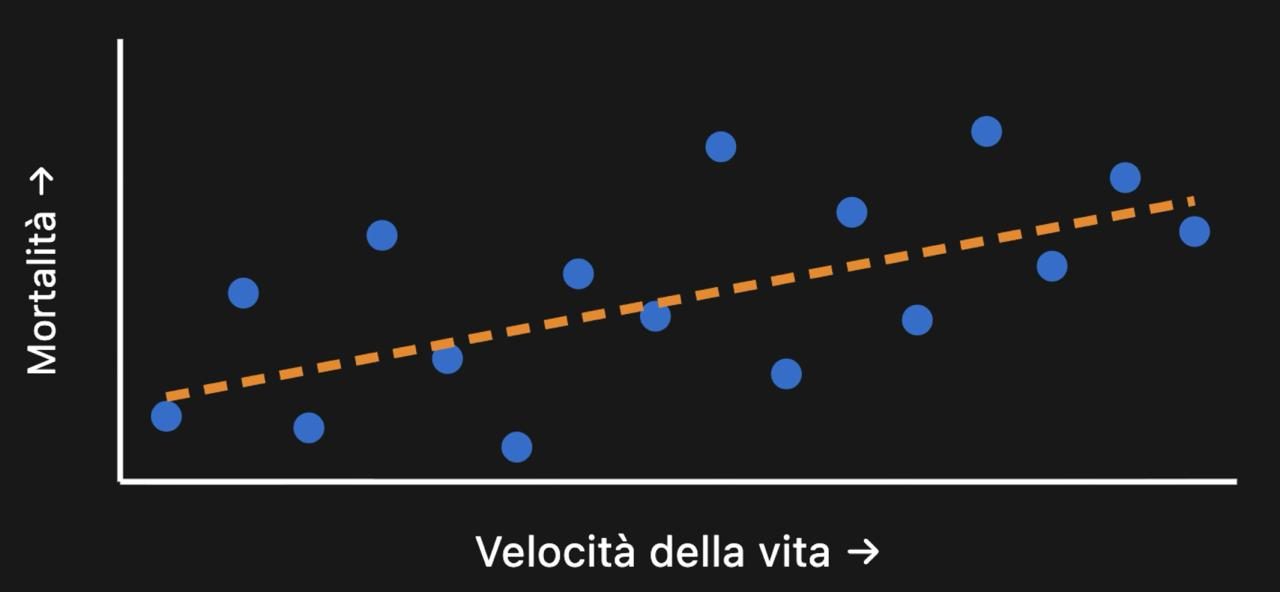
The same study *4 offers a first answer to the second question asked at the start, about the harms of hurry. The countries with faster paces also showed, in fact:
– higher mortality from coronary heart disease (r* = 0.35);
– a higher prevalence of smoking (r* = 0.52);
– a higher average calorie intake (r* = 0.51).
*the letter r stands for Pearson's correlation coefficient, a statistical value that measures how much two variables tend to vary together. It can take values from −1 to +1:
r = +1: perfect positive correlation, meaning that when one variable increases, the other also increases in a perfectly linear way;
r = 0: no linear correlation;
r = −1: perfect negative correlation, meaning that when one variable increases, the other decreases in a perfectly linear way.
The authors also found a negative correlation (r = −0.59) between cultural collectivism and the speed of life. This means that:
– in countries with a stronger community orientation, paces of life were generally slower;
– in countries with a stronger individualist orientation, paces of life were generally faster.
One last study is interesting because it concerns how the feeling of being in a hurry has changed over time. Melanie Rudd's study (2019)*5 gathers and compares research on three questions: how widespread the feeling of not having enough time is, how it has evolved historically and what its psychological consequences are.
Between 1965 and the early '90s, the share of American adults who said they always felt rushed grew gradually, from about a quarter to more than a third of respondents. It then remained stable for more than a decade, before falling back toward the values of previous decades. In the most recent surveys, however, about two Americans in three say they always or sometimes feel rushed.
| Period | What was measured | Americans who feel rushed |
|---|---|---|
| 1965 | Always feel rushed | About 25% |
| Early '90s | Always feel rushed | More than 33% |
| Most recent surveys examined | Always or sometimes feel rushed | About 67% |
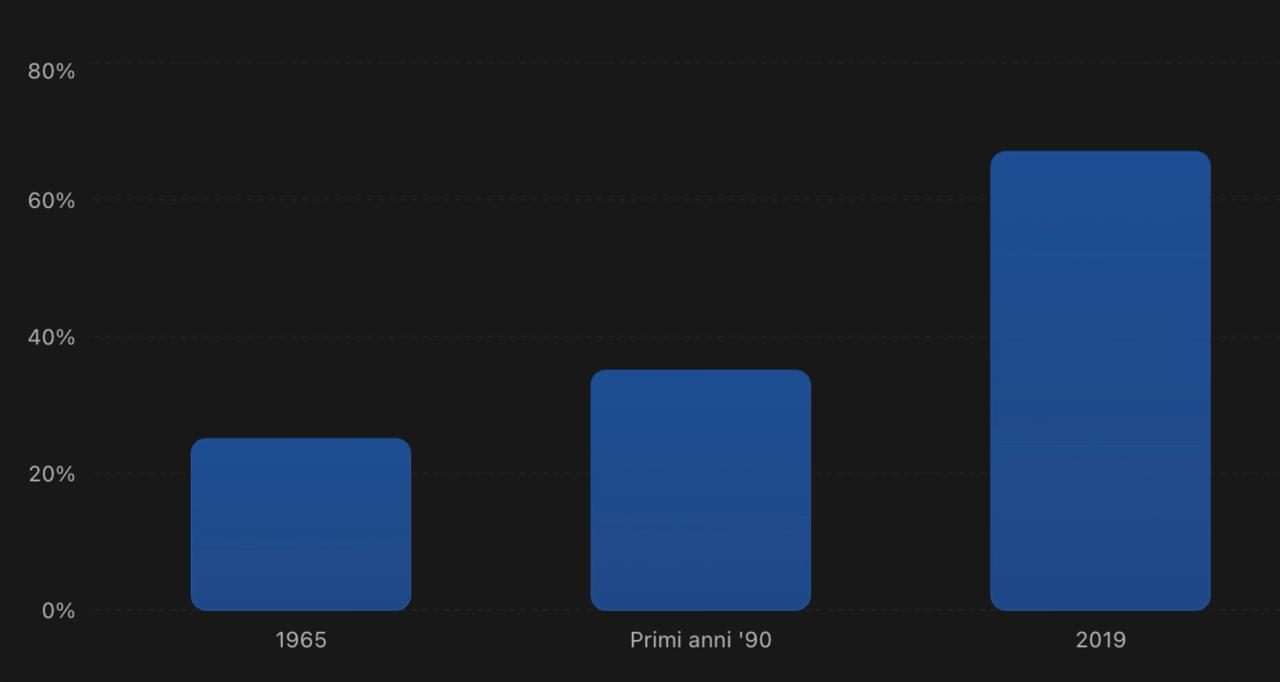
The study concludes that the feeling of not having enough time remains very widespread and is gradually growing, even if it does not grow continuously.
Research, then, shows that feeling under time pressure is an experience shared by a large part of the population, and that faster paces go hand in hand with worse health conditions.
Being in a hurry, therefore, is not just a passing feeling, but a real and widespread problem. To fully grasp how much it matters, you need to look at the consequences it produces in everyday life.
The effects of hurry
The effects of a problem are often underestimated: people tend to ignore them or not give them weight. Yet, in the case of hurry, the consequences are very significant.
- Greater exposure to risk (loss of clarity): being a distortion of time, hurry pushes the mind to make reality fit its expectations, reversing the relationship between the two. Just to arrive on time and meet the expectation, people take enormous risks: think of the car accidents that, assessing the situation with a clear head, would be avoided. When you are in a hurry, wrong and risky choices become the most readily available, and the mind goes along with them, losing clarity. With the loss of clarity, a person's ethics, morals and priorities change too.
- Higher likelihood of mistakes and oversights: hurry undermines how tasks are carried out. You are more likely to make mistakes, and less likely to reach a productive state that lets you make the most of your knowledge and skills. Studying in a hurry, for example, produces only effort and no results, because a mind in a hurry is not oriented toward learning, and so everything done while out of rhythm turns out to be of clearly lower quality.
- Frequent stress, tension and sense of urgency: besides making you work worse, hurry leads to a worse and dangerous state of being. Heart and brain are constantly under strain and, as a result, do their job poorly, worsening the health of a body that ends up under stress. The back and abdomen also stiffen, become sore and work less well. The tension triggered by hurry in turn leads you to act as if you were always in a state of emergency.
Hurry pulls you away from the present moment, from the "here and now", and leads to mistakes with serious consequences, which people often regret.
Precisely because these effects are so serious, it becomes clear that being in a hurry is extremely harmful: you cannot just act superficially to soften these effects. You need to understand how to eliminate the problem at the root, starting from the definition of the goal to reach, so as to arrive at a deep and lasting solution.
The right goal for eliminating hurry
Once the urgency and seriousness of the problem have been framed through its effects and the supporting scientific research, solving it first requires identifying the ideal condition, that is, the goal to reach in order to stop being in a hurry.
Faced with a problem, the mind tends to look for the fastest solution to eliminate the symptom. That solution is often not the one that uproots it in depth.
To reach the definitive solution, you first need to understand the problem better, identifying the essential elements to act on in order to solve it.
So you need to rely on a problem-management method aimed first of all at understanding, and only then at the solution. Without this method, the risk is working in the wrong direction, which only creates the illusion of a temporary solution.
According to the natural problem-management method, the first step in understanding a problem is identifying the goal to set, the true ideal condition to aim for. Setting the wrong outcome is as harmful as staying stuck in the difficulties the problem creates: that is why it is so important to set the right goal.
In the case of hurry, the wrong ideal condition is "managing to do everything and always arriving on time, deciding first what to do and then the pace".
This goal leads you to prioritize the activities and commitments to be carried out rather than the pace to keep during your day.
And this is exactly why people are always in a hurry: if the goal is to do everything and arrive on time, hurry becomes a solution. By rushing, you apparently manage to do everything and arrive on time. Hurry not only stops being perceived as a problem but, paradoxically, becomes the answer to the problem, a genuine strategy for making it every time and at any cost.
Society's view helps reinforce this idea: someone who is always in a hurry looks important, a person with a lot to do, able to handle several activities at once (multitasking), a good worker, a productive individual.
But this is a superficial view. People who move frantically often leave many things unfinished, make more mistakes and may even fail to fulfill their duties, precisely because of hurry.
As long as the goal remains doing everything and always arriving on time, you will keep deciding first what to do and then the pace to keep. Pace is not treated as a priority, while commitments take first place, forcing a speed that is neither healthy nor conducive to quality.
Underestimating the importance of the right pace means not really paying attention to how your own body works, to your own life, to work done with care.
Giving pace its due importance, on the other hand, leads to setting a completely different goal.
The correct ideal condition, then, is "first decide the pace, then what to do".
You need to break the mental habit of thinking first about what to do and only then about pace. If you cannot ask your heart to beat at twice its rhythm, why force yourself to do more than is naturally acceptable to stay within your own pace?
Hurry generates tension and is a form of not accepting where you are compared with where you think you should be. It is a mix of guilt for not having done something and the ambition to do what cannot be done.
That is why the correct ideal condition reverses the order of priorities, bringing it back to the natural hierarchy that should be followed to avoid living under constant strain: first you decide the pace, then what to do.
A solution that does not follow the right goal will not help you reach an ideal condition in which the problem has been eliminated for good: aiming to do everything and still arrive on time will never solve the problem of hurry; putting pace first, instead, will radically change your choices, the quality of your work, the way you live and the rhythm of your days, because you will start doing the right amount and doing it better.
The goal, then, is not to go faster but to decide the pace first and then what to do.
Defining the right goal is essential, but it is not enough. You also need to understand which mechanism prevents you from reaching it and keeps feeding the problem.
The mechanism that creates and feeds hurry
Why can't a problem be solved for good?
A problem keeps showing up because there is little knowledge of a few fundamental elements without which it cannot be solved: the ideas, which then shape the solutions, and the true causes, the deep ones on which the existence and persistence of the symptom depend.
The natural problem-management method identifies these two elements, analyzes them and starts from there to find the definitive solution to the problem. Recognizing them is essential, because how you will try to act on the problem depends on them.
At the root of this topic there are some wrong ideas about the very concept of hurry and the way people relate to it.
Wrong idea: "hurry is a problem; hurry has to be managed".
Hurry is commonly identified as the problem: being out of breath, feeling under strain, having to honor the commitments made and their deadlines is a problem in itself.
Treating hurry as the problem to manage, however, shifts attention entirely to how to manage to do everything and on time, deploying actions that at best patch up the situation.
Following this idea, effort will go into trying to fight time, packing activities into the calendar, lowering the quality of execution just to get everything done: you will try to change speed while still completing everything that was planned.
And in doing so, you hide the real mechanism that leads to hurry, the true problem to solve.
In fact, the point is not arriving on time, managing to do everything, or reducing the sense of urgency and strain. The point is not to get into this situation at all but to act earlier, by protecting your own pace.
Hurry is not the problem; hurry is a signal that something is wrong with your rhythms.
What has been described so far as the problem, with its effects and how widespread it is, is in reality the visible symptom of something that happens earlier.
The real problem is how the amount of things to do and their timing are chosen: it is the ambition to do everything, without considering how much time it takes, that makes people live in a constant hurry.
In practice, people think only about the things to do but not about the time really needed to do them, nor about their own natural and healthy pace: the calendar fills up with commitments without carefully and realistically weighing the time required, and this throws you out of rhythm.
It therefore becomes necessary to turn the (wrong) belief about hurry into the (correct) idea that finally lets you act in the right direction to solve the problem.
Correct idea: "hurry is a consequence; hurry can only be prevented".
Seeing hurry as a consequence leads you to treat it as a signal, a warning of another problem that needs to be investigated.
The problem is not hurry, but what hurry is pointing to.
To fully understand this correct idea, it helps to dwell on the meaning of two key terms: hurry and punctuality.
What hurry and punctuality really mean
Hurry
The Italian word for hurry, fretta, comes from the verb frettare, which goes back to the Latin frictare, "to rub".
The term indicates the need or desire to act quickly, but it also evokes a state of impatience and agitation that leads you to speed up your movements and actions.
Hurry is a feeling generated by feeling slow, late, out of rhythm, at a point different from where you should or would like to be.
It is no coincidence that the word etymologically recalls the Italian verb fregare, "to rub", which in everyday Italian also means "to cheat": acting in a hurry can mean, in a sense, cheating yourself, fooling yourself.
Hurry can, in fact, deceive: it leads you to believe that speeding up is the best way to save time when, instead, it can generate mistakes, inefficiencies and unsatisfactory results. In trying to get things done faster, you risk making errors, overlooking important aspects and making your work less effective.
That is why being in a hurry is a way of fooling yourself: you convince yourself that you can be where you actually are not, that you can meet the expectation regardless of the conditions that meeting it would require.
Punctuality
Punctuality is usually understood as "arriving on time".
Being punctual means, instead, arriving at the right pace, with a calm stride. Someone who arrives running, even if on time, is out of rhythm and therefore not moving at the right pace.
The etymology of the word helps clarify its meaning:
from the Latin punctuàlem, linked to "to prick", "to penetrate" and, therefore, to "precise", "diligent";
derived from pùnctum, "point": what is at the point, on time, at the right pace, in good order.
Being punctual means being in rhythm, in the present, being "right". Hurry is the way punctuality is canceled out.
What matters is being punctual, and punctuality starts from pace, defined by respect for the physiology and anatomy of your own body.
When the priority is the things to do, you are in a hurry; when the priority becomes pace, and not the things to do, you manage to be punctual and, therefore, right and present.
The goal, seen above, for eliminating hurry can therefore also be reframed as "being punctual", in the true sense of the word, that is, moving at the right pace.
The correct way to proceed is not to adapt your pace to the things to do, but to adapt the things to do to your natural pace.
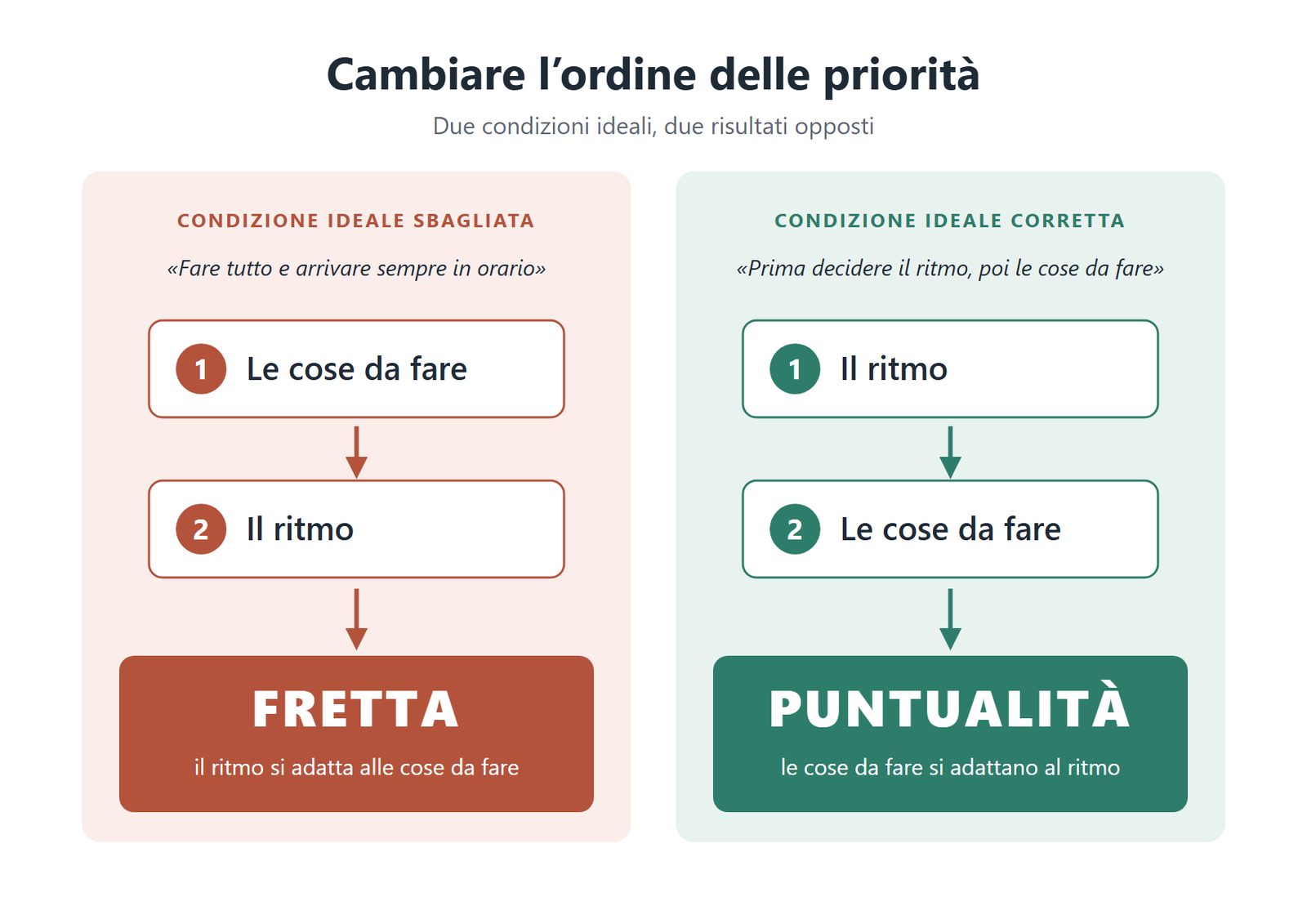
That is why hurry needs to be seen as a consequence of not being punctual, of not moving at the right pace, of prioritizing the things to do over your natural stride.
So hurry is a consequence of not prioritizing your own pace and of not proceeding punctually.
To prevent it, then, you need to go back to what creates and sustains it: the true causes of the problem.
The true causes of hurry
Identifying the true causes is a fundamental phase of the natural problem-management method: only by identifying the real reason why a problem exists and persists over time will it be possible to define a strategy that eliminates the problem at the root.
Reaching the true causes of a problem takes the right analytical skill, starting from beliefs and putting order into what determines them.
The causes of a problem are gaps that, if not filled, keep making it reappear day after day.
The true causes of hurry are:
- Lack of awareness of your natural pace.
You need to know your own pace, listen to yourself and recognize what is sustainable and gives you energy, that is, the pace and the amount of things you can manage to do.
It also means accepting that you don't have to do everything, letting go of widespread beliefs and focusing on your body, your heart and your brain. Everyone has their own personal pace.
Without this awareness, you will tend to be in a hurry and to suffer its negative effects.
- Lack of an effective forecasting method (the duration of activities is underestimated).
People tend to underestimate how long even simple, routine actions take, because of some common biases, that is, distortions in thinking that lead to underestimating the time needed.
One example is survivorship bias: an error of judgment that occurs when you focus only on cases of success (the "survivors" or the visible results), ignoring those that did not pass a given selection or test.
The mind automatically searches its memory for the episode in which the task took the least time, and that episode becomes the standard against which future forecasts are measured. The brain then calibrates all estimates on that reference and on the main activity, compressing too much the micro-actions to carry out and the different phases of execution.
Your estimates, therefore, leave out all the concrete activities that should still be considered to reach a realistic estimate of the time needed: the mind considers only the specific activity and drops everything else.
This underestimation leads you to speed up and to always be in a hurry.
The most underestimated activities are the common and frequent ones, the most present in everyday life, which thus end up causing delays and hurry.
Defining causes as gaps makes it clearer where to act to solve the problem. The practical tips that follow turn these two gaps into concrete actions.
Practical tips for eliminating hurry
The natural problem-management method arrives at solutions through practical actions, designed to fill the gaps that created the problem.
To tackle the problem of hurry in practice, you need to put two actions into practice, each designed to fill one of the true causes identified:
- Set your own pace in all basic, physiological movements: walking, driving, talking, listening.
Start from the most common and frequent activities, which are also the most underestimated, and begin measuring in order to set your own pace.
How do you want to drive, walk, talk, listen? At what speed?
Finding your own pace is the most important result to achieve. So you need to pay attention to your pace, record your speed and take it into account when estimating the time and the activities to carry out: notice your own timings and write them down.
- Define realistic standard times for activities.
Start from four routine activities and establish how much time they take.
Then analyze the whole process, quantifying every phase realistically.
In the estimate, also consider a negative scenario, which accounts for unexpected events, even small ones, that may occur.
By applying these two tips, your calendar will change and, with it, the way you live your life: commitments will become fewer and shorter, more in line with your natural pace, and the quality of your work will improve considerably.
In conclusion, hurry is not an inevitable condition of modern life, even though research shows how widespread it is and how faster paces go hand in hand with negative consequences. As the analysis shows, hurry is not the problem to manage, but the consequence of a wrong goal, namely wanting to do everything and always arrive on time, and of two specific gaps: poor awareness of your natural pace and the tendency to underestimate how long activities take.
To prevent it, you need to know and respect your own pace and base your planning on realistic times, measured on concrete activities. The aim is not to do everything on time, but to decide the pace first and only then what to do: this is true punctuality.
Sources and references
*1 Southerton, D., & Tomlinson, M. (2005). ‘Pressed for time’ – The differential impacts of a ‘time squeeze’. The Sociological Review, 53(2), 215–239.
*2 Eurofound (2022). Working conditions in the time of COVID-19: Implications for the future. Publications Office of the European Union, Luxembourg. https://www.eurofound.europa.eu/sk/publications/report/2022/working-conditions-in-the-time-of-covid-19-implications-for-the-future
*3 Gallup (2026). State of the Global Workplace: 2026 Report. Gallup, Inc. https://www.gallup.com/workplace/697904/state-of-the-global-workplace-2026.aspx
*4 Levine, R. V., & Norenzayan, A. (1999). The pace of life in 31 countries. Journal of Cross-Cultural Psychology, 30(2), 178–205.
*5 Rudd, M. (2019). Feeling short on time: Trends, consequences, and possible remedies. Current Opinion in Psychology, 26, 5–10.