

Some tasks keep getting put off even though you recognize their importance and know they should be done. Time passes, commitments pile up, and what could have been handled calmly turns into an emergency.
When this behavior repeats, the consequences go beyond the tasks left hanging. Struggling to keep your commitments can disrupt how your work is organized, increase stress and weaken your confidence in your ability to finish what you planned.
Procrastination is often chalked up to a question of personal discipline.
But how effective is it to tackle it by simply forcing yourself to do what you keep postponing?
To understand how to intervene, you first need to understand the nature of the problem and the mechanisms that feed it.
The problem: low discipline
Procrastination, meaning the voluntary delay of a necessary action or decision or of an important task, is commonly associated with low discipline, poor self-regulation and weak willpower.
It is a distinctly human behavioral dysfunction: no other living being procrastinates in the same way.
So when you are facing postponed commitments, you are dealing with a low-discipline problem.
To tackle the problem effectively, you first need to make it objective by looking at how widespread it is, what causes it and what it leads to. For this purpose, it helps to look at what scientific research shows.
What science says about procrastination
Many studies have analyzed procrastination, how it has evolved over the years, how it shows up in different contexts and the causes behind it.
Two questions are useful for deepening your understanding of the problem:
1-How widespread is procrastination in the population?
Procrastination is a common behavior that can affect work, study and the pursuit of personal goals. Scientific research has tried to understand how widespread it is in the population and which mechanisms lead people to put off an activity even when they are aware of its importance.
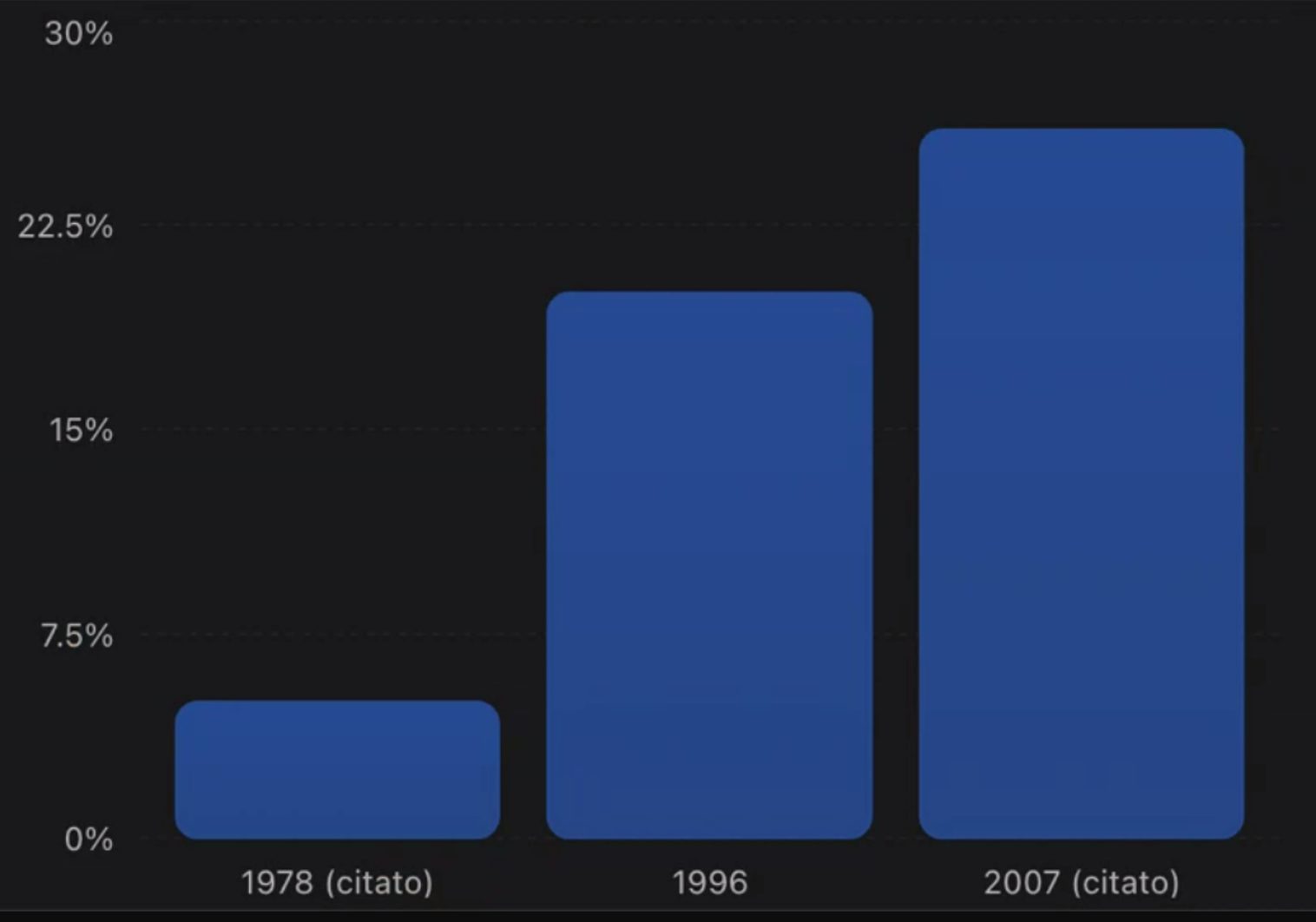
Procrastination is a widespread phenomenon: it is estimated to affect about 20-25% of the adult population. It is even more common among university students, who often postpone study-related activities. Klingsieck (2013)*1 showed how procrastination has become an increasingly studied topic, also because of the effects it can have on performance and personal well-being.
In 2007, Steel*2 analyzed the results of numerous studies on the topic and found that the prevalence of procrastination appeared to be increasing.
2-And what are its main causes?
Research shows that procrastination has no single cause. Putting off a task can depend on several factors, including the emotions it stirs up, the difficulty of controlling distractions and the way future results are valued.
Steel's analysis (2007)*2 identifies a few important factors.
A first factor is the difficulty of managing the emotions tied to the task. A task can be important and necessary, yet at the same time tiring, boring or a source of worry. To avoid those feelings, you may choose to put it off.
Sirois and Pychyl (2013)*3 explain that, in some cases, procrastinating is a way to feel better in the short term: temporarily avoiding an unpleasant task brings relief, even though the problem remains and will have to be dealt with later.
A second factor is impulsivity and the difficulty of self-control. When you have to carry out a demanding task, it can be hard to resist something more pleasant or immediately rewarding. You end up spending time on other activities, even when you know it would be more useful to take care of the planned one.
Zhang and colleagues (2019)*4 examined the cognitive processes underlying procrastination, highlighting the role of self-control and impulsivity. These factors help explain why knowing what you should do doesn't necessarily mean being able to do it.
A third factor is discounting what will happen in the future. The benefits of a task can seem less important when they are far off in time, while the effort needed to start is present and immediate. As a result, you may prefer to put it off, even if completing the task would be advantageous. When the deadline gets closer, on the other hand, the consequences of not finishing become more concrete and the motivation to act can increase.
Zhang and colleagues (2019)*4 link this mechanism to the way people value outcomes as a function of the time needed to achieve them.
Neuroscience has also studied these processes, trying to understand which areas of the brain take part in decisions to postpone. Research shows associations between procrastination and certain brain structures involved in controlling behavior, managing emotions and imagining the future.
The study Neural Connectome Features of Procrastination: Current Progress and Future Direction (2022)*5 proposes looking at three brain systems that work together.
The first is the cognitive control system, which mainly includes the dorsolateral prefrontal cortex (DLPFC) and other connected areas. This system helps keep attention on the goal, manage distractions and control behavior.
The second is the emotional evaluation and regulation system, which involves areas such as the amygdala, the insula and the orbitofrontal cortex. These structures take part in evaluating emotions and how unpleasant a task is, which can contribute to the decision to avoid it.
The third is the future representation system, which includes structures such as the hippocampus and the parahippocampal cortex. These areas help you imagine what might happen and assess the future consequences of your actions.
Together, these three systems let us look at procrastination from different angles: the ability to hold on to a goal, the management of emotions and the evaluation of future outcomes.
Some studies have looked more closely at the link between these brain areas and the tendency to postpone. A study published in Cerebral Cortex in 2020, with 688 participants, found associations between procrastination and structural characteristics of areas involved in self-control, emotional regulation and the representation of the future (Chen et al., 2020)*6.
A 2022 experiment using functional magnetic resonance imaging studied how the effort needed to carry out a task is evaluated. The results indicate that procrastination is associated with a tendency to undervalue effort when it lies in the future. This difference was linked to the brain activity involved in evaluation and decision-making (Le Bouc and Pessiglione, 2022)*7.
Another study, conducted in 2024 with 243 participants, found that a greater ability to regulate emotions was associated with less procrastination. The research also found a link between emotion regulation and the functional connectivity between the right dorsolateral prefrontal cortex and the left insula (Li et al., 2024)*8. These results are consistent with the importance of managing emotions, but they don't show that an emotional difficulty is always the cause of the delay.
Finally, a 2018 study examined the relationship between impulsivity, motivation, emotion regulation and procrastination, analyzing 638 participants. The research looked into the contribution of these factors and the differences between students and non-students. The authors also refer to Steel's 2007 meta-analysis, which reports a correlation of about 0.41 between impulsivity and procrastination (Wypych et al., 2018)*9.
Overall, the studies describe procrastination as a behavior that can have different origins. The difficulty of facing unpleasant emotions, the control of distractions and the way efforts and future benefits are valued all help explain why a task can be postponed even when you know it matters.
These factors help us understand the mechanisms that can favor procrastination. To work out how to intervene concretely, though, we also need to examine the conditions in which tasks are defined, organized and tackled: as we will see further on, solving a problem means starting from the real causes that generate and sustain it.
Putting things off is not a behavior without consequences. When it repeats over time, the difficulty of tackling important tasks turns into concrete effects, which can get in the way of reaching your goals, pile up tasks still to be done and feed dissatisfaction with the results you get.
The effects of low discipline
Low discipline doesn't just produce postponed tasks. When procrastination becomes a recurring behavior, it has consequences that involve work, the management of commitments and self-confidence.
The main effects are:
- Procrastination: tasks get postponed and some roles, along with their responsibilities, get neglected. The delay therefore doesn't concern only individual tasks, but can also undermine the commitments you have taken on.
- Piling up of deadlines and urgent work: postponed tasks accumulate and end up requiring urgent intervention. This situation creates stress, tension and mood swings, affecting your ability to be present and clear-headed in different situations.
- Gradual loss of confidence: the consequence mainly concerns your relationship with yourself. When low discipline repeatedly keeps you from honoring your commitments, it becomes hard to trust your own abilities. You can end up convincing yourself that this is just how you are, as if being unable to finish what you decided were an unchangeable trait. Confidence in others can drop too: when people don't do what they should and commitments are not met, it becomes hard to keep trusting them.
These negative effects show how low discipline can compromise not only the management of tasks, but also your relationship with yourself and with others.
To tackle the problem, though, it isn't enough to consider the consequences of the delays: you need to define the ideal condition to reach, that is, the goal that would let you manage your commitments effectively and meet your responsibilities.
How much discipline is needed to reduce procrastination
To tackle a problem, you need to ask yourself which condition you want to reach once procrastination is solved.
It is important to pay attention to how the goal is worded. If the ideal condition is defined wrongly, the brain will try to reach it anyway, even accepting side effects that were not anticipated at first.
A wrong ideal condition sets "having high discipline" as the goal.
The starting idea is that, to procrastinate less, you need to train and strengthen discipline, changing your behavior by exercising willpower more.
In this regard, people often cite the metaphor proposed by Baumeister (2011)*10, according to which willpower is like a muscle. This metaphor has helped spread a misleading view of willpower.
Willpower, in fact, is not a muscle. If you believe it is, you will tend to try to train it to make it stronger, setting up your work on discipline as if it were muscle-building.
This metaphor, however, overlooks two fundamental differences between a muscle and willpower.
The first is how each reacts to disuse. Muscles follow the principle that if they are not used, they atrophy and gradually lose their function: if you don't use it, you lose it.
Willpower, on the other hand, can be recovered even after years in which it has not been exercised: it is a strength that stays inside you at a baseline level throughout your life and can be called on at any moment to face the challenges that arise.
The second difference concerns how each changes over a lifetime. A child can have more willpower than an adult. As we grow up, in fact, willpower tends to decline, while muscles, on the contrary, tend to develop and get stronger in adulthood.
Willpower, then, doesn't necessarily follow the same course as a muscle. Focusing exclusively on training it means starting from an assumption that doesn't let you address the problem at its root.
So aiming for high discipline as the goal to remedy procrastination can lead to solutions that work on short-term effects but don't act on the deeper causes, with the risk of falling back into the same problem again and again.
The correct ideal condition, then, is needing low discipline to get things done.
The goal should not be to depend more and more on willpower, but, on the contrary, to reduce the need to rely on it.
To be able to carry out a task while requiring a low level of discipline, you first need to work on the external environment, even before working on your own inner order. The first step is to simplify life by reducing the obstacles that make it hard to act.
The principle can be expressed through a metaphor: first release the handbrake, then increase the push.
In other words, before trying to increase discipline, you need to reduce the resistance that stands in the way of action. Tasks should require a low level of discipline, leaving only a few of them to need a greater use of willpower.
Discipline, in fact, should be considered something unnatural, because the organism can resist many of the activities you have decided to carry out.
It becomes important, then, to ask yourself about the reasons for this resistance: was it a decision made consciously? Is the activity consistent with your own principles? And, if it is something good and useful, why is it still hard not to procrastinate?
Often, in fact, the very tasks you consider good and right are the ones you put off. This leads to the question of why you keep postponing something that, at least rationally, you recognize as important.
The answer shouldn't be sought in a lack of discipline to be corrected by training willpower. The first intervention should concern the external environment and the conditions in which the task is carried out, so as to reduce the resistance that stands in the way of doing it.
To explore the solution to procrastination in more depth and reach the correct ideal condition, then, you need to examine the mechanism that generates and sustains procrastination, starting from the beliefs that guide behavior and the causes that help the problem persist.
The mechanism that generates procrastination
When you start from a wrong assumption in solving a problem, the solution risks being wrong too: beliefs and causes are at the base of the mechanism that generates any problem.
To analyze an unwanted situation such as postponing commitments, you first need to look at the ideas that support choosing some actions over others.
To understand how to tackle procrastination in particular, you need to examine the process through which discipline is exercised at the moment you decide to do something, and the way decisions are made.
What do you usually think when you have to carry out a task you would tend to put off?
Wrong idea: "if I force myself to do something, I'm more likely to do it".
This statement can seem true: forcing yourself to do a task can indeed lead you to carry it out. However, the problem is that what is imposed risks becoming more and more dissociated from the person who has to do it.
To understand this mechanism, it helps to dwell on the meaning of the word imposition itself.
Etymologically, the word comes from the Latin impositio, from imponere, meaning to put upon.
But put what upon what? Upon your own natural preferences.
Imposition consists of laying something over your preferences, instead of starting from them to organize your behavior.
This mechanism can show up, however, even when the imposed task falls within your preferences.
Even in that case, in fact, it is the imposition itself that causes dissociation.
Imposition generates two possible reactions:
- Opposition – repulsion: what is imposed arouses resistance, a tendency to move away from it or avoid it.
- Submission – automatism: the task is carried out automatically, without real involvement in its meaning.
In both cases, you risk losing the connection with the meaning and usefulness of the task: it can be avoided, or done because it has to be done, without real involvement.
When work is imposed, you risk losing the connection with its meaning and usefulness. The task gets done because it has to be, not because you understand it and recognize its value.
Little understanding of the usefulness and value of an action produces low motivation to carry it out.
The real mechanism in the exercise of discipline is, then, exactly the opposite of the one commonly recognized.
Correct idea: "if I force myself to do something, I will dissociate more and more from it".
Imposition is not a lasting solution to procrastination, because it gradually moves the person away from what they are doing.
Whatever is imposed can lead you away from your natural principles, triggering the two mechanisms described: opposition, which generates repulsion, and submission, which leads to automatism.
The problem, therefore, isn't solved by simply adding more impositions or trying to exert greater control over your behavior.
You need to work on the conditions that make the task hard to face, reducing the obstacles that feed resistance and make it harder to move into action.
To do that, you need to identify the real causes of the problem and intervene in the areas that let you reduce procrastination without relying on willpower as the only engine of action.
The real causes of procrastination
To tackle procrastination, you need to identify why the problem exists and persists over time.
The first two causes to consider in order to define the areas of intervention, in order of priority, are the following:
1. decisions and actions are not written down
First of all, it is important to distinguish between putting off an action and putting off a decision. Often, in fact, these two moments get confused, making it harder to understand what actually needs to be carried out.
If actions and decisions are not written down, they remain only in your head at a vague level of definition that lends itself more easily to procrastination.
Continuing not to write down what needs to be done or decided is one of the first reasons why procrastination shows up and keeps repeating.
2. excessive cognitive load that creates resistance toward tasks
When a task requires too much effort to be understood, organized or started, it becomes harder to face.
For this reason, you need to work on lowering the load required, making tasks simpler to handle and reducing the obstacles that delay their execution.
Identifying these two causes lets you see which aspects to work on to reduce procrastination without resorting to willpower.
The next step is to turn this awareness into concrete choices and behaviors, through measures that help clarify what needs to be decided and done and make tasks simpler to tackle.
Practical tips for reducing procrastination without relying on willpower
How to intervene to solve a problem depends directly on the two areas of intervention identified as the main causes of procrastination: distinguishing and writing down decisions and actions, and reducing the cognitive load needed to carry out tasks.
Here is how to tackle the problem in practice through two concrete actions:
1. Write down and schedule every decision to be made
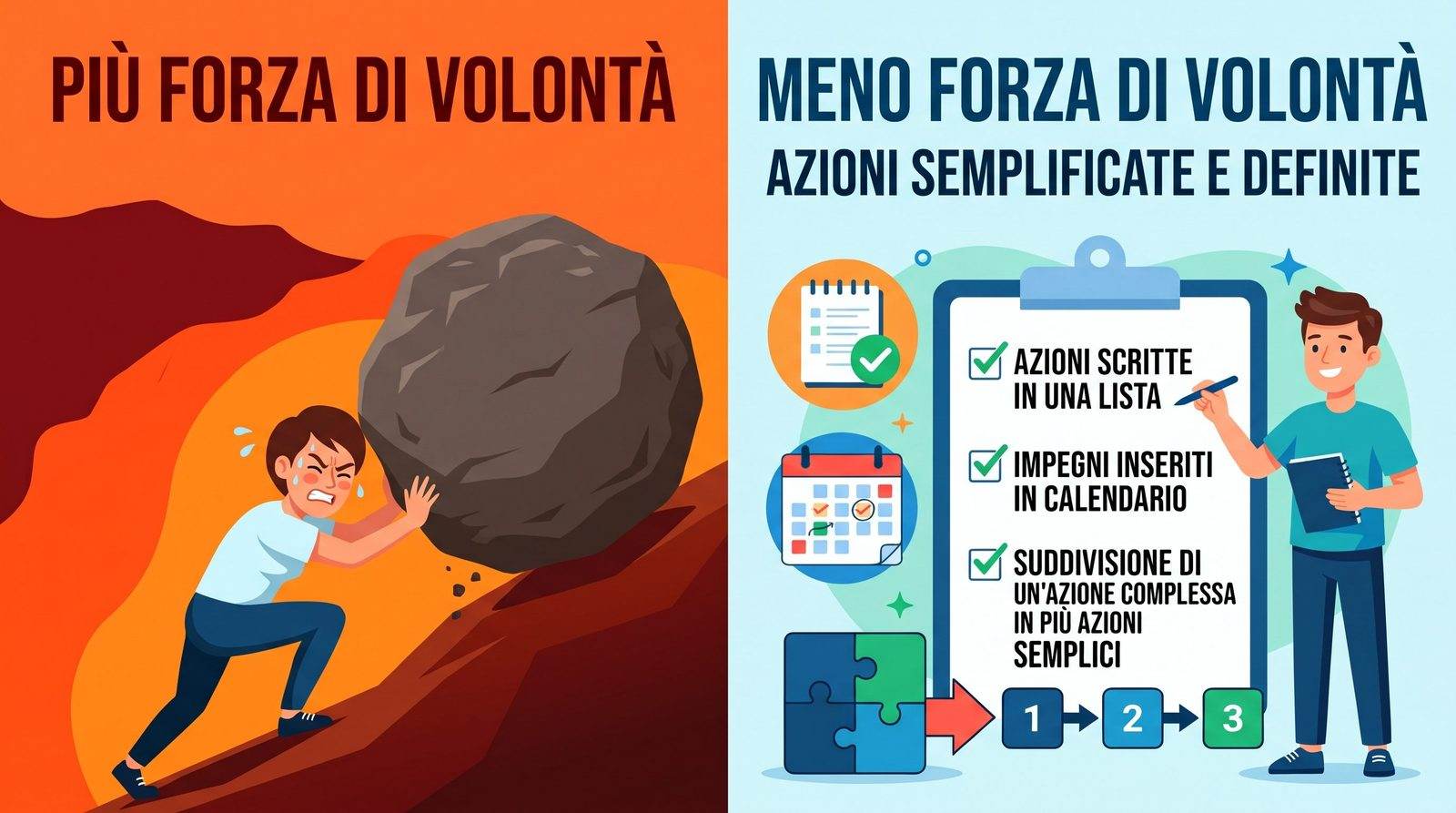
Every decision to be made should be written down, by adding it to a list or scheduling it in a calendar.
This way, decisions become explicit and can be turned into concrete actions to carry out:
- writing makes the action explicit
- scheduling places it in time.
Making visible what needs to be done lets you tell actual commitments apart from intentions that are still undefined.
Following this reasoning, you should aim to procrastinate only written actions: this would mean that every decision has been clarified and turned into an action, and that every action has become concrete because it is written down and scheduled.
Postponing a written action lets you recognize the delay and reschedule the action so as not to neglect roles and commitments and not to lose confidence in yourself.
This change introduces a new way of managing tasks, favoring consistency and personal confidence.
2. Make your tasks easier (constrain them, reduce them, motivate them, limit them, detail them)
To reduce the need to rely on willpower, you need to make tasks easier to tackle by working on the obstacles that make them hard to start or carry out. This can be done in 5 ways:
- Constrain them: create constraints that make it easier to start and carry out the task. The aim is to set up conditions that make it more immediate to move into action.
- Reduce them: simplify tasks and break them down into smaller actions. This makes it possible to take one step at a time. It is also important to check whether a seemingly single task is actually made up of two or more distinct actions, which can be separated to make execution simpler.
- Motivate them: increase your understanding of why the task matters. Understanding why a task has to be done helps you recognize its value and connect it to the result you intend to achieve.
- Limit them: set precise time boundaries by building a reference time into your tasks. Setting a timing for each task lets you circumscribe how it gets done and makes it clearer within what time limits it has to be tackled.
- Detail them: prepare a written checklist containing all the tasks to be carried out. Having a complete, concrete list of the necessary steps lowers the cognitive load, because you no longer have to remember every item or constantly decide what the next action is. This also reduces the need to rely on willpower to finish the task.
In conclusion, procrastination isn't solved by increasing discipline or forcing yourself to act with greater willpower.
Scientific research shows that postponing can be associated with the difficulty of managing emotions, with impulsivity and with the way efforts and future benefits are valued.
The method proposed here also identifies concrete conditions to work on in order to make the move into action simpler.
To reduce procrastination effectively, then, you need to work on the causes that feed it, rather than merely counteracting its effects. Writing down the decisions and actions to be taken and reducing the cognitive load of tasks makes commitments clearer and tasks simpler to tackle.
To reduce procrastination, therefore, the aim is not to become more disciplined, but to create the conditions under which less discipline is needed to do what you have decided to do. This way, you can reduce delays, keep your commitments and regain confidence in your ability to finish your tasks, without constantly relying on willpower.
Sources and references
*1 Klingsieck, K. B. (2013). Procrastination: When Good Things Don’t Come to Those Who Wait. European Psychologist, 18(1), 24–34.
*2 Steel, P. (2007). The Nature of Procrastination: A Meta-Analytic and Theoretical Review of Quintessential Self-Regulatory Failure. Psychological Bulletin, 133(1), 65–94.
*3 Sirois, F. M., & Pychyl, T. A. (2013). Procrastination and the Priority of Short-Term Mood Regulation: Consequences for Future Self. Social and Personality Psychology Compass, 7(2), 115–127.
*4 Zhang, S., Liu, P., & Feng, T. (2019). To Do It Now or Later: The Cognitive Mechanisms and Neural Substrates Underlying Procrastination. WIREs Cognitive Science, 10(4), e1492.
*5 Neural Connectome Features of Procrastination: Current Progress and Future Direction (2022). Chen and Feng, Brain and Cognition, 161, article 105882
*6 Chen, Z., Liu, P., Zhang, C., & Feng, T. (2020). Brain Morphological Dynamics of Procrastination: The Crucial Role of the Self-Control, Emotional, and Episodic Prospection Network. Cerebral Cortex, 30(5), 2834–2853.
*7 Le Bouc, R., & Pessiglione, M. (2022). A Neuro-Computational Account of Procrastination Behavior. Nature Communications, 13, 5639.
*8 Li, K., Zhang, R., & Feng, T. (2024). Functional Connectivity in Procrastination and Emotion Regulation. Brain and Cognition, 182, 106240.
*9 Wypych, M., Matuszewski, J., & Dragan, W. Ł. (2018). Roles of Impulsivity, Motivation, and Emotion Regulation in Procrastination – Path Analysis and Comparison Between Students and Non-students. Frontiers in Psychology, 9, 891.
*10 Baumeister, R. F., & Tierney, J. (2011). Willpower: Rediscovering the Greatest Human Strength. Penguin Press.