
The line is true, it goes into the minutes, and nothing changes on the next job.
Lessons learned are the insights drawn from a finished piece of work, or from one of its milestones: what was planned, what actually happened, what is worth doing the same way again and what is not.
The question applies to the professional who delivers alone, to the person coordinating a department and to the one running an eighty-person company: what changes is the number of people at the table, not what they are asked.
A lesson learned is not what you understood at the end of the job: it is the line that, from that moment on, changes how the next job is set up, checked or accepted.
Below: how to recognize a lesson, when to collect it, who takes part and what they are asked, where the output has to end up, how to write a list someone will actually reread, and what empties it.
Recognizing a lesson learned: the line between minutes and final reports
What sets a lesson learned apart from what you normally jot down at the end of a job?
Three elements a closing note does not have: a verifiable fact, its cause, and a rule that applies to the next job.
Among the figurative senses of lezione (lesson), the Italian Treccani dictionary lists the "salutary teaching drawn from the consequences of an unpleasant act or event, from a mistake made" [1]: the teaching is not in the event itself, but in what the event produced.
Four things resemble it, and they are the ones it is most often confused with.
The final cost report says how much the job cost and how far it went over budget: it is a measurement, and a measurement does not tell you what to do.
The closing minutes record what was said on a given date, including the remarks no one will ever pick up again.
The corrective action is already a decision made about an unmet requirement, and it follows its own rules inside a quality system: the path is the one described in nonconformity management.
The improvement proposal is an answer, and an answer is judged by different criteria than a fact — the subject of business improvement proposals.
Finally, there is a boundary in time: the issue log collects while the work is in progress, while collecting lessons closes the loop once the work is finished or has passed a milestone.
A well-written lesson can be recognized by its form: "the final drawing reached production eleven days late because the customer's approval had no deadline written into the quote" is a lesson; "we need to communicate better with the customer" is a resolution.
When to collect lessons: at the end of the job or at milestones
At the end of the job, or while the work is still underway?
Both, with a difference in yield: at the end you see the effects, at milestones people still remember the decisions that produced them.
The NASA fact sheet describing the After Action Review is explicit: the review should be held right away, while participants are available and memories are fresh, so that what is learned can be applied the next day [2].
NASA also states that it adapted the U.S. Army practice into a format called Pause and Learn, in which sessions are held not at the end but throughout the project life cycle [2].
On a long contract, whoever sits down after eight months ends up discussing the effects of choices they can no longer reconstruct.
Outside the space sector, the working rule is to tie the collection to moments that already exist: the delivery of a phase, acceptance testing, customer sign-off and the administrative close of the contract are points where the team is together and the facts are recent.
Half an hour at those points yields more than two hours in a closing meeting called cold.
For short, repetitive jobs — orders, files, installations — it pays to flip the trigger: a fixed monthly window on the jobs closed in that period, instead of one session per job.
In teams that work in iterations, this same practice is called a project retrospective, and it takes place at regular intervals rather than once the project is over.
The four questions of a closing meeting that teaches something
Who sits at the table, and what are they asked?
The people who did the work, not just the ones who led it, and four questions in a fixed sequence.
The NASA sequence is: what was supposed to happen, what actually happened, why there is a difference, what will be done differently — and, on the other side, what will be done to repeat what went well [2].
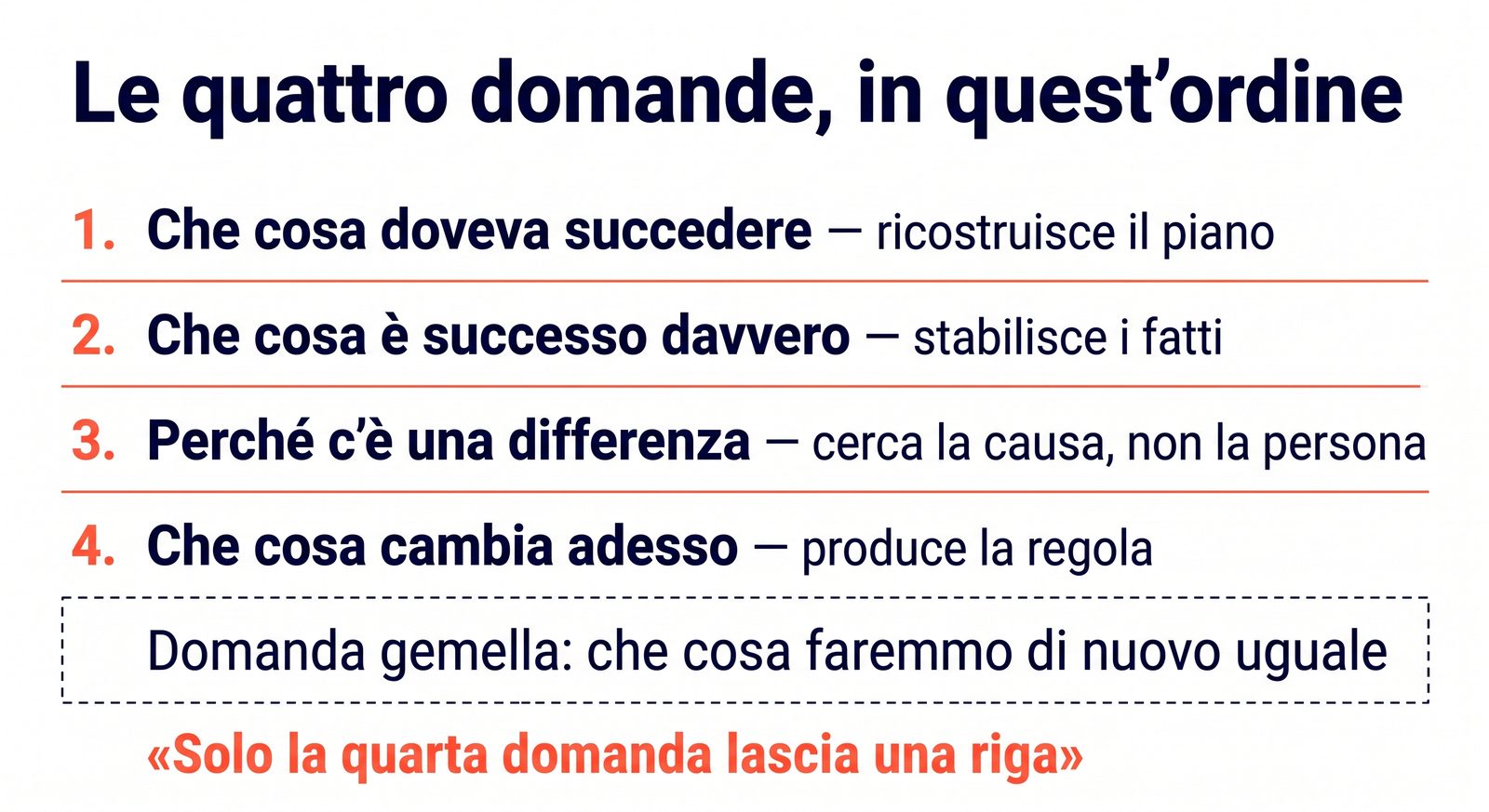
The first two questions look identical and are not: the first reconstructs the plan, the second the facts, and the gap between them is the subject matter of the meeting.
The first three establish a fact and a cause; only the fourth produces a line.
The meeting's usefulness is decided at the third question, and that is the point where the NASA sheet calls for a climate free of rank and seniority: these reviews are learning events rather than critiques, and they should not be treated as individual performance evaluations [2].
This is not a matter of good manners: talking about your own mistakes is a behavior people engage in only when they are not afraid of damaging their image [4], and the conditions that make it possible are described under psychological safety.
In Italian companies the difficulty also has a structural root: in 2022, among businesses controlled by an individual or a family, management was entrusted to an internal or external manager in 3.2% of those with 10-49 employees and in 0.8% of those with 3-9 employees [5].
Almost everywhere, the person running the closing meeting is the same person who wrote the quote and promised the date: the question "why did it go this way" becomes a judgment, unless it is asked about a written fact.
The remedy lies in the role, not in personality: whoever facilitates is not there to have the answers but to draw out the team's [2], and where the business owner is also the project manager, it is worth handing facilitation to someone else.
When the meeting involves several functions, the basic rules of effective business meetings apply: an agenda, a stated duration, one person taking notes.
Where lessons learned end up when they actually change the work
Where does what comes out of the meeting need to go, so that the next job is different?
To one of three places — a procedure, an acceptance criterion, a start-up check — and never only into the minutes.
The clearest measure comes from a public review of an organization that has been collecting lessons for decades: in 2001 the U.S. General Accounting Office surveyed 192 NASA program and project managers, obtaining 115 usable responses [3].
58% said the processes and systems in use did not allow them to retrieve the right lesson at the right time, 53% said they found lessons useful in fewer than a quarter of cases, and 43% had not entered a single one into the database in the previous two years; the barriers cited included lack of time and intolerance of mistakes [3].
An agency with an official database, an internal procedure and dedicated staff still got this result: the problem is not the collection, it is the destination.
A lesson that stays in the minutes has no destination: it changes the work only when it becomes a line in a procedure, an acceptance criterion or a check at the start of the next job.
The three destinations that change the work are recognizable because they also act on people who were not at the meeting.
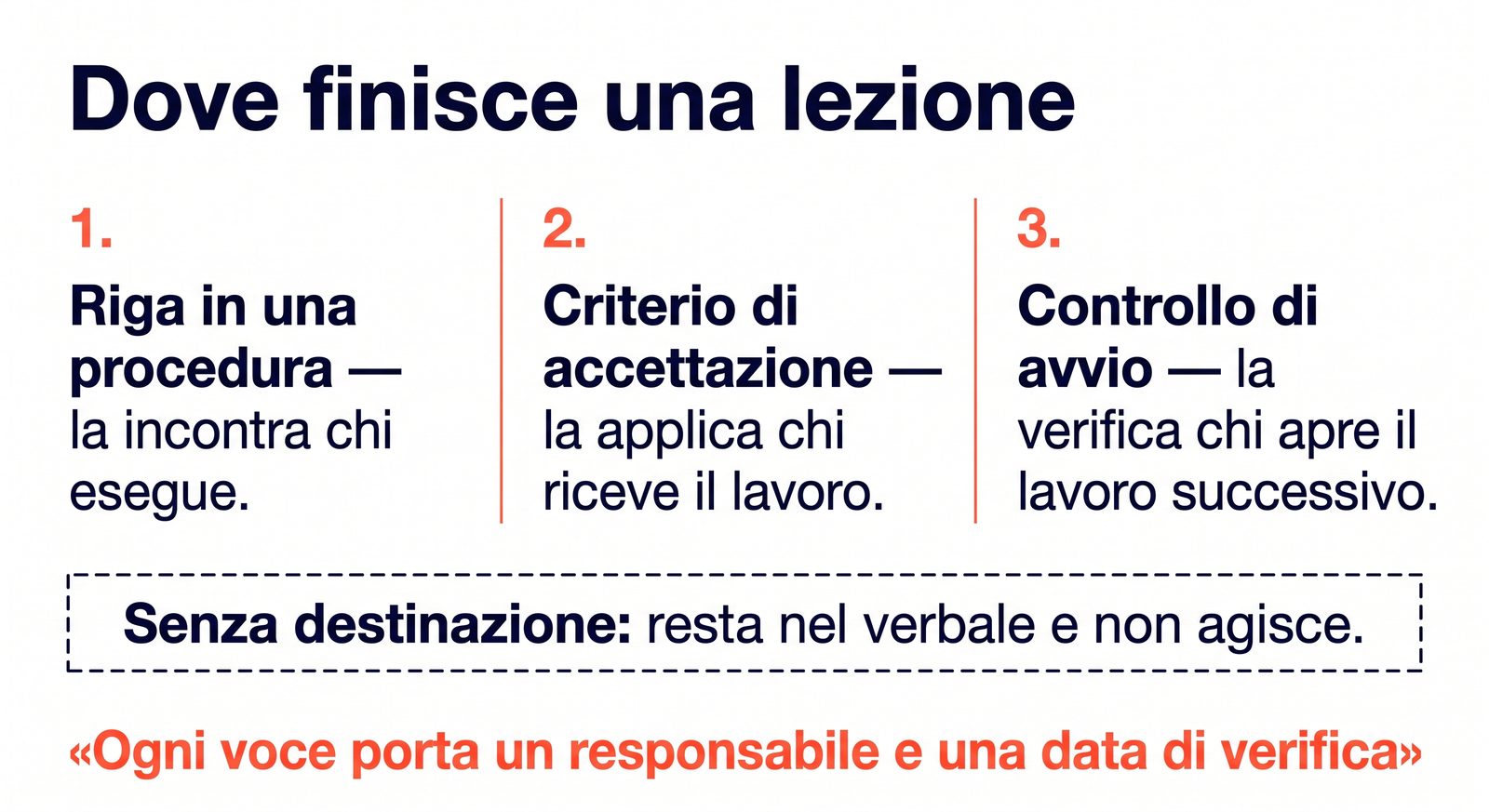
A line in a procedure or work instruction: the rule goes into the point of the process where it is needed, and the person doing the work runs into it.
An acceptance criterion: the condition a piece of work has to meet to be considered finished, applied by whoever receives it and not by whoever did it.
A check at the start of the next job: an item on the list used to open the contract, which forces someone to verify the condition before the problem comes back.
It is the same logic as quality management systems, where continuous improvement is a declared principle and not a separate document: the reference standard is ISO 9001, now in its 2026 edition — published on September 16, 2026 to replace the 2015 edition [6] — which confirms the framework of those principles [7].
In Italy this is far from a marginal framework: there were 101,426 active certificates as of December 31, 2024, the second-highest figure in the world [8].
For those without a formal system, the principle stays and only the medium changes: the destination can be a line on the order form or a box on the start-up list, as long as it is a point someone passes through while working.
When the cause is tangled and involves several departments, the intermediate step is an analysis sheet such as the A3 report, which holds fact, causes and countermeasures together before they turn into rules.
Writing a lessons learned list someone will reread
Why does almost no one reread the list of lessons from the previous job?
Because it is long, it is written like an essay and it has no owner: three flaws that are fixed with three constraints on form.
Few items. Three to five per job, chosen from everything that came up: a list of twenty is not a record, it is giving up.
Written as rules. The useful form is conditional — "when X happens, do Y" — because a description does not say what to do.
With an owner and a review date. One person per item, and a date on which someone checks whether the rule was actually applied, not whether it was written down: these are the same two fields as a corrective action, but here they close out a working rule, not an unmet requirement.
The collection form fits on a single page — a lessons learned template with eight fields: job, date, observed fact, cause, rule, destination, owner, review date.
The fields up to the cause are filled in during the meeting; the other four are added right after, so that the discussion does not stall on where to file things instead of what happened.
Before: "communication with the supplier was poor."
After: "when an order has delivery tied to a site date, the supplier's written confirmation must be obtained before confirming to the customer — owner: purchasing, review on the third date-bound order."
In a twenty-five-person family-owned machining company, the template works if it lives where the rule is applied: the sheet in the contract folder gets reread when the next contract opens, the file in a shared folder gets opened when someone happens to remember it.
There, the review does not require a meeting: it coincides with the opening of the next contract and takes as long as reading three lines.
Anyone who works alone or with a couple of team members uses the same scheme with one difference: the owner is also the person who reviews, so the date has to go on the calendar, or it does not exist.
The mistakes that empty the lessons learned process
What turns collecting lessons into a ritual no one defends?
Five habits, and four of them can be spotted by reading the list produced, without asking anyone anything.
Looking for someone to blame instead of the cause. When the question "why" stops at a person, the meeting has changed its job: it produces a justification, not a rule.
The signal is arithmetic: the final list contains names and no working conditions.
The long list. A twenty-item list gets filled in diligently and never reread: its mere existence gives the impression that the work has been done, and it is the quickest way to do none of it.
Lessons written as judgments. "Plan better," "be more careful," "improve handoffs" cannot be verified, so no one will ever be able to say whether they were applied.
Collecting only from jobs that went badly. The question about what to repeat is also part of the sequence [2], and it serves another purpose: without it, what works remains the personal knowledge of whoever did it and disappears when that person changes roles.
Not reviewing. The signal is repetition: when the same item appears in two different closing meetings, the problem is not that people do not learn, it is that the lesson never reached any point in the work.
Those who collect many lessons do not work worse than those who collect none: they are simply looking, and that is the condition any improvement starts from.
Limitations and conditions of applicability
The percentages on retrieving lessons and on their usefulness come from a 2001 survey, published in 2002, of program managers at a space agency [3]: they point to a mechanism — collection without a destination — and not to a frequency measured in Italian companies.
The study on perceived safety in teams covers 51 teams at a single manufacturing company and dates back to 1999 [4]: it shows an association between climate and learning behaviors, not a causal relationship.
NASA's operational guidance comes from engineering projects with large teams, and the sheet summarizing it is itself a compilation of third-party sources [2]: the sequence of questions is transferable, the organizational scale is not.
The references to ISO 9001 [6] [7] are there to show where a formal system places improvement actions: the article does not describe certification requirements and refers to the edition in force at the date of publication.
Collecting lessons does not produce any improvement by itself: it makes information available, and the result depends on the decisions that follow.
In periods of tight deadlines the closing meeting gets skipped: it is better to say so and move it back a week than to hold it out of obligation and produce lines no one will review.
FAQ
What does lessons learned mean?
Lessons learned are the insights drawn from a finished piece of work or from one of its milestones, comparing what was planned with what happened.
A lesson is complete when it contains a verifiable fact, its cause and a rule that applies to the next job: without the rule, it remains an observation.
When should lessons learned be collected?
It is best done right after a significant moment — the delivery of a phase, acceptance testing, customer sign-off — and not only at the final close.
The more time passes, the more you collect what people remember instead of what happened [2]; for short, repetitive jobs a fixed monthly window works better, and the meeting includes the people who did the work, not only the ones who led it.
What is the difference between lessons learned and a project retrospective?
The project retrospective is the meeting format: a periodic session in which the team examines the way it works.
Lessons learned are what that meeting produces and what outlives it, once written down as a rule with an owner.
A retrospective without written lessons leaves only a conversation.
What should go into a lessons learned template?
Eight fields are enough: job, date, observed fact, cause, rule, destination, owner, review date.
The field most often missing is the destination, meaning the point — procedure, acceptance criterion, start-up check — where the rule will enter the work.
Key takeaways
A lesson learned differs from a final cost report and from the minutes because it contains three elements: a verifiable fact, its cause and a rule for the next job.
Collection is tied to moments that already exist — end of a phase, acceptance testing, sign-off, close — and at short intervals it yields more than a single closing meeting.
The people at the table are the ones who did the work, not only the ones who led it, and there are four questions: what was supposed to happen, what happened, why there is a difference, what changes now.
Facilitation should be kept separate from whoever made the main decisions, so that the third question stays on causes and does not slide onto people.
Every lesson has a declared destination: a line in a procedure, an acceptance criterion or a check at the start of the next job.
The list stays short — three to five items — and each item carries an owner and a review date.
The process is judged by a single number: how many of the rules written in the last six months turn out to be applied when someone goes to check.
Conclusion
Lessons learned are not what you understand at the end of a job: they are the few lines that, from that moment on, change how the next job is set up, checked or accepted.
Everything else — the meeting, the minutes, the tidy list — is the means of getting there, and on its own it leaves no trace.
Four questions, three items and a declared destination for each are enough; the part that decides the outcome is the date on which someone checks whether the rule has actually entered the work.
If you want to place this practice in a broader path, you will find it in continuous improvement in business; if you already have a quality system, you know that the same lesson, when it concerns an unmet requirement, follows the track of nonconformity management.
After a few jobs closed this way, the content of meetings changes: people discuss rules applied or ignored, not blame to be assigned, and closing meetings get shorter because the list is already on the table.
Whoever leads stops being the only keeper of what the company has learned, and you feel it in the working days before you see it in the numbers: the same problems come back less often, and when they do, they find someone who already knows where to start again.
Sources and references
[1] Treccani, «lezione», Vocabolario on line, Istituto della Enciclopedia Italiana. Available at: https://www.treccani.it/vocabolario/lezione/
[2] NASA – APPEL Knowledge Services, «After Action Review (Pause and Learn)», fact sheet. Available at: https://www.nasa.gov/wp-content/uploads/2025/09/after-action-review-v3.pdf
[3] United States General Accounting Office (GAO), «NASA: Better Mechanisms Needed for Sharing Lessons Learned», report GAO-02-195 to the Subcommittee on Space and Aeronautics, January 30, 2002 (survey closed July 13, 2001; 192 managers contacted, 115 usable responses). Available at: https://www.gao.gov/assets/gao-02-195.pdf
[4] Edmondson, A. C., «Psychological Safety and Learning Behavior in Work Teams», Administrative Science Quarterly, vol. 44, no. 2, 1999, pp. 350-383 (study of 51 work teams at a manufacturing company); copy deposited on the Massachusetts Institute of Technology domain, read for this article. Available at: https://web.mit.edu/curhan/www/docs/Articles/15341_Readings/Organizational_Learning_and_Change/Edmondson_1999_Psychological_safety.pdf
[5] ISTAT, «Censimento permanente delle imprese 2023: primi risultati», report of November 14, 2023 (reference year 2022; 1,021,618 companies with at least 3 employees represented). Available at: https://www.istat.it/comunicato-stampa/censimento-permanente-delle-imprese-2023-primi-risultati/ — PDF: https://www.istat.it/it/files/2023/11/REPORTCensimprese.pdf
[6] ISO, «ISO launches update to world's most widely used quality management standard for a new era of business», press release of September 16, 2026 (publication of ISO 9001:2026, replacing ISO 9001:2015). Available at: https://www.iso.org/news/2026/09/ISO9001-2026
[7] ISO, «ISO 9001:2026: What businesses need to know». Available at: https://www.iso.org/quality-management/iso-9001-2026
[8] Accredia, «ISO Survey 2024: le imprese accelerano su sostenibilità e digitalizzazione», AccrediaHub, October 30, 2025 (ISO data as of December 31, 2024). Available at: https://www.accredia.it/comunicazione/accrediahub/iso-survey-2024-le-imprese-accelerano-su-sostenibilita-e-digitalizzazione/