
Are discount requests becoming more and more frequent?
Why do some customers seem to consider a discount a normal part of the deal?
Is price really the reason they ask for it, or does the problem stem from different dynamics?
A request for a discount is one of the most recurring situations in business relationships and, if handled poorly, it can turn into a habit that gradually reduces the perceived value of the product or service.
Over time, the conversation tends to shift more and more toward price, with a consequence that affects the entire system: it becomes harder to protect margins and build solid relationships with customers.
Understanding why this happens and how to deal with it in a structured way is the first step toward breaking a mechanism that often feeds itself.
The problem: poor handling of discounts
Discount requests are a problem that involves not only sales but also operations.
Every price reduction, in fact, doesn't affect only the outcome of the sale: it influences margins, the economic sustainability of the offer and the company's ability to keep investing in improving its products or services.
That is why handling discounts can't be considered a simple sales decision: it is an element that has effects on the entire company system.
In problem solving, in fact, it's important to distinguish between operational problems and systemic problems: the former can be solved with a specific action, while the latter require broader intervention because they are the result of dynamics that affect the entire system.
The discount request is a systemic problem: it doesn't concern only the individual customer asking for a lower price, but all those situations in which the discount becomes an established expectation.
How to tackle the problem always depends on the context, but the analysis must follow a precise method.
The Problem Noting approach starts from defining the problem correctly: before identifying a solution, you need to understand how the problem shows up, where it occurs and who is really involved.
To deal effectively with discount requests, then, you need to start by identifying the problem.
Every problem must be described through observable elements, avoiding interpretations or assumptions.
The questions to ask to define the problem are:
- what signals show that the problem exists?
- where does the problem show up?
- who is affected by the problem?
Only after gathering this evidence can you move on to a structured analysis of the problem.
Signs that discount requests are being handled ineffectively
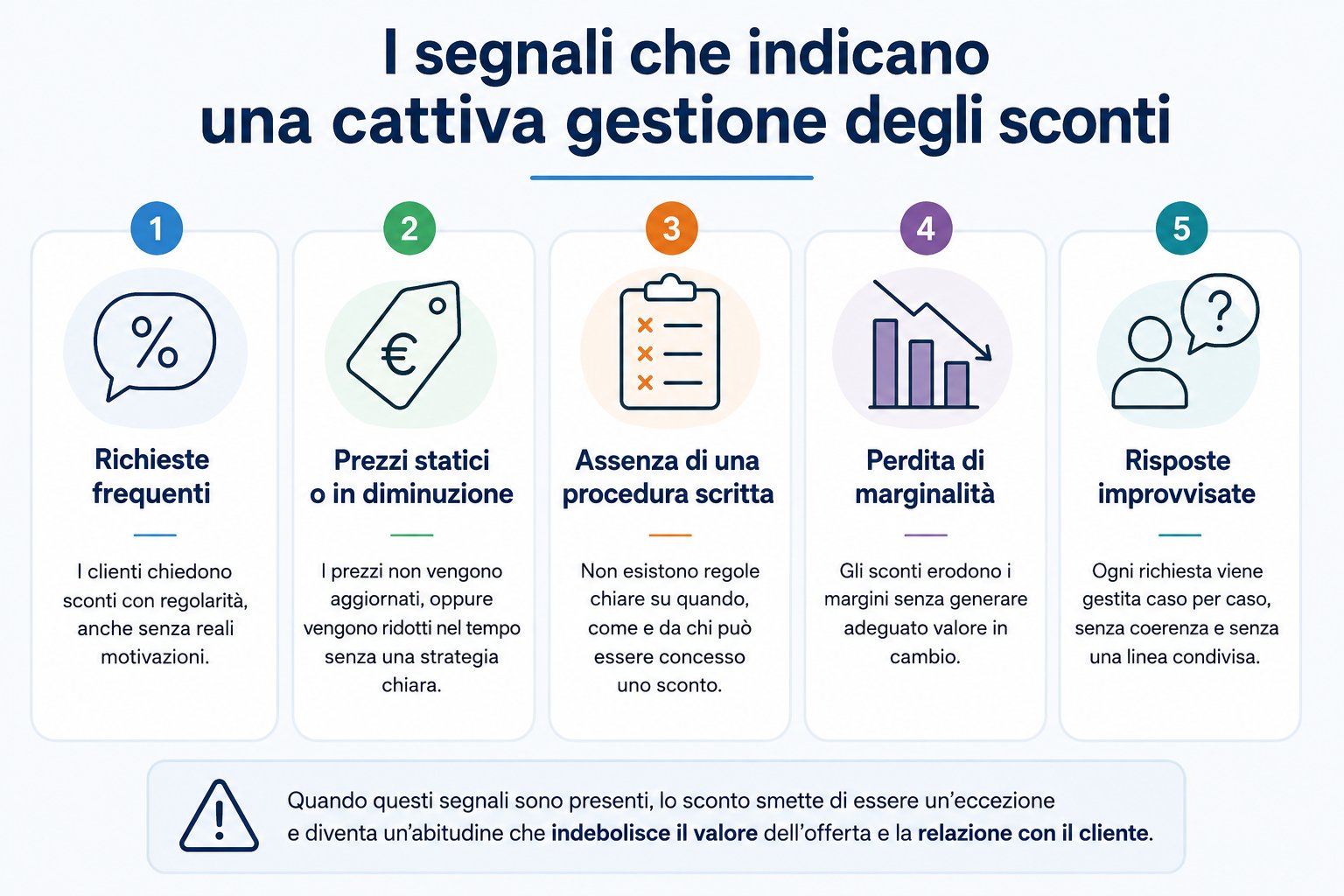
There are several signs that discount handling has become a problem in a sales system.
- Frequent discount requests: requests for lower prices become recurring and tend to be considered a normal stage of the sale.
- Inadequate responses to discount requests: the discount is granted immediately or refused curtly and impulsively. Both responses can undermine the deal: granting the discount right away reduces the perceived value of the offer, while an immediate refusal can lead to losing the customer.
- Losing customers because of price: a useful check is to ask yourself whether a price increase, for example of 10%, would lead to a significant loss of customers. If the answer is yes, the problem is probably not the price itself, but the way the discount request is handled.
- Static or even falling prices: when prices stay unchanged for long periods despite improvements to the product or service, or decrease over time, it reveals difficulty in assigning value to what is offered. If quality goes up, the price should go up too. Otherwise, margins are gradually lost.
- No written procedure: there is no shared procedure defining how to respond to a discount request. Each salesperson reacts according to their own judgment, making the system inconsistent.
These signs also help quantify the negative consequences that poor discount handling brings to a system.
The effects of this problem are, therefore, many and significant:
- shrinking margins;
- lost customers;
- low sales conversion rates;
- salespeople who are less and less skilled at creating value.
It's very important to consider that, underlying the habit of granting discounts, there is a feature of the human mind that makes this practice recurring and almost automatic: the mind naturally tends to choose the fastest route to a goal.
When a discount is considered a plausible option in the deal, the mind takes a shortcut to reach the intended result (in this case, the sale).
Rather than increasing the perceived value of the product or developing more effective sales skills, it becomes easier to cut the price just to close the sale.
The first choice for converting a customer should instead be to increase the value of the offer, not to lower the price.
What remains to be understood is how much price really matters to buyers, and how much a discount costs whoever grants it.
How much price matters and what a discount costs
Before moving on to actions, it's worth separating what has actually been measured from what is taken for granted, starting from two guiding questions:
- are customers asking for more and more discounts, fewer and fewer, or has the demand for discounts remained stable over time?
- are companies and salespeople becoming more effective at responding to discount requests, or less capable of handling them?
At present, neither question has a measured answer: none of the sources cited on this page tracks the same indicators at two distant points in time, which is what would be needed to establish whether discount requests are growing, declining or staying stable.
Price weighs heavily in purchasing decisions, and the Italian ISTAT data reported below show this for the most recent two-year period: saying that it has become so in recent years, however, would require a longer time series, which none of the sources on this page provides.
Data from ISTAT, Italy's national statistics institute, on household consumer spending in Italy show how price pressures have changed purchasing behavior in a lasting way: price sensitivity remains high even after inflation has come down, and looking for better financial terms has become standard practice.[1]
In 2024, with average monthly consumer spending essentially unchanged (2,755 euros versus 2,738 euros in 2023), 31.1% of Italian households still said they had tried to limit the quantity or quality of the food they bought: a share almost identical to the previous year, when it was 31.5%.[1]
This greater attention to price, however, doesn't mean that granting a discount is always the most effective choice.
Alavi, Wieseke and Guba (2016)[2] observed that many salespeople tend to make price concessions to close the deal and win the customer.
The research shows, however, that discounts are often granted on the basis of an inaccurate assessment of how important price really is to the customer.
This frequently leads to cutting the sales margin even when it wasn't necessary, undermining the outcome of the negotiation without increasing the chances of success.
The best strategy, then, is not to grant fewer discounts, but to build the conditions that make a discount the exception.
If a discount isn't always the solution, it becomes essential to understand what ideal condition you want to reach.
The ideal condition to reach in handling discount requests
Before stepping in with solutions, you need to define precisely what goal you want to reach: what result the solution must lead to in order to prove that the problem has been solved.
This is a fundamental stage of the problem-solving process: if the ideal condition isn't identified correctly, you risk not solving the problem at its root.
Every path to a solution therefore starts with a fundamental question:
"If this problem were completely solved, what situation would you want to see?"
The most immediate answer might be: "Never give anyone a discount again."
This, however, is not the correct result, that is, the situation you should reach if the symptom disappeared completely.
The problem is not eliminating discounts.
A discount is, in fact, a terrible tool when used within a sales pitch, but it can become an excellent tool within a negotiation.
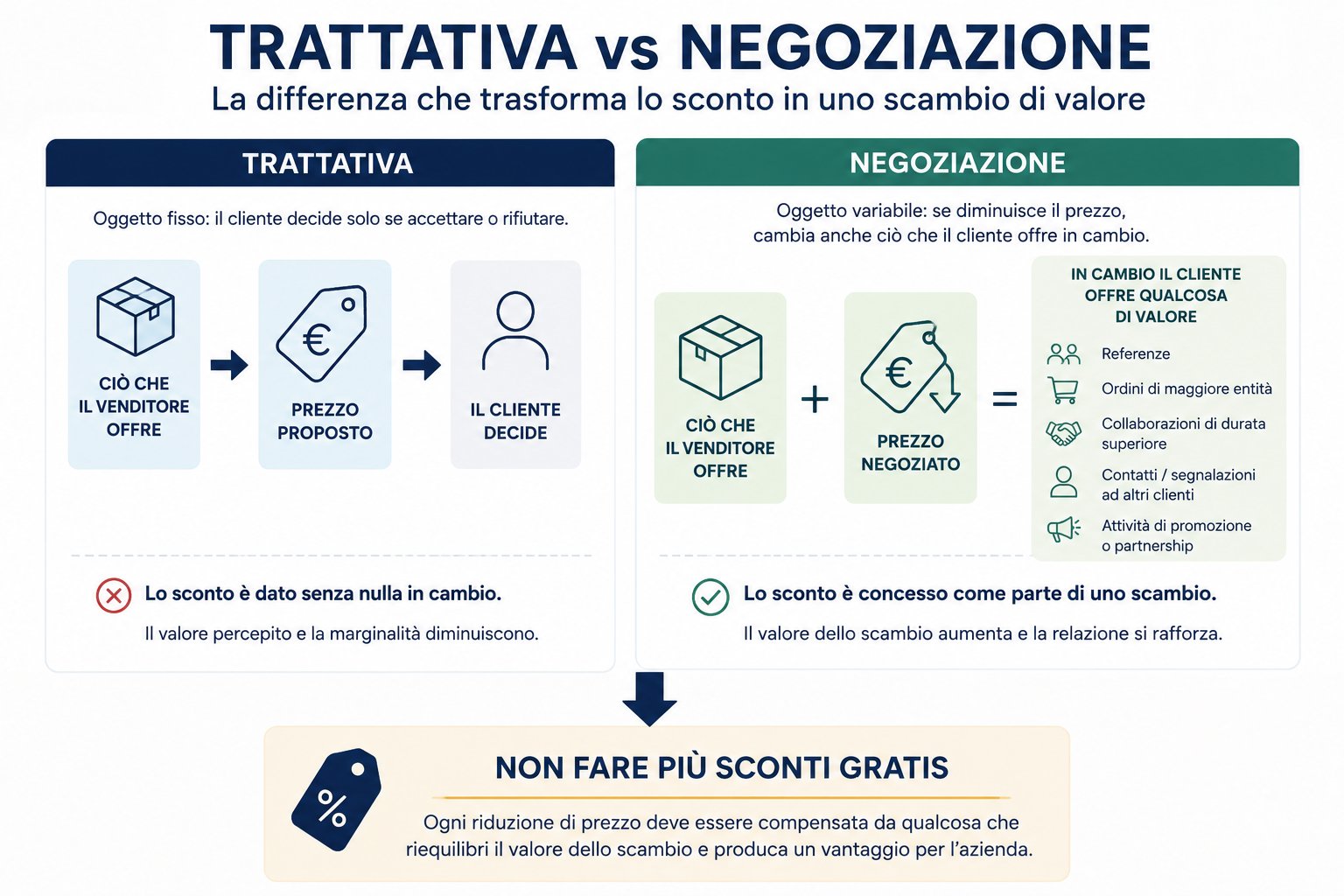
The difference between a sales pitch and a negotiation is substantial.
In a sales pitch, the salesperson presents what they offer and the customer simply decides whether to accept or refuse. What is given and what is received stay the same: a product is offered at a certain price and the customer decides whether to buy it.
A negotiation, on the other hand, changes the relationship between what is given and what is received. If the price goes down, what the customer offers in return must change too.
A discount can therefore be granted, but not for free. In exchange, you can ask for things that have value for the company, such as:
- references;
- contacts;
- larger orders;
- longer-term collaborations;
- referrals to other customers;
- promotional activities or partnerships.
A discount is a reduction in price and, precisely for this reason, it must be offset by something that rebalances the value of the exchange.
The goal to reach in order to have a correct result and live an ideal condition thus becomes: "No one gets a discount for free anymore."
This doesn't mean eliminating discounts completely, but making sure that every possible price reduction falls within a balanced negotiation, in which both parties get something of value.
Only by shifting attention from price to the overall exchange can you keep discounts from becoming a habit and preserve the value of the business relationship.
The mechanisms that turn discounts into a habit
Understanding a problem means going beyond its immediate effects and analyzing the mechanisms that generate it.
In the case of discount requests, this requires, first of all, questioning some very widespread ideas and beliefs and then observing how the phenomenon actually develops within the relationship between company, salesperson and customer.
The most common misconceptions
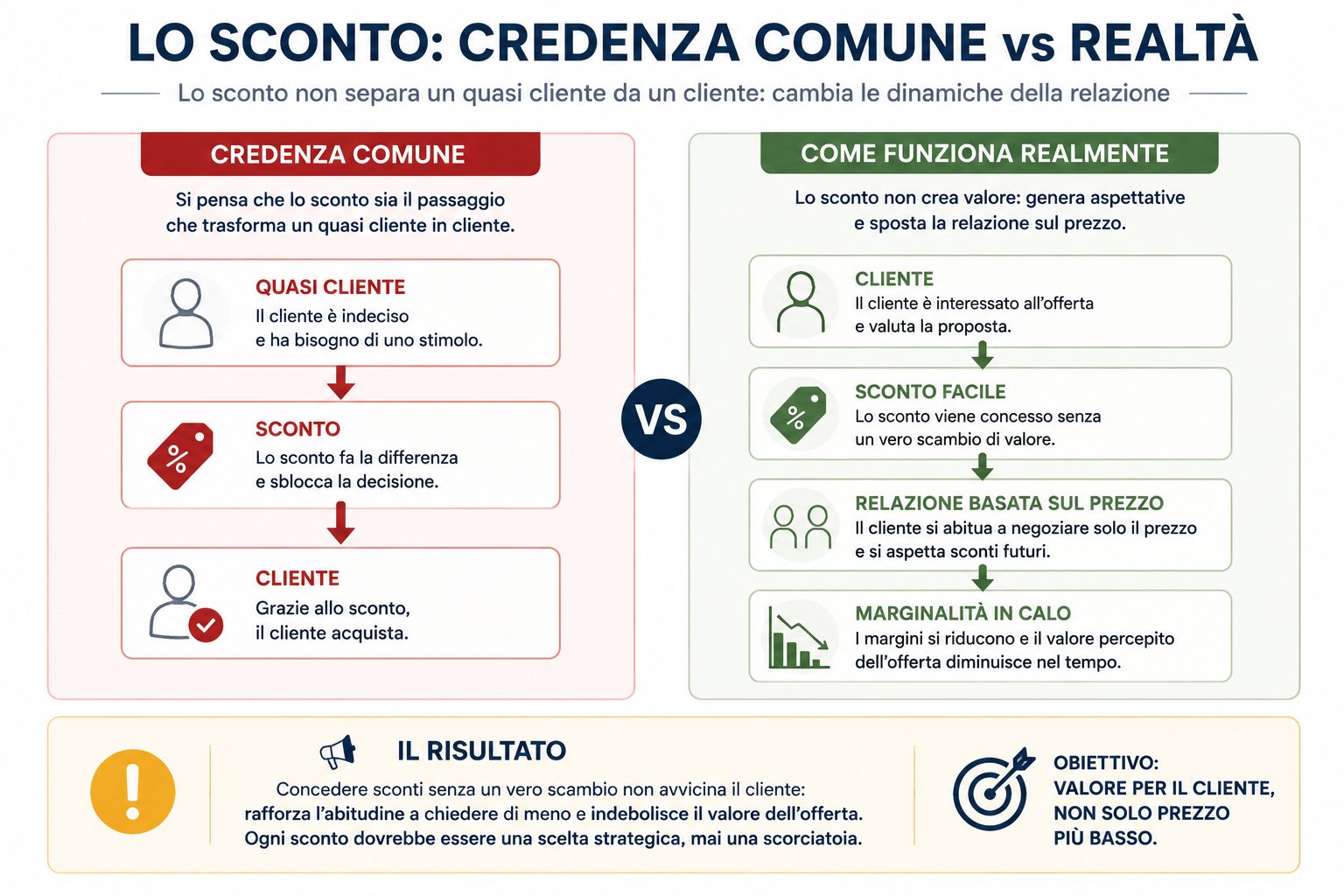
Underlying the tendency to grant discounts is a widespread but wrong idea that sees the discount as the element separating an "almost customer" from an actual customer: the missing piece for closing the sale.
This belief leads the salesperson to perceive the discount as a natural tool of the deal.
This is also where the phenomenon known as the Loyalty Discount Circle, the paradox of the loyal customer, comes from.
The mechanism follows a precise sequence:
- the loyal customer starts expecting better financial terms;
- the salesperson grants the discount more easily precisely because it's a regular customer;
- the discount reinforces a loyalty that is increasingly based on price;
- the customer expects ever better terms (a higher discount percentage and confirmation of the discount in every deal);
- margins keep shrinking.
This creates a paradox: precisely the customers from whom you should be earning the most profit end up being the ones you earn the least from.
That the expectation really does form, and is not just a salesperson's impression, is documented by experimental research on price expectations: Kalwani and Yim (1992), in a controlled experiment, measured that both the frequency of promotions and the size of the discount have a statistically significant effect on the price buyers expect to pay.[3]
The same authors found that the response to promotion expectations is asymmetric, because losses weigh more than gains: the absence of a discount that has come to be expected affects the choice more than the presence of an unexpected discount does.[3]
The study concerns consumer purchases, not business-to-business deals, so the mechanism is documented, while its extension to B2B sales remains an analogy.
Without written procedures, this expectation grows over time and becomes an integral part of the business relationship.
A discount also has another very important effect: it calls into question the credibility of the initial price.
When a discount is granted easily, the customer may come to think that the price originally offered wasn't real.
Two questions may then arise in the customer's mind:
- if I hadn't asked for the discount, would I have paid a higher price?
- if I push harder next time, will I be able to get an even bigger discount?
In this way, the discount risks generating distrust.
If the consequences of granting discounts have such an impact on the system, on the relationship with the customer, on the quality of the product offered, on ways of working and on the related work habits of team members, why is this practice so widespread?
The three causes that lead to granting discounts
Granting a discount is rarely a random decision. Underlying this choice are some recurring mechanisms that make cutting the price the most immediate response during the deal.
The main causes that lead to granting discounts are three:
1. The value of what is being sold isn't clear
Value must be defined precisely and in writing. You need to break the product or service down into the individual elements that make it up and assign a concrete value to each of them. If this work isn't done, granting a discount becomes much more likely.
2. The discount is considered a variable of the deal
As soon as the salesperson admits the possibility of a discount, the mind automatically tends to choose it as the simplest way to close the sale.
Even when a salesperson proposes granting a discount to an important customer, immediately accepting the request means reinforcing a habit that worsens the system in the long run. The response should protect not only the customer, but also the salesperson and the company.
3. There is a blind ambition to win the customer
When the goal becomes winning the customer at any cost, price inevitably ends up becoming the main lever.
To solve the problem of poor discount handling, then, you need to act directly on these causes.
Acting on these causes means, in fact, reducing the likelihood that a discount becomes an automatic response, and building a sales system capable of better showcasing the value of what is offered.
What a discount really communicates to the customer
Every discount sends a message that goes beyond a simple price reduction. The way the customer perceives it can influence the value attributed to the offer and the credibility of the sales proposal.
The origin of the word offers food for thought.
In Italian, sconto (discount) is the noun derived from the verb scontare, which in turn comes from conto (bill, account) with the subtractive prefix s-: the literal meaning recorded by the dictionary is "to deduct from the bill."[4]
If something is taken off the bill, the customer can interpret the situation in two ways: thinking that the initial calculation was wrong, which casts doubt on the salesperson's professionalism, or believing that the price is arbitrary, which fuels a perception of unfairness.
Understanding the meaning the customer attributes to the discount helps explain why this choice can have effects that go well beyond the individual deal, influencing the business relationship over time.
How the discount request mechanism is generated
To understand even better the mechanism that generates the problem, it helps to ask three questions.
1- Why do customers ask for a discount?
The main reasons are:
- habit: in some industries, asking for a discount has become habitual behavior. It isn't a trait of the person, but of the context in which they buy;
- low perceived value: the price doesn't seem consistent with the value attributed to the product;
- plausibility of acceptance: if, in the customer's mind, there is a chance that the discount will be granted, the request will be made, because not trying would seem like a missed opportunity.
2- What does granting a discount generate?
A discount produces a condition of need: you need the customer and must do everything not to lose them.
When there is a strong need to win that customer, even the mere possibility of granting a discount is taken into consideration and quickly becomes the chosen solution.
3- What is the process that generates the problem?
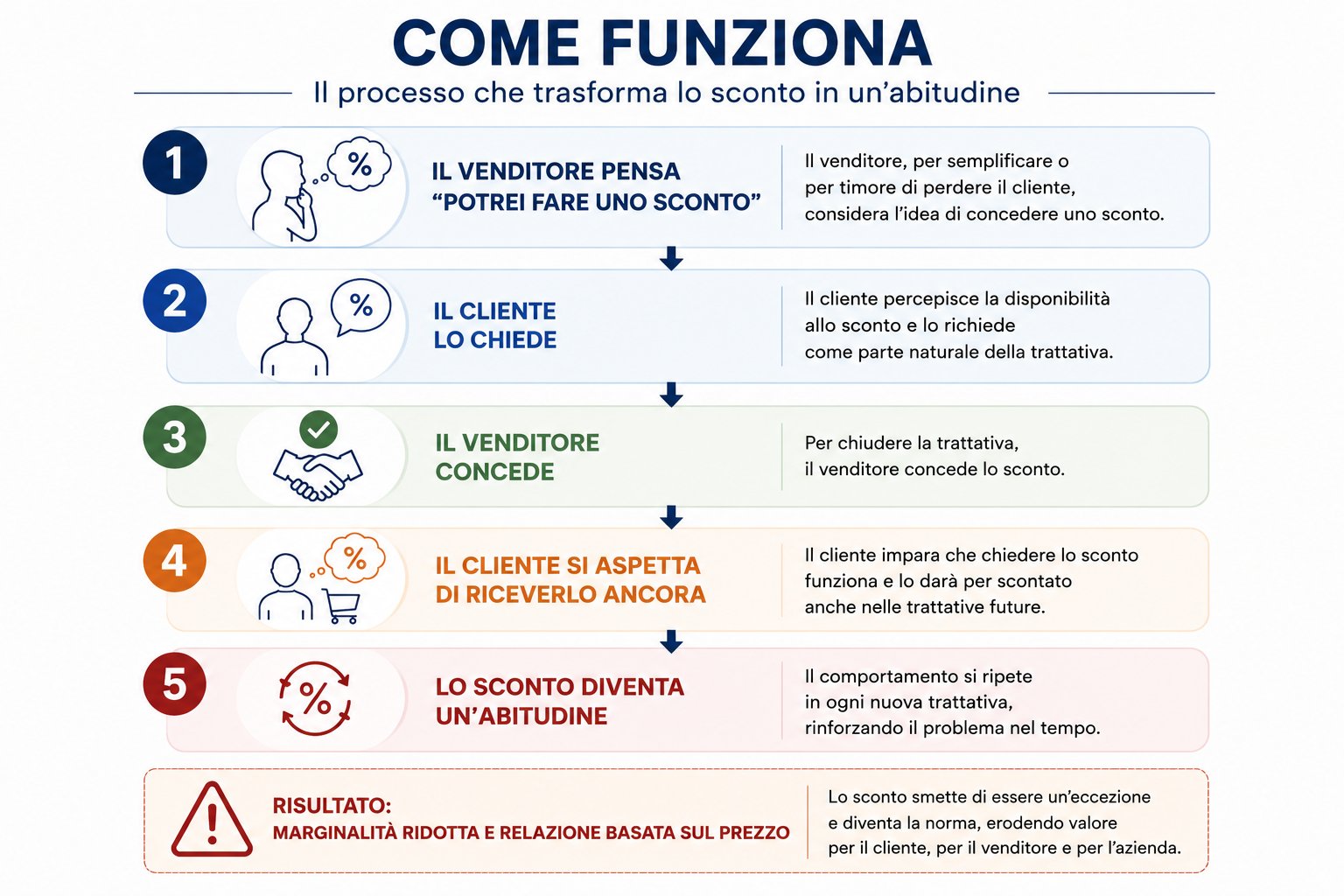
The path that leads to a discount generally follows four stages:
- the salesperson conceives the possibility of granting the discount;
- the customer explicitly makes the request;
- the salesperson gives their response;
- the customer evaluates that response and builds an image of the salesperson and the business relationship.
If the salesperson shows hesitation, the customer tends to insist. If the customer gets the discount, that approach will become a model to repeat in future deals.
Contrary to the most popular and widespread belief, then, a discount is not what separates an "almost customer" from a customer.
A discount that has been granted is, instead, what separates an almost relationship from a compromised relationship.
When granting discounts becomes automatic, the relationship risks being based less and less on the value of the product and more and more on price. In this way the business relationship becomes fragile, because every new deal will be influenced by the expectation of getting further reductions.
Actions for handling discount requests through negotiation
To act on the problem for good, solutions must work directly on the causes that generate it.
To handle discounts productively, turning sales pitches into negotiations in which the value of the exchange increases and the relationship with the customer grows stronger for the right reasons, it helps to follow these practical tips:
1. Clarify your discount policy
You need to define a clear, written position on discounts. The first change concerns the salespeople's mindset, even before the customers'.
Everyone involved in sales should know when a discount can be considered, who is authorized to grant it and according to what criteria. A shared policy avoids improvised decisions, makes the behavior of the whole organization consistent and keeps the customer from perceiving the discount as an automatic concession.
2. Create a standard procedure for responding to discount requests
The response shouldn't open a simple discussion, but a real negotiation.
Receiving a discount request doesn't mean having to choose between granting or refusing it: it means turning the conversation into an exchange of value.
That is why it helps to define a procedure that establishes how to handle these requests, what questions to ask and what conditions to propose.
In negotiation, "no" is often the least effective answer. The logic to apply is rather to answer with: "Yes, but on this condition," shifting attention from price to what the customer is willing to offer in return.
3. Create a list of things to ask the customer for in exchange for the discount
Every price reduction should be offset by something that has value for the company.
That is why it helps to prepare in advance a list of possible trade-offs to use during the negotiation, so you don't have to improvise during the deal. Trade-offs can include, for example, larger orders, longer-lasting collaborations, references, referrals to other potential customers or any other element that produces a concrete benefit.
This approach requires good knowledge of the customer and makes it possible to turn a discount from a simple financial sacrifice into a balanced exchange of value.
Customers and suppliers who don't base their relationship on a constant exchange of discounts generally develop more solid relationships, focused on value and less dependent on price.
In conclusion, solving the problem of discount handling doesn't mean preventing any discount, but making sure that every concession is part of a balanced negotiation and produces a mutual advantage.
Sources and references
[1] ISTAT (2025). Le spese per consumi delle famiglie — Anno 2024 (Household consumer spending — Year 2024), Statistiche Report, press release of October 7, 2025 — https://www.istat.it/comunicato-stampa/spese-per-consumi-delle-famiglie-anno-2024/
[2] Alavi, S., Wieseke, J., & Guba, J. H. (2016). Saving on Discounts through Accurate Sensing: Salespeople's Estimations of Customer Price Importance and Their Effects on Negotiation Success. Journal of Retailing, 92(1), 40–55 — https://doi.org/10.1016/j.jretai.2015.08.002
[3] Kalwani, M. U., & Yim, C. K. (1992). Consumer Price and Promotion Expectations: An Experimental Study. Journal of Marketing Research, 29(1), 90–100 — https://doi.org/10.1177/002224379202900108
[4] Treccani, Vocabolario della lingua italiana, entries scónto and scontare — https://www.treccani.it/vocabolario/scontare/