

A generational transition is a delicate phase in the life of a company, one in which expectations, personal relationships and the continuity of the work built over the years are all intertwined.
The change is not only about who will take over leadership: it also affects internal balances, responsibilities and the way decisions are made.
When this transition proves difficult, the consequences can spill over into both the company's organization and family relationships.
What makes the move from one generation to the next so complex, and which obstacles risk undermining its success?
To tackle the problem, you need to look beyond the simple transfer of the company and understand the dynamics that come into play when the person in charge changes.
The problem: when the generational transition is only on paper
A generational transition consists of handing a company over to future generations.
It does not necessarily involve one's children, although in Italy it is often understood that way, given the number of family-run businesses.
The concept is broader: it covers the transfer of ownership, leadership and business responsibilities to someone from a later generation, regardless of family ties.
The difficulties of a generational transition are not only about delegation or the transfer of skills. Often they are above all relational: they involve the relationship between the person leaving the company and the person taking over its leadership, the roles each of them continues to hold and the ability to recognize the successor's autonomy.
To understand the problem, you need to distinguish the generational transition in a general sense from the family one. The first concerns the transfer of the company to a later generation, while the second concerns the transfer within the family.
The problem of the generational transition affects both parties involved: the person leaving the company and the person preparing to take it over. On one side, the founder has to manage to hand over leadership and give up their own role; on the other, the successor has to be able to take on the responsibilities needed to run the business autonomously.
When the generational transition does not translate into an actual transfer of leadership and responsibilities, the company's continuity can become harder to secure.
But what are the concrete consequences of this process? And how much do the choice of successor and their relationship with the company affect the results that are achieved?
To answer, it is useful to look at what emerges from the scientific literature on generational transitions.
What science says about generational transitions
What happens, statistically, after a generational transition?
Is a family successor or an external manager more effective?
The scientific literature shows that the choice of successor affects business results, with effects that vary by context and that touch continuity, economic performance and the capacity to innovate.
One of the main studies, carried out in Denmark by Bennedsen and colleagues (2007)*1, shows that family succession leads on average to a drop of at least four percentage points in the operating return on assets compared with appointing an external CEO. This gap is more pronounced in large companies, in high-growth sectors and where the workforce is highly qualified, although it does not imply an automatic fall in revenue or a decline for every family business.
A more nuanced picture emerges from the review by Reif and colleagues (2025)*2 of 306 publications, which breaks down the process of transferring the management of a company into three phases:
- succession planning, which includes defining the rules and selecting the successor;
- successor development, aimed at building the skills needed to lead the business;
- successor onboarding into the company's leadership, during which leadership is transferred and responsibilities are taken on.
The study confirms that external managers are associated with better financial results, while family successors ensure greater protection of the family's values and socioemotional goals.
It is interesting to note that comparing different countries and business contexts shows equally different situations and results.
In Italy, research by the Bank of Italy authored by Cascarano and colleagues (2026)*3 finds that about three in four Italian limited companies are family-controlled and that more than one Italian family business in five has at least one elderly shareholder, which makes the question of ownership turnover a relevant one.
Italian family businesses are on average smaller and less productive than other companies, but they are more profitable and less likely to exit the market.
Above all, generational transitions within the family are not associated, on average, with statistically significant changes in company performance.
The entry of external shareholders, on the other hand, is accompanied by growth in employment and productivity.
These results highlight large differences between countries: the studies look at different contexts, samples and aspects of succession, but on their own they do not allow the conclusion that one national model is always more effective than another.
While in Denmark handing the company over to an external successor proves more effective, in Italy family succession is more common, and it involves less of a break from the inherited model, which keeps being carried forward over the years without any particular departures.
A further factor behind these differences is the variety of parenting styles across countries and, with it, the way the successor is prepared to take on their role.
The study by Liu, Zhu and Wang (2024)*4, carried out in China, indicates that an authoritative parenting style, based on rules, support and autonomy, encourages children to want to take over the business and to change its status quo, unlike an authoritarian style.
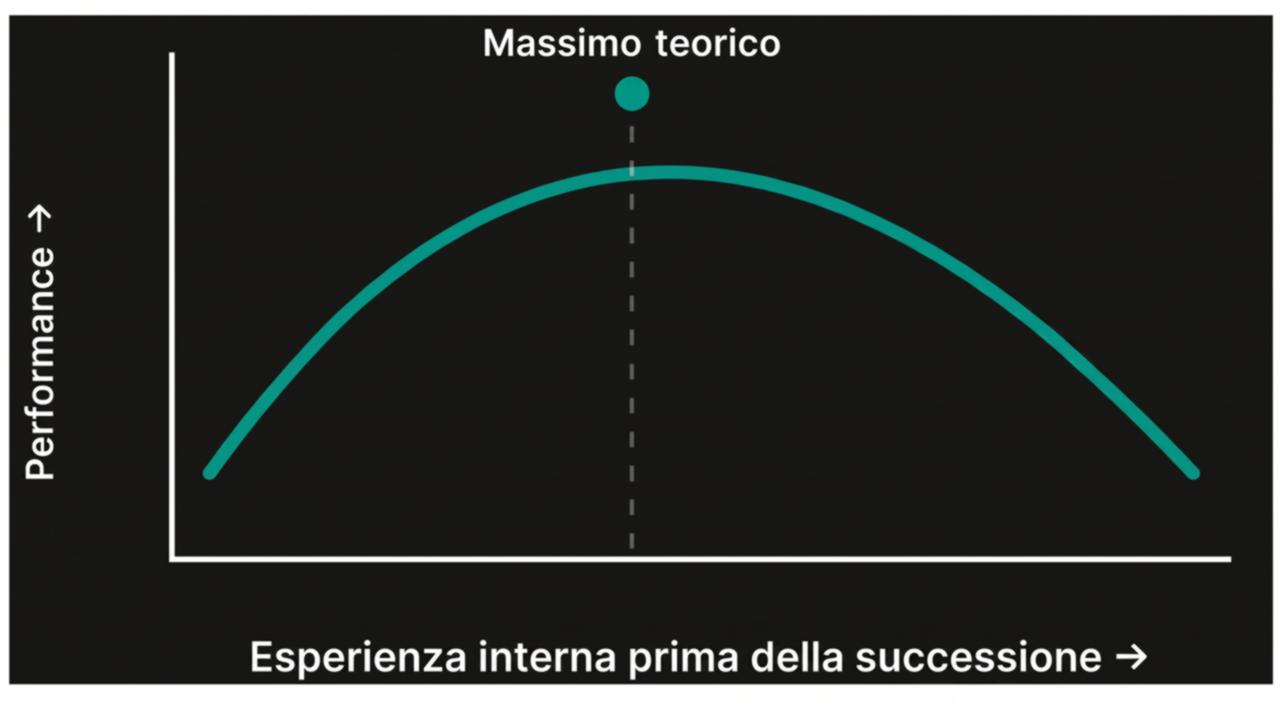
In parallel, the analysis by Istipliler and colleagues (2023)*5 of 405 German companies shows a negative association between excessive internal experience before succession and subsequent performance, together with fewer strategic changes.
When the predecessor's experience is passed on without leaving room for independent judgment, some cognitive biases can also come into play, that is, systematic distortions of judgment:
- authority bias (deference to authority) leads people to consider decisions more correct because they come from an authoritative figure;
- the halo effect can lead people to generalize the predecessor's successes, overrating their other decisions as well;
- status quo bias (resistance to change) favors keeping existing ways of working.
These concepts help describe some of the possible mechanisms through which the successor may be led to confirm past choices instead of assessing them critically.
Finally, the effectiveness of the transition also depends on how knowledge and power relationships are managed.
Cristofaro, Bonomi and Reina (2023)*6 highlight the complexity of transferring knowledge that is tacit, tied to decision-making know-how and to the ability to govern, which cannot be passed on through formal channels alone.
Tacit knowledge is the knowledge that comes from experience and that cannot always be fully expressed or passed on through formal explanations. It differs from explicit knowledge, which can be described and documented more easily.
In a generational transition, this distinction matters because the successor does not only need to acquire technical knowledge, commercial, economic and organizational, but also know-how, which includes the ability to make decisions, deal with problems, negotiate and coordinate people, and the ability to govern, which concerns exercising authority, weighing priorities, keeping control of the company and steering its development.
The difficulty of transferring these skills also depends on the relationship between predecessor and successor.
As Muskat and Zehrer (2017)*7 point out, imbalances of power and authority between the person handing over leadership and the person taking over risk slowing down this transfer.
Trust and shared family assets can help the process, but they do not necessarily remove the difficulties linked to decision-making authority, rivalry and the successor's ability to acquire an autonomous role.
From this perspective, preparing a successor does not only mean passing on the way the business has been run up to that point. It also means developing their ability to assess the knowledge they receive, make decisions and question existing practices when needed.
Succession can ensure continuity and maintain performance levels without new management skills or greater decision-making autonomy being developed.
Maintaining the results achieved, therefore, does not necessarily mean that the successor has fully taken on responsibility for leading the company.
That is why it is important to distinguish between the ability to carry on the predecessor's work and the ability to take full responsibility for leading the company.
Overall, the studies examined do not support a universal rule whereby a family successor is always less effective than an external manager. Rather, they show that the resulting performance depends on how succession is handled, on the context, on the successor's skills and on the way knowledge and responsibilities are transferred.
Family continuity can help preserve the company's values and goals, while bringing in an outside figure can be associated with better financial results.
The central question, then, is not only who will lead the company, but also how they will be prepared to lead it and how much room they will have to develop their own judgment.
When the transfer focuses mainly on preserving what has been done up to that point, difficulties can arise that concern not only the new CEO but the entire future of the company.
So what happens when the generational transition does not work as it should?
The consequences can go well beyond the difficulties between predecessor and successor, affecting the organization, strategic decisions and the company's results.
The effects of a generational transition that is only on paper
The difficulties of a generational transition can have consequences that affect financial results as much as the organization of work and family relationships. Here are some of the most significant:
- Worse financial results: the company may lose effectiveness and achieve poorer results after the generational transition. If the successor cannot fully perform their role or lacks the conditions needed to introduce the appropriate changes, the company's continuity can be compromised.
- Loss of knowledge and experience: when the skills the founder has built up are not passed on, an important part of the company's assets risks being lost. The problem is not only technical knowledge, but also the knowledge developed through experience, which is hard to put into words.
- Disrupted work rhythms: founders who have already reached a very advanced age often stay on in the company, and this creates an imbalance between the role they hold, their professional stage and the contribution they actually make to the organization. The issue is not simply age, but the ability to keep a functional balance between generations. At an individual level, moreover, you need to consider a balanced rhythm made of alternating work and rest: working intensely all the time is neither healthy nor natural. For everyone, the moment comes to rest and to live a lifestyle that fits the stage of life they are going through.
- Family conflicts: difficulties that arise at work can spill over into private life. When professional and family roles overlap, disagreements over business decisions risk damaging personal relationships too.
In light of these consequences, it becomes clear that handing over leadership of the company only on paper is a problem that needs solving.
Before choosing how to act, however, it is essential to define which condition you actually want to reach: the chance of arriving at an effective solution depends precisely on pinning down the goal to set.
The goal to set for an effective generational transition
To tackle a problem effectively, you first need to identify the result you want to achieve. However, what looks like the most desirable solution does not always represent the condition worth pursuing. An apparently sensible choice can actually end up feeding the problem instead of helping to overcome it.
To tackle the problem of a generational transition that is only on paper, you need to correctly identify the ideal condition to reach.
There is a widespread ideal condition that seems reasonable but does not necessarily lead to the desired results. Alongside it, there is a less intuitive condition that shifts attention to the result to aim for in order to ensure an actual transfer of the company's management.
The wrong ideal condition is wanting the successor to know how to run the company.
This goal falls short because it focuses on the management skills of the person taking over, without considering how the business is organized. A generational transition can fail even when the successor is well prepared, if the company has been set up to work only thanks to the founder's presence.
When the organization depends on one person, handing over leadership becomes difficult. The founder stays involved in decisions, keeps their positions and retains an influence that prevents the successor from fully taking on their role. This dependence can persist even when the founder is no longer around.
The ideal condition, then, must concern the company, not the successor: the company must be designed to work without the founder.
If the business is organized so that it does not constantly depend on the person who created it, the generational transition becomes a different process. The successor can take on real responsibilities, exercise their own authority and make decisions without constantly having to refer back to the founder.
Otherwise, the formal transfer of responsibilities is not enough. It becomes hard to recognize as the boss someone who has always been seen as a son or daughter, especially when the father keeps coming into the company and behaving as if he were still in charge.
The point, then, is not only to prepare someone to run the business, but to design an organization that can work even when the founder is no longer at the helm.
A generational transition can therefore be defined as the process of transferring a company's ownership, leadership and responsibilities from the current generation to the emerging one.
As already noted, two types of generational transition need to be distinguished: the family one and the general one.
In a family transition, people often take it for granted that children should do what their parents did. The father's profession is automatically assigned to the children, without checking whether this match is really wanted.
The first question to ask, instead, is whether the children actually want to lead the company. It is not right to force the children's professional future to match their parents', because doing so risks erasing each person's individuality.
Sometimes those who inherit a business may feel bound to carry it on out of convenience, family expectations or because they find themselves receiving assets that have already been built. However, the transition should be the result of a choice, not an obligation.
The generational transition in a general sense, on the other hand, consists of handing the company over to future generations.
Each generation has been shaped by specific historical or socioeconomic events and is set apart by well-defined behavioral and cultural traits.
As the age gaps between generations tend to shrink over the years, people from different generations can work side by side in the same organization.
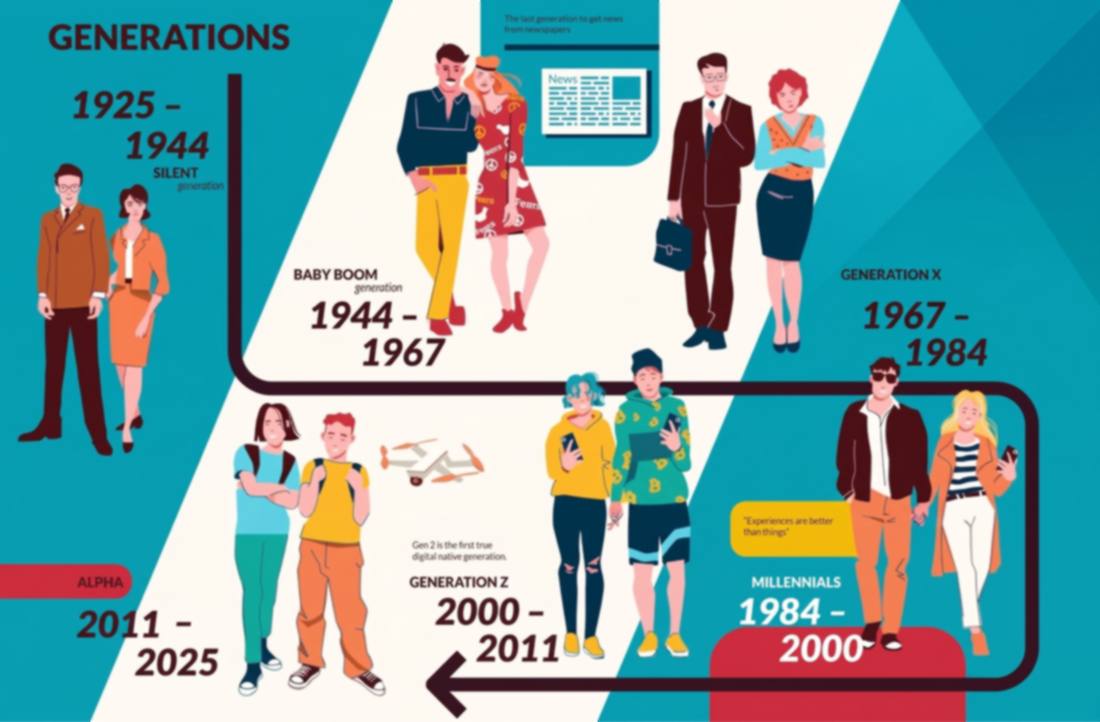
Each generation has been molded by specific historical contexts and has distinctive attitudes. Understanding these traits allows companies to make the most of their strengths and to contain potential sources of friction or misunderstanding.
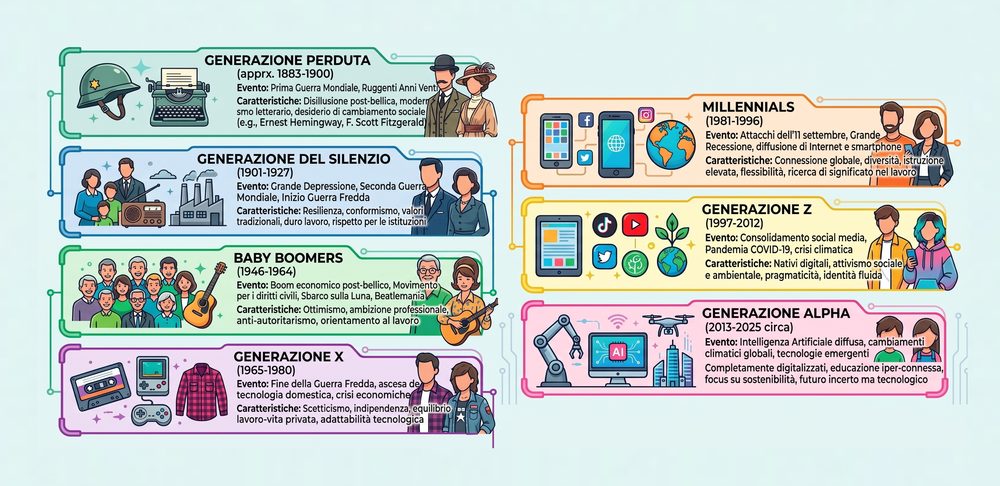
In this context, carrying out a generational transition also means knowing how to make the most of the contribution of the different generations in the company, drawing on their traits and potential.
At this point it is useful to ask how to reach the ideal condition and which mechanisms make it possible to plan a generational transition that is not only formal but effective.
Where to start to make the generational transition effective
To overcome the difficulty of making the generational transition effective, you need to start from the beliefs underlying the transfer of company leadership, from the false solutions these beliefs lead to and from the real causes that create and sustain the problem.
A problem often stems from mistaken ideas that steer people toward ineffective interventions. Instead of removing the cause, these solutions end up feeding the problem, making it persistent and making it look like a normal condition.
In the case of a family transition, the wrong idea is precisely that the child must succeed the parent in running the company.
Taking this succession for granted is one of the roots of the problem: it is assumed that the son or daughter must take on the father's role, without considering whether they really want it and which profession they intend to pursue.
The right idea should instead be: the child decides to pursue the same profession as the father (and the father teaches them how to do it).
The difference lies in the freedom to choose.
If the child freely decides to take up that profession, they must also be able to practice it according to their own judgment and take responsibility for their own decisions, including the possibility of making mistakes and, ultimately, of driving the company into bankruptcy.
Transferring a company means handing over to the successor what has been built, leaving them free to intervene, change it and make it their own. The business is inherited, but the way it is run must become that of the new person in charge.
In the first case, where succession is seen as an obligation, the possibility of failure is never really considered. In the second, the successor takes on genuine responsibility and, precisely for this reason, must be able to decide and answer for the consequences of their own decisions.
The transfer has to become clear-cut and visible to everyone, and the successor has to be left in a position to act autonomously, taking on all the responsibilities of their role.
In reality, however, the generational transition often happens only formally: the founder remains a cumbersome presence who does not allow the successor to actually take the helm of the company, and this affects the whole system, which suffers the consequences of confused roles and directions.
This situation is mainly caused by the way people believe they can solve the generational transition, through solutions that, instead of acting on the real causes, end up working on more superficial effects, so the problem persists.
The most common false solutions for handing over company leadership
When planning the handover of company leadership, it is common to make a few mistakes that, instead of making the generational transition effective, increase the vagueness, uncertainty and confusion within the system.
The false solutions most often put in place are:
Leaving the company a little at a time
A frequently adopted solution is to gradually reduce the founder's presence in the company, with the idea that the son or daughter can progressively learn to run it.
The problem is that an intermittent presence of the founder can create confusion. If they keep stepping in, giving advice and holding on to their influence, the successor cannot take full control. The importance of their role is constantly taken away by the very person who should be making room for them.
Meanwhile, the company gets used to an ambiguous situation, in which one person cannot fully perform their role and the other keeps stepping in despite having formally started to withdraw.
Gradual steps can be useful in preparing the successor, who must be ready when the transition comes. This, however, does not mean that the handover of leadership must also happen gradually. Once the decision to leave the company has been made, the transition must be clear-cut: the time needed to prepare the successor must be kept separate from the moment responsibilities are actually transferred to them.
Stepping up the training of the children
Another false solution is to increase the training of the children, in the belief that ever more intensive preparation will allow them to run the company better.
However, if the goal is to let the successor express their own individuality, training them to reproduce the founder's behavior is not enough. You need to teach them a profession and give them the skills to practice it, then leave them the room to manage it autonomously.
Training should therefore prepare the successor to perform their own role, not bind them to repeat every choice made by those who came before them.
Bringing in more young people
A third false solution is to think that lowering the average age of the team is enough to achieve a generational transition.
The arrival of a new generation can bring novelty and change, but not all novelty is necessarily positive. That is why lowering the average age of the team is not enough to make the generational transition effective: you need to distinguish what can improve the organization from what does not produce useful results.
The goal is not to bring in indiscriminately everything that characterizes the new generations, but to adopt a clear criterion for deciding which aspects to embrace and which not to adopt.
These solutions do not work on the real causes that create and sustain the problem, and that is why they are false solutions. It becomes necessary to look more closely at the real causes behind a generational transition that is not effective.
The real causes of a generational transition that is only on paper
To tackle a problem effectively, you need to trace it back to the factors that generated it and that allow it to drag on over time.
The real causes come down to gaps, that is, shortcomings or missing elements that give rise to the issue and help it persist.
To understand why the problem of the generational transition arises and keeps going, you need to identify some of its main causes.
1. Confused roles
Confused roles also stem from the lack of a clean break between the person leaving the leadership and the person taking it on. This ambiguity shows up first of all at a semantic and grammatical level, in the way people are addressed within the company.
Continuing to call the boss "Dad", for example, keeps the family role and the professional role overlapping. The family relationship continues to prevail over the organizational role, making it harder to recognize the authority of the new person in charge.
Language thus helps entrench the confusion: as long as roles are not distinguished in the way people refer to one another, an effective transition becomes harder to achieve.
2. Micromanagement (going over the new CEO's head)
Micromanagement is a management style in which the person in charge exercises excessive, obsessive and detailed control over every single activity and decision of their team members, limiting their autonomy.
In a generational transition, this behavior shows up when the founder keeps intervening in the decisions of the new CEO, going over their head and holding on to a control that should by now have been handed over.
Until there is a clean break, the successor is not really left free to perform their role. Even when responsibilities have been formally assigned, the founder's constant intervention prevents the handover of leadership from becoming effective.
3. Not being clear about what to take from the new generations and what not to
Another cause of the problem is the lack of clear criteria for deciding which traits of the new generations can be useful to the company and which, instead, should not be adopted.
This applies to both tools and mindset. Some behaviors, such as looking for the least effort, can be considered problematic; other aspects, instead, can offer opportunities for improvement.
Without a defined evaluation criterion, you risk accepting or rejecting new things indiscriminately. The task, then, is to distinguish what can contribute to the functioning of the company from what does not fit its needs.
Identifying the causes of the problem makes it possible to understand which aspects to act on to make the generational transition effective. The next step is to turn this awareness into concrete behaviors, through choices that help distinguish roles, truly hand over leadership and define the successor's areas of autonomy.
Practical tips for an effective generational transition
To make the generational transition effective, you need to act on the dynamics that prevent the successor from fully taking over the leadership of the company. Some organizational choices and concrete behaviors can help clarify roles, support the handover of responsibilities and create the conditions for the new generations to exercise their autonomy.
1. Stop mixing up roles in the way you address people
It is important to use names and forms of address correctly within the company. First name, surname or professional title should be used consistently with the position held.
Distinguishing the family role from the business role helps make the organization clearer and helps people recognize the authority of whoever has taken over the leadership.
2. Work toward the decision to hand over the reins and, once it is made, let go
The founder must prepare for the decision to hand over the leadership of the company. Training the successor may take time, but it must not become a reason to postpone the transition indefinitely.
Once the decision has been made, you need to actually leave responsibilities to the successor, avoiding stepping into their decisions and keeping a role that runs parallel to the one formally handed over.
3. Define the decision-making boundaries of the younger generation
To allow the new generations to take on real responsibilities, you need to establish clearly which decisions they can make on their own.
Defining decision-making boundaries means making explicit the space within which the successor can act without constantly being overruled. In this way, autonomy does not remain a formal statement, but becomes a concrete condition for performing one's role.
A generational transition, then, is not achieved simply by handing over a title or assigning a position. It requires an organization able to work without depending on the founder, a clear distinction between roles and the possibility, for the person taking over, to make decisions and take responsibility for them.
The goal is not to reproduce exactly what has been done in the past, but to hand over what has been built while putting the successor in a position to make it their own. Only in this way can the company's continuity go hand in hand with the growing autonomy of whoever takes over its leadership.
In conclusion, planning an effective generational transition requires going beyond the simple transfer of the company from one generation to the next.
To make the generational transition effective, it is not enough to prepare the person who will lead the company: you also need to create the conditions for them to truly perform their role. This means avoiding overlaps between the responsibilities of the person leaving and the person taking over, assigning tasks and authority clearly and establishing which decisions the new generations can make on their own.
It therefore becomes essential to distinguish roles clearly, delegate specific responsibilities and define the decision-making boundaries within which the new generations can act autonomously. Only then can the generational transition turn from a purely formal handover into a concrete change, able to ensure the continuity of the business and create the conditions for how it will be run in the future.
Sources and references
*1 Bennedsen, M., Nielsen, K. M., Pérez-González, F., & Wolfenzon, D. (2007). Inside the Family Firm: The Role of Families in Succession Decisions and Performance. The Quarterly Journal of Economics, 122(2), 647–691.
*2 Reif, T., Bauer, D., Junge, S., & Hossnofsky, V. (2025). An Update on Family Firm Succession: A Systematic Literature Review and Future Research Directions. Journal of Family Business Strategy, 16(3), Article 100671.
*3 Cascarano, M., Garbin, S., Mocetti, S., & Modena, F. (2026). Le imprese familiari e i passaggi generazionali in Italia. Questioni di Economia e Finanza (Occasional Papers), n. 1068. Banca d'Italia.
*4 Liu, P. C. Y., Zhu, F., & Wang, J. (2024). The Apple Doesn't Fall Far from the Tree: Parenting Styles and Its Effects on Family Business Succession Intentions. Journal of Business Research, 172, Article 114429.
*5 Istipliler, B., Ahrens, J.-P., Bort, S., & Isaak, A. (2023). Is Exposure to the Family Firm Always Good for the Next CEO? How Successor Pre-Succession Firm Experience Affects Post-Succession Performance in Family Firms. Journal of Business Research, 167, Article 114179.
*6 Cristofaro, C. L., Bonomi, S., & Reina, R. (2023). Tacit Knowledge and Skills Transfer in a Family Business During Generational Succession. In Proceedings of the 24th European Conference on Knowledge Management (ECKM 2023).
*7 Muskat, B., & Zehrer, A. (2017). A Power Perspective on Knowledge Transfer in Internal Succession of Small Family Businesses. Journal of Small Business & Entrepreneurship, 29(5), 333–350.