
A product can have important features and qualities, but that does not mean the market will automatically recognize its value. Competitors may get better results, sales may require constant effort, or the price may become hard to defend.
When the value of what you offer is not sufficiently recognized, the consequences can reach several areas of the business: from the ability to sell, to the ability to maintain healthy margins, all the way to the development of the product or service.
But what determines the value a customer assigns to what they buy? And why can it be hard to get that value recognized even by the people inside the company who are responsible for selling?
Understanding how perceived value forms and which factors influence how a product is evaluated lets you dig into a problem that can have a concrete impact on your company's results.
The problem: failing to communicate the value of what you sell
If your value is not recognized, you have a problem.
It is not about having a deficient product or service, one of little interest or low quality: sometimes, even when what you sell is good, it is still hard to sell, to hit sales targets, and to keep up with competitors.
You may also see competitors who, despite offering products or services considered lower in quality, manage to achieve better sales results.
The problem, then, is not necessarily the quality of the product or service, but the ability to make its value evident.
Without this ability, your product risks falling behind the market and setting off sales dynamics that in turn devalue it and lower its worth.
A product works not just when it sells, but when it sells easily.
Ideally, every company should be able to sell its products with increasing ease: over the years, a company should tend to achieve results with progressively less effort.
The goal is to reach a state of stability, getting as close as possible to the maximum result with the minimum effort.
Over time, with continuous effort to develop and improve its features, the value of the product should become recognizable and distinctive, to the point of making it easier to sell.
This is why being able to communicate and convey the value of your product becomes essential.
The intrinsic value of the product — its features, its usefulness, its development — should therefore be the real reason behind buyers' choices.
From this perspective, it should not be necessary to keep resorting to big sales and marketing strategies to support sales.
And yet the trend seems to be going in a different direction.
What science says about perceived value, marketing levers, and buying habits
To better understand the problem of failing to communicate the value of your product, it helps to look at some phenomena studied by research on how marketing techniques are used in selling today and on buyers' choice habits, starting from two questions:
- how much have the marketing levers used to increase the perceived value of products and services grown?
- which criteria are most often considered when buying?
Research shows that, alongside the product's own features, consumer choice can also be significantly influenced by elements external to the product itself.
One line of research that describes this phenomenon is choice architecture, that is, designing the context in which a choice is presented. Research by Szaszi et al. (2018)*1 catalogued 422 choice architecture interventions across 156 studies, showing how broad this field has become.
A later meta-analysis by Mertens et al. (2022)*2, which analyzed more than 200 publications and over 2.1 million participants, found a significant average effect of choice architecture interventions on behavior, while highlighting important differences between techniques and contexts.
The point is that changing the way a choice is presented can change behavior even without changing the product.
The same principle emerges in the study of intrinsic and extrinsic attributes.
Enneking, Neumann, and Henneberg (2007)*3 compared, through an experiment with 621 consumers, an intrinsic characteristic of a beverage with extrinsic elements such as brand, price, and labeling, finding that preferences for the product characteristic also depended on the information associated with the brand.
Research therefore shows that the value attributed to a product does not depend solely on its concrete features. Price, brand, packaging, reviews, reputation, and the sales context can become signals through which the consumer interprets the product.
In some cases, these signals can even change the experience of the product itself. Plassmann et al. (2008)*4 showed that when the same wine was presented at different prices, a higher price produced greater reported pleasantness and different brain activity associated with evaluating the experience.
McClure et al. (2004)*5, on the other hand, observed that knowing the brand changed stated preferences and brain responses during a Coca-Cola and Pepsi tasting.
Packaging can also influence evaluation: van Rompay, Deterink, and Fenko (2016)*6 found that the appearance of the package can influence the experience of the product, although the effect varies depending on the purchase setting.
Another particularly relevant lever is price promotions.
The analysis by Neslin and van Heerde (2019)*7 shows that, in the consumer packaged goods market, the money spent on price promotions is a very substantial part of commercial activity, higher than advertising spending and much higher than investment in research and development.
This helps explain how much price, and the way it is presented, have become important tools for influencing choice.
But what, concretely, are the criteria a buyer considers?
The literature does not identify a single criterion that holds in every situation. Recurring ones include perceived quality, price, the ratio between perceived value and price, trust, reputation and brand, reviews, features and functionality, previous experience, perceived risk, convenience, social proof, emotional and symbolic aspects, service and support, availability, and promotions.
In particular, Sung, Chung, and Lee (2023)*8 studied the role of different signals in trust in the quality of products bought online, finding that star ratings, number of reviews, and platform reliability could carry significant weight, even compared to price.
The picture that emerges, then, is one of growing attention, in both research and marketing practice, to the extrinsic signals that help shape perceived value: price, brand, packaging, reviews, reputation, communication, and the choice context.
Intrinsic value remains tied to the product's features, performance, actual quality, and real usefulness, but these features alone do not determine what the consumer perceives and evaluates.
There is no need to eliminate extrinsic elements, but you do need to decide what role they should play relative to the product's intrinsic value.
The growing availability of levers for influencing perception makes one question central: if the product's value exists, how is it communicated and recognized by the market?
This is exactly where the problem lies: understanding how to increase perceived value without confusing it with the product's intrinsic value.
Testimonials, partners, reviews, and other communication elements can help increase a product's perceived value. They are elements added on top of the product that can influence how it is evaluated.
If these activities and efforts take on an ever greater role, you need to question the relationship between perceived value and intrinsic value.
Intrinsic value is about what the product is actually able to offer, its features and its usefulness. Perceived value, on the other hand, is the value the customer assigns to it.
The question is how much of the value recognized by the customer depends on the product's real usefulness, and how much on external elements that influence its evaluation. If attention is focused mainly on the latter, intrinsic value risks being pushed into the background.
The effects of failing to communicate the value of your product
Difficulty in communicating the value of what you sell can have consequences that go beyond the moment of purchase. The problem can affect sales, margins, and the ability to develop the product or service further.
The most significant effects of the problem are:
-
Difficulty selling
When the product's value is not recognized, selling can become harder. You may need to spend a lot of time convincing the customer, finding the right salespeople, training them, and managing to delegate the sales activity to them.
The difficulty becomes especially clear when the outcome of a sale depends on the person handling it. If the business owner can sell the product but a team member gets different results, it becomes hard to make the sales process autonomous and stable.
One reason may be that the business owner knows the product more deeply than the person doing the selling. They understand its features, how it works, and its value better, while the salesperson may not have the same awareness.
As a result, the product's value risks remaining tied to the individual ability of whoever sells it, instead of being recognized and communicated consistently by the whole organization. -
Difficulty defending margins
Another effect is the difficulty of holding the price and defending margins.
When the product's value is not sufficiently recognized, you have to keep a constant eye on competitors, their offers, and the pricing terms on the market.
Customer loyalty may also end up being managed through discounts and price cuts. This way, customers can get used to paying less for the same product, which helps devalue it.
If, instead, the customer knows and recognizes the product's actual value, they may be willing to pay full price, without the need to keep resorting to a discount.
The difficulty in communicating value, then, can turn into a difficulty in sustaining the price and maintaining margins. -
Stalled product development
The problem can also affect the ability to improve and develop the product over time.
A product should be able to be refined through experience, learning, and the work needed to make it more useful. As it develops, the value it can offer should increase as well.
If the value added by that refinement is not recognized externally, however, customers may keep asking for discounts or treating the product as if it had not changed.
In this situation, the price fails to reflect the value built up over time. The resources needed to improve the product become harder to recover (given the thin margins) and, as a result, the ability to reinvest in its development shrinks as well.
This creates a bind: the product needs to be refined, but the failure to communicate its value limits the resources available to do so.
Who needs to value the product even before the customer
To solve a problem, you need to identify the ideal state to aim for: the goal to set and pursue by solving it.
Be careful what you wish for, though: an ideal state that is very common and seemingly desirable, but wrong, can lead you in the wrong direction.
For the problem of conveying the value of your product, it is important to identify both the goal most commonly set and the one that should be set instead to reach a true ideal state.
Wrong ideal state: “Customers must place a high value on the product”
At first glance, it may seem natural to want customers to place a high value on the product. However, this formulation risks shifting attention straight to the external result, without considering what has to happen inside the organization to achieve it.
To reach this state, you will probably lean toward the path of least effort, relying on marketing levers instead of working on the product's actual value.
First of all, though, you need to ask yourself: does the product have value? How much is it worth?
Knowing this is essential. If you recognize that the product does not yet have enough value, you can start working on the product itself in a different way. If, instead, the product does have value, the question becomes: how do you communicate it? Why is this value not being recognized?
The ideal state must therefore be formulated differently.
Correct ideal state: “Our team members must place a high value on our product”
If the end problem is that the customer does not recognize the product's value, then before working on external perception you need to check whether that value is sufficiently clear inside the organization.
The correct ideal state is to make sure that, first and foremost, your team members place a high value on the product.
Team members can be less easily influenced by the external elements that shape the customer's perception, because they know the product from the inside: how it is made and the elements that determine its value. If they can understand the actual value of what the company offers, they can communicate it more knowingly and consistently.
The same principle applies to people who work alone, without a team: knowledge and awareness of the product's value must first of all live within the person who makes and offers it.
If these people understand the value of what is being done, they can help convey it correctly to the outside world as well.
This means that the elements that generate value must first be known and understood internally, and then made recognizable to the customer through the decisions, behaviors, and ways in which the product is presented and sold.
In this sense, communicating value does not just mean using marketing tools. It means conveying an awareness through everyday decisions and behaviors.
Every time a discount is authorized for a customer, for example, you are also implicitly telling the salesperson that the product may be worth less than the price originally asked.
The way sales terms are handled, then, helps shape the internal perception of the product's value.
The priority is to help team members understand the value and then to convey that same awareness externally.
What causes the failure to communicate the product's value
Solutions are sought based on what you believe lies behind a problem. Holding the wrong beliefs therefore leads to the wrong solutions.
That is why you need to know and recognize both the wrong ideas and the correct ones, to understand the mechanism that leads to unstable, temporary solutions in the case of wrong ideas, or to stable, lasting ones in the case of correct ideas.
Wrong belief: value is built through marketing and sales.
Marketing is useful, but it becomes dysfunctional when it is used to sell a product that has no value. The more marketing levers are used, the harder it becomes to tell whether the customer is buying the product because of the marketing or because of the product's value.
The product's value communicated through marketing may come across gradually and slowly, but what should remain stable is the product's intrinsic value.
Marketing does not build value: at most, marketing can communicate it.
Correct belief: value is built through the product and internal awareness of what you do.
How the product comes about, how it takes shape, how it works, and how it develops: everything about the product must be known and understood. This value must be communicated and, even before that, team members must be trained.
The sequence is therefore internal first and external second: first you work on your team members' awareness, and then you bring the same awareness to the customer.
First you do the research to increase the product's value, and then you spread awareness of how the product has developed.
For example, a hotel breakfast buffet may include a cake made from a traditional recipe. If this feature is not communicated to the guest, the value that comes from it stays in the product but goes unrecognized.
At this point, you need to choose which value to work on.
Extrinsic value: price, brand, reviews, partners associated with the product, endorsements (for example, having been featured in a newspaper), packaging, sales context, partners.
Intrinsic value: features, performance, actual quality of the product, real usefulness of the product.
Extrinsic value, in the end, is an external construction. If you need to use it as the main pillar, it may mean that underneath there is not enough intrinsic value to hold the product up.
The result will tend toward instability, because the product becomes more sensitive to external factors that can change, such as competition and general marketing trends.
The necessary shift is from “I need to communicate the product's value” to “I need to increase the product's value”.
Sales and marketing should not be eliminated. What should be eliminated is the sales lever as the end point and top priority of selling the product, so that it does not end up drawing attention away from the product's real value.
Communication has to be there, but it has to be about the product's intrinsic value.
It is a question of priorities: intrinsic value comes first. If this priority is reversed, it means there is a lack of awareness of how to increase the product's value.
The more you rely on marketing as the main element, the more you risk creating elements that cloud the understanding of the product's intrinsic value.
You can end up believing that the product's value is determined by how much of it is sold. However, financial results are not in themselves an indicator of a product's usefulness and intrinsic value: a product can sell a lot without that necessarily proving it has high intrinsic value.
Once you have identified the correct idea that should drive the solution, you can take a further step and trace back to the causes behind the problem.
Here too, though, you need to be careful: what is perceived as the cause of the problem does not always match its real origin. Acting on an apparent cause can lead to a superficial solution that does not solve the problem for good.
That is why it is important to distinguish false causes from real causes, identifying the elements you actually need to act on to communicate the value of your product.
The false causes of failing to communicate the value of what you sell
When it comes to sales, how a product performs on the market, and the difficulty of getting your product's value recognized, it is easy, and very common, to point to the following causes:
- Ineffective marketing and sales: the assumption is that customers do not understand your product because there is not enough sales activity. The solution is therefore sought in improving marketing and sales activities.
- Price too high: the assumption is that the product does not sell because it costs too much. So you decide to lower the price to stay in the market, but this can instead further lower the product's perceived value and also signal to your team members that the product is worth little.
Neither of these causes leads to solutions that actually act on the product's value and on the customer's perception of its intrinsic value.
The real causes of failing to communicate the value of what you sell
The real causes of a problem are the reasons why it exists and persists.
Identifying the real causes takes deeper analysis, but it also leads to solutions that act on the root of the problem.
The real cause is always a lack, a gap to be filled with a precise corrective action, and in this case it answers the following question: why is the product's value not recognized?
-
Lack of clarity about the elements that generate value
There has been no work to analyze and quantify the product and the elements that determine its intrinsic value.
If these elements have not been clearly identified, it becomes hard to know what to communicate and to demonstrate the product's value concretely.
In practice, you need to break the product down into all the elements that generate value, identifying what concretely brings value and quantifying it.
The quantification can be expressed, for example, in money saved or risks avoided. The question is: how much is what you do really worth?
What is missing, then, is an asset in which the product is broken down into the various elements that generate value and in which that value is made concrete and quantifiable. -
Assuming these elements will be noticed without being communicated
There is no clear, visible communication of the product's value elements.
The assumption is that anyone who comes into contact with the product can recognize its value elements on their own, whereas only those who know the product can isolate them: someone who does not know the product in depth may not immediately recognize the benefits it brings.
Communicating the value elements is a fundamental part of the sales process and reflects in-depth knowledge of the product you offer and sell.
Once the value elements have been identified, you need to pin down precisely whether the value is being communicated, when the communication happens, and with which tool.
What is missing is what you need to eliminate the problem, to convey the value of your product, and to earn recognition from both team members and customers.
So the solution to the problem lies in practical actions that fill the gaps that cause it.
Practical tips for conveying your product's intrinsic value
Practical tips need to act on the real causes of the problem, supplying what is missing: clarity about the elements that generate value and awareness of how to communicate them.
-
Break down the elements that generate value and quantify them
The first step is to analyze the product or service and identify all the activities and features that help generate value.
For a service, the analysis can cover the different phases of the work:- How is client information gathered?
- How does interaction with the client happen while the service is being delivered?
- What is done to stay up to date?
- Which activities are carried out with the support of partners to offer a better service?
- What is done after the data is collected? Is a report sent, for example?
The goal is to make visible the elements that make up the service and contribute to its usefulness.
Quantifying value means asking what objective benefits the product produces and what would happen if it were not available.
What problems would arise without the product or service? What resources would be saved? What risks would be avoided?
Value can be quantified in money when it is possible to assign an economic value to the benefit; when this is not possible, it is still useful to make explicit and describe precisely the benefit produced or the risk avoided. -
For each value element, define how to communicate it
Once the elements that generate value have been identified and quantified, the second step is to define how to communicate them.
For each element, you need to decide which tool to use and at what point to make it understandable to the customer.
Communication must be tied to the actual value of the product or service. It is not simply a matter of promoting what you sell, but of making recognizable the elements that determine its usefulness.
This way, communication can become an integral part of the sales and delivery process, helping the customer understand the value of what they receive.
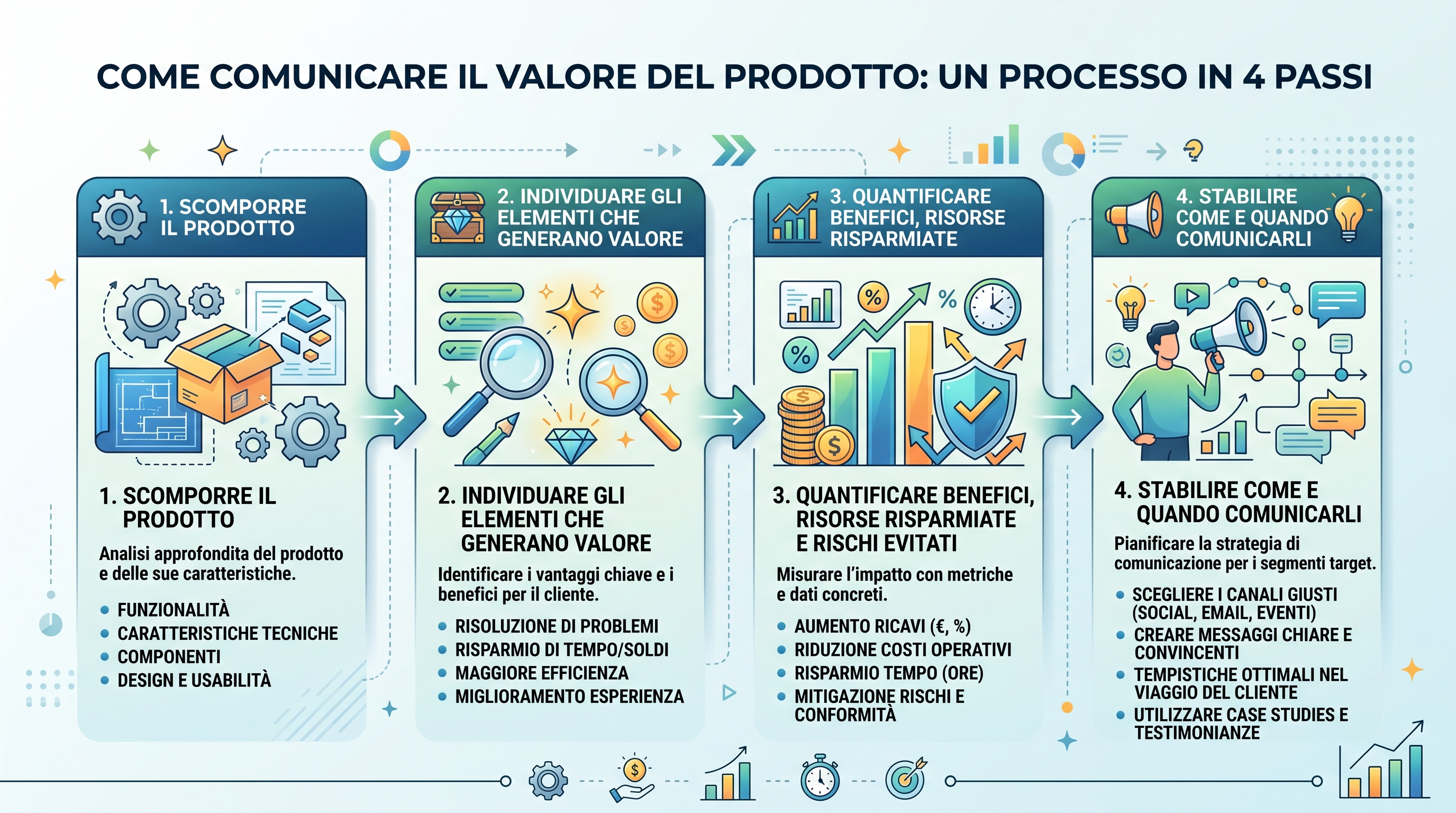
Conveying the value of what you sell does not mean ramping up marketing activities or finding the most effective way to convince a customer. It means, first of all, knowing the product's intrinsic value, breaking it down into the elements that generate it, and making it concrete and quantifiable.
The actions to take therefore start from analysis: identify the elements that produce value and quantify, where possible, the benefits, the resources saved, and the risks avoided. The next step is to define, for each element, how and when to communicate it.
This way, communication does not replace the product's value; it makes it recognizable. First you build and increase value, then you communicate it. When this sequence is respected, marketing stops being the main prop for sales and becomes what it should be: a tool for making visible a value that truly exists.
Sources and references
*1 Szaszi, B., Palinkas, A., Palfi, B., Szollosi, A., & Aczel, B. (2018). “A Systematic Scoping Review of the Choice Architecture Movement: Toward Understanding When and Why Nudges Work.” Journal of Behavioral Decision Making.
*2 Mertens, S., Herberz, M., Hahnel, U. J. J., & Brosch, T. (2022). “The effectiveness of nudging: A meta-analysis of choice architecture interventions across behavioral domains.” Proceedings of the National Academy of Sciences, 119(1).
*3 Enneking, U., Neumann, C., & Henneberg, S. (2007). “How important intrinsic and extrinsic product attributes affect purchase decision.” Food Quality and Preference, 18(1), 133–138.
*4 Plassmann, H., O’Doherty, J., Shiv, B., & Rangel, A. (2008). “Marketing actions can modulate neural representations of experienced pleasantness.” Proceedings of the National Academy of Sciences, 105(3), 1050–1054.
*5 McClure, S. M., Li, J., Tomlin, D., Cypert, K. S., Montague, L. M., & Montague, P. R. (2004). “Neural Correlates of Behavioral Preference for Culturally Familiar Drinks.” Neuron, 44(2), 379–387.
*6 van Rompay, T. J. L., Deterink, F., & Fenko, A. (2016). “Healthy package, healthy product? Effects of packaging design as a function of purchase setting.” Food Quality and Preference, 53, 84–89.
*7 Neslin, S. A., & van Heerde, H. J. (2019). “How price promotions work: A review of practice and theory.” Handbook of the Economics of Marketing, 1, 497–552.
*8 Sung, E., Chung, W. Y., & Lee, D. (2023). “Factors that affect consumer trust in product quality: a focus on online reviews and shopping platforms.” Humanities and Social Sciences Communications, 10, 766.