
The question sounds academic until you count how many times the answer was "let's just remake the batch for now," and the defect came back the following month.
The 8D method answers it by separating the two moves: eight disciplines that take a complaint from the moment the team is assembled to the check that the action actually worked, from containment to prevention.
It applies to anyone who delivers work to a client: a professional firm with two team members, a family business with fifteen employees, an organization of a hundred.
What changes is who signs the document, not the sequence.
For Italian companies that client is often abroad: in 2025 Germany, the United States and France absorbed 11.2%, 10.8% and 10.1% of Italy's goods exports [6], and in those supply chains the format used to respond to a complaint is almost always this one.
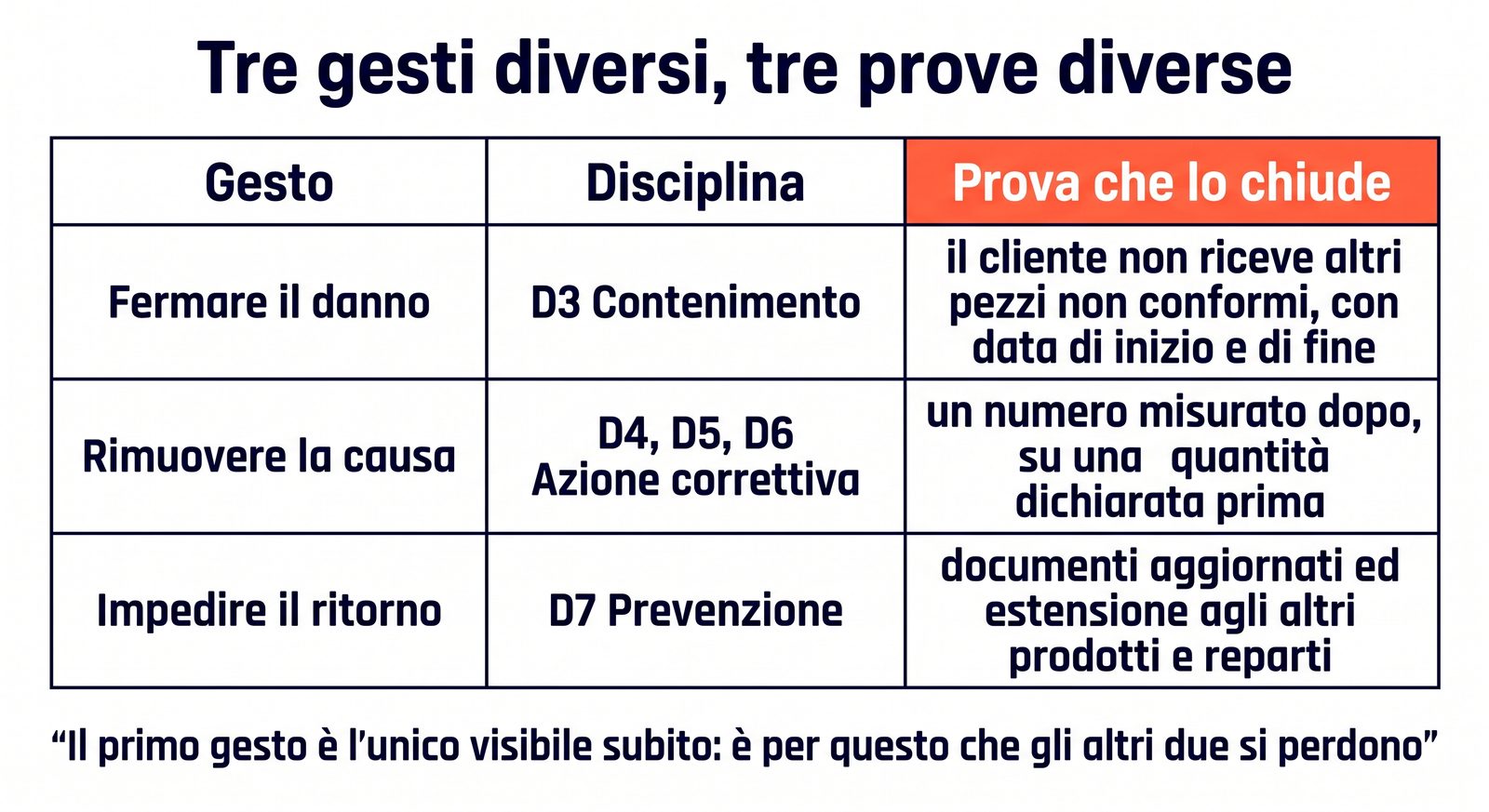
The 8D is not a form to fill out for the customer: it is the discipline that keeps apart three moves that companies tend to blur — stopping the damage, removing the cause, preventing recurrence — and it closes only when the third has been verified.
The pages that follow walk through the phases from D0 to D8, containment in the first hours, the move to the cause and to a verified action, and the mistakes that leave an 8D open after it has been handed in.
Eight disciplines, not eight steps: what an 8D report is
The 8D method is a structured team procedure for identifying the cause of a defect, putting a short-term remedy in place and introducing a permanent one that prevents the problem from coming back [2].
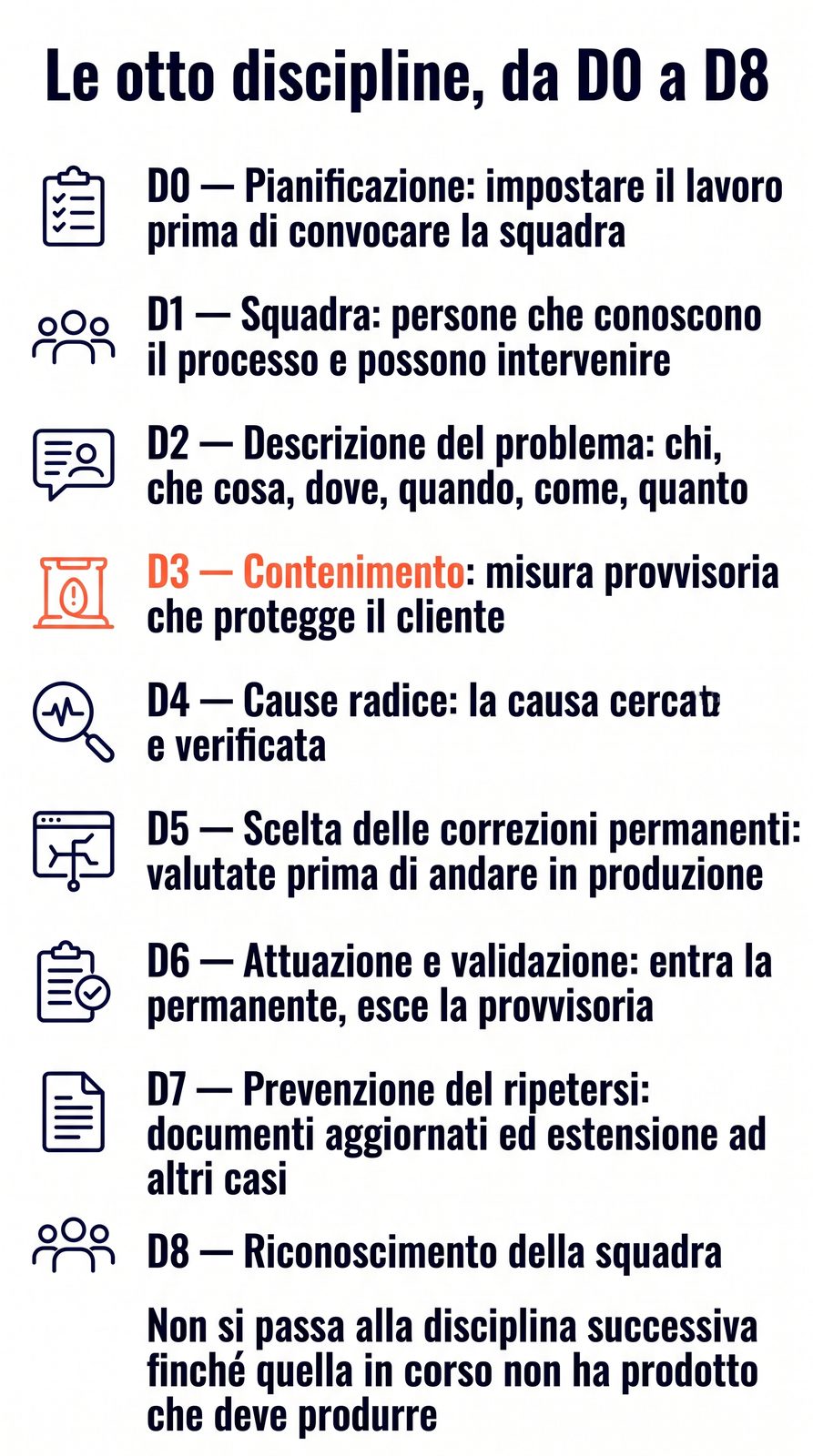
In the version taught today there are nine phases, numbered D0 to D8: planning, team, problem description, containment, root causes, selection of permanent corrections, implementation and validation, prevention, recognition [1].
The name stayed "eight disciplines" because D0 was added later, as a preliminary setup [1].
The word "discipline" is not an elegant synonym for "step": the Italian dictionary defines it as a body of rules that impose order, and as the observance of those rules [8].
That is the sense that matters here: each D is a rule accepted before you start, and the most expensive one to respect is the simplest to state — you do not move to the next discipline until the current one has produced what it is supposed to produce.
"8D report," in turn, is the document that shows that path to whoever suffered the damage: in automotive supply chains, customers require their own formats for complaints, and the 8D is the most widespread [1].
Three boundaries keep the definition tight.
The 8D is not the correction: in quality vocabulary, a correction eliminates the detected nonconformity, while a corrective action eliminates its cause and prevents recurrence [3].
It is not the same as root cause analysis, which is the family of techniques used to look for the cause: here we describe the container, and the search is carried out with the tools covered in root cause analysis.
And it is not the A3 report, which keeps together the versions of an internal problem: here the counterpart is outside the company and there is a response deadline.
The origin is not automotive: the literature traces the model back to a US government procedure on nonconforming materials, later applied by Ford [2].
The original documentation is not freely available, so the provenance is stated without attributing content to it.
The distinction, however, is not an industry habit: the standard on quality requirements refers to that vocabulary for terms and definitions and reached its sixth edition on September 16, 2026 [4], adopted in Italy as UNI EN ISO 9001:2026 [5].
When to open an 8D and when the method is oversized
The first job of an 8D is deciding whether you need an 8D.
Discipline D0 asks you to recognize that a problem exists and to set up the plan for tackling it, before calling anyone in [1] [2].
D1 forms a cross-functional team: in the published case study it had four to ten people, chosen because they knew where and why the problem had appeared and how to intervene on the process that generated it [2].
The criterion for opening one comes down to a single question.
The 8D is designed for nonconformities that affect the customer and require immediate containment together with documented prevention of recurrence [1]: did the problem leave the plant, or could it have?
If the answer is yes — a delivered batch, a customer line stopped, a safety requirement involved — the path makes sense, because outside the company someone is waiting and will not be satisfied with knowing that the part has been remade.
If the answer is no, the method is almost always oversized.
A defect caught by internal inspection and fixed in the department does not call for a cross-functional team: it calls for a line in the log, a decision on who does what and a follow-up check, as in nonconformity management.
The same conclusion holds for a chronic, low-severity defect that has been recurring for years: there the point is not to protect the customer right now but to reduce variability, and the comparison between methods places that work outside the 8D, in a data-driven improvement path [1].
Then there is oversizing by scale: D1 assumes four to ten people with different skills around a table [2].
In a twenty-person machine shop those people are three, and two of them also do other things: the team shrinks to the business owner, the production manager and whoever machined the part.
That is not an obstacle, as long as the three are different people: when the only participant is the person who signed off on the part, the 8D becomes a self-certification and you are better off stopping before you start.
The overview of the methods and the criterion for choosing among them are in the guide to business problem solving.
Stopping the damage before understanding it: containment in the first hours
The moment that sets the 8D apart from any other path is the one in which you act without yet knowing why.
Stopping the damage, removing the cause and preventing recurrence are three distinct moves: the discipline exists so they do not collapse into the first one, which is the only one visible right away.
Discipline D2 asks you to describe the problem with all the necessary parameters, answering the questions that pin it down: who, what, where, when, how and how many [1].
In practice these are six boxes to fill in with numbers, not adjectives: part number and drawing involved, measured defect, point of detection, production and reporting dates, quantity involved and quantity still suspect.
D3 calls for an interim containment action: a temporary measure that protects the customer on the spot, at the moment the problem appeared, and that is removed when the permanent action goes into service [2].
The two disciplines sit next to each other for a practical reason: without a description you do not know what to contain, and without containment the description drags on while the damage continues.
Containment remains a correction, not a corrective action: this is exactly where many 8Ds stop.
The scenario that follows is hypothetical and built for this article: a contract precision machine shop, a family business with twenty-four employees, two machining centers, and a foreign customer that assembles the part into a larger unit.
The customer reports that on a batch of twelve hundred parts a hole is out of position and blocks assembly: a communication like this is a complaint in the formal sense of the term, that is, an expression of dissatisfaction made to an organization for which a response is expected [3].
Containment is not "let's remake the batch."
It is the set of actions that, before you know why, bring to zero the probability that another out-of-position part reaches assembly: a hold on internal stock and on parts in transit, 100% sorting of the material already at the customer's site under agreed procedures, tightened inspection on the following batches, and written communication of what has been done and since when.
Each of these actions has a start date and, by design, an expected end date.
It is the part of the 8D that the customer sees first, and on which they decide whether the company is reliable while the rest is being figured out.
From root cause to verified corrective action in the 8D method
With the damage stopped, the work that the 8D does not do on its own begins.
Discipline D4 asks you to identify the root causes, and the techniques indicated in the literature are the familiar ones: the chain of whys and the cause-and-effect diagram [1].
The method tells you when to look for them and with what evidence, not how to dig.
When the plausible answers belong to different families — machine, material, method, people — it pays to open up the range with the Ishikawa diagram; when instead there is only one lead, you go down it with the 5 whys technique.
Verifying the cause is part of the discipline, not an add-on: a cause counts as found when it explains the case at hand and also explains why the other batches passed.
D5 selects and verifies the permanent corrections, that is, it evaluates the proposed solutions before taking them into production [1].
D6 implements and validates them, and it is in this discipline that the containment action is removed from the process, because it is no longer needed [2].
The order is binding, and it explains why many 8Ds close badly: whoever removes the sorting before validating the permanent action is betting, not verifying.
Quality vocabulary sets the finish line with two conditions that must hold together: a corrective action eliminates the cause of a nonconformity and prevents recurrence [3].
An intervention that eliminates the cause on one machining center and leaves it on the other has met the first and missed the second.
In the machine shop scenario, if the cause is the locating fixture that shifts when it is reinstalled after a production changeover, replacing the batch is a correction, promising more attention is an intention, and the corrective action is the change to the locating reference that makes incorrect mounting impossible, applied to both machining centers.
Finally, verifying effectiveness is not a signature.
It is a number collected afterward, on a quantity declared beforehand, at a point chosen beforehand: how many parts inspected, over how many batches, with what result and who measured it.
Without those four elements discipline D6 remains open, even if the document shows as delivered.
Closing for real: prevention, lessons learned and recognition
The last two disciplines are the ones most often skipped, and the ones that turn a closed problem into something learned.
D7 prevents recurrence by updating the documents, systems, operations and procedures involved in the permanent action [2], that is, by changing the procedures so the situation does not happen again [1].
The concrete move is less noble than it sounds: you reopen the work instruction, the control plan and the process risk analysis, and you write into them what was learned.
Then there is the part that gives the exercise its value, and that is extension: the same condition must be looked for on the other products, the other fixtures and in the other departments where it may exist, not only where it showed up [1].
D8 formally recognizes the team's work [1] [2].
It looks like the ornamental discipline and it is not: explicit recognition is the cheapest way for management to show that time spent on an 8D counts as much as time spent producing.
What remains is the document, and it asks for nothing new: a readable 8D report sets out, in order, what each discipline produced, with the names of those who did it and the dates.
The closing criterion is not the date: it is the evidence.
An 8D closes when the effectiveness check exists as data, not when the last box has been filled in.
Once the document has gone back to the customer, a line remains inside the company: nonconformity, cause, action and date of verification go into the log, where a problem stops being an episode and becomes a series you can read over time — how this works is described in nonconformity management.
Five mistakes that make an 8D fail, from skipped containment to the culprit
The first mistake is about timing and you pay for it right away: you wait to understand before containing, while the intended sequence puts protecting the customer ahead of the explanation [2].
The bill is paid by whoever receives parts in the meantime.
The second is the mirror image: containment becomes permanent.
100% sorting is born as a temporary measure to be removed when the permanent action comes in [2]; when it lasts a year, the company has bought peace of mind at a recurring cost and has stopped looking for the cause.
The third is the most common and the hardest to see from the inside: the root cause is a person's name.
"The operator didn't check" ends the discussion and changes nothing, because a corrective action cannot remove a human being from the process; the chain stops where the answer points to a condition that can be changed, as the 5 whys technique shows.
The fourth is closing without verifying effectiveness.
That the distinction is not an abstraction shows in the way it is measured: in the Bank of Italy's 2019 Invind survey of about 3,200 Italian companies with at least twenty employees, the response to a production problem is graded on three levels — fixed and nothing else, fixed with an action so it does not recur, fixed with a process to anticipate similar problems [7] — which is exactly the distance between D3, D6 and D7.
The fifth is about motive: the 8D opened as a formal obligation, because the customer asks for it, on a problem nobody intends to study.
The literature lists the conditions that make the method effective — team training, discipline in following the steps, management involvement — and notes that without them the result does not come [1].
One quick cross-check works for all five: if the effectiveness box contains a date and not a number, the 8D has not been closed, it has been handed in.
Limits and conditions of applicability
The literature on the 8D describes the procedure more often than it measures its results, and it points out the scarcity of large empirical studies itself [1].
The case study in the main source is declared hypothetical by its authors [1], while the other concerns a single wiring harness company [2]: these are illustrations of the procedure, not transferable estimates of effectiveness.
The machine shop scenario used in these pages is also hypothetical and built for this article.
The method assumes a written requirement: where there is no specification stating what is conforming, "nonconforming" is not a finding but an opinion, because a nonconformity is by definition the non-fulfillment of a requirement [3].
Most published cases come from the automotive industry and from supply chains with large customers: elsewhere the format may not be requested at all, and the path remains useful as an internal discipline more than as a document.
The transition rules between the fifth and sixth editions of the quality management systems standard are not covered in these pages: the sixth was published in September 2026 [4], and certified companies should check them with their own certification body.
FAQ
What is an 8D report?
It is the document that records the eight-discipline path a team follows to deal with a nonconformity that has reached the customer: problem description, containment, root cause, corrective action, verification of effectiveness and prevention [1] [2].
It has two audiences: the team that fills it in and the customer that receives it as the response to the complaint.
What are the eight disciplines of the 8D method?
In the current version there are nine items numbered D0 to D8: planning, team formation, problem description, containment, root causes, selection of permanent corrections, implementation and validation, prevention of recurrence, team recognition [1].
The name stayed "eight" because D0 was added later as a preliminary phase [1].
What is the difference between containment and corrective action?
Containment is a correction: it eliminates the detected nonconformity and protects the customer immediately, but it does not touch the cause [2] [3].
Corrective action eliminates the cause and prevents recurrence [3], and it replaces containment once it has been validated.
Is there an 8D form in PDF I can use?
In industrial supply chains the format is usually imposed by the customer, who sends its own form together with the complaint [1].
When none comes from outside, a useful 8D form is simply a page with one row per discipline and three fixed columns: what was done, by whom, with what evidence.
How long does an 8D take?
Durations are not set by the method and depend on the problem: containment is decided in the first hours, while verifying effectiveness by design requires waiting for the following batches.
This is a practical indication from the editorial team, not a measured figure; when the customer sets a deadline, that deadline concerns the delivery of the document, not the closing of the path.
Operational summary
The work starts with a decision that comes before the method: you open an 8D when the problem has reached the customer or could have, otherwise a line in the nonconformity log is enough.
Once the case is recognized, you set up the plan and call in a team of people who know the process and can act on it.
The problem is described with numbers before any hypothesis: part number, measured defect, point of detection, dates, quantity involved and quantity suspect.
Immediately afterward, and before knowing why, you put containment in place: a hold on the material, sorting of what is already at the customer's site, tightened inspection, written communication with a start date.
The cause is looked for next, with the dedicated techniques, and it counts as found when it explains both the affected batch and the ones that passed.
The chosen corrective action must eliminate the cause and prevent its return on all the workstations involved, not only on the one where the defect was seen.
Containment is removed only after the permanent action has been validated with data.
Closure comes with prevention — updated documents and extension to the other products — and with recognition of the team's work.
Conclusion
The 8D is not a form to fill out for the customer: it is the discipline that keeps apart three moves that companies tend to blur — stopping the damage, removing the cause, preventing recurrence.
The first is the only one visible right away, and that is why the other two get lost: a remade batch can be seen, a removed cause cannot, and prevention that works produces no event to talk about.
If, after containing, you need to dig down a single lead, the natural next step is the 5 whys technique; if you realize the plausible causes belong to different families, open the Ishikawa diagram first, and the general framework of the investigation is in root cause analysis.
When instead the problem has not left the plant, the right place is not an 8D but the log described in nonconformity management; the map of all the methods, with the criterion for choosing among them, is in the guide to business problem solving.
After a few 8Ds closed for real, the tone of the calls with customers changes: nobody argues anymore about whether the problem was taken seriously, the discussion is about the number that proves it is not coming back.
It is a change you measure in 100% sorting that ends instead of becoming a habit, and in complaints that have no sequel.
A problem closed without evidence is a problem postponed, and the whole difference between the two lies in a number collected afterward.
Sources and references
[1] Cirtina, L.-M., Dumitrascu, A.-E., Cazacu, D. V., Ianasi, C. A., Rădulescu, C., Tătar, A. M., Pasăre, M. M., Nioață, A. and Cirtina, D., "Eight-Disciplines Analysis Method and Quality Planning for Optimizing Problem-Solving in the Automotive Sector: A Case Study", Processes, vol. 13, no. 10, art. 3121, MDPI, September 29, 2025 (Constantin Brancusi University of Targu Jiu and Transilvania University of Brasov; open access article). DOI 10.3390/pr13103121. Available at: https://www.mdpi.com/2227-9717/13/10/3121
[2] Elangovan, S., Jusoh, M. S., Muhd Yusuf, D. H., Ismail, M. S. and Hj Din, M. S., "8D Problem Solving Methodology: Continuous Improvement in Automation Organization", Journal of Physics: Conference Series, vol. 2129, art. 012017, IOP Publishing, 2021 (Universiti Malaysia Perlis; proceedings of the ICMProTech 2021 conference, open access, CC BY 3.0 license). DOI 10.1088/1742-6596/2129/1/012017. Available at: https://iopscience.iop.org/article/10.1088/1742-6596/2129/1/012017/pdf
[3] ISO, "ISO 9000:2026 — Quality management — Fundamentals and vocabulary", International Organization for Standardization, fifth edition, May 2026 (ISO/TC 176/SC 1; cancels and replaces ISO 9000:2015). Terms consulted on the Online Browsing Platform: 3.5.13 nonconformity, 3.6.2 preventive action, 3.6.3 correction, 3.6.4 corrective action, 3.9.3 complaint. Available at: https://www.iso.org/obp/ui/en/#iso:std:iso:9000:ed-5:v1:en — overview page: https://www.iso.org/standard/9000
[4] ISO, "ISO 9001:2026 — Quality management systems — Requirements", International Organization for Standardization, sixth edition, published September 16, 2026 (ISO/TC 176/SC 2; cancels and replaces ISO 9001:2015 and incorporates amendment ISO 9001:2015/Amd 1:2024). Foreword and introduction consulted on the Online Browsing Platform. Available at: https://www.iso.org/standard/9001 — preview text: https://www.iso.org/obp/ui/en/#iso:std:iso:9001:ed-6:v1:en
[5] UNI, "UNI EN ISO 9001:2026 — Sistemi di gestione per la qualità — Requisiti", Ente Italiano di Normazione (Italian adoption of EN ISO 9001:2026; in force). Available at: https://store.uni.com/ — information page: https://www.uni.com/lp-uni-en-iso-9001/
[6] ISTAT and ICE Agenzia, "Commercio estero e attività internazionali delle imprese — Annuario statistico, edizione 2026", press release of July 16, 2026 (twenty-eighth edition, data referring to 2025). Available at: https://www.istat.it/comunicato-stampa/comunicato-stampa-annuario-statistico-istat-ice-2026/ — PDF: https://www.istat.it/wp-content/uploads/2026/07/NOTA-STAMPA_ISTAT-ICE_2026.pdf
[7] Baltrunaite, A., Formai, S., Linarello, A. and Mocetti, S., "Ownership, governance, management and firm performance: evidence from Italian firms", Banca d'Italia, Questioni di Economia e Finanza (Occasional Papers) no. 678, March 2022 (Invind survey, 2019 wave, representative sample of about 3,200 manufacturing and service companies with at least 20 employees; MOPS section, Table A.1). DOI 10.32057/0.QEF.2022.0678. Available at: https://www.bancaditalia.it/pubblicazioni/qef/2022-0678/index.html — PDF: https://www.bancaditalia.it/pubblicazioni/qef/2022-0678/QEF_678_22.pdf
[8] Treccani, entry "disciplina", Vocabolario on line, Istituto della Enciclopedia Italiana. Available at: https://www.treccani.it/vocabolario/disciplina/